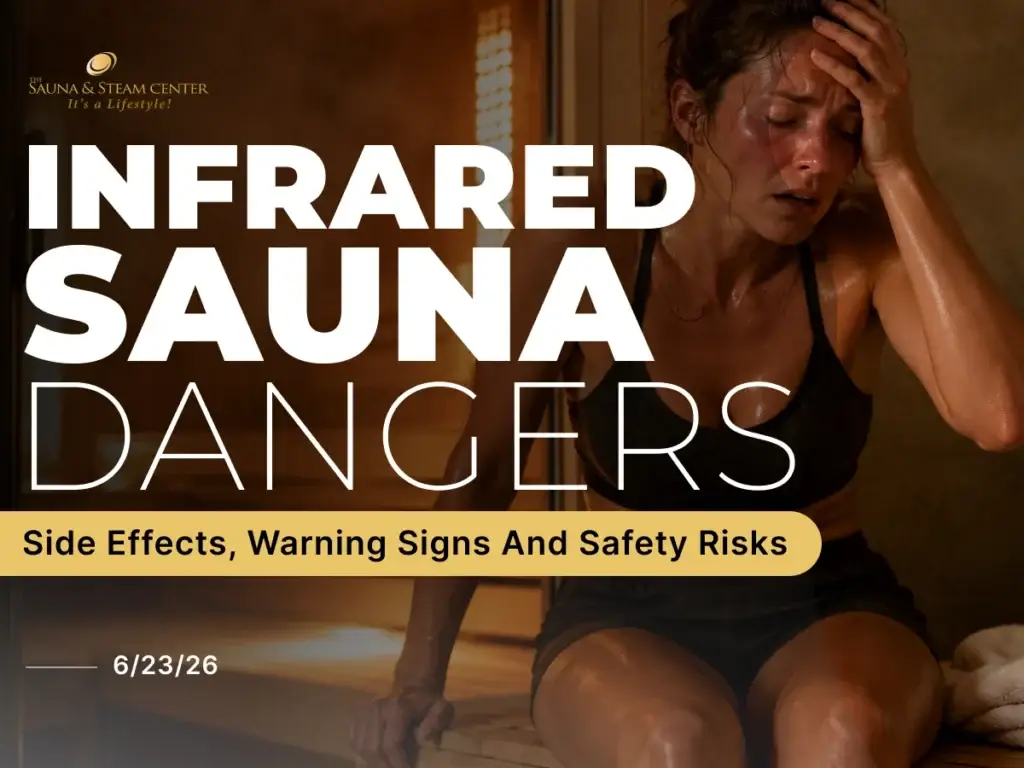
Dangers of Infrared Saunas: Are They Safe? Side Effects, Risks & Safety
Medical and editorial disclosure:
Sauna & Steam Center sells, installs, and services sauna systems. This article provides general educational information about infrared sauna safety and is not medical advice. Individual heat tolerance varies. People who are pregnant, take medications that affect heat tolerance or hydration, or have cardiovascular, kidney, neurological, circulation, blood-pressure, sweating, or temperature-regulation concerns should discuss sauna use with a qualified healthcare professional.
What are the dangers of infrared? When people ask this question about infrared saunas, the most important risks are usually related to heat exposure, fluid loss, changes in circulation, and unsafe equipment, not the same radiation hazards associated with X-rays or ultraviolet light. Infrared sauna dangers can include dehydration, dizziness, headache, nausea, overheating, temporary blood-pressure changes, fainting, skin irritation or burns, medication interactions, and electrical or installation problems.
Infrared saunas usually operate at lower air temperatures than traditional saunas, but lower temperature does not mean the body cannot experience meaningful heat stress. Infrared heaters transfer radiant heat toward the body, which can increase body temperature, sweating, heart rate, and fluid loss.

For many healthy adults, infrared sauna use is generally considered low risk when the sauna is properly installed, the equipment is functioning correctly, and sessions are conservative. The most common infrared sauna side effects include thirst, dehydration, dizziness, headache, nausea, temporary fatigue, skin redness, and lightheadedness. Leave the sauna if you become dizzy, weak, nauseated, confused, unusually short of breath, develop chest discomfort, experience painful skin, or feel unable to cool down normally.
Infrared is non-ionizing electromagnetic radiation. It should not be confused with X-rays, gamma rays, or ultraviolet radiation. In a consumer infrared sauna, the most practical established risks involve heat and the body’s response to heat.
What Are the Dangers of Infrared?
The phrase dangers of infrared can refer to several very different types of exposure. Industrial infrared sources, infrared lasers, specialized heating systems, and residential infrared saunas can involve very different wavelengths, intensities, distances, and exposure conditions.
For a normal consumer infrared sauna, the main practical dangers are related to thermal exposure and the body’s response to heat:
- Dehydration from sweating
- Dizziness or lightheadedness
- Temporary blood-pressure changes
- Headache
- Nausea
- Overheating and heat illness
- Fainting and falls
- Cardiovascular strain in susceptible people
- Medication-related heat sensitivity
- Skin irritation or burns
- Electrical or installation problems
- Malfunctioning controls, sensors, or heating components
The most realistic dangers of infrared sauna use are usually heat-related rather than ionizing-radiation related. That distinction is important because the word “radiation” can make infrared sound more dangerous than it is while distracting from the real risks users should monitor.
Is Infrared Sauna Safe?
Infrared sauna use is generally considered safe for many healthy adults when sessions are moderate, the person is adequately hydrated, and the sauna is properly installed and functioning correctly.
Infrared saunas differ from traditional saunas because infrared heaters transfer radiant heat toward the body instead of relying primarily on heating the surrounding air. This allows many infrared cabins to operate at lower air temperatures.
That lower air temperature can feel more comfortable, but the body can still:
- Heat up
- Sweat heavily
- Lose fluids
- Experience an increased heart rate
- Experience temporary changes in blood pressure
- Become overheated if exposure is excessive
What Recent Research Shows About Heat Strain
A 2026 study of 12 healthy adults examined a 45-minute far-infrared sauna exposure at 65°C. The researchers reported a substantial rise in core temperature and heart rate along with measurable fluid-related changes. Because the study was small and used a relatively intense exposure, it should not be interpreted as what happens during every residential infrared sauna session. It does demonstrate an important safety point: infrared sauna exposure can produce meaningful physiological heat strain when temperature and duration are high enough.
That is why a lower sauna air temperature should not be interpreted as permission for unlimited exposure.
Infrared sauna is not automatically dangerous, but it is still a form of heat exposure. Safety depends on the user, session length, temperature, hydration, medications, medical conditions, equipment, and installation.
Infrared Sauna Safety: Quick Answers
| Question | Practical Answer |
|---|---|
| Is infrared sauna safe? | Generally, yes for many healthy adults when used conservatively and with properly functioning equipment. Individual medical conditions and medications can change the risk. |
| Are infrared saunas safe? | They can be safe for many healthy adults, but safety depends on heat tolerance, hydration, health status, medications, equipment, and session intensity. |
| Are infrared saunas dangerous? | They are not inherently dangerous, but excessive heat, dehydration, medication interactions, unsafe installation, or ignoring warning symptoms can make them dangerous. |
| What are the most common infrared sauna side effects? | Common problems include thirst, dehydration, headache, dizziness, nausea, fatigue, temporary skin redness, and lightheadedness. |
| What is the biggest infrared sauna danger? | Excessive heat exposure combined with dehydration or reduced heat tolerance is one of the most important practical risks. |
| Can infrared sauna make you sick? | Yes. A session that is too hot or too long may cause dizziness, nausea, headache, weakness, dehydration, or overheating. |
| Is infrared radiation dangerous? | Infrared is non-ionizing radiation. In a consumer sauna, the primary practical concern is excessive thermal exposure rather than ionizing-radiation injury. |
| Are infrared saunas safer than traditional saunas? | Infrared saunas usually operate at lower air temperatures, which some people tolerate better, but either sauna type can cause heat-related problems when used improperly. |
| Can medications make infrared sauna less safe? | Yes. Some medications can affect sweating, thirst, blood pressure, fluid balance, alertness, kidney function, or temperature regulation. |
| Is daily infrared sauna use dangerous? | Daily use is not automatically dangerous for every healthy adult, but frequent sessions make hydration, conservative exposure, recovery, and symptom monitoring more important. |
Infrared Sauna Dangers: 10 Risks You Should Know
1. Dehydration
Sweating causes fluid loss. The amount varies with sauna temperature, session duration, body size, recent exercise, hydration status, medications, and individual physiology.
Possible signs of dehydration include:
- Thirst
- Dry mouth
- Darker urine
- Headache
- Fatigue
- Dizziness
- Muscle cramps
- Reduced concentration
2. Overheating and Heat Illness
An infrared sauna can cause excessive heat exposure even if the room feels cooler than a traditional sauna. Staying beyond your individual heat tolerance can progress from discomfort to heat stress and, in severe situations, heat illness.
Warning signs can include increasing headache, nausea, unusual weakness, dizziness, difficulty concentrating, excessive thirst, confusion, or feeling unable to cool down normally.
3. Dizziness and Temporary Blood-Pressure Changes
Heat causes blood vessels near the skin to widen. This can temporarily lower blood pressure and may cause lightheadedness, especially when standing quickly after a session.
Dehydration, naturally low blood pressure, recent exercise, and certain medications can increase this effect.
4. Fainting and Falls
Dizziness becomes more dangerous when a person stands up or walks across a hard or wet floor. Sit briefly after a session, stand slowly, and do not walk unassisted if you feel unstable.
5. Cardiovascular Strain
Heart rate can increase during heat exposure as the body moves more blood toward the skin to release heat. Healthy people may tolerate this response well, but people with unstable cardiovascular conditions or unexplained chest symptoms should obtain individualized medical guidance before regular sauna use.
6. Medication-Related Heat Sensitivity
Some medications can change sweating, thirst, blood pressure, fluid balance, alertness, kidney function, or temperature regulation. These effects can change how safely a person tolerates sauna heat.
7. Skin Irritation and Burns
Excessive heat can contribute to skin dryness, irritation, heat rash, discomfort, or burns. Localized heating-element problems, damaged emitters, unusually hot surfaces, or reduced heat sensation may increase risk.
8. Pregnancy and Reduced Heat Tolerance
Pregnancy changes circulation and temperature regulation. Excessive heat exposure is a concern, particularly early in pregnancy. Pregnant users should follow individualized guidance from an obstetric clinician rather than relying on general sauna recommendations.
9. Fertility Concerns With Repeated Heat Exposure
Repeated high-heat exposure has been associated in some research with temporary changes in male sperm production and quality. Evidence does not establish that occasional infrared sauna use causes permanent infertility, but people actively trying to conceive or undergoing fertility treatment may wish to discuss repeated heat exposure with their clinician.
10. Electrical, Installation, and Equipment Hazards
Some infrared sauna dangers come from the sauna system rather than the user’s physiology. Incorrect electrical circuits, overloaded wiring, damaged components, blocked ventilation, failed sensors, abnormal hot spots, water intrusion, or a sauna that does not shut off correctly require immediate attention.

What Are the Most Common Infrared Sauna Side Effects?
The most common infrared sauna side effects are generally related to heat, sweating, fluid loss, and circulation changes.
| Possible Side Effect | Why It May Happen | What to Do |
|---|---|---|
| Thirst | Fluid loss through sweating | Finish the session if needed and replace fluids according to your normal health needs. |
| Headache | Heat, dehydration, blood-pressure changes, or excessive exposure | Leave the sauna, cool down, rest, and avoid another session until you feel normal. |
| Dizziness | Blood-vessel dilation, temporary blood-pressure reduction, or dehydration | Leave immediately and sit or lie down somewhere safe. |
| Nausea | Heat stress, dehydration, or excessive session intensity | End the session and cool down. |
| Fatigue | Heat exposure and fluid loss | Rest and evaluate whether the session was too long or intense. |
| Temporary skin redness | Increased blood flow near the skin | Usually improves after cooling. Persistent pain or irritation requires more caution. |
| Muscle cramping | Fluid and electrolyte loss may contribute | Stop the session and recover before using the sauna again. |
| Lightheadedness after standing | Temporary blood-pressure changes | Stand slowly and remain seated if you feel unstable. |
Headache, dizziness, nausea, weakness, or feeling unusually unwell should not be interpreted as proof that the sauna is removing toxins. These symptoms can indicate excessive heat exposure, dehydration, or another problem.
Infrared Sauna Side Effects: What Is Normal and What Is a Warning Sign?
One of the most useful ways to understand infrared sauna safety is to separate expected heat responses from symptoms that mean the session should end.
| Level | Examples | Recommended Response |
|---|---|---|
| Expected heat response | Feeling warm, sweating, mild temporary skin flushing, increased thirst | Monitor how you feel and remain within your comfort level. |
| Stop the session | Dizziness, nausea, worsening headache, unusual weakness, painful skin, significant lightheadedness, strong palpitations | Leave the sauna and cool down. |
| Get medical attention | Persistent or recurring concerning symptoms, repeated faintness, recurrent palpitations, symptoms that do not improve normally | Seek appropriate medical evaluation. |
| Emergency | Confusion, collapse, loss of consciousness, seizure, severe chest pain, severe breathing difficulty, inability to cool down | Call emergency services. |
A sauna session does not need to become difficult or unpleasant to be worthwhile. Increasing temperature or duration after warning symptoms begin increases risk rather than benefit.
What Happens If You Stay in an Infrared Sauna Too Long?
Staying inside beyond your personal heat tolerance can gradually turn a comfortable session into heat stress.
Early Signs
- Increasing thirst
- Heavy sweating
- Mild headache
- Feeling more tired than expected
- Increasing heart rate
Signs You Should Leave Immediately
- Dizziness
- Nausea
- Worsening headache
- Unusual weakness
- Difficulty concentrating
- Skin pain
- Feeling unstable when standing
Possible Emergency Signs
- Confusion
- Collapse
- Loss of consciousness
- Seizure
- Severe chest pain
- Severe breathing difficulty
- Inability to cool down normally
There is no universal session duration that is safe for every person, every temperature, and every health situation.
For dedicated session-length guidance, see our how long to stay in a sauna guide.
What Should You Do If You Feel Sick After an Infrared Sauna?
1. Leave the Sauna
Do not stay inside to complete a target time. Move to a cooler environment.
2. Sit or Lie Down Safely
If you feel dizzy or unstable, avoid walking unnecessarily. Sit or lie down somewhere safe to reduce fall risk.
3. Cool Down
Move into a cooler environment and allow your body to recover.
4. Replace Fluids Appropriately
If you are able to drink normally and do not have medically prescribed fluid restrictions, gradual fluid replacement may help after sweating.
5. Do Not Re-Enter the Sauna
Give your body time to recover rather than beginning another session the same day after significant symptoms.
6. Monitor Your Symptoms
Mild symptoms that improve with rest and cooling may reflect heat stress or dehydration. Symptoms that persist, worsen, or repeatedly occur deserve medical evaluation.
Loss of consciousness, seizure, severe confusion, severe chest pain, significant breathing difficulty, collapse, or symptoms that continue worsening after leaving the heat.
Who Is at Higher Risk From Infrared Sauna Side Effects?
Heat tolerance varies substantially between people. Having a risk factor does not automatically mean that every form of sauna use is prohibited, but individualized medical guidance may be appropriate.
People With Cardiovascular or Blood-Pressure Concerns
Heat can alter circulation, heart rate, and blood pressure. People with unstable heart disease, recurring fainting, unexplained chest symptoms, abnormal heart rhythms, or significant blood-pressure concerns should seek individualized advice.
People With Kidney or Fluid-Balance Concerns
Sweating changes fluid balance. People with kidney disease, heart failure, electrolyte disorders, dialysis requirements, or medically prescribed fluid restrictions should not rely on generic hydration advice.
People With Reduced Heat Sensation
Neuropathy, reduced sensation, certain neurological conditions, and circulation problems can make it harder to recognize excessive heat or hot surfaces.
People Who Do Not Sweat Normally
Impaired sweating can interfere with one of the body’s cooling mechanisms. Do not remain inside longer simply to force sweating.
Pregnancy
Pregnancy changes circulation and temperature regulation. Excessive heat exposure is a concern, particularly early in pregnancy. Follow individualized guidance from an obstetric clinician.
See our dedicated sauna during pregnancy guide for more detail.
People Who Are Sick or Feverish
Do not use a sauna to try to “sweat out” a fever or acute illness. Fever already raises body temperature, while vomiting or diarrhea can increase dehydration risk.
People Who Have Used Alcohol
Alcohol can affect hydration, blood pressure, judgment, alertness, and the ability to recognize warning symptoms. Do not use an infrared sauna while intoxicated.
Can Infrared Saunas Interact With Medications?
Yes. Some medications can change how your body responds to heat.
Medication-related heat risk can involve:
- Reduced sweating
- Increased sweating
- Reduced thirst
- Lower blood pressure
- Fluid loss
- Electrolyte imbalance
- Reduced alertness
- Changes in temperature regulation
- Increased risk of fainting or falls
Medication Categories That May Require Extra Caution
Examples can include certain:
- Diuretics
- Blood-pressure medications
- Antihistamines
- Antidepressants
- Antipsychotic medications
- Stimulants
- Medications with anticholinergic effects
- Sedatives
- Medications affecting fluid or electrolyte balance

Ask the prescribing clinician or pharmacist whether your specific medication, dose, health history, and sauna routine create a heat-related concern.
Are Infrared Saunas Dangerous for Your Heart?
For many healthy adults, the cardiovascular response to sauna heat is tolerated without a serious problem. However, sauna heat changes circulation and can increase heart rate while temporarily lowering blood pressure in some people.
Use extra caution and seek individualized medical guidance if you have unstable cardiovascular disease, repeated fainting, unexplained chest pain, significant rhythm problems, or symptoms that appear during heat exposure.
Chest pain, chest pressure, severe shortness of breath, unusual weakness, fainting, or a rapid or irregular heartbeat that feels concerning.
Are Infrared Saunas Dangerous for Your Skin?
Responsible infrared sauna use does not normally damage healthy skin, but excessive heat can cause irritation, dryness, heat rash, discomfort, or burns.
Risk may be greater if you have:
- Reduced heat sensation
- Neuropathy
- Poor circulation
- Open wounds
- Active skin inflammation
- Recent cosmetic procedures
- A malfunctioning heating panel
- An unusually hot surface inside the sauna
Is Temporary Redness Normal?
Mild temporary flushing can occur as blood flow near the skin increases. Redness that is painful, persistent, blistering, or associated with a localized hot spot is different and should not be ignored.
If one area of the cabin feels dramatically hotter than surrounding surfaces, stop using the sauna and have the heating system checked.
Can Infrared Sauna Damage Your Eyes?
Infrared energy at sufficiently high intensity can create thermal injury risk to eye tissues, which is why specialized industrial and laser environments use exposure limits and eye protection. Those exposure conditions should not automatically be treated as equivalent to a residential infrared sauna.
For consumer sauna use, follow the exact manufacturer’s operating instructions and any guidance provided for exposed lamps or emitters. Avoid staring directly at unusually intense exposed infrared lamps or damaged heating elements, and stop using the sauna if a component appears abnormal.
If a sauna manufacturer specifies eye protection or special positioning, follow those instructions rather than relying on a generic rule.
Infrared Dangers: Is Infrared Radiation Harmful?
The word radiation covers many types of electromagnetic energy, and those types do not all affect the body in the same way.
| Type | Ionizing? | Why the Distinction Matters |
|---|---|---|
| Infrared | No | Primarily produces thermal effects at the exposure levels relevant to sauna use. |
| Visible light | No | Part of the non-ionizing electromagnetic spectrum. |
| Ultraviolet | No, but biologically different from infrared | UV can damage skin and DNA through mechanisms that should not be assumed for infrared sauna exposure. |
| X-rays | Yes | Ionizing radiation can remove electrons from atoms and molecules. |
| Gamma rays | Yes | Ionizing radiation with fundamentally different exposure hazards from infrared. |
Infrared is non-ionizing radiation. In a consumer infrared sauna, its primary effect is heat.
That does not mean unlimited infrared exposure is harmless. Excessive thermal exposure can still cause dehydration, burns, dizziness, overheating, and cardiovascular stress in susceptible individuals.
Can Infrared Sauna Cause Cancer?
Current evidence does not support the claim that responsible consumer infrared sauna use causes cancer through the same mechanism associated with ionizing radiation. Infrared energy is non-ionizing and should not be confused with X-rays or gamma rays.
Infrared sauna should also not be marketed as a treatment for cancer.
What About EMF?
Electromagnetic-field measurements are a separate buying consideration from the common heat-related side effects discussed in this article. A low-EMF marketing claim does not eliminate the need to consider heat exposure, hydration, electrical safety, installation quality, and individual medical risk.
For dedicated buying and measurement information, see our low-EMF sauna guide.
Infrared Sauna Myths vs. Real Risks
| Claim or Concern | What Matters More |
|---|---|
| “Infrared sauna causes radiation poisoning.” | Infrared is non-ionizing. The primary practical hazard in sauna use is excessive thermal exposure. |
| “Lower temperature means you cannot overheat.” | False. The body can still experience substantial heat strain, sweating, fluid loss, and cardiovascular changes. |
| “A headache means the sauna is detoxing you.” | Headache can be a warning sign of dehydration, excessive heat, or blood-pressure changes. |
| “More sweating always means more benefit.” | Not necessarily. More sweating also increases fluid loss. |
| “Dizziness is normal and should be pushed through.” | No. Dizziness is a reason to stop the session, cool down, and recover safely. |
| “Daily infrared sauna use is safe for everyone.” | No. Frequency should depend on individual tolerance, health status, medications, hydration, and recovery. |
| “Low EMF means there are no sauna safety concerns.” | EMF is separate from heat exposure, electrical safety, equipment quality, and medical heat tolerance. |
Home Infrared Sauna Dangers: Electrical, Fire, and Equipment Risks
Poor installation or malfunctioning equipment can create electrical, fire, ventilation, heat-management, and access risks.
An infrared sauna should not automatically be treated like ordinary furniture simply because it arrives as a prefabricated cabin.
Common Installation Problems
- Using the wrong electrical circuit
- Overloading a circuit
- Ignoring manufacturer clearances
- Blocking ventilation
- Using extension cords where they are not permitted
- Installing indoor-rated equipment outdoors
- Ignoring grounding requirements
- Installing on an unsuitable or unstable surface
- Ignoring electrical panel capacity
- Failing to follow manufacturer assembly instructions
- Allowing water intrusion near electrical components
- Ignoring unusual hot spots or failed controls
Verify Before Installation
| Check | Why It Matters |
|---|---|
| Voltage | Infrared sauna models can have different electrical requirements. |
| Amperage | The circuit must support the equipment load. |
| Dedicated circuit requirements | Some models require their own circuit. |
| Clearances | Required spacing helps equipment operate as designed. |
| Ventilation | Do not block openings designed for airflow. |
| Indoor or outdoor rating | Equipment should be used only in approved environments. |
| Electrical safety listing | Verify the certifications and listings specified for the exact product and jurisdiction. |
| Manufacturer instructions | Installation requirements vary by exact model. |
| Local electrical requirements | Permits and professional electrical work may be required. |
Sauna & Steam Center provides professional sauna installation in South Florida for homeowners who want electrical requirements, placement, ventilation, equipment, and installation reviewed together.
How Can You Tell If an Infrared Sauna Is Unsafe?
Stop using an infrared sauna when the equipment behaves in a way that is inconsistent with normal operation.
Equipment Warning Signs
- Burning smell
- Electrical smell
- Visible scorching
- Exposed or damaged wiring
- Cracked heating panels
- Localized hot spots
- Unresponsive controls
- Temperature continuing to rise unexpectedly
- Sauna failing to shut off properly
- Repeated breaker trips
- Door that sticks or cannot easily be opened from inside
- Visible water intrusion near electrical components
Electrical Warning Signs
- Lights flicker when the sauna starts
- A breaker repeatedly trips
- An extension cord is being used as a permanent connection where the manufacturer does not permit it
- The outlet or plug becomes unusually hot
- You hear buzzing or crackling from electrical components
Stop operation and have the system inspected by a qualified professional.
Common Infrared Sauna Problems and What to Do
| Common Problem | Possible Cause | What to Do |
|---|---|---|
| Dizziness during or after use | Heat, dehydration, temporary blood-pressure changes, standing too quickly | Stop the session, move to a cooler area, sit or lie down safely, and do not continue that day if symptoms were significant. |
| Headache after sauna | Dehydration, excessive heat, long session, recent exercise | End the session, cool down, rest, and use a shorter or less intense session next time if appropriate. |
| Nausea | Heat stress or excessive session intensity | Leave immediately. Do not try to finish the session. |
| Feeling exhausted afterward | Excessive heat exposure, fluid loss, or poor recovery | Reduce session intensity or frequency. Repeated symptoms deserve medical discussion. |
| Not sweating much | Individual variation, lower temperature, short session, impaired sweating in some people | Do not increase the temperature aggressively just to force sweating. |
| Skin feels irritated | Heat, dryness, sensitive skin, cosmetic products, hot spots | Stop the session and allow the skin to recover. Persistent or painful irritation should be evaluated. |
| One wall or area feels unusually hot | Heating-element or equipment problem | Stop using the sauna until the system is inspected. |
| Burning or electrical smell | Electrical or heating-component problem | Stop use immediately and have the sauna professionally inspected. |
| Breaker repeatedly trips | Electrical load, circuit, wiring, or equipment issue | Do not repeatedly reset the breaker and continue using the sauna. Have the electrical system checked. |
| Controls do not respond | Control, sensor, power, or component fault | Stop using the unit until the problem is diagnosed. |
| Sauna does not heat evenly | Emitter failure, sensor issue, blocked airflow, or installation problem | Inspect according to manufacturer guidance or request qualified service. |
| Door sticks or will not open easily | Alignment or hardware problem | Do not use the sauna until the door opens reliably from inside. |
Sauna Dangers: Infrared vs. Traditional Sauna
Many sauna dangers and sauna side effects are related to heat rather than one specific sauna technology.
| Safety Factor | Infrared Sauna | Traditional Sauna |
|---|---|---|
| Dehydration | Possible | Possible |
| Dizziness | Possible | Possible |
| Blood-pressure changes | Possible | Possible |
| Overheating | Possible | Possible |
| Burn risk | Heating components or malfunctioning hot spots | Heater, stones, hot surfaces, steam, or contact |
| Typical air temperature | Usually lower | Usually higher |
| Medication concerns | Relevant | Relevant |
| Alcohol-related risk | Relevant | Relevant |
A lower infrared-sauna air temperature can feel easier to tolerate, but it does not make every infrared session safer for every person.
For a full comparison of heat style, temperature, experience, installation, and buying considerations, read our infrared vs. traditional sauna guide.

Infrared Sauna Benefits vs. Risks
Searchers researching infrared sauna dangers often want to know whether the possible benefits justify the risks.
Infrared sauna research has explored possible applications involving:
- Relaxation
- Cardiovascular responses
- Muscle and joint comfort
- Recovery
- Quality of life in certain studied populations
However, the evidence varies by outcome, many studies are small, and research involving traditional sauna should not automatically be treated as infrared-specific evidence.
Infrared sauna can be enjoyable and useful for many people, but the safest approach is to consider potential benefits and realistic risks together rather than treating infrared sauna as either completely harmless or inherently dangerous.
For the positive side of the evidence, see our dedicated infrared sauna benefits guide.
How to Reduce Infrared Sauna Dangers and Side Effects
Before the Session
- Use the sauna only when you feel well.
- Avoid beginning a session while already dehydrated.
- Avoid alcohol and recreational drugs.
- Consider recent exercise and fluid loss.
- Follow your sauna manufacturer’s instructions.
- Check for unusual smells, damaged components, or control problems.
- Ask a pharmacist or clinician about medication-related heat concerns when appropriate.
- Start conservatively if you are new to sauna use.
During the Session
- Pay attention to how you feel.
- Do not compete with another person’s time or temperature.
- Do not fall asleep.
- Do not block vents.
- Do not touch exposed heating components.
- Stop for dizziness, nausea, headache, weakness, chest discomfort, or skin pain.
After the Session
- Remain seated briefly if you feel lightheaded.
- Stand slowly.
- Move into a comfortable cooler environment.
- Replace fluids according to your normal health needs.
- Do not drive until dizziness has fully resolved.
- Do not repeat a session when you still feel unwell.
A temperature or session length that feels easy for another person may be excessive for you. Your body’s response matters more than matching someone else’s routine.
Is Using an Infrared Sauna Every Day Safe?
Daily infrared sauna use is not automatically dangerous for every healthy adult, but greater frequency increases the importance of conservative exposure and symptom monitoring.
Pay particular attention to:
- Hydration
- Recovery between sessions
- Repeated headaches
- Recurring dizziness
- Unusual fatigue
- Skin irritation
- Changes in exercise recovery
- Blood-pressure symptoms
- Sleep changes
If you repeatedly feel worse after using the sauna, increasing frequency is not a reasonable solution.
Frequency should follow tolerance. Recurring side effects are a reason to reduce, pause, or discuss sauna use with a healthcare professional.
Can Infrared Saunas Cause Long-Term Health Problems?
For healthy adults using infrared saunas conservatively, current evidence has not established widespread long-term harm from normal use. However, long-term research specifically involving consumer infrared saunas is more limited than the research available for traditional Finnish sauna bathing.
Potential long-term concern is more relevant when a person repeatedly:
- Becomes dehydrated
- Ignores dizziness or nausea
- Uses excessive heat
- Uses sauna despite medication-related heat sensitivity
- Continues despite cardiovascular symptoms
- Uses damaged or unsafe equipment
- Ignores recurring skin or neurological symptoms
What About Fertility?
Repeated heat exposure has been associated in some research with temporary changes in male sperm production and quality. Evidence does not establish that occasional infrared sauna use causes permanent infertility.
People actively trying to conceive or undergoing fertility treatment may wish to discuss repeated high-heat exposure with their clinician.
What About Cancer?
Current evidence does not support classifying normal residential infrared sauna exposure as a known cancer-causing form of radiation.
Infrared sauna should also not be marketed as a treatment for cancer.
Planning an Infrared Sauna at Home?
Choose the Sauna and the Installation Together
Sauna & Steam Center helps South Florida homeowners compare infrared sauna models, electrical requirements, room conditions, safety features, warranties, controls, delivery, and installation before the system goes into daily use.
Frequently Asked Questions About Infrared Sauna Dangers and Safety
What are the dangers of infrared?
For consumer infrared sauna use, the main practical dangers are excessive heat, dehydration, dizziness, temporary blood-pressure changes, overheating, fainting, medication interactions, skin burns, and electrical or equipment problems. Infrared is non-ionizing radiation and should not be confused with X-rays or gamma rays.
Is infrared sauna safe?
Infrared sauna use is generally considered safe for many healthy adults when the sauna is properly installed, sessions are moderate, and warning symptoms are not ignored. Individual medical conditions and medications can change the risk.
Are infrared saunas safe?
For many healthy adults, yes. The most important risks involve excessive heat, dehydration, temporary blood-pressure changes, medication interactions, medical conditions, and unsafe or malfunctioning equipment.
Are infrared saunas dangerous?
Infrared saunas are not inherently dangerous, but they can become dangerous when someone stays too long, becomes dehydrated, combines heat with alcohol, ignores symptoms, uses medications that affect heat tolerance, or uses unsafe equipment.
What are the most common infrared sauna side effects?
Common side effects can include thirst, dehydration, headache, dizziness, nausea, temporary fatigue, lightheadedness, and temporary skin redness.
What are the biggest infrared sauna dangers?
The most important practical dangers involve heat stress, dehydration, overheating, fainting, falls, medication interactions, cardiovascular symptoms in susceptible people, skin burns, and electrical or installation problems.
What are the side effects of sauna use in general?
Possible sauna side effects include dehydration, dizziness, headache, nausea, temporary blood-pressure changes, overheating, skin irritation, and weakness. Many heat-related risks can occur in both traditional and infrared saunas.
Can an infrared sauna make you sick?
Yes. Excessive heat or a session that exceeds your tolerance may cause nausea, dizziness, headache, weakness, dehydration, cramping, or overheating.
Why do I feel dizzy after an infrared sauna?
Heat can widen blood vessels and temporarily lower blood pressure. Dehydration and standing quickly can make dizziness worse. Sit or lie down safely, move to a cooler environment, and do not continue the session.
Why do I get a headache after infrared sauna?
Possible contributors include dehydration, heat stress, blood-pressure changes, recent exercise, excessive session duration, or individual heat sensitivity. Recurring headaches should not be treated as a normal sign that the sauna is working.
Can infrared sauna cause nausea?
Yes. Nausea can occur when heat exposure becomes excessive or dehydration develops. Leave the sauna rather than trying to complete the session.
Can infrared sauna cause dehydration?
Yes. Infrared sauna can produce substantial sweating, which removes fluid from the body. Dehydration risk increases with longer sessions, recent exercise, alcohol, illness, hot weather, or inadequate fluid intake.
Can infrared sauna lower blood pressure?
Heat can widen blood vessels and temporarily affect blood pressure. This can contribute to dizziness or faintness, especially in people with low blood pressure, dehydration, or certain medications.
Can infrared sauna damage your skin?
Normal use generally should not damage healthy skin, but excessive heat or malfunctioning equipment can contribute to irritation, dryness, rash, pain, or burns.
Can infrared sauna damage your eyes?
High-intensity infrared sources can create thermal eye hazards, but those exposures should not automatically be equated with normal residential sauna use. Follow the exact manufacturer’s instructions regarding emitters, positioning, and eye protection.
Is infrared radiation from a sauna dangerous?
Infrared is non-ionizing electromagnetic radiation and primarily acts as heat in a consumer sauna. It should not be confused with X-rays or gamma rays. The more practical risks of infrared sauna use involve excessive heat and dehydration.
Can infrared sauna cause cancer?
Current evidence does not support the claim that responsible consumer infrared sauna use causes cancer through the same ionizing-radiation mechanism associated with X-rays or gamma rays. Infrared sauna should also not be promoted as a cancer treatment.
Can infrared sauna interact with medications?
Yes. Certain medications can affect sweating, thirst, blood pressure, fluid balance, alertness, kidney function, or temperature regulation. Ask your pharmacist or prescribing clinician whether your medications affect heat tolerance.
Who should avoid or be cautious with infrared sauna?
People who are pregnant, acutely ill, feverish, significantly dehydrated, intoxicated, unable to sense heat normally, or managing certain cardiovascular, kidney, neurological, circulation, blood-pressure, or sweating-related conditions should obtain individualized guidance before sauna use.
Is daily infrared sauna use dangerous?
Daily use is not automatically dangerous for every healthy adult, but frequent use makes hydration, conservative sessions, recovery, and monitoring for recurring side effects more important.
What happens if you stay in an infrared sauna too long?
Excessive exposure can progress from thirst, headache, and heavy sweating to dizziness, nausea, weakness, confusion, fainting, or severe heat illness. Leave at the first sign that the session no longer feels normal.
What should I do if I feel sick after an infrared sauna?
Leave the sauna, move to a cooler environment, sit or lie down safely, allow your body to cool, and rest. Seek urgent medical attention for severe chest pain, confusion, loss of consciousness, seizure, breathing difficulty, or worsening symptoms.
Why does my infrared sauna keep tripping the breaker?
Repeated breaker trips can indicate a circuit, electrical-load, wiring, or equipment problem. Do not repeatedly reset the breaker and continue using the sauna. Have the installation and equipment evaluated.
Why does my infrared sauna smell like it is burning?
A burning-plastic or electrical smell is not something to ignore. Stop using the sauna and have the unit inspected before operating it again.
Why is one area of my infrared sauna much hotter?
An unusually hot localized area can indicate an emitter, sensor, installation, or equipment problem. Stop using the sauna if the surface feels painfully hot or abnormal.
Is an infrared sauna safer than a traditional sauna?
Infrared saunas generally operate at lower air temperatures, which some users find easier to tolerate. That does not automatically make infrared safer for everyone. Both systems can cause heat-related problems when used excessively or improperly.
References
- Centers for Disease Control and Prevention
Heat and Medications: Guidance for Clinicians. - Centers for Disease Control and Prevention
Clinical Overview of Heat. - American College of Obstetricians and Gynecologists
Can I Use a Sauna or Hot Tub Early in Pregnancy?. - Mayo Clinic
Do Infrared Saunas Have Any Health Benefits?. - Hussain J, Cohen M.
Clinical Effects of Regular Dry Sauna Bathing: A Systematic Review. - Hannuksela ML, Ellahham S.
Benefits and Risks of Sauna Bathing. - Kaiser P, et al.
Injuries Related to Sauna Bathing. - Sauna & Steam Center
Infrared Sauna Benefits Guide.
Conclusion: Are Infrared Saunas Safe or Dangerous?
Infrared saunas are generally considered safe for many healthy adults when the sauna is properly installed and used conservatively.
The most realistic infrared sauna dangers and side effects are related to heat exposure, fluid loss, individual health factors, and equipment safety rather than infrared being the same type of radiation as X-rays or gamma rays.
Important risks include:
- Dehydration
- Dizziness
- Headache
- Nausea
- Overheating
- Temporary blood-pressure changes
- Fainting and falls
- Skin irritation or burns
- Medication interactions
- Individual medical conditions
- Electrical or installation problems
- Malfunctioning equipment
Most problems can be reduced by using properly installed equipment, following the manufacturer’s instructions, beginning conservatively, avoiding alcohol, paying attention to hydration, and leaving immediately when symptoms develop.
A safe sauna session should not require you to tolerate dizziness, nausea, severe fatigue, pain, confusion, or other warning signs.
If you are considering purchasing an infrared sauna for your home, evaluate the sauna and the installation together. Correct sizing, electrical requirements, ventilation, equipment quality, controls, safety features, warranty support, and professional installation can be just as important as the sauna itself.
Sauna & Steam Center can help South Florida homeowners select and install infrared sauna systems designed around the home, electrical system, available space, and intended use.