
Can You Use a Sauna While Pregnant? Safety by Trimester
Can you use a sauna while pregnant? The safest general answer is to avoid sauna use unless your OB-GYN, midwife, or pregnancy care provider specifically clears it for you. ACOG says it is best not to use saunas or hot tubs early in pregnancy because they can raise core body temperature, which may be harmful to the fetus.1 Pregnancy can also increase vulnerability to overheating, dehydration, dizziness, and fainting.
This guide explains what the research says, trimester-by-trimester sauna pregnancy guidance, what OB-GYNs usually recommend, the difference between infrared sauna, traditional sauna, steam rooms, and hot tubs, safer lower-heat alternatives, and when to avoid heat entirely. At Sauna & Steam Center, we design and install long-term home wellness spaces, but pregnancy is a season where medical safety comes first.Medical disclaimer: This article is for general education only and is not medical advice. Pregnancy safety depends on your trimester, health history, symptoms, medications, blood pressure, hydration, and pregnancy risk level. Always ask your OB-GYN, midwife, or qualified healthcare provider before using a sauna, steam room, hot tub, or any high-heat environment while pregnant.
Quick Answer: Can You Use a Sauna While Pregnant?
Sauna During Pregnancy: Quick Answers by Search Intent
| Question | Best Evidence-Aware Answer |
|---|---|
| Can you sauna while pregnant? | Do not assume it is safe. Ask your OB-GYN or pregnancy care provider first. |
| Can you use a sauna while pregnant? | ACOG advises avoiding saunas early in pregnancy. Later pregnancy still requires individualized medical guidance. |
| Can you go in a sauna pregnant? | The safest general answer is to avoid it unless your provider specifically clears you. |
| Sauna while pregnant first trimester? | This is the highest-caution period. ACOG says it is best not to use saunas or hot tubs early in pregnancy. |
| Sauna pregnancy second trimester? | Do not assume it becomes safe. Overheating, dehydration, and fainting risks still exist. |
| Sauna pregnancy third trimester? | Provider clearance is still important. Heat sensitivity, balance changes, and fainting risk can make sauna use more difficult. |
| Can pregnant women go in a sauna? | Only with individualized medical guidance. There is no universal safe sauna time or temperature for pregnancy. |
| What does ACOG say about sauna pregnancy? | ACOG says it is best not to use saunas or hot tubs early in pregnancy because they can raise core body temperature. |
Key Takeaways
- Sauna during pregnancy is a medical safety topic first. Do not treat it like a normal spa or wellness habit without provider approval.
- Early pregnancy needs extra caution. ACOG advises avoiding saunas and hot tubs early in pregnancy because core body temperature can rise.1
- Infrared sauna is not automatically safer. Lower air temperature can still warm the body and cause sweating.
- Steam rooms and hot tubs also require caution. Humidity and heated water can make cooling harder.
- Trimester matters, but there is no universal safe session length. Sauna pregnancy second trimester and sauna pregnancy third trimester questions still need medical guidance.
- Safer alternatives are usually better during pregnancy. Warm showers, gentle stretching, prenatal massage with approval, hydration, and rest are better starting points.
ACOG Sauna Pregnancy Guidance: What Does ACOG Actually Recommend?
Several GSC queries are specifically looking for ACOG sauna pregnancy guidance. The American College of Obstetricians and Gynecologists says that it is best not to use saunas or hot tubs early in pregnancy because they raise core body temperature, and that rise may be harmful to the fetus.1
That guidance is especially important for the first trimester. ACOG does not provide a universal “safe” sauna temperature or a single number of minutes that applies to every pregnant person.
What the Research Says About Saunas During Pregnancy
The biggest research concern is hyperthermia, which means elevated body temperature. ACOG states that using saunas and hot tubs early in pregnancy can raise core body temperature, and that this rise may be harmful for the fetus.1 MotherToBaby explains that hyperthermia happens when the body absorbs more heat than it releases, and that hot tubs or saunas might cause hyperthermia.4 The research does not mean one brief accidental exposure automatically causes harm. It means the risk is serious enough that major medical guidance recommends caution, especially early in pregnancy. For SEO and safety, the article should not promise that sauna is safe during pregnancy. The more accurate answer is that sauna use while pregnant should be avoided unless your provider gives personal clearance.What is well supported
Saunas, hot tubs, steam rooms, and other high-heat environments can make the body work harder to cool itself. Pregnancy can make people more vulnerable to heat-related illness and dehydration because the body must work harder to cool both the pregnant person and the developing baby.2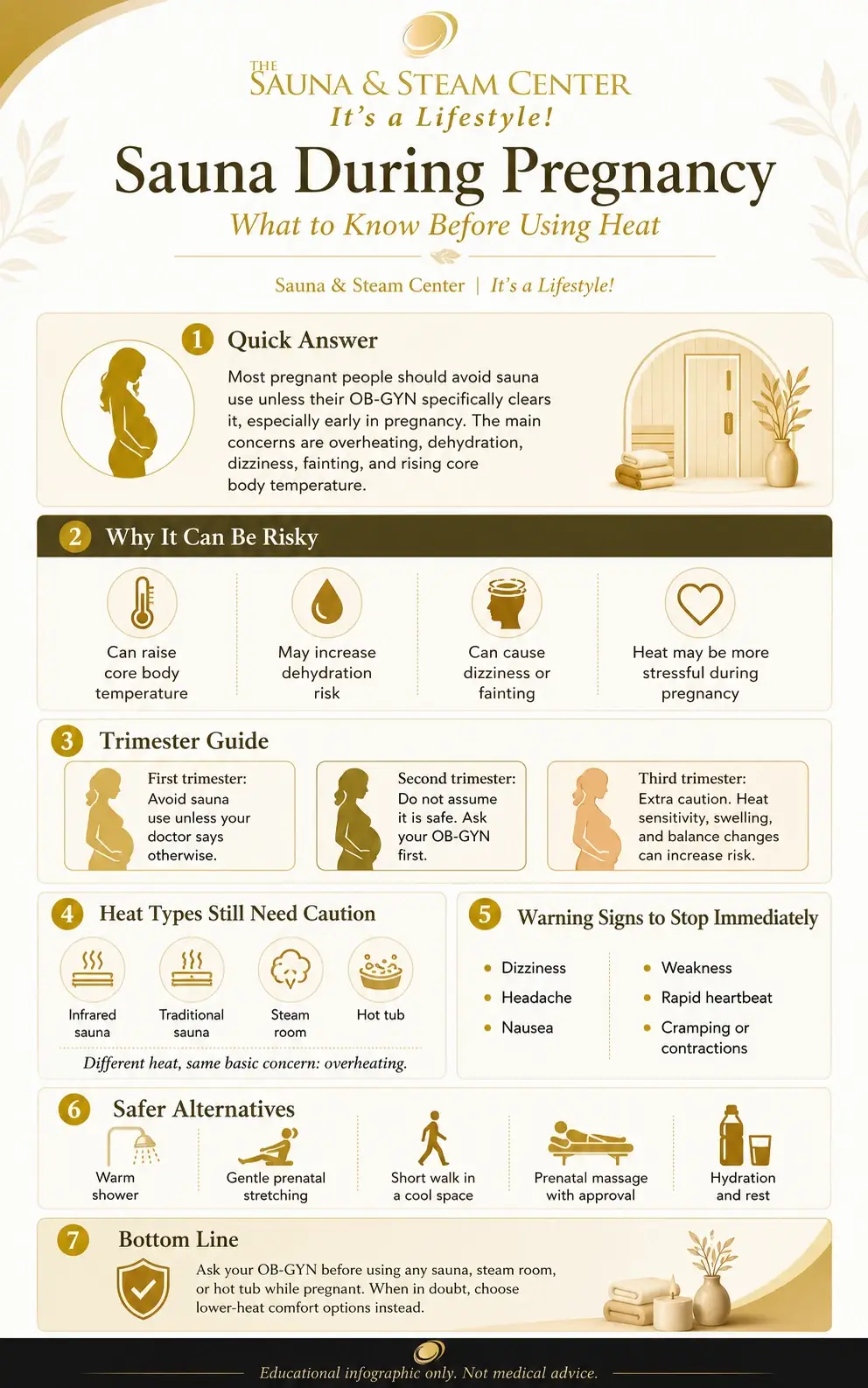
What is mixed or conditional
Some research has explored shorter heat exposures, but that does not create a universal safe sauna routine for all pregnant people. Personal risk changes with trimester, hydration, room temperature, humidity, medications, symptoms, blood pressure, and pregnancy complications.What is overstated or unproven
It is overstated to claim that infrared sauna, sweat-based detox, circulation benefits, or relaxation benefits make sauna use safe for pregnant women. Pregnancy safety should be based on medical clearance, not wellness marketing. Bottom line: What the research supports most clearly is caution around overheating, not a claim that any sauna type is pregnancy-safe.Can you go in a sauna while pregnant?
In most cases, the safest answer is no unless your OB-GYN or pregnancy care provider has specifically told you it is safe for your situation. This applies whether someone searches for sauna pregnancy, pregnant sauna, saunas pregnancy, sauna for pregnant women, or saunas during pregnancy. The wording changes, but the intent is the same: people want to know if heat exposure is safe for the mother and baby. A sauna is different from a warm room because it intentionally creates heat stress. Even if the session feels relaxing, your body has to manage sweating, fluid loss, heart rate changes, blood pressure changes, and cooling. During pregnancy, those changes matter more.Why “I feel fine” is not enough
Feeling comfortable for a few minutes does not prove that core body temperature, hydration, or blood pressure are staying in a safe range. Some people feel overheated only after symptoms appear suddenly. Bottom line: Do not use comfort alone as your safety test. Ask your provider before using any sauna while pregnant.Is sauna safe during early pregnancy?
Early pregnancy is the period where caution matters most. ACOG says it is best not to use saunas or hot tubs early in pregnancy because core body temperature rises during use and that rise may be harmful for the fetus.1 The first weeks of pregnancy are a sensitive development period. Some people may not know they are pregnant yet, which is why those trying to conceive or waiting to test may choose to be cautious with high-heat environments too.What to do if you used a sauna before knowing you were pregnant
Do not panic. One exposure does not automatically mean something is wrong. Write down how long you stayed in, the approximate temperature if you know it, whether it was a dry sauna, infrared sauna, steam room, or hot tub, and whether you felt overheated, dizzy, faint, nauseated, or dehydrated. Then call your OB-GYN if you are worried or had symptoms. Bottom line: Early pregnancy is the strongest reason to avoid saunas unless your OB-GYN gives you personal guidance.Why are saunas risky during pregnancy?
Saunas are risky during pregnancy because they can increase heat load on the body. That can lead to overheating, sweating, dehydration, dizziness, fainting, blood pressure changes, and possible core temperature rise. CDC guidance says pregnancy can make people more likely to get heat exhaustion, heat stroke, or other heat-related illness sooner than people who are not pregnant. The CDC also notes that pregnancy can make dehydration more likely, which can make cooling through sweating less effective.2The risk is not only the baby
Heat can also affect the pregnant person. Fainting, slipping, dehydration, nausea, or weakness can create immediate safety concerns. In late pregnancy, balance changes can make a fall more serious.The risk can build quickly
Heat exposure does not always feel dangerous at first. A few minutes can feel pleasant, then dizziness, nausea, or weakness can show up quickly. Bottom line: Sauna risk during pregnancy is about heat stress, not just comfort.Can sauna use raise core body temperature while pregnant?
Yes. Sauna use can raise core body temperature because the body absorbs heat from the environment. MotherToBaby explains that hyperthermia is a rise in body temperature that happens when the body absorbs more heat than it releases, and sauna or hot tub use can contribute to this.4 This is the central reason medical guidance is cautious. Pregnancy safety is not just about whether the air feels tolerable. It is about how your internal temperature, hydration, circulation, and symptoms respond.Sweating is not a guarantee of safety
Sweating is the body’s cooling response, but it does not guarantee that core temperature is staying within a safe range. In humid environments, sweat evaporation can be less effective.Room temperature does not tell the full story
The same room can affect two people differently. Hydration, pregnancy stage, body size, fitness level, blood pressure, medications, and symptoms all influence how quickly someone overheats. Bottom line: Core body temperature is the main concern, not only the sauna setting.Sauna Pregnancy Guide by Trimester
| Pregnancy Stage | General Guidance | Main Concern |
|---|---|---|
| First trimester | Avoid sauna use unless your pregnancy care provider gives specific guidance. | Core-temperature elevation is the main concern, and ACOG specifically advises against sauna/hot-tub use early in pregnancy. |
| Second trimester | Do not assume sauna becomes safe. Ask your provider before any high-heat exposure. | Overheating, dehydration, dizziness, blood-pressure changes, and fainting can still occur. |
| Third trimester | Provider clearance remains important, and many people may be less heat tolerant. | Heat sensitivity, fatigue, balance changes, dizziness, and fall risk can be more relevant. |
Sauna While Pregnant in the First Trimester: Should You Avoid It?
The first trimester is the highest caution period. ACOG advises that it is best not to use saunas or hot tubs early in pregnancy because core temperature rises during use and this may be harmful to the fetus.1 Some studies have connected hyperthermia in early pregnancy with a small increased chance of certain birth defects, while findings are not identical across all studies.4 Because the potential risk is serious, the conservative recommendation is to avoid sauna use during the first trimester unless your provider gives specific medical guidance.Trying to conceive or in the two-week wait?
People trying to conceive often ask whether to avoid high heat before they know for sure. The safest practical choice is to ask your doctor, especially after fertility treatment, IVF, embryo transfer, or a history of pregnancy complications. Bottom line: If there is one trimester where sauna avoidance is most important, it is the first trimester.Sauna Pregnancy Second Trimester: Is It Safe?
Do not assume second trimester sauna use is safe. Some people feel more energetic and less nauseated in the second trimester, but overheating, dehydration, dizziness, and blood pressure changes can still happen. If your provider gives medical clearance, their advice may include lower temperature, very short duration, hydration, cooling breaks, avoiding solo use, and leaving immediately if symptoms appear. But without clearance, the safest general recommendation is to avoid sauna use.
Why the second trimester can feel misleading
Because many pregnant people feel better in the second trimester, they may feel ready to restart normal routines. But pregnancy heat tolerance is still different, and feeling better does not remove heat-related risk. Bottom line: Sauna pregnancy second trimester decisions still require your OB-GYN’s guidance.Sauna Pregnancy Third Trimester: Is It Safe?
Third trimester sauna use should be approached very cautiously. Later pregnancy can bring swelling, shortness of breath, fatigue, heartburn, balance changes, and heat sensitivity. These changes can make a hot room feel more stressful than expected. Fainting or slipping in the third trimester is also more concerning because of fall risk. Heat-related dehydration may also worsen discomfort or make you feel weaker.Third trimester warning symptoms matter
If you have contractions, abdominal cramping, dizziness, severe swelling, headache, shortness of breath, bleeding, or unusual pain, avoid heat and contact your pregnancy care provider. Bottom line: Sauna pregnancy third trimester use is not automatically safe and should not happen without medical clearance.Is infrared sauna safe during pregnancy?
Infrared sauna is not automatically safe during pregnancy. Infrared saunas often use lower air temperatures than traditional saunas, which can feel gentler, but the body can still absorb heat, sweat, and experience temperature changes. Pregnancy safety depends on core temperature, hydration, symptoms, blood pressure, and provider guidance, not just the style of heat. Lower air temperature may reduce exposure, but it does not remove the concern.Infrared feels different, but risk still exists
Infrared heat warms the body differently than a traditional hot-air sauna, but from a pregnancy safety perspective, the question remains the same: is your body heating up more than it can safely release? For future non-pregnancy planning, our infrared vs traditional sauna guide explains heat style, comfort, and installation differences. Bottom line: Infrared sauna may feel milder, but it still needs medical clearance during pregnancy.Is a traditional sauna safe while pregnant?
A traditional sauna is generally not recommended during pregnancy unless your OB-GYN gives specific approval. Traditional saunas often use higher air temperatures, which may increase the risk of overheating, sweating, dehydration, dizziness, and fainting. Even people who used traditional saunas comfortably before pregnancy should not assume the same routine is safe while pregnant. Pregnancy changes blood volume, heat tolerance, hydration needs, and how quickly symptoms can appear.Traditional sauna ownership note
Traditional saunas can be excellent for long-term wellness routines outside pregnancy. During pregnancy, however, the same strong heat that many sauna users enjoy is exactly why caution matters. Bottom line: A traditional sauna is a high-heat environment and should be avoided during pregnancy unless your provider says otherwise.Is a steam room safe during pregnancy?
A steam room is not automatically safer than a sauna during pregnancy. Steam rooms use moist heat and high humidity, which can make it harder for sweat to evaporate and cool the body. Some people think steam is gentler because the room temperature may be lower than a dry sauna. But humidity changes the experience. The air can feel heavier, breathing can feel less comfortable, and the body may struggle to cool down.Steam room vs dry sauna during pregnancy
Dry sauna heat and steam room heat feel different, but both can create heat stress. If you are comparing them while pregnant, the safest answer is to avoid both unless your OB-GYN clears you. For general, non-pregnancy wellness use, our steam room guide explains timing, hydration, and comfort basics. Bottom line: Steam rooms during pregnancy require the same conservative caution as saunas.Hot tub vs sauna during pregnancy: which is riskier?
Both hot tubs and saunas can be risky during pregnancy because both can raise body temperature. Hot tubs can be especially concerning because heated water transfers heat efficiently and surrounds much of the body, making it harder to cool down quickly. ACOG includes both saunas and hot tubs in its early pregnancy caution because core body temperature rises when using them.1 That means the safest approach is not to swap one high-heat option for another without medical guidance.Why hot water can be different from hot air
Water transfers heat to the body more efficiently than air. That is why a hot tub can raise body temperature faster than some people expect, even when it feels relaxing. For general home wellness planning outside pregnancy, our guide to hydrotherapy at home explains how hot tubs are normally used for relaxation and recovery. Bottom line: Hot tubs may be especially concerning, but saunas and steam rooms also require caution during pregnancy.How long can you sit in a sauna while pregnant?
There is no universal safe sauna time during pregnancy. A five-minute session may sound short, but time alone does not guarantee safety. Heat level, humidity, hydration, symptoms, trimester, blood pressure, medications, and health history all matter. If your provider gives specific clearance, follow their exact instructions. Those instructions may include lower heat, shorter duration, no solo use, hydration before and after, avoiding heat after exercise, and stopping at the first sign of discomfort.Why “just a few minutes” can still be a problem
Heat symptoms can appear quickly. Some people do not feel lightheaded or overheated until they stand up to leave. During pregnancy, that sudden change can increase fall risk. For non-pregnant sauna users, our guide on how long to stay in a sauna explains beginner timing and common mistakes. Pregnant users should follow medical advice first. Bottom line: Do not rely on a fixed time limit during pregnancy. Rely on medical clearance and symptom awareness.What sauna temperature is too hot during pregnancy?
No single sauna temperature is safe for every pregnant person. Your internal body response matters more than the number on the heater. A lower sauna setting may reduce heat exposure, but it does not guarantee that core temperature, hydration, or blood pressure will stay safe. Traditional saunas can be very hot, infrared saunas can still warm the body, steam rooms can limit sweat evaporation, and hot tubs transfer heat efficiently through water. Each heat environment can affect the body differently.Lower temperature and shorter duration: safer alternative or false confidence?
Lower temperature and shorter duration may reduce risk compared with longer, hotter exposure, but they are not a medical safety guarantee. If your provider says to avoid high heat, lowering the setting does not override that advice. Bottom line: The safest pregnancy heat limit is the one your OB-GYN gives you personally.What are the warning signs of overheating during pregnancy?
Warning signs of overheating during pregnancy include dizziness, headache, nausea, vomiting, weakness, heavy sweating, rapid heartbeat, thirst, shortness of breath, muscle cramps, abdominal cramping, contractions, confusion, or feeling faint. CDC clinical guidance lists symptoms of heat-related illness in pregnancy that include heavy sweating, muscle cramps, weakness, lightheadedness, headache, nausea, vomiting, and preterm contractions.3 If any of these happen, leave the heat immediately, cool down, hydrate if you can safely do so, and contact a healthcare provider if symptoms are concerning.What to do immediately
- Leave the sauna, steam room, or hot tub right away.
- Sit or lie down in a cooler area.
- Drink water if you are not vomiting and can safely drink.
- Use a cool cloth on your neck or forehead.
- Call your OB-GYN if symptoms do not resolve quickly or if you have contractions, bleeding, severe headache, confusion, fainting, or unusual pain.

What can you do instead of sauna during pregnancy?
Most people looking up sauna for pregnant women are really looking for relief: relaxation, stress reduction, muscle comfort, better sleep, or a quiet wellness ritual. You can support those goals without high heat.Safer alternatives to discuss with your provider
- Warm shower instead of sauna heat
- Gentle prenatal stretching approved by your provider
- Short walks in a cool environment
- Prenatal massage with medical approval
- Breathing exercises and rest
- Cooling cloth on the neck or forehead
- Hydration and electrolyte support when appropriate
- Side-lying rest with pillows for comfort
- Light mobility work approved by your provider
Best option if you want warmth
A warm shower is usually easier to control than a sauna, steam room, or hot tub. Keep it comfortable, avoid overheating, and leave immediately if you feel lightheaded, nauseated, weak, or unusually warm.Best option if you want relaxation
Gentle breathing, quiet rest, prenatal massage with approval, and light walking may support relaxation without the same heat stress. Bottom line: During pregnancy, choose comfort strategies that do not push body temperature.What OB-GYNs Usually Recommend About Pregnant Sauna Use
Most OB-GYN guidance focuses on avoiding overheating, staying hydrated, reducing fainting risk, and avoiding unnecessary heat stress. If a patient asks about pregnant sauna use, a cautious provider will usually look at trimester, health history, blood pressure, hydration, pregnancy risk level, medications, and symptoms before giving advice.Questions to ask your OB-GYN
- Is any sauna, steam room, or hot tub use safe for my pregnancy?
- Does my trimester change your recommendation?
- Do I have blood pressure, dehydration, or fainting risks?
- Should I avoid infrared sauna even if the air temperature is lower?
- What symptoms mean I should stop immediately?
- Are there safer options for muscle tension, stress relief, or sleep support?
When to Avoid Sauna Entirely During Pregnancy
Avoid sauna use entirely if you are in the first trimester without provider clearance, have a high-risk pregnancy, have high blood pressure or preeclampsia risk, have gestational diabetes concerns, are dehydrated, have severe nausea or vomiting, feel dizzy or faint, have a fever, have contractions, have bleeding, or are taking medication that affects sweating, hydration, heat tolerance, or blood pressure.Do not use sauna if you have warning symptoms
Do not use sauna, steam room, or hot tub heat if you have abdominal pain, contractions, bleeding, severe headache, confusion, chest pain, shortness of breath, fainting, vomiting, fever, or any symptom your pregnancy provider has told you to report.Do not use sauna alone
If a provider has cleared limited heat exposure, avoid using high-heat spaces alone. Symptoms can come on suddenly, and having someone nearby is safer. Bottom line: Pregnancy is not the time to test heat tolerance.Planning a Home Sauna for After Pregnancy
Pregnancy may not be the right time to use a sauna, but it can still be a good time to plan a future home wellness space. If you are thinking ahead, you can get an instant price estimate, compare that with our home sauna cost breakdown, or learn what to expect from professional sauna installation. At Sauna & Steam Center, we have designed and installed sauna and steam systems in South Florida since 2004. That experience helps us plan long-term wellness spaces, but pregnancy safety is a medical decision, so your pregnancy care provider’s guidance should come before any sauna routine.Postpartum and breastfeeding considerations
After pregnancy, ask your healthcare provider when it is safe to return to sauna use, especially after a C-section, significant blood loss, complications, dizziness, blood pressure issues, or breastfeeding concerns. Hydration is especially important if you are nursing. Bottom line: A sauna can be a smart future wellness investment, but pregnancy safety comes before routine.Frequently Asked Questions
Can you sauna while pregnant?
The safest general answer is to avoid sauna use unless your OB-GYN, midwife, or pregnancy care provider specifically clears it for your situation.
Can you use a sauna while pregnant?
ACOG advises avoiding saunas and hot tubs early in pregnancy because they can raise core body temperature. Later pregnancy still requires individualized medical guidance.
Can you go in a sauna pregnant?
Do not assume that a short session is safe. Pregnancy changes heat tolerance, hydration needs, blood pressure, and fainting risk, so ask your provider first.
What does ACOG say about sauna use during pregnancy?
ACOG says it is best not to use saunas or hot tubs early in pregnancy because they raise core body temperature and that rise may be harmful to the fetus.
Is sauna safe in the first trimester?
The first trimester is the highest-caution period. ACOG specifically advises avoiding saunas and hot tubs early in pregnancy.
Is sauna safe in the second trimester?
Do not assume it becomes safe in the second trimester. Overheating, dehydration, dizziness, and blood-pressure changes can still occur, so provider clearance is important.
Is sauna safe in the third trimester?
Third-trimester sauna use also requires caution. Heat sensitivity, fatigue, balance changes, dizziness, and fall risk may be more relevant later in pregnancy.
Can pregnant women use a sauna?
Most pregnant women should avoid sauna use unless their OB-GYN gives personal medical clearance. The main concern is overheating, dehydration, fainting, and raising core body temperature.Are saunas during pregnancy always unsafe?
Not every exposure automatically causes harm, but routine sauna use during pregnancy is not something to assume is safe. Because the risk depends on your body and pregnancy, ask your provider first.Is sauna safe during early pregnancy?
Early pregnancy requires extra caution. ACOG advises that it is best not to use saunas or hot tubs early in pregnancy because core body temperature rises when using them, and this rise may be harmful for the fetus.1Is infrared sauna safe during pregnancy?
Infrared sauna is not automatically safe during pregnancy. Even if it feels gentler than a traditional sauna, the body can still absorb heat, sweat, and experience temperature changes.What about sauna pregnancy second trimester use?
Second trimester sauna use still needs medical clearance. Some pregnant people feel better during this stage, but overheating, dizziness, dehydration, and blood pressure changes can still happen.What about sauna pregnancy third trimester use?
Third trimester sauna use should be approached very cautiously because heat sensitivity, balance changes, swelling, fatigue, and fainting risk may be higher.Are saunas during pregnancy safer than hot tubs?
Not necessarily. Both can raise core body temperature. Hot tubs can be especially concerning because heated water transfers heat efficiently, but saunas and steam rooms also carry overheating and dehydration risks.How long can you sit in a sauna while pregnant?
There is no universal safe time. Even short sessions can be risky for some people depending on heat level, hydration, trimester, and medical history.What sauna temperature is too hot during pregnancy?
No single sauna temperature is safe for every pregnant person. Your internal body response matters more than the room temperature. Lower heat may reduce exposure, but it does not replace medical clearance.What are warning signs of overheating during pregnancy?
Warning signs include dizziness, headache, nausea, weakness, rapid heartbeat, heavy sweating, thirst, shortness of breath, muscle cramps, abdominal cramping, contractions, confusion, or feeling faint.What can I do instead of sauna during pregnancy?
Consider a warm shower, gentle stretching, prenatal massage with approval, breathing exercises, hydration, light walking, rest, and cooling breaks.Conclusion
Sauna during pregnancy should be handled carefully. The main issue is not whether sauna feels relaxing. The issue is overheating, dehydration, dizziness, fainting, and raising core body temperature, especially early in pregnancy. Infrared sauna, traditional sauna, steam rooms, and hot tubs all require caution because each can challenge the body’s ability to stay cool. The best next step is simple: ask your OB-GYN before using any sauna, steam room, or hot tub while pregnant. In many cases, a warm shower, gentle movement, prenatal massage with approval, hydration, and rest will be safer choices until after pregnancy.If you are planning a home sauna for after pregnancy, our team can help you design a safe, comfortable, long-term wellness space that fits your home, budget, and routine. During pregnancy, your doctor’s guidance comes first.Back to top
References
- American College of Obstetricians and Gynecologists: Can I use a sauna or hot tub early in pregnancy?
- CDC: Heat and Pregnancy
- CDC: Clinical Overview of Heat and Pregnancy
- MotherToBaby: Fever and Hyperthermia in Pregnancy
- CDC NIOSH: Heat-Related Illnesses
- PubMed Central: Suggested limits to the use of the hot tub and sauna by pregnant women