
How to Use a Steam Room: 8 Steps, Session Time & Safety
Editorial disclosure: Sauna & Steam Center sells, designs, installs, and services sauna and steam systems. Our experience relates to equipment, room design, installation, and maintenance. Health information in this educational article is not medical advice or a substitute for individualized guidance.
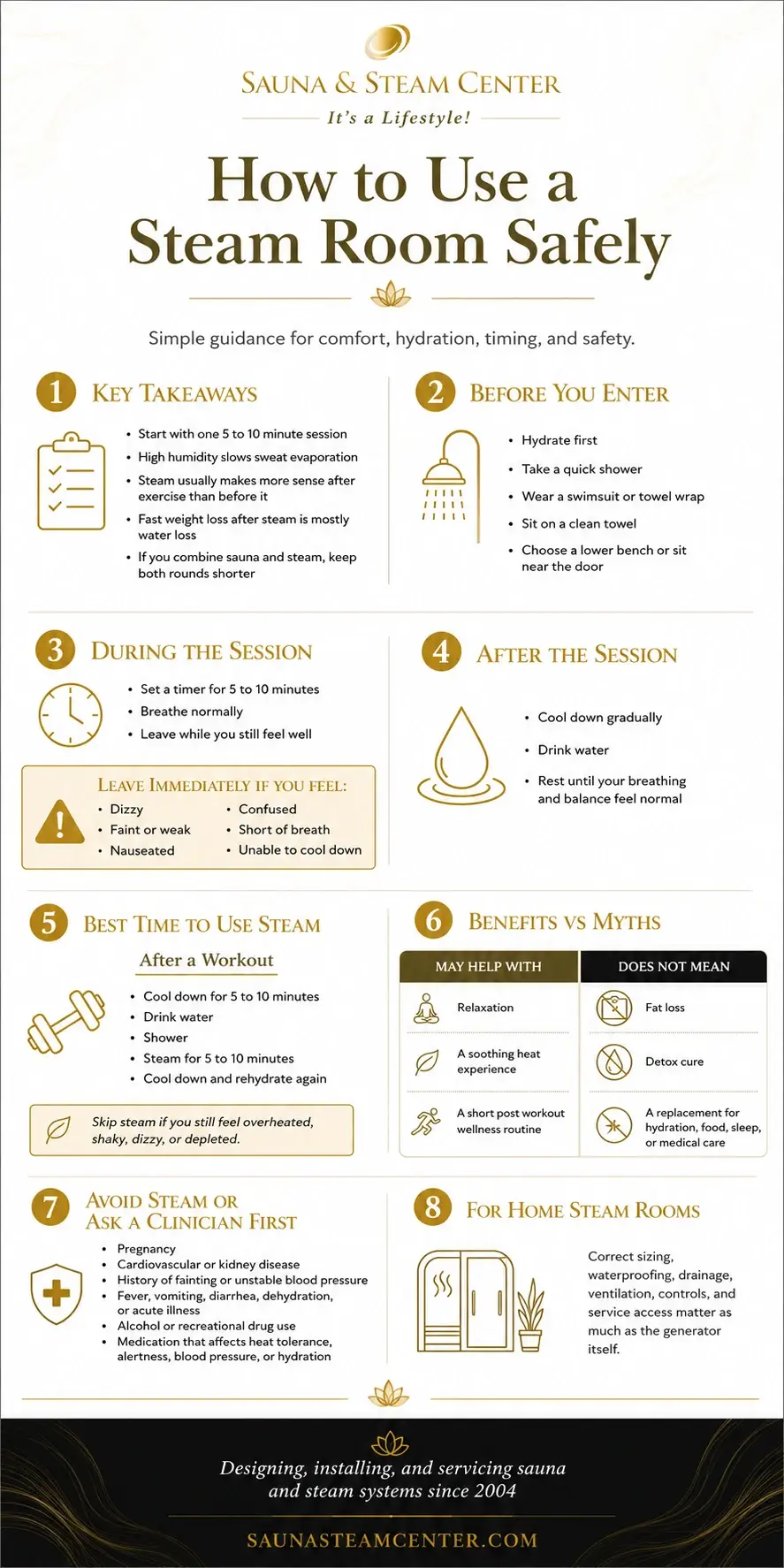
Quick answer: How do you use a steam room? First, drink water and shower. Sit on a clean towel, begin with a short 5 to 10 minute visit if you are new, and leave whenever heat feels uncomfortable. Cool down gradually and rehydrate afterward.
There is no medically required order for sauna and steam. Try them separately at first. People who already tolerate both may choose either order with a cooling break, but more exposure is not automatically better.
A steam room, sometimes called a steam bath, is a heated, high-humidity enclosure. Because humidity limits sweat evaporation, even a lower air temperature can feel intense. Use the room for comfort, never endurance.
This practical guide explains steam-room timing, hygiene, first visits, post-workout use, home steam controls, and when to leave. For equipment basics, see our steam bath guide. For other questions, explore steam room benefits or steam room weight-loss claims.
Steam Room Basics: Quick Answers
| Your question | Practical answer |
|---|---|
| How long should you stay in a steam room? | Start with 5 to 10 minutes. Experienced healthy users may tolerate 10 to 15 minutes, but leave sooner for symptoms. |
| What is a steam bath? | Steam bathing means sitting in a heated, very humid enclosed room; it is often another name for using a steam room. |
| Sauna or steam room first? | There is no required order. Experienced users may prefer sauna, cooling break, then brief steam; beginners should use one heat room at a time. |
| What is steam room etiquette? | Shower before entering, sit on a clean towel, follow clothing rules, and do not block doors or steam outlets. |
How to Use a Steam Room in 8 Steps
Follow these steps at a gym, spa, or home steam room. Always follow posted facility rules or the manufacturer’s instructions when they differ.
1. Hydrate before entering
Drink water in advance rather than trying to correct dehydration after you feel unwell. If you have just exercised, cool down and replace some fluid before entering. Do not use alcohol as part of a steam-room routine.
2. Shower first
A quick rinse removes sweat, lotions, cosmetics, and residue. This improves hygiene and helps reduce contamination of benches and shared surfaces.
3. Wear simple, appropriate clothing
Follow the facility rules. A swimsuit or towel wrap is common. Wear slip-resistant sandals in wet common areas and sit on a clean towel. Avoid heavy clothing or garments intended to trap extra heat.
4. Choose a lower or easier position
Sit lower or closer to the exit when you are new. Do not block the door. Keep your posture stable, and stand slowly when leaving because heat and vasodilation can contribute to dizziness.
5. Set a timer
Start with 5 to 10 minutes. Do not rely on how long other people remain inside. Tolerance depends on the exact room conditions and the person using it.
6. Breathe normally
Do not force deep inhalation. Leave if the humidity causes coughing, wheezing, chest tightness, or uncomfortable breathing. Steam may feel soothing to some people but irritating to others.
7. Leave at the first warning sign
Exit for dizziness, headache, nausea, weakness, muscle cramps, confusion, chest discomfort, unusual shortness of breath, faintness, or inability to cool down. Do not wait for a timer to expire.
8. Cool down and rehydrate
Sit in a cooler area until your breathing and balance feel normal. Begin with a gradual cool-down rather than an extreme temperature change. Drink water and follow any clinician-directed fluid or electrolyte restrictions.
How Long Should You Stay in a Steam Room?
For most beginners, 5 to 10 minutes is a sensible starting session. Experienced healthy adults may tolerate 10 to 15 minutes, but longer is not automatically more beneficial. The correct stopping point is based on heat tolerance and symptoms, not on proving that you can reach a particular number.
Is There a Steam Room Time Limit?
There is no universal medical time limit for every person and room. Treat the 10-to-15-minute range as an example for healthy, experienced users, not a target. High humidity, prior exercise, dehydration, medication, and individual tolerance all affect when to stop.
| Situation | Starting Session | Cool-Down | Best Approach |
|---|---|---|---|
| First-time user | 5 to 10 minutes | At least 5 to 10 minutes | Use one short round only. |
| Regular healthy user | 10 to 15 minutes if well tolerated | 5 to 10 minutes or longer | Leave sooner whenever symptoms develop. |
| After exercise | 5 to 10 minutes initially | Longer cool-down with fluid replacement | Skip it if already overheated or depleted. |
| Using sauna and steam together | Two shorter rounds | Cooling break between rooms | Limit total heat exposure. |
How often can you use a steam room?
Some healthy adults tolerate several sessions per week, while others need more recovery. There is insufficient evidence to prescribe an ideal frequency for everyone. Daily use should not be treated as necessary, and frequency should decrease if you notice persistent fatigue, headaches, excessive thirst, sleep disruption, dizziness, or poor workout recovery.
Using a Steam Room for the First Time
The goal of a first session is to learn how your body responds, not to reach a maximum time. Choose a day when you are rested, hydrated, and not recovering from alcohol, illness, outdoor heat, or a difficult workout.
- Arrive rested and normally hydrated. Avoid going in immediately after a heavy meal or when fasting has left you weak.
- Set a timer for 5 to 10 minutes.
- Sit near the door or on a lower bench.
- Do not combine the first session with a sauna, cold plunge, or hard workout.
- Leave while you still feel comfortable.
- Wait to see how you feel for the rest of the day before increasing future exposure.
Do not assume a lower air temperature means the room is mild. Humidity can make heat difficult to tolerate because sweat does not evaporate normally.
What Is a Steam Room?
Steam Room, Steam Bath, or Steam Shower?
The terms steam room and steam bath often refer to the same high-humidity bathing environment. A steam shower is a smaller residential shower enclosure designed to retain steam as well as provide ordinary showering. Dry saunas use much less humidity. steam room and steam bath interchangeably for the same warm, humid experience. A steam shower is usually a smaller residential enclosure that produces steam while functioning as a shower. By contrast, a dry sauna uses substantially less humidity. A steam room is an enclosed heated space that uses a steam generator to create warm, very humid air. Many residential and commercial rooms operate at a lower air temperature than a traditional dry sauna, but the humidity is much higher. Surfaces are typically tile, stone, glass, or another material designed for moisture exposure. A steam shower is a residential shower enclosure designed to retain steam, while a commercial steam room is usually larger and may serve several users. Both require appropriate waterproofing, vapor management, drainage, ventilation planning, controls, and equipment sizing. Steam rooms should not be confused with traditional saunas. A sauna uses substantially drier heat, while a steam room surrounds the user with moisture-saturated air. Each can feel relaxing, but the body manages the heat differently.
Want to understand generators, steamheads, and how the system works? Read our detailed steam bath explanation. This article focuses on how to use a steam room.
Steam Room Etiquette: What to Do and What to Avoid
At a gym, spa, or wellness center, good steam-room etiquette protects hygiene, comfort, and safety for everyone using the space.
- Shower before entering.
- Sit on a clean towel.
- Keep conversation and device use consistent with facility rules.
- Do not shave, apply oils, or perform personal grooming in a shared room.
- Do not pour substances into vents or steam outlets.
- Keep the door closed but never obstruct the exit.
- Report poor drainage, unusual odors, damaged surfaces, or malfunctioning controls.
Find Your Steam Room Routine in 60 Seconds
Five quick questions to help you choose a beginner-friendly steam session, a gym routine, or a safe approach to sauna and steam.Steam feels different from dry sauna heat. High humidity can make cooling harder, so one short session is enough for many visitors.
Create a steam-room plan that fits your visit.
We will ask about your experience with humid heat, your plans today, and whether there are precautions to consider.Educational guidance only. The quiz cannot establish that steam heat is safe for your health.
How experienced are you with steam rooms?
Your personalized guidance
Practical next steps
Have a Steam Room Project in Mind?
Get help planning a home steam room, steam shower, or combined sauna and steam space. Your results stay above, and you can contact our team right here without leaving the article.Your project interests
We can share these general preferences with your inquiry. Health and symptom answers are not included.If your project interests do not automatically appear in the form, paste this summary into its message or notes field.
Form not appearing? Open our contact page or call 954-744-5395.
The form is optional. Submitting it sends your entered contact details to HubSpot for Sauna & Steam Center to follow up on your inquiry. This quiz does not provide medical clearance. Please do not include private medical information in your inquiry.
This educational quiz cannot determine medical safety. If you have a relevant medical condition, are pregnant, or take medications affecting heat tolerance, ask a healthcare professional. Stop heat exposure if you feel faint, dizzy, nauseated, weak, or unwell.
Sauna or Steam Room First?
Neither order is medically required. Use the room you prefer, and consider stopping after one session, especially if you are a beginner. Heat exposure is cumulative. If you already tolerate both, allow yourself a cooling and hydration break before deciding whether a second session still feels appropriate.
Practical rule: Never move immediately between heat rooms just to complete a routine. Skip the second room when you feel lightheaded, thirsty, overheated, unusually tired, or otherwise unwell.
For complete routines and comparisons, see our dedicated guide: Sauna or Steam Room First? If you also use cold water, read our sauna and cold plunge guide before combining extremes.

Steam Room After a Workout: Gym Routine and Etiquette
Steam-room use generally belongs after exercise, not before it. Entering before training may increase heat strain and fluid loss before the workout even begins. After exercise, steam can provide a relaxing transition, but it should not replace hydration, nutrition, sleep, or an appropriate recovery plan.
A practical post-workout sequence
- Finish the workout.
- Walk or perform an easy cool-down for 5 to 10 minutes.
- Drink water and assess how you feel.
- Take a quick shower.
- Use the steam room for 5 to 10 minutes at first.
- Leave, cool down, and rehydrate again.
Skip steam that day if you feel shaky, depleted, nauseated, unusually thirsty, lightheaded, or still overheated. For more detail on combining exercise with heat exposure, see our guide to using a sauna after the gym.
Steam room etiquette at the gym
In a shared fitness center, shower after training before entering the steam room. Follow the posted clothing rules, sit on a clean towel, keep the steamhead and exit clear, and do not groom or apply oils inside. See the complete etiquette checklist.
How to Use a Home Steam Room
A Typical Steam Room Control: Step by Step
- Confirm the enclosure and steamhead are clear and the door closes correctly.
- Use the wall control or approved app to start the generator according to its manual.
- Choose a comfortable setting and use the built-in timer, if provided. Allow the system to reach operating conditions.
- Check that steam is coming from the proper outlet, stay clear of the hot steamhead, and enter only when the room feels suitable.
- End the session with the control, then follow the manufacturer’s drying, ventilation, and maintenance instructions.
Important: Control labels, warm-up behavior, temperature adjustments, and automatic shutoff features vary by generator brand and model. These steps are an example, not a substitute for the installation manual.
Follow the manufacturer instructions for the generator, controls, aromatherapy options, cleaning process, and maintenance schedule. Control interfaces vary, but a normal sequence includes checking the room, starting the generator, selecting the permitted settings, allowing the enclosure to warm, and confirming that steam output and drainage appear normal.
Before Turning on a Home Steam Room
- Check that the door, seals, drain, surfaces, controls, and steam outlet appear normal.
- Remove objects that are not intended for a high-humidity environment.
- Confirm that the steam head is unobstructed.
- Do not touch or sit directly next to the steam outlet.
During the Steam Session
- Use the timer and temperature controls as instructed.
- Do not bypass safety controls.
- Use only manufacturer-approved aromatherapy products and delivery methods.
- Stop the system if output, noise, controls, drainage, or odor seems abnormal.
If you enjoy aromatherapy, eucalyptus is one of the most familiar scents associated with steam rooms, but it should be used only in a form and delivery method approved for your specific steam generator or aromatherapy system. Our eucalyptus steam room relaxation guide explains what eucalyptus may add to the sensory experience, what health claims should be treated cautiously, and what to consider before using essential oils around steam equipment.
After the Steam Session
- Allow the room to ventilate according to the system design.
- Rinse or wipe surfaces as recommended.
- Keep the drain clear.
- Follow the generator flushing and descaling schedule.
If you are comparing generators, controls, sizing, and ownership requirements, see our steam shower kits buying guide.
Thinking about your own steam shower? Explore steam shower installation in South Florida. If your existing system will not start, does not produce steam, or needs maintenance, see our steam room repair services.
How Steam Heat Affects the Body
When the body is exposed to heat, blood flow shifts toward the skin and sweating increases. In dry conditions, sweat evaporation helps release heat. In a highly humid room, sweat cannot evaporate as efficiently, so the body loses one of its main cooling mechanisms.
Heart rate and circulation can increase
Passive heat can raise heart rate and increase skin blood flow. Blood vessels near the skin widen to support heat transfer. This may contribute to lightheadedness, especially when a person is dehydrated, stands abruptly, has low blood pressure, or takes medication that affects circulation.
Humidity changes heat tolerance
High humidity can make a moderate air temperature feel oppressive because moisture remains on the skin. Research comparing dry and wet sauna conditions found greater difficulty with thermoregulation in wet heat. Humid heat has also been described as poorly tolerated in controlled passive-heating research.
Sweating removes fluid and electrolytes
Sweating reduces body water and removes sodium and other electrolytes. The amount varies widely. A short session may require only normal hydration and a balanced meal for many healthy adults, while exercise, repeated rounds, hot weather, illness, or longer exposure can increase replacement needs.
- Heat tolerance is not the same from one day to the next.
- Exercise before steam exposure increases the total thermal and fluid burden.
- Alcohol, illness, poor sleep, dehydration, and some medications reduce the margin for error.
- Feeling less sweat on the skin does not mean the body is staying cool.
Steam Room Risks, Disadvantages and Common Myths
Dehydration and electrolyte loss
Steam exposure adds sweat loss to whatever fluid deficit already exists. Exercise, hot weather, fasting, illness, alcohol, or repeated rounds can increase the risk. More electrolytes are not always better, especially for users with kidney, heart, or blood pressure restrictions.
Dizziness, low blood pressure and falls
Heat-related vasodilation and fluid loss may cause lightheadedness. Stand slowly, keep the exit clear, and do not walk unassisted if you feel faint.
Breathing discomfort
Some people find warm humid air soothing, while others experience coughing, chest tightness, or shortness of breath. Leave immediately if breathing becomes uncomfortable. A steam room is not a substitute for asthma, infection, or sinus treatment.
Hygiene and maintenance concerns
Persistent moisture requires appropriate cleaning, drainage, waterproofing, and maintenance. Poorly maintained recreational water environments have been associated with microbial hazards. Avoid a facility that appears unsanitary, has standing water, damaged finishes, strong abnormal odors, or poorly functioning ventilation.
Weight-loss and detox myths
A rapid scale change reflects water loss, not a meaningful reduction in fat. For the steam-specific explanation, including what sweating changes on the scale, whether steam meaningfully burns fat, and why weight commonly returns after rehydration, read our guide on whether a steam room helps you lose weight. For the broader comparison across heat exposure, calories, and body weight, read our evidence-based guide on whether saunas help with weight loss.
Who Should Avoid a Steam Room or Ask a Clinician First?
Generic session advice cannot account for every condition or medication. Avoid steam or obtain individualized guidance when any of the following applies:
- Pregnancy, especially early pregnancy or when advised to avoid hyperthermia
- Unstable cardiovascular disease, recent chest symptoms, serious rhythm disorders, or uncontrolled blood pressure
- History of fainting, heat intolerance, or symptomatic low blood pressure
- Kidney disease, dialysis, fluid restriction, or electrolyte disorders
- Acute fever, respiratory distress, vomiting, diarrhea, infection, or dehydration
- Alcohol or recreational drug use
- Medication that affects sweating, alertness, blood pressure, hydration, heart rate, or temperature regulation
- Recent surgery or a condition for which heat exposure has not been approved
ACOG notes that saunas and hot tubs raise core body temperature and advises pregnant patients to discuss exposure with their obstetric care professional. Medical advice should be based on the exact health history, not a universal internet time limit.
What Does the Evidence Say About Steam Rooms?
Direct research on modern steam rooms is smaller than the research base for traditional dry sauna bathing. One commonly cited study compared healthy men in dry and steam sauna conditions and concluded that high humidity reduced the effectiveness of thermoregulation and made wet heat stressful despite the lower temperature. This supports shorter, symptom-guided use rather than assuming moist heat is automatically safer. Research on passive heat therapy suggests possible cardiovascular and vascular effects under controlled conditions, but findings from dry saunas, hot-water immersion, or clinical heat protocols cannot automatically be applied to every public steam room. Evidence for treating colds with heated humidified air is also uncertain, and steam should not be described as curing respiratory infections.
How We Evaluated the Information
We prioritized peer-reviewed human studies, systematic reviews, CDC heat-illness guidance, and professional medical guidance. We treated personal testimonials and commercial claims about detoxification, fat loss, immune boosting, respiratory cures, or disease treatment cautiously.
Steam Room Research: Evidence at a Glance
Steam rooms can provide an enjoyable heat experience, but the evidence is stronger for some statements than others.
| Claim or Factor | Evidence Strength | Best Way to Understand It |
|---|---|---|
| High humidity reduces sweat evaporation | Strong physiological basis | Steam can be difficult to tolerate even when the air is cooler than a dry sauna. |
| Steam may feel relaxing | Reasonable but subjective | Many users value the experience, but relaxation is not the same as disease treatment. |
| Steam creates rapid scale-weight loss | Strong for water loss | The immediate reduction is primarily fluid and should return after rehydration. |
| Steam treats a common cold | Uncertain | Warm humid air may feel soothing, but systematic-review evidence does not establish a reliable cure. |
| Steam detoxifies the body | Unsupported as a broad claim | The liver and kidneys remain the primary organs responsible for processing and eliminating waste. |
| Steam improves post-workout recovery | Limited and protocol-dependent | It may support relaxation, but it does not replace hydration, food, sleep, or rehabilitation. |
What Our Experience Since 2004 Has Taught Us
The quality of a steam experience depends on more than the generator. Correct sizing, vapor management, drainage, ceiling design, seating, control placement, steam-head location, service access, and maintenance all affect comfort and reliability.
More steam is not always a better experience
An oversized or poorly controlled system can produce uncomfortable bursts, uneven heat, excessive condensation, and short cycling. The goal is consistent steam distribution and responsive controls, not the most aggressive output.
The steam head and controls need careful placement
The steam outlet should be positioned where users will not contact the hot discharge. Controls should be easy to reach without forcing the user to cross a slippery room or sit next to the outlet.
Maintenance access should be planned before installation
Generators, drains, valves, controls, and service components need realistic access. A beautiful room becomes expensive to maintain when essential equipment is buried behind finished construction.
South Florida humidity makes enclosure planning especially important
In a humid climate, waterproofing, vapor containment, ventilation, drainage, and post-session drying deserve careful attention. The steam enclosure must be designed as a complete moisture-management system rather than an ordinary shower with a generator added later.
Real-world planning note: A proper steam enclosure depends on the room as a complete system, not only the generator. If you are planning a renovation in South Florida, our steam room design and installation team can review room conditions, equipment access, and steamhead placement before finishes are selected.
Choosing a Steam Routine or Planning a Home System
Public steam-room users should focus on cleanliness, visible maintenance, room conditions, and personal tolerance. Homeowners should focus on proper design, generator sizing, controls, service access, and professional installation.
| Your Main Goal | What to Prioritize | Recommended Next Step |
|---|---|---|
| Try steam safely for the first time | Short session, hydration, clean facility, easy exit | Use one 5-to-10-minute round and assess your response. |
| Add steam after workouts | Cooling down, fluids, conservative timing | Practice steam separately before combining it with other recovery methods. |
| Install a residential steam shower | Generator sizing, waterproofing, drainage, controls, service access | Have the room and equipment planned as one system. |
| Create a larger wellness space | Heat options, layout, utilities, ventilation, budget | Compare steam, sauna, and other features before construction begins. |
Plan Your Steam Room Project
Planning a Steam Room or Steam Shower?
Sauna & Steam Center helps South Florida homeowners, designers, builders, hotels, and wellness properties plan custom steam rooms and steam showers. We consider generator sizing, enclosures, steamhead and control placement, drainage, maintenance access, and long-term reliability.
Already have a steam system? Visit our steam room repair and troubleshooting services, or contact our team with the model and symptoms.
For a combined sauna and steam wellness area, compare the additional costs in our home sauna cost guide.
Frequently Asked Questions About Using Steam Rooms
How long should you stay in a steam room?
Begin with 5 to 10 minutes. Some healthy experienced users tolerate 10 to 15 minutes, but heat symptoms mean you should leave sooner. These are examples, not medical rules.
Is a steam bath the same as a steam room?
Often, yes. Steam bath and steam room usually describe the same heated, high-humidity experience. A steam shower is a smaller enclosure that also functions as a shower.
Should I use the sauna or steam room first?
No medical evidence establishes a required order. Many experienced users prefer sauna, full cool-down, then a short steam session. First-time users should try each separately.
Can I use a steam room after a workout?
Only after cooling down and hydrating, and only if you feel well. Keep the first steam session short, and skip extra heat after hard exercise if you are still overheated or depleted.
What is proper steam room etiquette?
Shower first, sit on a clean towel, follow the facility’s clothing rules, keep the door and steam outlet unobstructed, and do not shave or apply oils in a shared steam room.
What should I wear in a steam room?
Follow the facility’s posted rules. A swimsuit or towel wrap is common, and slip-resistant sandals help in wet common areas. Avoid heavy or heat-trapping clothes.
Can I use a steam room every day?
No ideal frequency is established for everyone. Use it according to your health, room conditions, hydration, and how you recover. Daily sessions are not necessary for benefits.
Can a steam room cure a cold or help with congestion?
Some people find humid warmth temporarily soothing, but steam has not been established as a cure for colds or sinus infections. Avoid steam if you have a fever, contagious illness, worsening breathing symptoms, or feel unwell.
Who should consult a clinician before steam use?
People who are pregnant, have relevant heart, kidney, blood pressure, or fainting issues, or take medicines that change heat tolerance should get individualized guidance. Anyone who is dehydrated, intoxicated, acutely ill, or overheated should avoid steam.
Conclusion: Use Steam for Comfort, Not as an Endurance Test
The best way to use a steam room is to enter hydrated, begin with a short session, pay attention to symptoms, and cool down gradually afterward. High humidity makes sweat evaporation less effective, so a steam room can create meaningful heat strain even when its temperature looks moderate. Keep post-workout sessions conservative, practice sauna and steam separately before combining them, and treat rapid weight changes as water loss. Leave immediately for dizziness, nausea, confusion, faintness, chest symptoms, breathing difficulty, or inability to cool down. For a home installation, prioritize correct sizing, waterproofing, vapor management, controls, drainage, ventilation, and service access. Those decisions affect the experience far more than simply choosing the most powerful generator.
References
- Comparison of physiological reactions and physiological strain in healthy men under heat stress in dry and steam heat saunas
- Acute physiological and psychophysical responses to different modes of heat stress
- Heat-related Illnesses
- Exercise under heat stress: thermoregulation, hydration, performance implications, and mitigation strategies
- Heat therapy: mechanistic underpinnings and applications to cardiovascular health
- Heated, humidified air for the common cold
- Can I use a sauna or hot tub early in pregnancy?
- Legionellosis associated with recreational waters: a systematic review