
Sauna After Workout: Benefits, Timing, Hydration & Gym Sauna Guide
Editorial disclosure: Sauna & Steam Center sells, designs, installs, and services sauna and steam systems. Product and installation guidance reflects our first-hand industry experience. Health and exercise information is educational and does not replace individualized medical or sports-performance advice.
Sauna After Workout: Quick Answers
| Search Question | Best Practical Answer |
|---|---|
| How long to sit in sauna after workout? | Start with about 5 to 10 minutes after cooling down. Longer is not automatically better. |
| How long to stay in sauna after workout? | Many regular users may tolerate 10 to 15 minutes, but workout intensity, hydration, room temperature, and symptoms should set the limit. |
| Is sauna good after a workout? | It can be useful for relaxation and may support selected recovery or heat-acclimation goals, but benefits are not guaranteed. |
| What are the benefits of sauna after workout? | Most realistic benefits are relaxation, temporary comfort, routine consistency, and possible protocol-specific recovery or heat-adaptation effects. |
| What does ACSM say about sauna after exercise? | ACSM publishes hydration and exertional-heat guidance, but we did not find a current ACSM position stand prescribing a specific post-workout sauna duration. |
| How should I hydrate before a gym sauna? | Replace fluid losses from exercise, use thirst and your normal hydration plan, and avoid adding more heat when you are clearly dehydrated or overheated. |
| How do I use a gym sauna after training? | Cool down, hydrate, shower if required, follow gym rules, use a towel, start short, and leave at the first sign of dizziness or weakness. |
Key Takeaways
- Sauna is usually more practical after training than before it.
- Cool down before adding more heat, especially after cardio, running, intervals, or hot-weather exercise.
- Beginners should usually start with one 5-to-10-minute post-workout session.
- Recovery evidence is mixed and depends on the heat method, exercise protocol, athlete, and outcome measured.
- Post-exercise heat may help heat acclimation and selected endurance outcomes when used as a structured training intervention.
- Sauna is not a replacement for sleep, protein, carbohydrate replacement, fluids, rehabilitation, or progressive training.
- The immediate scale drop after sauna is water loss, not body-fat loss.
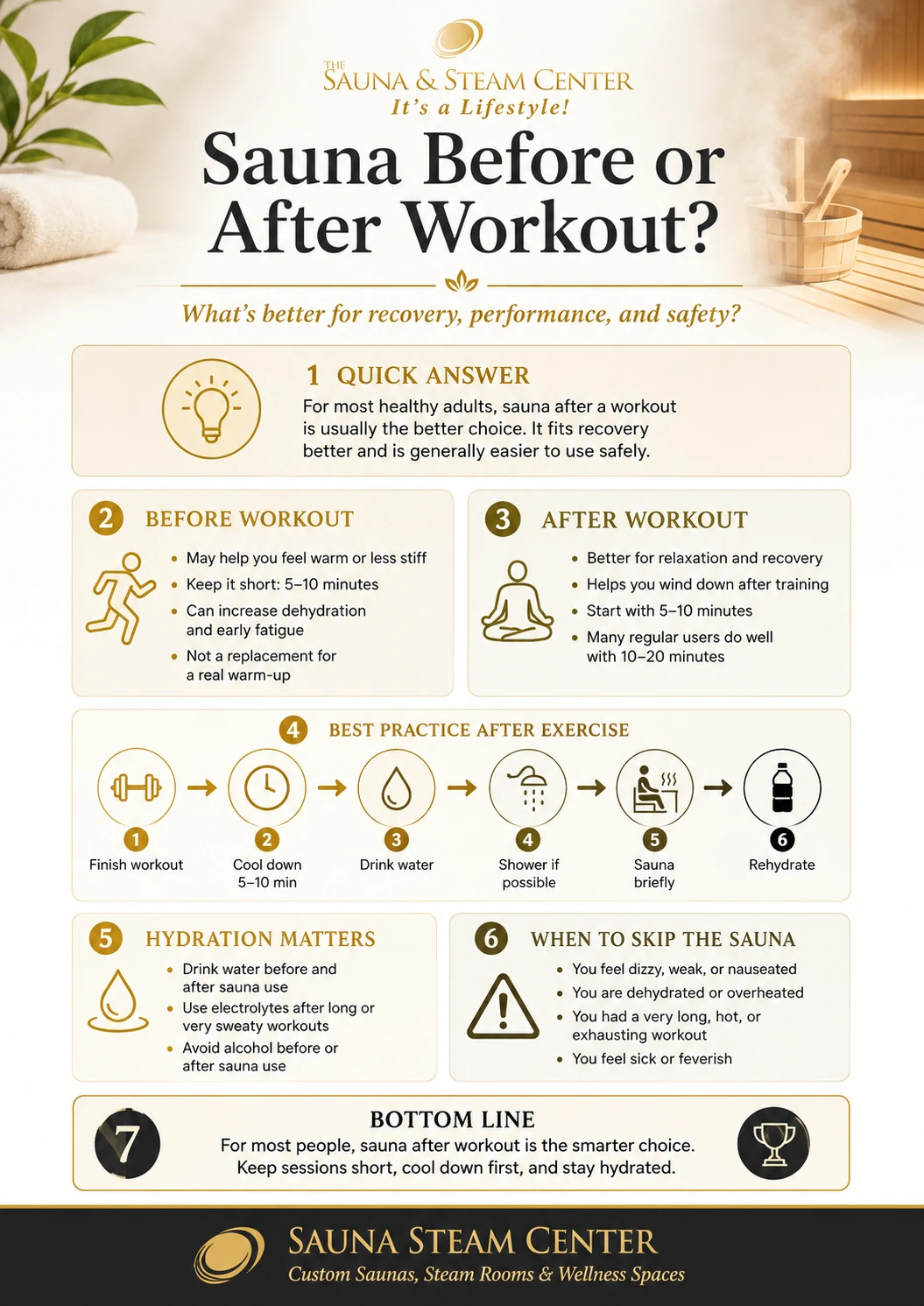
Is It Better to Use a Sauna Before or After a Workout?
For most people, after the workout is the better choice. A pre-workout sauna adds heat and fluid loss before performance begins. That can increase perceived effort, reduce heat tolerance, or leave you less prepared for hard lifting, running, cycling, intervals, or outdoor exercise. A post-workout sauna fits more naturally after the performance goal has been completed. It can provide a structured wind-down and may support selected recovery or heat-acclimation outcomes. The session should begin only after your breathing and heart rate have started to settle and you no longer feel overheated from exercise.What Counts as Post-Workout Sauna Use?
Post-workout sauna means deliberate passive heat exposure after exercise. It may involve a traditional dry sauna, infrared cabin, or another controlled whole-body heat method. Research protocols vary widely in temperature, duration, frequency, and timing. A casual 8-minute session after strength training is not equivalent to a repeated heat-acclimation protocol used by endurance athletes. This distinction matters because the potential benefit, fluid requirement, and recovery cost may differ substantially. The term should also be separated from a steam-room session. High humidity limits sweat evaporation and changes heat tolerance. Use our steam room safety guide when the facility provides moist heat rather than a dry sauna.How Exercise and Sauna Affect the Body
Exercise creates metabolic heat. The body increases skin blood flow and sweating to release that heat. Sauna exposure continues the thermal demand after the workout has ended. This can be manageable when the person is stable and hydrated, but it can compound strain when the workout was long, intense, hot, or dehydrating.Heart rate and skin blood flow may remain elevated
Heat causes peripheral blood vessels to widen and increases the need to move blood toward the skin. After exercise, these effects may contribute to lightheadedness when standing, especially if fluid volume is reduced.Sweat loss continues after the workout
A person may begin the sauna with an existing fluid deficit. Continued sweating removes more water and electrolytes. The safest response is not to force a fixed amount of fluid, but to use a normal individualized hydration plan that accounts for workout duration, climate, sweat rate, health conditions, and medical restrictions.Repeated heat exposure may promote adaptation
Structured post-exercise heat exposure can contribute to heat acclimation. Research in trained runners and systematic reviews suggests potential improvements in heat tolerance and selected endurance-performance markers. These are training adaptations, not guaranteed benefits from an occasional gym sauna.- Exercise intensity changes the remaining capacity for heat.
- Hot and humid outdoor training increases the total thermal burden.
- Dehydration can reduce exercise performance and increase heat-illness risk.
- A higher sauna tolerance does not eliminate the need to monitor symptoms.
What Does the Research Show About Sauna After Exercise?
Current evidence does not support one universal recovery claim. A 2025 systematic review of post-exercise whole-body heat exposure found that studies differed considerably in exercise type, heat method, timing, outcomes, and training duration. The authors evaluated both acute recovery and training adaptations, indicating that benefits are protocol-dependent rather than automatic. One controlled infrared-sauna study reported improvements in selected neuromuscular recovery measures and soreness after resistance exercise. Other traditional-sauna research has examined hormonal and neuromuscular responses following endurance, strength, or combined training. These studies are useful, but they are not strong enough to promise that every user will recover faster. Evidence is more consistent for heat-acclimation applications. Research in trained middle-distance runners and a systematic review of post-exercise heat exposure suggest that repeated sauna or hot-water protocols may improve heat tolerance and selected endurance markers. This is most relevant to athletes preparing for warm conditions, not to every recreational gym user.How We Evaluated the Information
We prioritized systematic reviews, controlled human trials, and official heat-safety guidance. We treated subjective feelings of looseness or relaxation as valid personal outcomes but not proof of accelerated tissue repair. We also separated acute recovery studies from multiweek heat-acclimation programs.ACSM Sauna After Exercise Guidance: What Does It Actually Say?
Several of your Google Search Console impressions are coming from searches such as “ACSM sauna after exercise hydration guidance” and “ACSM sauna after exercise dehydration guidance.” The important distinction is that the American College of Sports Medicine publishes authoritative guidance on exercise hydration, heat illness, and exertional heat stress, but we did not find a current ACSM position stand that gives a universal sauna-after-workout time such as “10 minutes” or “20 minutes.”
ACSM’s current Position Stand library includes Exercise and Fluid Replacement and an updated expert consensus statement on Exertional Heat Illness during Training and Competition. Its public heat-stress guidance emphasizes paying attention to hydration status, reducing heat load when conditions are demanding, and recognizing symptoms of heat stress.
| ACSM Principle | How It Applies to a Post-Workout Sauna |
|---|---|
| Exercise can create substantial heat and fluid loss | Do not move directly from a hard workout into intense heat when you are still overheated. |
| Hydration status matters | Begin replacing exercise-related fluid losses before adding sauna heat. |
| Heat exposure should be adjusted to conditions and acclimatization | A beginner, dehydrated athlete, or person training in South Florida heat should use less sauna time or skip it. |
| Symptoms such as dizziness, confusion, weakness, or excessive heat stress matter | Leave the sauna immediately and cool down. Severe symptoms require medical attention. |
See the ACSM Position Stands and ACSM’s heat and cold stress prevention guidance.
“Effects of Post-Exercise Heat Exposure on Acute Recovery” Full Text: What the Review Found
The query “effects of post-exercise heat exposure on acute recovery full text” refers to a 2025 open-access systematic review in Sports Medicine – Open. The review included 14 studies and 194 participants examining whole-body heat exposure after exercise, including sauna bathing and hot-water immersion.
The acute-recovery results were mixed: some studies found no effect, some found benefits, and one reported an adverse effect. The authors concluded that the current evidence does not allow a definitive statement that post-exercise heat exposure universally improves recovery or physical performance. Repeated heat exposure may be more relevant for certain running and heat-acclimation outcomes than for general gym recovery.
Read the full open-access systematic review.
Benefits of Sauna After a Workout
The most realistic benefits of sauna after a workout involve comfort, relaxation, routine consistency, selected recovery outcomes, and heat adaptation for certain athletes. These effects vary by person and protocol, so they should be understood as possible benefits rather than guaranteed results.1. A structured transition into recovery
A short session can create a clear end to training and encourage quiet rest. This is a practical behavioral benefit, even when it does not change muscle-damage markers.2. Temporary feelings of reduced stiffness
Warmth may make muscles and joints feel more comfortable for some users. The sensation does not prove that tissue has repaired faster, and it should not be used to hide a significant injury.3. Selected recovery effects
Small studies suggest possible improvements in soreness or neuromuscular recovery under certain infrared or sauna protocols. The 2025 systematic review indicates that results vary, so sauna should remain an optional recovery tool rather than a required step.4. Heat acclimation for some endurance athletes
Repeated post-exercise heat can help prepare an athlete for hot conditions by encouraging thermal adaptation. This requires planned frequency and monitoring and may not be appropriate during every training phase.5. Routine consistency and enjoyment
A recovery method that is convenient and enjoyable may help people maintain a regular training routine. This indirect benefit depends on the person and should not be confused with a direct performance guarantee.
Can You Use a Sauna Before a Workout?
A brief pre-workout session may feel pleasant before low-intensity mobility or easy movement, but it should not be treated as the default. Sauna does not prepare movement patterns, increase skill, activate target muscles, or rehearse the loads used in training.Possible reasons someone might use it briefly
- They prefer warmth before gentle mobility work.
- They are completing a clinician- or coach-directed heat protocol.
- The upcoming activity is easy and the user is fully hydrated and heat-acclimated.
Why it may hurt performance
- It can start sweat loss before exercise.
- It may raise thermal strain and perceived effort.
- It can contribute to lightheadedness or fatigue.
- Sauna-induced hypohydration has been associated with reduced performance in older experimental research.
Sauna Before vs. After Exercise
| Factor | Before Exercise | After Exercise |
|---|---|---|
| Main purpose | Warmth or a specialized heat protocol | Relaxation, selected recovery uses, or heat acclimation |
| Main concern | Beginning exercise hotter or less hydrated | Adding heat to an already warm and fluid-depleted body |
| Best default for most users | Skip it and perform a dynamic warm-up | Use a short session after cooling down |
| Reasonable starting duration | No routine need; if used, keep it brief | About 5 to 10 minutes for a beginner |
| Performance impact | May impair performance if it increases heat strain or dehydration | Performance is already completed, but next-day recovery still matters |
Best Sauna Timing by Workout Type
| Workout Type | Best Timing | Why |
|---|---|---|
| Strength training | After cooling down | Avoids pre-lift heat and fluid loss; recovery effects remain individual. |
| Moderate cardio | After cooling and drinking | Cardio already adds heat and sweat, so assess hydration first. |
| Long run or cycling session | Short post-session exposure or skip | Endurance sessions may produce a large heat and fluid burden. |
| HIIT or repeated sprints | Usually after, but often worth skipping | High-intensity work can leave heart rate, temperature, and fatigue elevated. |
| Easy mobility or recovery day | Before or after may be tolerated | A brief session may fit, but active warm-up remains necessary before loading. |
| Training for hot conditions | Structured post-exercise protocol | Repeated heat exposure may support acclimation when planned carefully. |
Gym Sauna After Workout: How to Use It Properly
The query gym sauna is broader than recovery science. Many people simply want to know what to do when their gym has a sauna next to the locker room.
- Finish your workout first. For most people, sauna fits better after training than before performance.
- Cool down. Walk easily and wait until breathing and heart rate begin settling.
- Start replacing fluids. Do not enter clearly dehydrated or extremely thirsty.
- Shower if your gym requires it. This also removes sweat, cosmetics, and residue before entering a shared space.
- Bring a clean towel. Sit or lie on the towel according to facility etiquette.
- Start with 5 to 10 minutes. Especially if you are new, trained hard, or exercised in hot weather.
- Follow posted gym rules. Rules about clothing, phones, footwear, water, fragrances, and maximum occupancy vary by facility.
- Leave immediately if you feel unwell. Dizziness, weakness, nausea, confusion, chest symptoms, or unusual shortness of breath are reasons to stop.
- Cool down and continue normal recovery. Rehydrate and eat according to your training needs.
Safest Sauna-After-Gym Routine
The safest routine begins with an honest assessment. A hard workout does not have to be followed by more stress. Skip the sauna when your body has already had enough.- Finish the workout and perform an easy cool-down.
- Wait until breathing and heart rate are settling.
- Drink according to thirst and your normal individualized hydration plan.
- Shower if facility rules or hygiene conditions call for it.
- Start with 5 to 10 minutes in a moderate position.
- Leave immediately for dizziness, nausea, weakness, headache, confusion, chest symptoms, unusual shortness of breath, or inability to cool down.
- Stand slowly, cool gradually, and continue normal recovery with fluids and food.
How long should you stay?
Beginners should usually start with 5 to 10 minutes. Experienced users may tolerate a longer session, but there is no reason to make 20 minutes a required target after exercise. Workout intensity, room conditions, health, hydration, and acclimatization should determine the decision. For more detailed session guidance outside the workout context, read how long you should stay in a sauna.Hydration After Exercise Before the Sauna
Hydration should reflect how much fluid you lost during training, the climate, workout duration, sweat rate, and your individual health needs. ACSM heat guidance emphasizes hydration status as a key part of reducing heat-related risk, while CDC advises athletes exercising in heat to drink more water than usual and not wait for thirst alone during hot-weather exercise.
Water is adequate for many ordinary workouts and short sauna sessions. Longer, hotter, or unusually sweaty exercise may require replacement of sodium and other nutrients as part of the person’s normal sports-hydration plan. People with kidney, heart, blood-pressure, or fluid-balance conditions should follow individualized medical guidance rather than self-prescribing concentrated electrolyte products.
Evidence at a Glance
Post-workout sauna claims range from well-grounded heat physiology to promising but incomplete recovery research.| Claim | Evidence Strength | Best Interpretation |
|---|---|---|
| Exercise plus sauna increases total heat and fluid stress | Strong physiological basis | Cool down and assess hydration before entering. |
| Sauna may help some users feel relaxed or less stiff | Reasonable but subjective | Comfort can be valuable, but it is not proof of faster tissue repair. |
| Post-exercise heat improves acute recovery | Mixed and protocol-dependent | Some studies are positive, but the systematic-review picture is not universal. |
| Repeated post-exercise heat supports heat acclimation | Moderate and promising | Most relevant to structured endurance training and hot-condition preparation. |
| Sauna burns body fat after a workout | Unsupported | Immediate scale loss is primarily water. |
| Sauna replaces a warm-up | Unsupported | Use movement-specific preparation before training. |
Risks, Myths and Limitations
Dehydration and heat illness
Exercise and sauna both increase sweat loss. CDC guidance notes that athletes exercising in heat face greater dehydration and heat-illness risk and should stop activity if they feel faint or weak.Low blood pressure and fainting
Heat-related vasodilation, fluid loss, and standing quickly may contribute to lightheadedness. Sit down if symptoms begin and do not walk unassisted.Recovery is not guaranteed
Sauna may feel good without improving the specific outcome you care about. Soreness, strength recovery, endurance adaptation, sleep, and perceived relaxation are different outcomes and should not be grouped into one universal “recovery” claim.The “200 rule” is not a safety rule
Adding Fahrenheit temperature to relative humidity is sometimes used informally to describe comfort. It does not account for exercise intensity, hydration, medications, acclimatization, health, sauna design, or session duration. Do not use it as medical permission to remain in the room.Weight loss is primarily water loss
A lower scale reading after exercise and sauna reflects fluid loss. For a complete explanation, read our evidence-focused guide on whether saunas help you lose weight.Who Should Avoid Sauna Around Exercise or Ask a Professional?
Seek individualized medical or sports-performance guidance when exercise and heat may interact with a condition, medication, or specialized training goal.- Pregnancy or postpartum recovery
- Cardiovascular disease, serious rhythm disorders, recent chest symptoms, or uncontrolled blood pressure
- Kidney disease, dialysis, fluid restrictions, or electrolyte disorders
- History of fainting, symptomatic low blood pressure, or heat intolerance
- Diabetes or medication that can affect glucose management
- Medication that changes sweating, heart rate, blood pressure, alertness, or hydration
- Acute illness, fever, vomiting, diarrhea, alcohol use, or existing dehydration
- Post-exertional symptom exacerbation or a condition in which exercise recovery requires individualized pacing
Infrared vs. Traditional Sauna vs. Steam Room After the Gym
| Heat Type | How It Feels | Potential Advantage | Main Caution |
|---|---|---|---|
| Traditional sauna | Higher air temperature with dry heat | Common in gyms and used in heat-acclimation research | Can feel intense after hard training. |
| Infrared sauna | Lower air temperature with radiant heat | May feel more tolerable to some users; selected recovery studies are promising | Still creates sweat loss and heat stress. |
| Steam room | Lower air temperature with very high humidity | Preferred by users who enjoy moist heat | Humidity limits sweat evaporation and may make cooling harder. |
What Our Experience Since 2004 Has Taught Us
People planning a home gym sauna often focus on the highest temperature or the most features. In practice, location, ventilation, controls, electrical requirements, seating, service access, and the path from workout area to cool-down space determine whether the sauna becomes a useful routine.Convenience matters for routine consistency
A sauna close to the training area is easier to use, but it should not force the user to cross slippery floors or enter without a cooling and hydration area.Controls should make moderation easy
A visible timer, predictable heat, simple temperature controls, and comfortable lower seating help users choose a moderate post-workout session instead of treating every use as a maximum test.Recovery spaces need more than a heater
Flooring, lighting, ventilation, towels, water access, drainage, privacy, electrical capacity, and maintenance all affect the finished experience.South Florida adds outdoor heat to the equation
Running, cycling, pickleball, outdoor work, and garage workouts can leave a person carrying a significant heat load before the sauna starts. A climate-controlled cool-down area is especially valuable in South Florida.
Is a Home Sauna Worth It for Workout Recovery?
A home sauna may be worthwhile when convenience, privacy, cleanliness, and routine consistency matter to you. It should not be purchased because of guaranteed recovery or fat-loss promises.- Which heat style do you tolerate after training?
- How many people will use it?
- Is the location close to a shower and cool-down area?
- What electrical service and site preparation are required?
- Will the controls, heater, and other components remain serviceable?
- What is the complete installed cost?
| Your Main Goal | What to Prioritize | Recommended Next Step |
|---|---|---|
| Home gym recovery | Convenient placement, timer, ventilation, water and cool-down space | Plan the sauna and workout area as one workflow. |
| Lower-temperature experience | Infrared system quality, emitter placement and controls | Compare infrared models and electrical requirements. |
| Traditional high-heat experience | Heater sizing, room construction, controls and ventilation | Have the space evaluated before selecting equipment. |
| Outdoor recovery area | Weather resistance, foundation, drainage and electrical planning | Review options for an outdoor sauna in Florida. |
Plan Your Recovery Space
Choose a Sauna That Fits Your Training Routine
Sauna & Steam Center can help compare traditional, infrared, indoor, outdoor, prefab, and custom systems based on your home gym, utilities, available space, heat preference, and budget. For a detailed project budget, review our home sauna cost breakdown. Homeowners comparing other recovery options may also find our guide to hot tub therapy benefits useful.Frequently Asked Questions About Sauna After the Gym
How long should I sit in the sauna after a workout?
A practical starting point is 5 to 10 minutes after your breathing and heart rate have started to settle. Experienced users may tolerate longer, but there is no need to force a 15- or 20-minute session after hard training.
How long should I stay in the sauna after a workout?
For many gym users, about 5 to 10 minutes is a conservative starting range. Your workout intensity, hydration, temperature, health, and symptoms matter more than reaching a fixed time.
Does ACSM recommend a specific sauna time after exercise?
We did not find a current ACSM position stand prescribing a universal post-workout sauna duration. ACSM does provide guidance on exercise hydration and exertional heat illness, which supports cooling down, managing fluid loss, and avoiding excessive heat stress.
What did the 2025 systematic review on post-exercise heat exposure find?
The review found mixed acute-recovery results across 14 studies involving 194 participants. The authors concluded that current evidence is not strong enough to say post-exercise heat universally improves recovery or performance. Repeated heat exposure may be more useful for selected heat-acclimation and running outcomes.
How do you use a gym sauna after working out?
Finish training, cool down, start replacing fluids, shower if required, use a clean towel, follow facility rules, begin with a short session, and leave immediately if you feel dizzy, weak, nauseated, confused, or unusually overheated.
Is it better to use a sauna before or after a workout?
For most people, sauna is more practical after a workout. Pre-workout heat may increase thermal strain or fluid loss, while post-workout use can be added after performance is complete and the body has started to cool.What are the benefits of sauna after a workout?
The potential benefits of sauna after a workout include relaxation, temporary relief from stiffness, selected recovery effects, improved heat tolerance for some athletes, and a more consistent post-training routine. Results vary, and sauna should not replace hydration, nutrition, sleep, or proper recovery.How long should you stay in a sauna after a workout?
Beginners should usually start with 5 to 10 minutes. Experienced users may tolerate longer, but workout intensity, room conditions, hydration, health, and symptoms should determine the session rather than a fixed target.Should you cool down before entering the sauna?
Yes. Wait until your breathing and heart rate are settling and you no longer feel severely overheated. Drink according to your normal hydration plan before adding more heat.Can sauna help muscle recovery?
Some studies report improvements in selected soreness or neuromuscular outcomes, but systematic-review evidence is mixed and depends on the protocol. Sauna should remain an optional addition to sleep, food, hydration, and appropriate training.Does sauna help with weight loss after a workout?
Sauna can reduce scale weight temporarily through sweating, but this is primarily water loss rather than body-fat loss.Is infrared sauna better after a workout?
Infrared sauna may feel more tolerable to some users because the air temperature is lower, and selected recovery research is promising. It has not been proven universally superior, and it still causes heat and fluid stress.Is a steam room good after the gym?
A short steam-room session may feel relaxing, but high humidity limits sweat evaporation and can make cooling harder. Cool down first, keep the session conservative, and leave if breathing or heat tolerance becomes uncomfortable.Who should avoid sauna around workouts?
People who are dehydrated, intoxicated, acutely ill, vomiting, experiencing diarrhea, faint, overheated, or unusually weak should avoid it. Pregnancy, cardiovascular disease, kidney disease, unstable blood pressure, fainting history, and relevant medications require individualized guidance.Is a home sauna worth it for workout recovery?
A home sauna may be worthwhile for convenience, privacy, cleanliness, and a repeatable relaxation routine. Its value depends on your space, budget, heat preference, installation requirements, and realistic frequency of use.Conclusion: Sauna Is Usually Better After the Gym
For most healthy adults, sauna use fits better after exercise than before it. It avoids adding heat and fluid loss before performance and can provide a controlled transition into rest. The benefits of sauna after a workout are not guaranteed. Current research suggests that selected protocols may influence soreness, neuromuscular recovery, heat acclimation, or endurance markers, but outcomes differ and the systematic-review evidence remains protocol-dependent. Cool down, assess hydration, start with a short session, and skip the sauna when the workout has already left you overheated or depleted. Use it as an optional part of recovery, not as a substitute for sleep, nutrition, fluids, rehabilitation, or smart training.References
- Effects of Post-Exercise Heat Exposure on Acute Recovery and Training-Induced Performance Adaptations: A Systematic Review
- The Effect of Post-Exercise Heat Exposure on Endurance Exercise Performance: A Systematic Review and Meta-Analysis
- A Post-Exercise Infrared Sauna Session Improves Recovery of Neuromuscular Performance and Muscle Soreness After Resistance Exercise Training
- Intermittent Post-Exercise Sauna Bathing Improves Markers of Exercise Capacity in Trained Middle-Distance Runners
- Acute Neuromuscular and Hormonal Responses to Different Exercise Loadings Followed by a Sauna
- Effects of Dehydration on Exercise Performance
- Differential Effects of Sauna-, Diuretic-, and Exercise-Induced Hypohydration
- Heat and Athletes
- Heat-Related Illnesses
- Can I Use a Sauna or Hot Tub Early in Pregnancy?