
Sauna for Runners: After Running, Heat Training & Recovery
Editorial and medical disclosure: Sauna & Steam Center designs, sells, installs and services saunas. Our practical expertise covers equipment and installation, not medical diagnosis or athletic coaching. This article explains published studies and general safety guidance; it is not individualized medical advice or a training prescription. People who are pregnant or have relevant heart, kidney, blood-pressure, fainting, heat-illness or medication-related concerns should seek individualized guidance before sauna use.
Is sauna good for runners? Some trained-runner studies suggest that repeated sauna use after exercise can support heat acclimation and may improve selected fitness measures. But the overall evidence for improved endurance performance remains uncertain. For most recreational runners, the practical sequence is finish the run, cool down, replace fluids and assess how you feel before considering more heat. Sauna is optional, not a substitute for running or recovery.

Quick answer: Sauna before or after running? After running is usually more practical because pre-run heat may make a workout harder and increase fluid loss. Finish your cool-down and replace fluids first. Do not use the sauna if you are dizzy, nauseated, unusually weak, overheated or dehydrated. Studies that found promising improvements usually involved trained runners and repeated, monitored post-exercise sessions, not one casual visit.
Stop for warning signs: Leave heat immediately if you develop dizziness, faintness, chest pain, unusual shortness of breath, confusion, nausea or severe weakness. Confusion, collapse, seizure or suspected heat stroke is an emergency. Move to a cooler place, begin safe cooling and call emergency services.
Sauna Before or After Running: Which Makes More Sense?
For most runners, sauna after running is the more practical choice. A sauna before intervals, tempo work, a long run or a race can raise body temperature and increase fluid loss before training starts. The potential value of sauna after running comes from adding a controlled heat exposure after the main workout, but that added stress is not appropriate on every day.
| Question | Before running | After running |
|---|---|---|
| Workout quality | Heat exposure may make the upcoming run feel harder. | The running workout is already complete. |
| Hydration | May begin exercise with additional sweat loss. | Adds more fluid loss to what the run already caused. |
| Research | Not the main protocol in the runner studies cited here. | Used in several small heat-acclimation trials. |
| Practical choice | Generally avoid before a key workout or race. | Consider only after cooling, fluids and a symptom check. |
A sensible post-run sequence
- Finish your run and complete an easy walking or movement cool-down.
- Get into shade or a cooler place, particularly after running in South Florida heat.
- Start replacing fluids and, after heavy sweat losses, consider electrolyte replacement consistent with your health needs.
- Check for dizziness, headache, nausea, cramps, unusual weakness or signs of overheating. If present, skip the sauna.
- If you feel normal and sauna is already familiar to you, use a conservative session rather than trying to reproduce a laboratory protocol.
- Cool down again, hydrate and reassess afterward.
Before a run: A casual sauna session immediately before a hard workout is usually a poor trade-off. Planned heat-acclimation programs are a different matter and should be individualized, especially for competitive athletes.

Benefits of Sauna for Runners: What Does the Research Actually Show?
The distinction matters: Some individual studies involving trained runners reported improved heat-tolerance measures or endurance-related markers. Yet a 2025 systematic review and meta-analysis examining ten studies and 199 participants concluded that the overall effects of post-exercise heat exposure on performance were uncertain, with low to very low certainty across outcomes.
| Potential effect | What the evidence supports | What it does not prove |
|---|---|---|
| Heat acclimation | Repeated exposure can produce heat-adaptation responses in selected protocols. | That any home sauna schedule is appropriate for everyone. |
| VO2 max | Some small runner trials found improvements; pooled results have greater uncertainty. | Guaranteed aerobic fitness gains from sauna alone. |
| Endurance performance | Promising results in certain trained-runner studies. | Consistent improvement across all runners or climates. |
| Perceived relaxation | Some people feel less tense or stiff after heat. | Accelerated muscle repair or verified injury treatment. |
| Immediate post-run recovery | Mixed findings in a 2025 systematic review. | That heat outperforms sleep, nutrition or hydration. |
Research quality note: The combined evidence includes small samples, trained athletes, different heat treatments and different outcome measures. Findings from traditional sauna or hot-water immersion should not automatically be generalized to every infrared sauna, recreational runner or recovery routine.
Does Sauna Improve VO2 Max and Running Endurance?
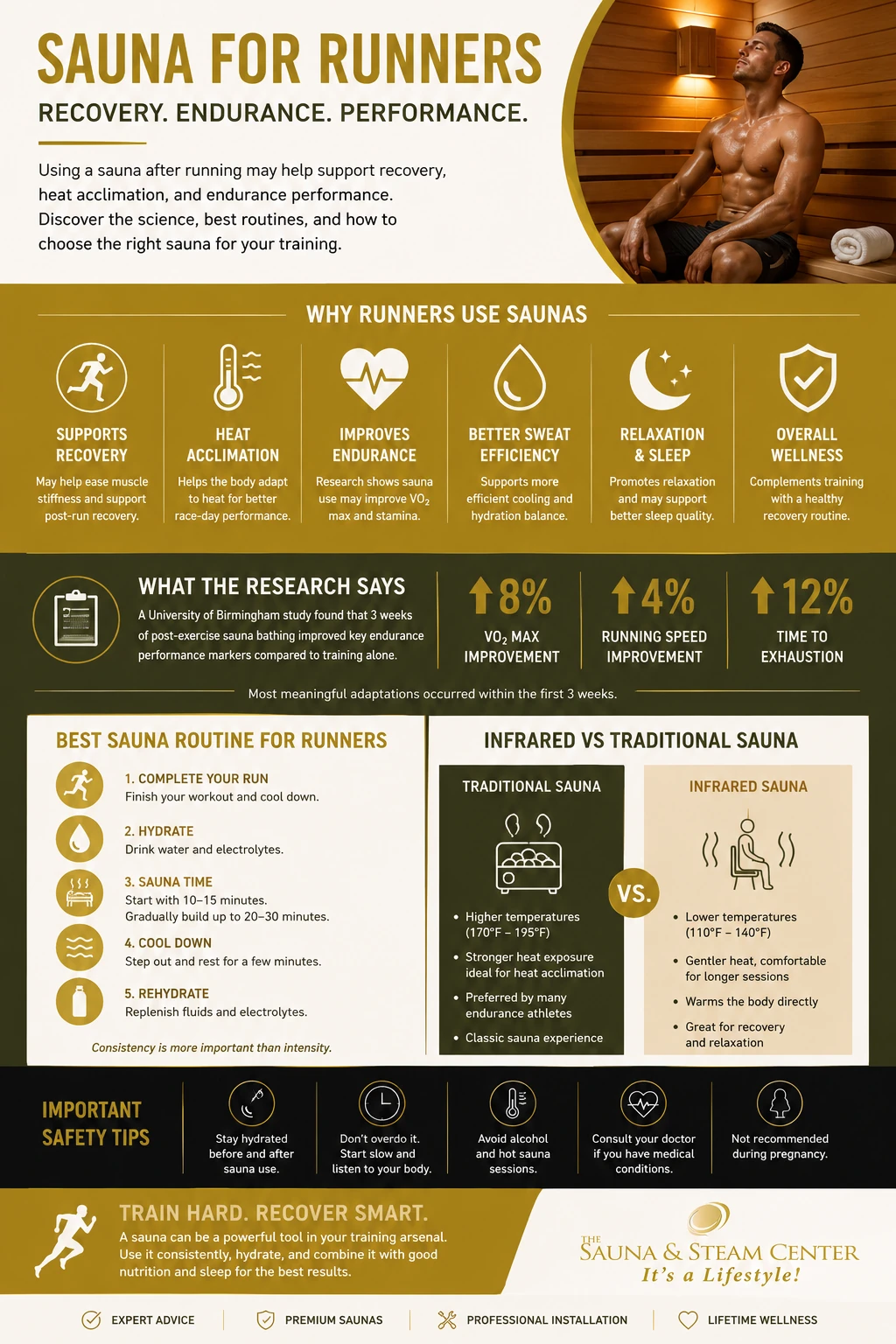
Possibly, under specific conditions. A study of 20 trained middle-distance runners compared normal training with training plus roughly 28 minutes of post-exercise sauna about three times weekly for three weeks. The sauna group reported favorable VO2 max and lactate-related results. A related study also examined adaptations in trained male and female runners.
An earlier, small study of competitive male runners observed changes in endurance-related measures following post-training sauna use. These individual findings are worth understanding, but they do not overturn the uncertainty identified in broader evidence reviews.
Sauna cannot replace VO2 max intervals, easy runs, long runs or sprints. Heart rate increases during passive heat, but the muscular, mechanical and sport-specific demands differ substantially from running.
Bottom line: Keep running as the foundation. Consider sauna an optional adjunct for selected training goals, not a shortcut to better VO2 max or faster race times.
Sauna Heat Training and Acclimation for Runners
Heat acclimation can help athletes prepare for hot conditions, but the best approach depends on the race, training phase, health and available supervision. Consensus guidance for training and competing in the heat emphasizes planned acclimatization and adequate hydration.
Post-exercise sauna has been studied as one way to add passive heat exposure after running. However, the approximately 28 to 31 minute sessions used in certain controlled research studies are descriptions of research protocols, not recommended starting durations.
What about a three-week sauna protocol?
Several runner experiments lasted about three weeks, but a duration or frequency copied from a trial is not a safe universal plan. Instead, use this decision framework:
| Situation | Better decision |
|---|---|
| New to sauna or unsure of heat tolerance | Learn whether you tolerate a brief, comfortable session on a rested day. Do not start by copying athlete protocols. |
| Easy run, well recovered and already familiar with sauna | Consider a modest session only if it does not compromise hydration or the next workout. |
| Hard workout, long run or hot-weather training | Prioritize fluid replacement and recovery. Skipping the sauna is often the better choice. |
| Training specifically for heat performance | Discuss duration, frequency, hydration, monitoring and contraindications with an appropriately qualified sports-performance professional. |
Heat training is not a contest. Longer exposure is not automatically better, and the best acclimation plan may involve exercise-in-heat protocols rather than sauna.
Hydration, Safety and When to Skip a Post-Run Sauna
Running and sauna both increase heat and fluid demands. If you finish a run dehydrated, overheated or unwell, adding heat can make matters worse. There is no fixed amount of water or fixed waiting period that makes every runner ready for a sauna.
Should I use a sauna after today’s run?
Consider only if you feel normal
You finished a manageable workout, cooled down, started replacing fluids and already know you tolerate sauna heat.
Postpone or skip
You finished a demanding or hot-weather run, have heavy sweat losses, or need to prioritize a race or quality workout soon.
Do not enter
You have dizziness, confusion, nausea, faintness, chest discomfort, severe weakness or suspected heat illness. Seek appropriate medical help for concerning symptoms.
Common mistakes: entering already thirsty or dizzy, treating 15 or 30 minutes as a required goal, using sauna suits to increase sweat loss, and assuming a drop in scale weight means fat loss. Rapid scale changes after sweating are primarily fluid loss.
For heat illness symptoms and first aid, see the CDC/NIOSH heat-stress guidance. Cleveland Clinic also identifies dehydration as an important sauna risk; see its sauna safety guidance.
Sauna Before or After a Marathon or Half Marathon
Race-day readiness matters more than completing a sauna routine. Heat adaptation develops over repeated exposures, not from one aggressive session immediately before a race.
| Timing | Practical guidance |
|---|---|
| Day before a marathon or half marathon | Avoid starting a new or demanding sauna protocol. Prioritize rest, sleep and adequate hydration. An already-familiar short session is not necessary for race preparation. |
| Immediately before the race | Usually avoid unnecessary heat exposure. Arrive prepared for the event, unless following an individualized sports-performance plan. |
| Immediately after a marathon or half marathon | Cooling, fluids, food and rest come first. Skip sauna when overheated, depleted or experiencing symptoms. |
| The day after a marathon | There is no requirement to sauna. Consider it only when you have recovered sufficiently, are normally hydrated and feel well. Persistent or concerning symptoms warrant medical evaluation. |
What about sauna after a long training run?
Long runs, especially in Florida heat and humidity, can leave substantial fluid and electrolyte deficits. After a demanding run, recovery is usually more important than extra heat. If the session was hard, hot or left you unusually fatigued, skip the sauna that day.
Race-week takeaway: A missed sauna session will not erase heat adaptation. A poorly timed, dehydrating session may interfere with the training or race that actually matters.
Sauna for Running Recovery, Rest Days and Fitness
Some runners use a sauna because it feels relaxing and may temporarily ease the sensation of stiffness. That is different from proving faster muscle repair or superior next-day performance. A 2025 systematic review found that effects of post-exercise heat exposure on recovery and training adaptations are not yet well established.
On rest days: A familiar, comfortable session can be a personal preference, but it should not leave you drained, thirsty or less prepared for the next workout.
Sauna versus running: Sauna does not replace aerobic workouts, long runs, sprints, strength training, fueling, sleep, physical therapy or a day off when one is needed.
For more general gym and workout considerations, see our sauna after the gym guide. For ordinary session-duration questions, read how long you should stay in a sauna.
Traditional vs. Infrared Sauna for Runners
Most runner-specific studies cited here used traditional high-temperature sauna conditions. That means traditional sauna provides a closer match to those published protocols, but it does not mean everyone should choose higher heat.
| Consideration | Traditional sauna | Infrared sauna |
|---|---|---|
| Match to cited runner studies | Closer match to most protocols. | Less direct runner-specific evidence. |
| Heat experience | Hotter air; settings vary. | Radiant heat with typically lower ambient air temperature. |
| Home suitability | Depends on space, electrical requirements and preferences. | Depends on equipment, electrical requirements and preferences. |
| Performance claims | Not guaranteed. | Do not transfer traditional-sauna research claims automatically. |
Read our infrared vs. traditional sauna comparison for construction, comfort and equipment details.
Planning a Home Sauna for Runners in South Florida
A convenient home sauna can make equipment access easier, but it does not replace an individualized training plan. Sauna & Steam Center’s practical knowledge relates to selecting, designing, installing and servicing the system itself.
What we consider during sauna design
- Heating type: traditional or infrared, depending on preferences, operating characteristics and installation requirements.
- Location: indoor or outdoor placement, including access to a cooler area and a nearby shower.
- Controls and usability: straightforward timer and temperature controls rather than relying on guesswork.
- Installation details: space, wiring, ventilation, safe access and long-term serviceability.
These are equipment-planning considerations, not evidence that a particular design improves race performance. See the home sauna buying guide and sauna installation services in South Florida.
Home Wellness Design in South Florida
Plan a Sauna That Fits Your Home and Routine
Sauna & Steam Center designs, installs and services residential sauna systems. We can help you compare traditional and infrared options, indoor and outdoor placement, controls, electrical requirements and maintenance.
Want a broader overview first? Read our home sauna buying guide.
Frequently Asked Questions About Sauna for Runners
Is sauna good after running?
It can be reasonable for a runner who has cooled down, replaced fluids and feels well. The larger evidence base does not establish guaranteed endurance or recovery benefits.
How long should I wait after running before entering a sauna?
There is no universal waiting period. Wait until you are no longer overheated, your breathing and balance feel normal and you have begun replacing fluids. Skip sauna entirely if you feel unwell.
Does sauna increase VO2 max?
Some small studies in trained runners found improvements after repeated post-exercise sauna exposure, but systematic-review evidence is uncertain. Sauna is not a replacement for training.
How long should runners stay in a sauna?
There is no universally safe duration for every runner. Start conservatively if sauna is new, respect your tolerance and do not copy the longer sessions used in controlled athlete studies. Leave early if symptoms develop.
Should I sauna the day before a marathon?
Do not begin a new or aggressive heat protocol just before racing. Starting the event hydrated, rested and fueled takes priority.
What about sauna after a half marathon or marathon?
Cooling, hydration, nutrition and rest are the immediate priorities. Skip sauna when the event has left you overheated, weak, dizzy or dehydrated.
Can I use a sauna the day after a marathon?
There is no requirement to do so. Consider it only if you feel well and have recovered adequately. Seek medical advice for unusual or persistent symptoms.
Is a traditional or infrared sauna better for heat training?
The cited runner trials generally used traditional high-temperature saunas, so their findings should not be automatically transferred to infrared models. Choice also depends on tolerance and practical installation needs.
Can sauna replace an easy run, cardio or sprint training?
No. Passive heat does not supply the running-specific cardiovascular, muscular and neuromuscular stimulus of actual training.
Final Takeaway: Let Your Run Come First
Sauna after running may have a place in a considered heat-training routine, and selected athlete studies have reported promising results. However, systematic reviews do not establish consistent performance or recovery benefits. Treat sauna as optional additional stress, not an obligation. Finish your run, cool down, replace fluids and skip further heat whenever recovery or safety should take priority.
Research and Safety References
- Kirby NV, et al. Intermittent post-exercise sauna bathing improves markers of exercise capacity in hot and temperate conditions in trained middle-distance runners.
- Kirby NV, et al. Sex differences in adaptation to intermittent post-exercise sauna bathing in trained middle-distance runners.
- Scoon GSM, et al. Effect of post-exercise sauna bathing on the endurance performance of competitive male runners.
- Systematic review and meta-analysis: post-exercise heat exposure and endurance performance.
- Systematic review: post-exercise heat exposure, acute recovery, and training adaptations.
- Consensus recommendations on training and competing in the heat.
- Cleveland Clinic: Sauna benefits and dehydration risks.
- CDC/NIOSH: Heat stress and heat-related illness.