
Best Home Sauna for Florida Homes: 2026 Buying Guide
Editorial disclosure: Sauna & Steam Center sells, designs, installs, repairs, and services sauna and steam systems. This guide is written from a buyer-planning and installation perspective, with special attention to South Florida homes. Product specifications are checked against current product information where available. Pricing, availability, electrical requirements, warranties, permits, delivery, and installation conditions can change, so confirm current model details before purchasing. Product safety notices are reviewed separately from sales recommendations.
If you are buying a sauna for a Florida home, the right choice depends on more than brand or appearance. Start with the location, heat style, number of regular users, electrical capacity, humidity exposure, ventilation, service access, budget, and how often you expect to use it. Florida homeowners also need to think about outdoor rain, intense sun, coastal salt exposure, drainage, storm conditions, and how equipment will be serviced after installation.
Start with four decisions before comparing models: your preferred heat experience, indoor or outdoor placement, comfortable everyday capacity, and the complete installed project budget. Then confirm power, ventilation, delivery access, maintenance, warranty, and local service.
Home Sauna Buying Guide: Quick Answers
| Buying Question | Best Starting Answer |
|---|---|
| What is the best sauna for homeowners? | The best home sauna is one that fits the property, normal number of users, preferred heat style, electrical system, budget, and expected routine. |
| What size home sauna should I buy? | Buy for normal weekly use rather than maximum occasional occupancy. Solo users may prefer one or two-person models, while families should prioritize actual bench space. |
| Should I buy infrared or traditional? | Infrared often suits buyers wanting lower air temperatures and simpler indoor installation. Traditional suits buyers wanting the hotter classic sauna experience with a heater and stones. |
| Is a portable sauna worth buying? | It can be for renters, small spaces, low budgets, or buyers testing whether they will actually use sauna regularly. Permanent cabins generally provide better comfort and durability. |
| Should I buy a one-person or two-person infrared sauna? | If space allows, a two-person unit can provide more bench room even for solo use and gives you flexibility for a second user. |
| Is a home sauna worth the money? | It can be when you use it regularly and the installation fits your home. Value depends on total ownership cost and frequency of use, not only the purchase price. |
| Should I choose prebuilt or custom? | Prebuilt cabins are usually simpler and more predictable. Custom saunas make more sense when the room, dimensions, finishes, benches, glass, heater, or architectural integration require a tailored design. |
| What should I check before buying? | Measure the location and delivery route, confirm electrical requirements, compare actual bench dimensions, check included equipment, warranty, replacement parts, installation scope, and total cost. |
| What is the best home sauna for Florida? | For many buyers, an indoor sauna is the simplest starting point because it avoids direct rain, UV, salt-air, and storm exposure. Outdoor saunas can work well when they are designed for exterior placement and the base, drainage, roof, hardware, electrical work, and maintenance plan are appropriate. |
| What matters most in a humid Florida climate? | Moisture management, drying, ventilation, exterior-rated construction where applicable, corrosion-resistant hardware, drainage, and access for inspection and service matter more than choosing a sauna only by wood species. |
| Can I pair a sauna with a cold plunge? | Yes. Plan the hot and cold equipment as one wellness zone so drainage, electrical service, walking surfaces, outdoor exposure, equipment clearances, and service access work together. |
| How much electricity does a sauna use? | Energy use depends mainly on heater or emitter power and run time. As a simple upper-bound calculation, a 6 kW heater running at full output for one hour uses about 6 kWh before thermostat cycling is considered. |
Best Sauna for Homeowners: Start With Your Home, Not the Brand
The best sauna for homeowners is the sauna that fits the property and is convenient enough to use regularly. A premium sauna can still be a poor purchase if it creates electrical problems, feels cramped, takes over too much floor space, requires inconvenient maintenance, or is located somewhere you rarely want to use it. Before comparing brands, decide which homeowner situation most closely matches yours.
| Homeowner Situation | Best Starting Direction | Why |
|---|---|---|
| Condo or small home | One-person or compact two-person infrared | Smaller footprint and often simpler electrical requirements. |
| Solo homeowner with available space | Two-person infrared or compact traditional | Provides more comfortable bench room and future flexibility. |
| Couple | True two-person or larger cabin | Allows both users to sit comfortably without relying on maximum advertised capacity. |
| Family | Roomier traditional or hybrid sauna | More usable seating and flexibility for different heat preferences. |
| Home gym | Infrared, traditional, or hybrid | Choice depends on heat preference, available space, power, and how the sauna fits the workout routine. |
| Luxury primary bathroom | Premium prefab or custom sauna | Allows stronger visual integration with cabinetry, tile, glass, lighting, and surrounding finishes. |
| Backyard wellness area | Outdoor kit or custom outdoor sauna | Preserves indoor space and creates a dedicated wellness destination. |
| Homeowner unsure about long-term use | Portable or compact sauna | Reduces initial commitment while testing whether sauna becomes part of the routine. |
How Do You Choose the Right Sauna When Buying for Your Home?
When buying a sauna for home, make the decisions in the correct order.- Choose your preferred heat experience.
- Decide how many people will normally use it.
- Measure the available location.
- Confirm electrical requirements.
- Decide between indoor and outdoor placement.
- Set a complete installed budget.
- Compare materials and bench comfort.
- Review warranty and replacement-part availability.
- Confirm delivery and installation requirements.
- Only then compare brands, features, lighting, audio, and controls.
1. Start With Heat Preference
Choose traditional heat if you want the classic hotter sauna environment with a heater and stones. Choose infrared if you prefer radiant heat at a generally lower room temperature. Choose hybrid if people in the household want both experiences.2. Match the Sauna to Normal Household Use
A two-person sauna may be a better purchase for one frequent user than a very tight one-person cabin because the extra bench space can improve comfort. Similarly, a five-person label is not automatically ideal for four regular users if everyone feels crowded.3. Confirm the House Can Support It
Check floor space, ceiling height, door swing, delivery access, electrical capacity, ventilation, service access, clearances, and outdoor site preparation where applicable.4. Compare Total Ownership Cost
Do not compare only the advertised sauna price. Electrical work, delivery, assembly, permits, flooring, foundation work, installation, accessories, repairs, and replacement parts can materially affect the real purchase cost.Types of Home Saunas You Can Buy
| Sauna Type | Best For | Main Advantage | Main Tradeoff |
|---|---|---|---|
| Traditional | Classic sauna enthusiasts | Higher-temperature heater-and-stones experience | Usually more electrical and installation planning |
| Infrared | Indoor homeowners and beginners | Lower air temperature and often simpler installation | Different experience from classic traditional sauna heat |
| Hybrid | Households with different preferences | Traditional and infrared modes | Higher equipment cost and more complex power requirements |
| Portable | Renters, small spaces, low budgets | Low commitment and easier storage | Less comfort, durability, and premium sauna feel |
| Prefabricated cabin | Most homeowners wanting predictable installation | Known dimensions, components, and warranty structure | Limited customization |
| Custom or bespoke sauna | Premium homes and unusual spaces | Designed around the property and homeowner | Higher budget and more construction coordination |
What Size Infrared Sauna Do You Need for Your Home?
Choose infrared sauna size based on the number of people who will normally use it, the amount of bench space you want, and the actual room available in your home. Do not use advertised capacity as the only sizing measurement. Two products labeled “two-person sauna” can have very different bench dimensions and comfort levels.| Typical Use | Good Starting Size | What to Consider |
|---|---|---|
| One person, extremely limited space | 1-person infrared | Best when footprint matters more than extra bench room. |
| One person wanting more comfort | 2-person infrared | Extra width can provide a less cramped experience. |
| Couple using it regularly | True 2-person or larger | Check actual bench width rather than trusting the capacity label. |
| Two people wanting extra room | 3-person class or roomy 2-person model | More space may improve comfort if the room and budget allow it. |
| Family or multiple regular users | 3 to 5-person sauna | Prioritize bench layout, heater capacity, ventilation, and electrical requirements. |
Measure the Sauna and the Delivery Path
Check more than the final floor dimensions. Measure:- Sauna width and depth
- Ceiling height
- Door swing
- Bench depth and length
- Electrical clearance
- Heater clearance
- Service access
- Hallways
- Doorways
- Stairs
- Elevators
- Outdoor gates where applicable
Portable Infrared Sauna vs. Full-Size Sauna: Is the Permanent Unit Worth the Extra Cost?
This is one of the most important questions for homeowners considering an infrared sauna. A portable sauna usually makes sense when minimizing cost, space, and commitment matters most. A full-size permanent cabin generally makes more sense when comfort, frequent use, build quality, shared sessions, and long-term ownership matter more.| Factor | Portable Sauna | Full-Size Permanent Sauna |
|---|---|---|
| Initial cost | Usually lower | Higher |
| Space required | Low | Higher |
| Ability to move it | High | Low |
| Seating comfort | More compromised | Generally better |
| Heat consistency | Varies widely | Generally more controlled |
| Durability | Usually lower | Generally stronger |
| Shared use | Limited | Better |
| Appearance in the home | Temporary equipment feel | Permanent wellness feature |
| Long-term routine | Good for testing the habit | Better suited to frequent ownership |
When a Portable Sauna Makes Sense
- You rent your home.
- You expect to move soon.
- You have extremely limited space.
- Your budget is limited.
- You are unsure whether you will use sauna regularly.
- You want to test heat exposure before making a larger investment.
When a Full-Size Sauna Is Usually Worth Paying More
- You own the home and expect to stay there.
- You plan to use the sauna several times per week.
- Comfort matters.
- Two or more people will use it.
- You want a permanent wellness feature.
- You care about materials and appearance.
- You want stronger warranty and service support.
What Should You Look for When Homeowners Say “I Would Buy This Sauna Again”?
Searchers asking “what sauna did you buy for your home and would you buy it again?” are usually looking for something product specifications cannot provide: the reality of living with the sauna after the purchase. When reading homeowner reviews, give more weight to comments about long-term use than first-day impressions.
Look for These Ownership Signals
| Owner Question | Why It Matters |
|---|---|
| Do you still use it regularly? | A sauna that becomes part of the weekly routine provides more value than one that becomes unused furniture. |
| Would you buy the same size again? | Owners often discover whether advertised capacity was realistic only after repeated use. |
| Would you choose the same heat type? | Long-term experience can reveal whether traditional, infrared, or hybrid was the right choice. |
| Was electrical work more complicated than expected? | Installation surprises can materially change the total project cost. |
| Is the bench actually comfortable? | Specifications rarely communicate how comfortable repeated sessions feel. |
| Has anything failed? | Controls, heaters, emitters, lighting, audio, doors, and electronics may eventually require service. |
| Were replacement parts available? | Long-term support can matter more than small feature differences at purchase. |
| Would you buy from the same dealer? | Delivery, installation, warranty handling, and post-sale service affect the ownership experience. |
How to Evaluate Sauna Value Before You Purchase
The best sauna value is not necessarily the cheapest sauna. A better way to judge value is to compare what you pay with how well the sauna fits your home, how often you will use it, and what it costs to own and maintain over time.What Creates Strong Home Sauna Value?
- Comfortable capacity for normal use
- Correct heat style for your preferences
- Convenient location
- Reasonable warm-up and operating requirements
- Appropriate electrical setup
- Good materials and construction
- Dependable heater or infrared emitters
- Useful controls rather than unnecessary gadgets
- Good warranty coverage
- Replacement-part availability
- Dealer or manufacturer support
- Installation that fits the property correctly
Sticker Price vs. Total Purchase Value
| Purchase Consideration | Low Sticker Price Can Lose Value If… |
|---|---|
| Electrical work | The model requires an unexpected panel upgrade or dedicated circuit. |
| Delivery | Freight, stairs, access, or handling costs are substantial. |
| Included equipment | The heater, controls, accessories, or necessary components cost extra. |
| Comfort | The sauna is too cramped to enjoy regularly. |
| Service | Parts or qualified technical support are difficult to obtain. |
| Durability | Lower-quality components create premature repair or replacement costs. |
| Use frequency | The sauna is inconvenient enough that you rarely use it. |
Custom and Bespoke Sauna Questions Homeowners Should Ask Before Buying
A bespoke sauna is essentially a custom sauna designed around a specific room, property, layout, material preference, and homeowner rather than a fixed factory cabin. Custom construction can make sense when a prefabricated sauna cannot provide the dimensions, architecture, glass, benches, materials, heater configuration, or appearance you want.When Is a Bespoke Sauna Worth It?
A custom sauna is most valuable when the customization solves a real problem or significantly improves the long-term experience. Examples include unusual room dimensions, luxury bathroom integration, custom bench layouts, architectural glass, premium wood selection, large family capacity, or an outdoor wellness project.What Should Be Designed Before Construction?
- Room dimensions and volume
- Bench levels and seating position
- Heater type and output
- Heater clearances
- Electrical service
- Ventilation
- Insulation
- Interior wood
- Glass and door location
- Lighting and controls
- Flooring
- Drainage where applicable
- Service access
Is Custom Automatically Better Than Prefabricated?
No. A quality prefabricated sauna can be the better purchase when its dimensions and design already fit the home. Custom construction becomes more valuable when standard models require compromises you do not want to make. Homeowners considering a fully tailored room can learn more about custom sauna design and construction in South Florida.What Should You Look for When Buying a Sauna?
1. Heat Type
Choose traditional, infrared, or hybrid based on the experience you actually prefer rather than marketing claims.2. Sauna Size
Compare real interior dimensions and bench space. A capacity label alone does not tell you whether the sauna will feel comfortable.3. Electrical Requirements
Some compact infrared saunas use 120V power. Larger traditional and hybrid models commonly require 240V service and professional electrical work.4. Build Quality
Inspect framing, interior wood, benches, door construction, glass, controls, heaters, infrared emitters, hinges, hardware, and overall fit and finish.5. Warranty
Compare what is covered, for how long, and whether labor is included or only replacement parts.6. Serviceability
A sauna can last many years. Ask whether heaters, controls, sensors, emitters, lighting components, and other parts can be obtained later.7. Installation
Confirm electrical work, room preparation, delivery, assembly, permits, ventilation, clearances, flooring, and outdoor foundation requirements before purchasing.8. Actual Use
The best home sauna is one that is comfortable and convenient enough that you continue using it after the excitement of the initial purchase wears off.Should Homeowners Buy an Indoor or Outdoor Sauna?
| Factor | Indoor Sauna | Outdoor Sauna |
|---|---|---|
| Convenience | Very high | Requires going outside |
| Interior floor space | Uses indoor space | Preserves indoor space |
| Weather exposure | Protected | Requires weather-ready construction |
| Site preparation | Room and flooring preparation | Foundation or stable outdoor base |
| Design experience | Integrated into bathroom, gym, or wellness room | Creates a separate backyard retreat |
How Much Does It Cost to Buy a Sauna for Your Home?
The total cost of buying a sauna can range from inexpensive portable equipment to premium custom construction. For homeowners, the most useful number is not the product price alone. Calculate the complete installed project.Include These Costs in Your Budget
- Sauna or cabin
- Heater if sold separately
- Controls
- Delivery and freight
- Assembly
- Electrical work
- Electrical panel upgrades where required
- Permits
- Indoor room preparation
- Outdoor foundation or base
- Ventilation
- Accessories
- Professional installation
- Long-term maintenance and service

What Installation Requirements Should You Check Before Buying a Home Sauna?
Electrical Requirements
Some smaller infrared models can use 120V power, while larger traditional and hybrid saunas may require dedicated 240V hardwired service.Ventilation
Correct airflow affects comfort, heat distribution, and drying. Follow manufacturer and heater requirements rather than guessing vent locations.Floor and Base
Indoor floors should tolerate heat, cleaning, and normal moisture. Outdoor saunas require a stable, level, properly drained base.Delivery Access
Measure every doorway, hallway, stair, elevator, and exterior gate the sauna components must pass through.Service Access
Do not install equipment in a way that prevents future access to heaters, controls, electrical components, or panels requiring inspection.What Should Florida Homeowners Consider When Buying a Sauna?
Humidity and Drying
Florida humidity makes drying and moisture management especially important. Sauna ventilation should follow the manufacturer and heater design, and the surrounding space should allow the sauna to dry after use rather than trapping moisture around walls, floors, benches, or electrical components.
Outdoor Rain, UV and Drainage
An outdoor sauna should not be treated like an indoor cabin placed outside. Review the roof, exterior cladding or finish, water shedding, drainage, base elevation, door exposure, electrical protection, and long-term maintenance requirements for the exact model.
Coastal Salt Air
Near the coast, salt exposure can accelerate corrosion. Ask what hardware, fasteners, heater housings, hinges, control components, and exterior materials are used, and how they should be inspected and maintained.
Storm, Wind and Site Conditions
Outdoor placement should be reviewed for the specific property. Foundation, anchoring, permitting, setbacks, HOA rules, wind exposure, and electrical requirements can vary by municipality and project. Confirm local requirements before installation.
Condos and High-Rise Homes
Condo projects may involve elevator reservations, loading access, certificates of insurance, association approvals, restricted work hours, electrical limitations, and protection of common areas. Check these constraints before ordering a large cabin or custom package.
Indoor Air-Conditioned Spaces
Bathrooms, home gyms, wellness rooms, spare rooms, and some garages can work well when dimensions, ventilation, flooring, electrical service, clearances, and surrounding moisture conditions are appropriate. The best location is usually the location you can use regularly while keeping the equipment protected and serviceable.
For a deeper Florida-specific discussion, see our outdoor sauna in Florida guide and South Florida sauna installation service.
Florida Home Sauna Decision Matrix
| Installation Situation | Good Starting Direction | What to Verify Before Buying |
|---|---|---|
| Air-conditioned indoor room | Infrared, traditional, hybrid, prefab, or custom | Floor space, delivery path, electrical capacity, ventilation, clearances, surrounding room heat, and service access |
| Home gym | Compact infrared, traditional, or hybrid | Outlet or dedicated circuit, sweat/moisture-resistant flooring, door clearance, airflow, and convenient everyday access |
| Primary bathroom or wellness suite | Premium prefab or custom | Architectural integration, glass, ventilation, moisture management, electrical routing, lighting, and maintenance access |
| Conditioned garage | Prefab or custom, depending on conditions | Temperature and humidity when the HVAC is off, floor level, electrical service, ventilation, and whether the manufacturer allows the placement |
| Covered lanai | Only models approved for the actual exposure | Wind-driven rain, humidity, salt air, UV, roof coverage, electrical protection, drainage, and warranty conditions |
| Fully exposed backyard | Purpose-built outdoor sauna | Exterior rating, roofing, base, drainage, hardware, finish maintenance, wind exposure, electrical work, access, and permitting |
| Coastal property | Indoor or carefully specified outdoor system | Corrosion-resistant hardware, salt exposure, maintenance frequency, enclosure protection, and serviceability |
| Condo or high-rise | Compact indoor model or custom solution | Elevator dimensions, association approval, electrical capacity, work-hour restrictions, insurance requirements, delivery logistics, and ventilation |
Home Sauna Electrical Requirements and Heater Sizing
What an Electrician or Installer Should Confirm
- Required voltage and amperage
- Dedicated-circuit requirements
- Breaker and conductor requirements
- Electrical panel capacity
- Distance from the panel to the sauna
- Disconnect or control requirements where applicable
- Indoor or outdoor wiring conditions
- Local permit and inspection requirements
How Is a Traditional Sauna Heater Sized?
Traditional heater selection is based on the heated room volume and the manufacturer’s sizing method. Large areas of glass, masonry, or other non-insulated surfaces can affect the required output. Use the heater manufacturer’s calculation and the sauna-room construction details rather than choosing wattage from floor area alone.
How Much Electricity Does a Sauna Use?
A simple planning formula is heater or emitter kW × hours of operation = kWh before cycling is considered. For example, a 6 kW heater operating at full output for one hour would use about 6 kWh. In real operation, thermostatic cycling, warm-up time, insulation, room temperature, door opening, and user settings affect actual consumption.
For deeper electrical planning, see our electric sauna heater, kW, 240V and controls guide and sauna heater guide.
Ventilation, Humidity and Moisture Control
Why Ventilation Matters
- Supports fresh-air exchange and user comfort
- Helps distribute heat as intended
- Supports drying after use
- Reduces the chance of trapping moisture around finishes
- Can affect heater and sensor performance when vents are incorrectly placed or blocked
Florida Moisture Questions to Ask
- Where does fresh air enter?
- Where does exhaust air leave?
- Does the exhaust terminate into a suitable surrounding space or according to the manufacturer’s design?
- How will the sauna dry after use?
- Is the surrounding room conditioned or naturally humid?
- Are exterior walls, floors, or adjacent finishes likely to experience condensation?
Sauna Materials, Maintenance and Long-Term Serviceability
Wood matters, but long-term ownership depends on the complete system. Cedar, hemlock, spruce, aspen, alder, and thermally modified woods can all be appropriate in the right design. For Florida outdoor installations, exterior weather protection and maintenance usually matter more than choosing a wood name in isolation.
| Ownership Area | What to Check Before Purchase | Why It Matters |
|---|---|---|
| Interior wood | Species, finish, bench comfort, cleaning guidance | Directly affects touch, appearance, maintenance, and user comfort |
| Exterior construction | Outdoor approval, roof, cladding, finish, drainage | Controls exposure to rain, UV, humidity, and standing water |
| Hardware | Hinges, fasteners, handles, corrosion resistance | Particularly important near the coast |
| Heater or emitters | Manufacturer, model, service access, replacement availability | Core components eventually require inspection or service |
| Controls and sensors | Location, replacement parts, app dependence, service procedure | Electronics can become the limiting factor on an otherwise sound cabin |
| Glass and door | Alignment, hardware, replacement feasibility | Large glass packages can affect heat load and repair cost |
| Local service | Who diagnoses and repairs the unit after the sale | Reduces downtime and uncertainty during long-term ownership |
Simple Home Sauna Maintenance Routine
- Let the sauna dry after use according to manufacturer guidance.
- Keep benches and floors clean using methods approved for the materials.
- Do not block vents, sensors, or heater clearances.
- Inspect doors, hinges, fasteners, controls, heater components, and exterior finishes periodically.
- For outdoor saunas, monitor roof, drainage, exterior finish, weather seals, hardware, and base conditions.
- Address unusual odors, overheating, electrical behavior, control faults, or visible damage before continued use.
For more, see our sauna maintenance guide, sauna wood guide, and South Florida sauna repair service.
Which Home Saunas Pair Well With a Cold Plunge in Florida?
Plan the Hot and Cold Zone as One Project
- Keep the walking path slip-resistant and uncluttered.
- Plan drainage before placing equipment.
- Keep electrical equipment and service access appropriate for the environment.
- Do not crowd the sauna vents, heater clearances, plunge equipment compartment, or maintenance panels.
- Consider privacy, lighting, towels, storage, and recovery seating.
- For outdoor installations, plan shade, rain exposure, landscaping debris, and coastal corrosion where relevant.
See our sauna and cold plunge setup guide and cold plunge installation service.
Home Sauna vs. Hot Tub for Relaxation: Which Fits Your Routine?
| Factor | Home Sauna | Hot Tub |
|---|---|---|
| Primary experience | Dry or radiant heat depending on sauna type | Warm-water immersion and hydrotherapy jets |
| Water care | No standing body of water to maintain | Requires regular water chemistry, filtration, and sanitation |
| Typical use style | Quiet heat session, solo or shared | Seated soaking, massage jets, often more social |
| Space planning | Cabin or built-in room plus electrical and ventilation needs | Large filled vessel, structural/base planning, water access, drainage, and electrical requirements |
| Best choice when | You specifically enjoy heat sessions and want a dry wellness ritual | You want warm-water soaking, buoyancy, jets, and social seating |
Neither category is automatically better. The better purchase is the one your household will actually use. Some wellness spaces include both because they serve different routines.
Who Is a Home Sauna Best For, and Who May Not Need One?
A Home Sauna May Be a Strong Fit If You…
- Already enjoy sauna and expect to use it regularly.
- Want private heat sessions without driving to a gym or spa.
- Have a suitable indoor or outdoor location.
- Are willing to plan electrical, installation, ventilation, and maintenance correctly.
- Value a permanent wellness feature more than a temporary portable solution.
You May Not Need a Permanent Sauna Yet If You…
- Are not sure you enjoy sauna heat.
- Expect to move soon.
- Cannot provide a suitable electrical or installation location.
- Have extremely limited space and rarely use sauna now.
- Are mainly buying because of exaggerated detox, weight-loss, or disease-treatment claims.
Real-World Florida Home Sauna Buying Scenarios
| Buyer | Likely Starting Direction | Questions That Decide the Final Choice |
|---|---|---|
| One person in a condo | Compact 1-person infrared | Will it fit the elevator and doorway? Is the outlet/circuit suitable? Does the association allow the installation? |
| Couple with a home gym | Roomy 2-person infrared or compact traditional | Which heat style do both users prefer? Is 120V sufficient for the selected model, or is a 240V circuit needed? |
| Family wanting a classic sauna | Larger traditional cabin | Is the bench layout comfortable? Can the panel support the heater? Where will ventilation terminate? |
| Coastal backyard project | Purpose-built outdoor sauna | How are roof, drainage, UV, salt air, hardware, electrical protection, and wind exposure handled? |
| Luxury bathroom renovation | Custom or premium prefab | How will glass, benches, wood, lighting, ventilation, controls, and service access integrate with the room? |
| Sauna plus cold plunge | Coordinated wellness zone | Are drainage, electrical loads, walking surfaces, equipment clearances, and maintenance paths planned together? |
Questions to Ask a Sauna Dealer or Installer Before You Buy
- Is this exact model approved for my intended indoor, covered, or fully outdoor location?
- What are the exact voltage, amperage, breaker, wiring, and disconnect requirements?
- What is included in the quoted price and what is excluded?
- What are the exterior dimensions and actual usable bench dimensions?
- What clearance is required around the sauna and heater?
- How is the sauna ventilated and where should intake and exhaust openings be located?
- How is the heater sized for the room volume and glass area?
- What floor, base, drainage, or foundation is required?
- What delivery-path dimensions are required?
- What permits or inspections may apply at my property?
- Who performs assembly, electrical work, commissioning, and future service?
- What does the warranty cover, and does it cover labor as well as parts?
- Which replacement heaters, controls, sensors, emitters, doors, and hardware are available later?
- What routine maintenance does the manufacturer require?
Want a Site-Specific Recommendation?
Match the Sauna to Your Space Before You Order
Send Sauna & Steam Center your room or outdoor dimensions, city, preferred heat style, number of regular users, and photos of the proposed location. The team can help narrow the product category and identify the installation questions that should be resolved before purchase.
Current Home Sauna Examples to Compare
The examples below are intended to show different buying directions rather than declare one universal winner. Confirm current availability, dimensions, electrical requirements, warranty, included equipment, delivery, and installation scope before purchase.
| Model | Type | Capacity | Planning Detail | Good Fit For |
|---|---|---|---|---|
| FINSAUNA Radia IR 100 | Infrared | 1 person | 38 in W × 38 in D × 78 in H exterior; standard home outlet listed | Solo user with limited indoor space |
| FINSAUNA Radia IR 200 | Infrared | Up to 2 | 48 in W × 44 in D × 78 in H exterior; standard home outlet listed | Couple or solo user wanting more room |
| ELLA H2 | Traditional sauna kit | 2 people | Heater is selected separately; airflow venting and drainage are built into the kit | Modern kit buyer wanting two bench levels and flexible heater selection |
| Finnleo Hallmark HM66C | Traditional | Multi-user | Designer 6.0 kW heater, 240V, 25 sauna amps listed | Indoor buyer wanting traditional heat and a roomier layout |
| Finnleo Hallmark HM57 | Traditional | 4 to 5 people | 5 × 7 class room; 240V hardwired, 30-amp planning listed | Family or frequent shared use |
| Finnleo Hallmark HM44 | Traditional | 2 people | 48 in W × 48 in D × 80 in H; 120V plug-in configurations listed | Compact traditional sauna for one or two regular users |
| Finnleo NorthStar 5×6 | Traditional | Multi-user | 5 × 6 class NorthStar room; confirm heater, controls, and electrical package for the selected configuration | Buyer wanting more traditional-sauna room without moving to a custom build |
| Finnleo S-Series S-825 | Infrared | 2 people | 64¼ in W × 42½ in D × 76½ in H; 120V dedicated 20A outlet listed | Couples or solo users wanting a wider infrared cabin |
| Enhanced G920 | Infrared | 2 people | Approx. 40 in × 48 in × 75 in H; 15A plug-in setup listed | Space-conscious indoor buyer wanting a practical two-person infrared option |
Home Sauna Model Gallery: Compare Size, Style and Heat Type
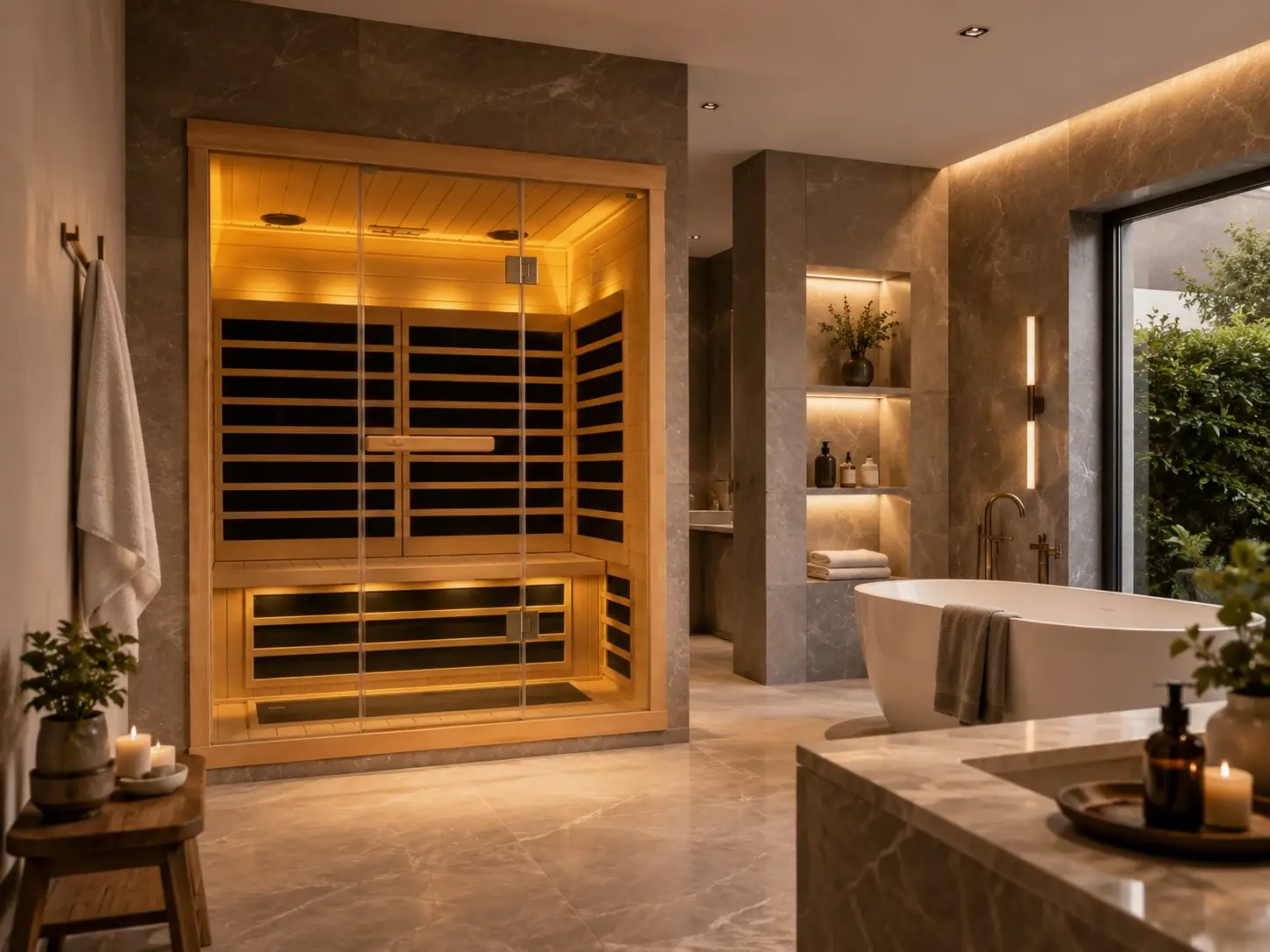
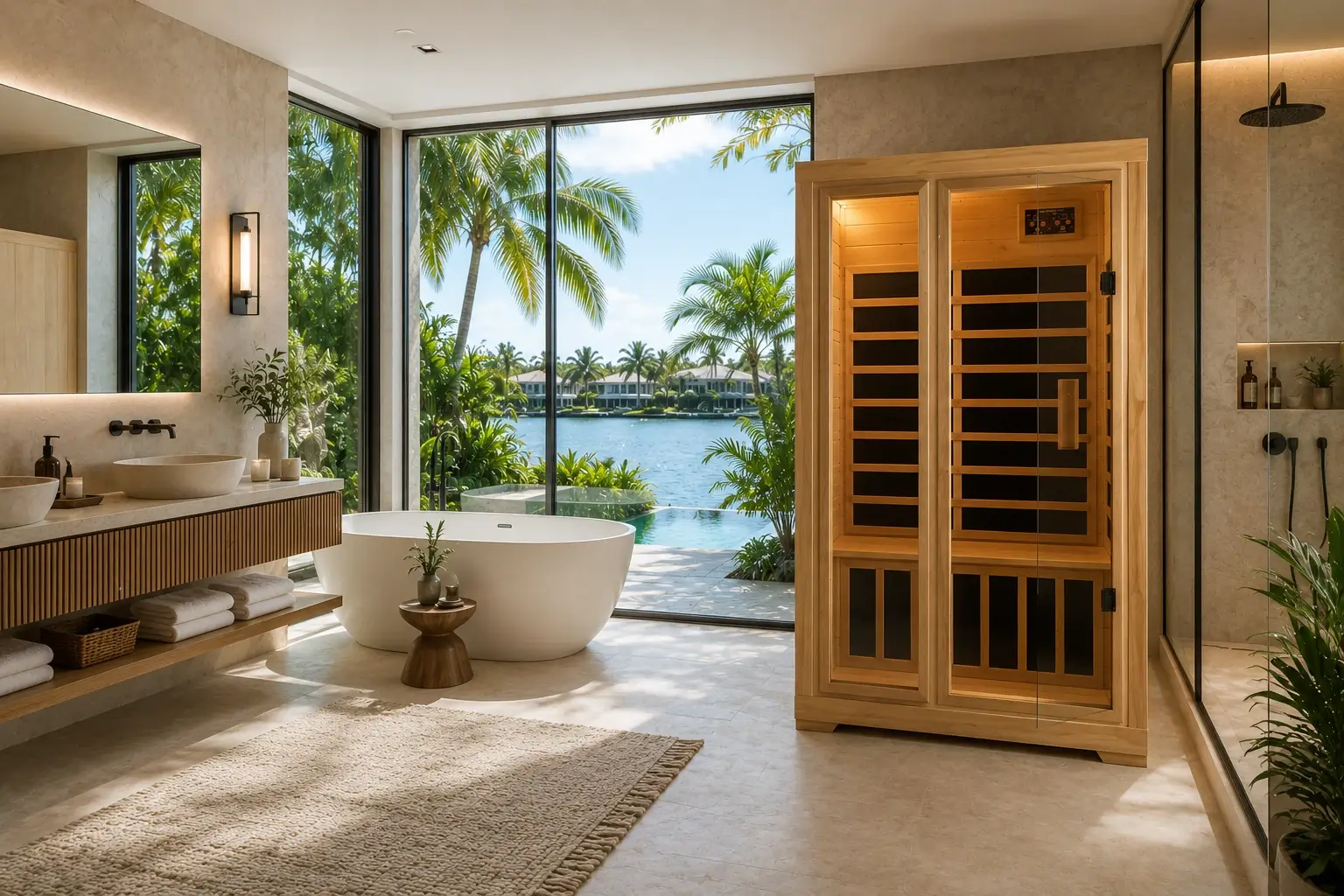
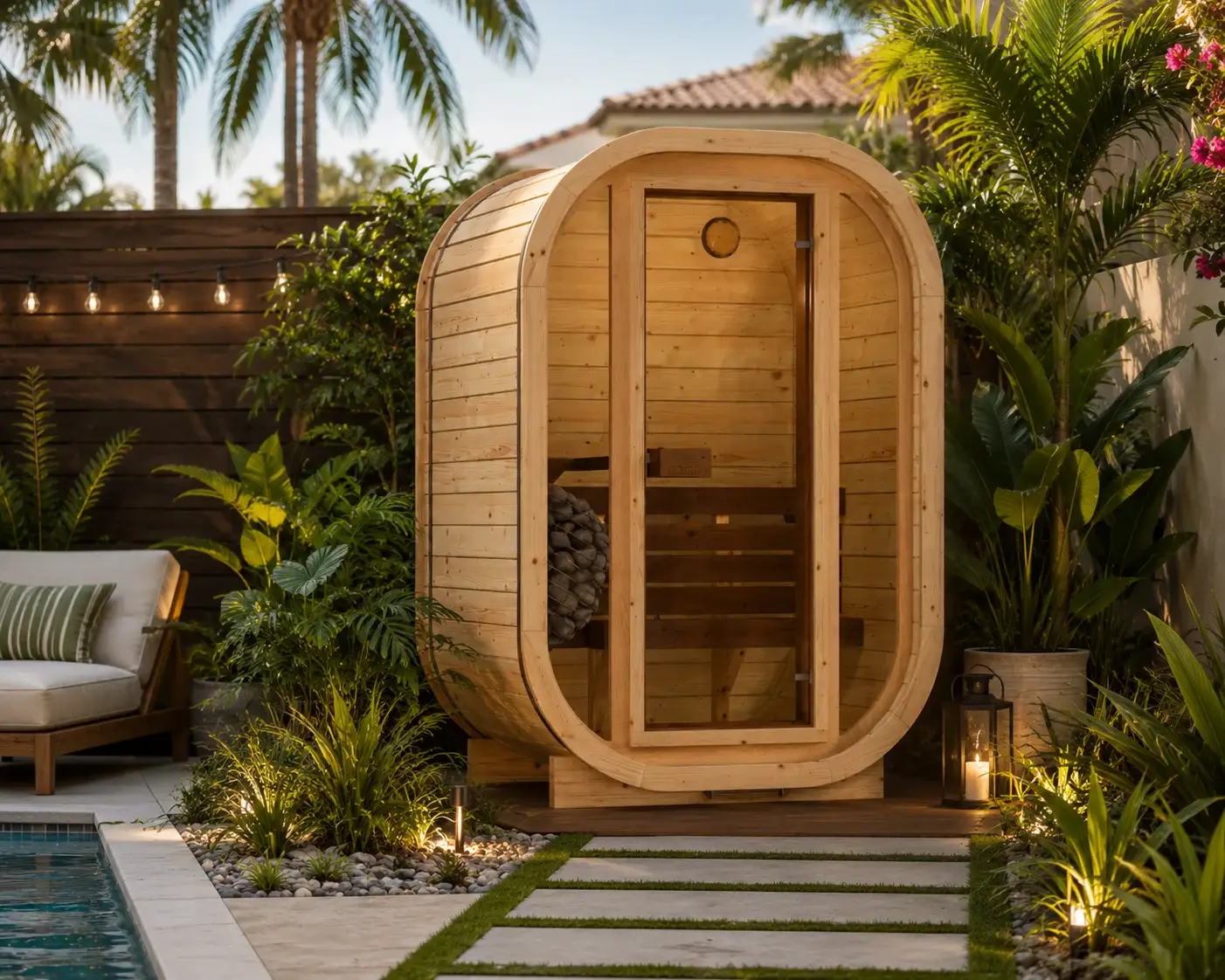
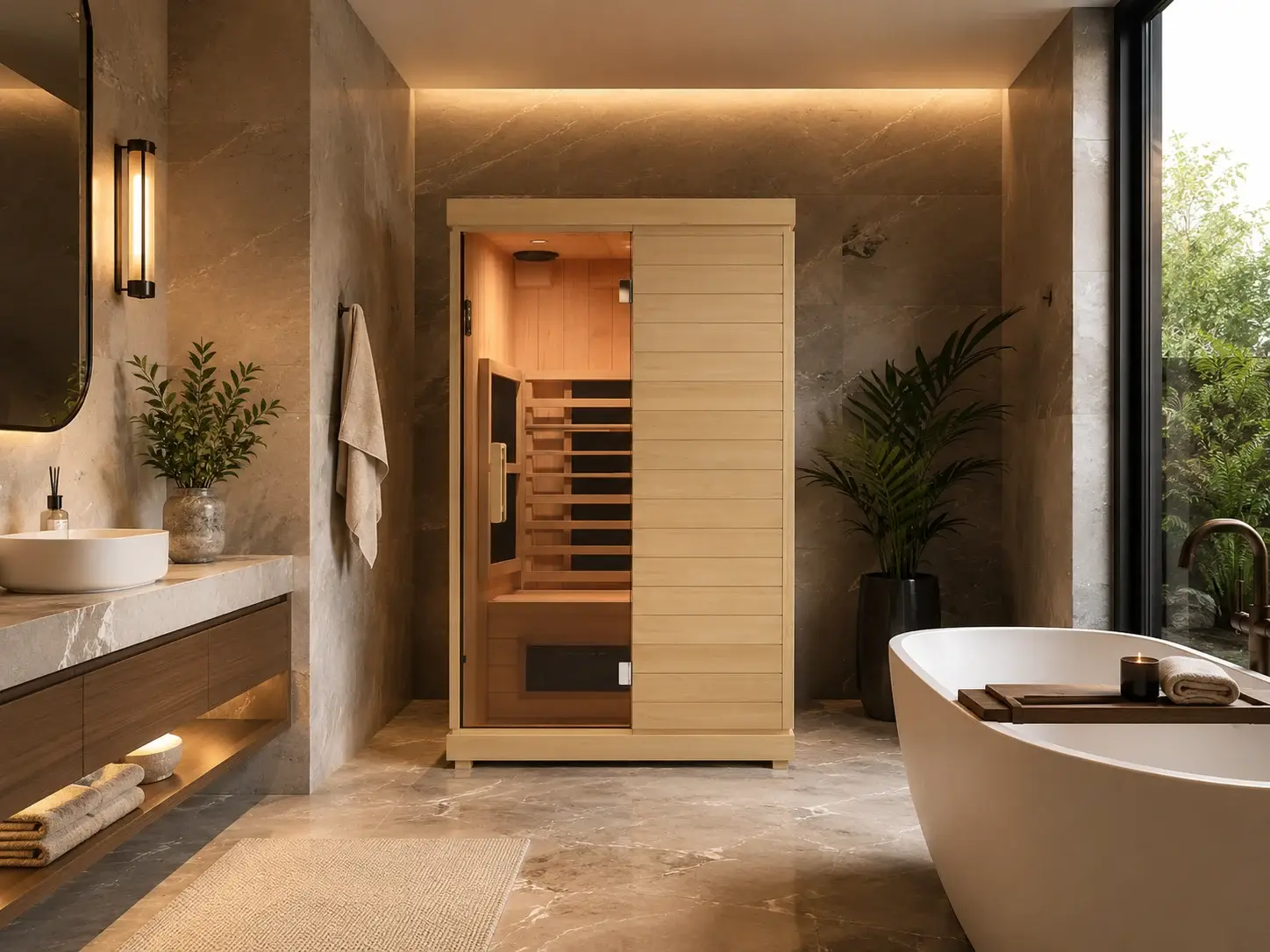
Photos make it easier to compare cabinet proportions, glass, bench layouts, indoor versus outdoor styling, and the overall look of different sauna categories. The models below include compact infrared cabins, traditional Hallmark rooms, a NorthStar room, a modern sauna kit, and a hybrid option. Click any image to open the related model page, then confirm the exact dimensions, electrical requirements, included equipment, warranty, delivery, installation scope, and current availability before ordering.





Five Detailed Home Sauna Options to Compare Before Buying
1. FINSAUNA Radia IR 100
Best for: one person who wants a compact indoor infrared cabin.
The current product information lists an exterior footprint of 38 inches by 38 inches and a height of 78 inches, with a standard home outlet setup, UL safety listing, Canadian hemlock construction, touchscreen controls, Bluetooth audio, and lighting.
- Small footprint for limited indoor space
- One-person privacy
- Standard-outlet convenience listed
- Clear dimensions for fit planning
2. FINSAUNA Radia IR 200
Best for: couples or solo users who want more bench space in an indoor infrared sauna.
The current product information lists exterior dimensions of 48 inches wide by 44 inches deep by 78 inches high, capacity for up to two bathers, a standard home outlet setup, UL safety listing, Canadian hemlock, touchscreen controls, Bluetooth audio, and lighting.
- More room than a one-person cabin
- Up to two bathers
- Standard-outlet convenience listed
- Works well as a home gym or wellness-room candidate
3. ELLA H2 2-Person Sauna Kit
Best for: buyers wanting a modern two-person traditional kit with flexible heater selection.
The current product page describes Nordic spruce construction, two-level thermowood benches, a full tinted glass front, airflow venting, drainage, and optional upgrades. The heater is not included, so the final electrical requirements depend on the selected heater.
- Modern glass-front appearance
- Two bench levels
- Built-in airflow and drainage features
- Heater can be matched to the project
4. Finnleo Hallmark HM66C
Best for: indoor homeowners wanting a traditional heater-and-stones experience with clear electrical specifications.
The current product page lists a Designer 6.0 kW heater, 240V service, 25 sauna amps, SaunaLogic2 controls, Bluetooth audio, multi-color lighting, and a three-bench configuration.
- Traditional sauna experience
- Roomier multi-bench layout
- Clear 240V planning specifications
- Modern controls and lighting
5. Finnleo Hallmark HM57
Best for: families and frequent shared use.
The current product page describes a 5-by-7-foot traditional indoor sauna seating four to five people, a 6.0 kW heater, 240V hardwired service, SaunaLogic2 Wi-Fi controls, Bluetooth audio, and Canadian hemlock construction.
- Family-size seating
- Traditional heat
- More space for stretching or lying down
- Clear installation dimensions and electrical planning
Common Mistakes When Buying a Sauna for Your Home
Buying the Smallest Sauna Just to Save Money
A cramped sauna may technically fit the room but become uncomfortable enough that you stop using it.Buying More Capacity Than You Need
Larger models require more space, more power, and more project budget. Buy for normal use.Ignoring the Electrical Requirements
Do not assume every sauna plugs into a normal outlet.Ignoring the Delivery Route
The sauna has to reach the final room before it can be installed.Focusing Only on Features
Bluetooth speakers and colored lights should not outweigh heater quality, bench comfort, ventilation, warranty, and service support.Buying Based on Health Claims
Choose a sauna because you enjoy heat, relaxation, routine, and the ownership experience rather than exaggerated claims involving detoxification, rapid weight loss, or disease treatment.Home Sauna Safety Considerations
Product safety matters as much as session safety. Before using a sauna, follow the exact manufacturer manual, electrical requirements, heater clearances, ventilation instructions, and installation requirements for the exact model.
- Start with shorter sessions.
- Hydrate appropriately.
- Avoid alcohol before and during sauna use.
- Follow heater and manufacturer instructions.
- Leave if you feel dizzy, nauseated, weak, confused, or unwell.
- Do not exceed safe heater clearances.
- Use qualified electrical installation where required.

Before You Buy a Home Sauna Checklist
- Choose traditional, infrared, hybrid, portable, prefab, or custom.
- Decide how many people will normally use it.
- Measure actual bench requirements.
- Measure the available room.
- Measure the complete delivery path.
- Confirm electrical voltage and amperage.
- Check electrical panel capacity.
- Review ventilation requirements.
- Confirm flooring or outdoor foundation requirements.
- Check heater and combustible clearances.
- Confirm what equipment is included.
- Compare total installed cost.
- Review warranty coverage.
- Ask about replacement parts.
- Ask who handles service after the sale.
- Compare realistic warm-up and operating requirements.
- Decide whether the sauna will remain convenient to use regularly.
- Confirm whether the exact model is approved for the intended indoor, covered, or outdoor location.
- For Florida outdoor projects, review roof, drainage, UV, humidity, salt exposure, wind, anchoring, and maintenance.
- Identify who will provide local diagnosis, repair, warranty support, and replacement parts after installation.
Buying a Sauna for Your Home?
Choose the Sauna and Installation Plan Together
Sauna & Steam Center can help homeowners compare traditional, infrared, hybrid, prefabricated, and custom saunas while reviewing room dimensions, outdoor locations, heater requirements, electrical needs, delivery, installation, and long-term service before the purchase is finalized.Frequently Asked Questions About Buying a Home Sauna
What is the best sauna for homeowners?
There is no single best sauna for every homeowner. Choose based on heat preference, actual household capacity, available space, electrical requirements, installation needs, total budget, warranty, and how often the sauna will realistically be used.What should I know before buying a sauna?
Know the available dimensions, number of regular users, preferred heat type, voltage and amperage requirements, ventilation needs, delivery path, total installed budget, warranty coverage, and availability of replacement parts before ordering.What size sauna should I buy for my home?
Choose for normal weekly use. A one-person sauna can work when space is extremely limited, but a two-person model can give a solo user more comfort and future flexibility. Families should prioritize real bench space rather than maximum advertised capacity.I want an infrared sauna for my home. How do I know what size I need?
Start with how many people will normally use it and how much sitting room you want. Then measure the room, door swing, ceiling, service clearance, electrical location, and delivery route. Compare actual interior and bench dimensions rather than capacity labels alone.Is a portable infrared sauna worth it compared with a full-size unit?
A portable sauna is often worth considering when budget, storage, renting, or limited space matters most. A full-size permanent sauna usually provides better seating comfort, durability, heat consistency, appearance, and shared use for homeowners planning frequent long-term sessions.Should I buy a one-person or two-person infrared sauna?
A one-person sauna is useful when floor space is the main limitation. If space and budget allow, a two-person sauna can provide more comfortable solo use and gives you the option of sharing the sauna later.What sauna should I buy if I want something I will not regret later?
Prioritize heat preference, comfortable bench space, convenient location, electrical compatibility, build quality, warranty, replacement parts, and service support. Avoid buying solely because a sauna is the cheapest, smallest, or has the longest feature list.What should I look for when someone says they would buy their sauna again?
Look for long-term comments about how frequently they still use it, whether the capacity feels accurate, bench comfort, warm-up experience, electrical or installation surprises, maintenance, failures, replacement parts, warranty handling, and dealer support.Are home saunas worth it?
A home sauna can be worth the investment when it fits your property and becomes part of your regular routine. Long-term value depends more on use frequency, comfort, correct installation, durability, and support than the purchase price alone.What makes a sauna a good-value purchase?
Good value comes from matching price with useful capacity, comfort, construction quality, heat performance, electrical requirements, installation cost, warranty, replacement parts, service support, and expected frequency of use.Is infrared or traditional sauna better for a homeowner?
Infrared often suits homeowners wanting lower-temperature radiant heat, compact sizes, and relatively simple indoor installation. Traditional sauna is better for people who specifically want the hotter classic heater-and-stones experience.Is a prebuilt sauna a good choice for homeowners?
Often, yes. Prefabricated saunas can make dimensions, pricing, delivery, installation, warranty, and equipment specifications more predictable when a standard model fits the available space.What is a bespoke sauna?
A bespoke sauna is a custom sauna designed around a specific property rather than fixed factory dimensions. The homeowner can typically customize room dimensions, bench layout, wood, glass, heater, lighting, controls, ventilation, and architectural integration.Is a bespoke or custom sauna worth it?
It can be when a standard sauna cannot provide the dimensions, appearance, materials, bench configuration, heater setup, or integration you want. A custom sauna is not automatically better if an existing prefabricated model already fits your needs.How much does a home sauna cost?
Prices range from low-cost portable products to premium prefabricated and custom installations. Calculate the sauna, heater, delivery, electrical work, room or site preparation, permits, installation, accessories, and maintenance when comparing total cost.Does a home sauna need special electrical work?
It depends on the sauna. Many smaller infrared models use 120V power, while larger traditional and hybrid systems frequently require dedicated 240V service. Always verify the exact model requirements before purchase.Can I put a home sauna in a bathroom, garage, or home gym?
Often, yes, when the space provides adequate dimensions, safe electrical service, ventilation, suitable flooring, required clearances, and delivery access. Site conditions should be evaluated before ordering.Do I need professional sauna installation?
Some prefabricated units are designed for relatively straightforward assembly, but larger traditional, hybrid, outdoor, and custom projects frequently require professional electrical, installation, or construction support.What is the best home sauna for Florida?
The best starting choice is usually the sauna that matches the installation environment. Indoor saunas are easier to protect from Florida rain, UV, salt air, and storms. Outdoor saunas can work well when the model is intended for exterior use and the project includes appropriate roofing, drainage, base, hardware, electrical protection, ventilation, and maintenance.Which sauna is best for a humid Florida climate?
For indoor placement, prioritize a conditioned location, correct ventilation, drying, electrical safety, and service access. For outdoor placement, prioritize purpose-built exterior construction, weather protection, drainage, corrosion-resistant hardware, and a maintenance plan. Do not choose by wood species alone.Can a sauna be installed outdoors in Florida?
Yes, when the exact sauna is suitable for exterior placement and the site is planned for foundation or base requirements, drainage, rain, UV, humidity, salt exposure where applicable, electrical work, service access, and local permitting or HOA requirements.How much electricity does a home sauna use?
Electricity use depends on the equipment power rating and run time. A simple planning calculation is kW multiplied by hours. A 6 kW heater operating at full output for one hour would use about 6 kWh before thermostat cycling is considered. Actual use varies with warm-up, insulation, temperature settings, door opening, and cycling.Does a traditional sauna need ventilation?
Yes. Ventilation is part of the room and heater design. Follow the manufacturer instructions for intake and exhaust locations rather than guessing, because airflow can affect comfort, heat distribution, drying, and equipment performance.What sauna is best for a small Florida home or condo?
A compact one-person infrared sauna is a practical starting point when floor space and delivery access are limited. A roomy two-person infrared cabin can be more comfortable for a solo user if the space allows. In condos, also check elevator dimensions, association rules, electrical capacity, delivery restrictions, and insurance requirements.Can I put a sauna next to a cold plunge?
Yes, but plan the sauna and plunge as one installation zone. Review drainage, slip-resistant walking surfaces, electrical service, equipment clearances, outdoor exposure, privacy, lighting, and service access for both systems.Is a sauna or hot tub better for relaxation?
They create different experiences. A sauna provides dry or radiant heat without maintaining a body of water. A hot tub provides warm-water immersion, buoyancy, and massage jets but requires ongoing water chemistry and filtration. Choose the format your household is more likely to use consistently.What should I ask a sauna installer before I buy?
Ask for the exact electrical requirements, ventilation plan, clearances, delivery path, included equipment, warranty, service responsibility, replacement-part availability, site preparation, outdoor approval if applicable.References
-
Sauna & Steam Center 2026 product catalog and specifications used for the featured sauna examples in this comparison.
-
Harvard Health Publishing Saunas and Your Health.
-
Cleveland Clinic Get Your Sweat On: The Benefits of a Sauna.
-
Laukkanen JA, et al. The Multifaceted Benefits of Passive Heat Therapies.
- Sauna & Steam Center FINSAUNA Radia IR 100 product specifications
- Sauna & Steam Center FINSAUNA Radia IR 200 product specifications
- Sauna & Steam Center ELLA H2 2-Person Indoor Sauna Kit product specifications
- Sauna & Steam Center Finnleo Hallmark HM66C product specifications
- Sauna & Steam Center Finnleo Hallmark HM57 product specifications
- Sauna & Steam Center Finnleo Hallmark HM44 product specifications
- Sauna & Steam Center Finnleo NorthStar indoor sauna series
- Sauna & Steam Center Finnleo S-Series S-825 product specifications
- Sauna & Steam Center Enhanced G920 product specifications
Conclusion: How to Choose the Best Home Sauna for Your Florida Property
Buying a sauna for your home should begin with your property and routine rather than a brand name. Decide whether you want traditional, infrared, or hybrid heat. Then determine how many people will normally use the sauna, how much space is available, what electrical service the property can support, and how much you are comfortable spending on the complete installed project. If you are unsure about commitment or have very little room, a portable sauna can be a reasonable starting point. If you already know sauna will become part of your long-term routine, a permanent infrared, traditional, hybrid, prefabricated, or custom sauna generally provides a more complete ownership experience. For infrared buyers, do not automatically choose the smallest model. A slightly larger sauna can provide better comfort and greater flexibility if the space and budget allow it. For homeowners evaluating value, consider the complete picture: purchase price, installation, electrical requirements, size, comfort, build quality, warranty, serviceability, replacement parts, and how frequently you expect to use the sauna. The best home sauna is ultimately the sauna that fits correctly, feels comfortable, operates safely, and remains convenient enough that you continue using it for years.