
Portable Home Sauna Guide: Types, Costs, Setup and How to Choose
Quick Answer: What Is a Portable Home Sauna?
Portable home sauna buyers are usually comparing self-contained or modular sauna cabins that are easier to place and install than a permanent custom sauna room. Compact infrared models commonly offer the simplest setup, while selected 120V traditional models provide a classic hot-room experience and can simplify electrical planning compared with larger 240V systems, although a dedicated circuit or specific receptacle may still be required. Larger traditional, hybrid, and outdoor units require more space, electrical planning, and delivery preparation.
Bottom line: The best option is the sauna that matches your available space, electrical service, preferred heat style, seating needs, budget, and realistic weekly routine.
What This Guide Helps You Decide
A portable home sauna can be a compact infrared cabin, a two-person indoor infrared sauna, a modular plug-in traditional sauna, or a larger prebuilt unit. These products can provide a serious home heat routine without requiring the framing, insulation, vapor barriers, and contractor coordination of a fully custom room.
At Sauna & Steam Center, we help South Florida buyers compare space, power, heat style, comfort, delivery access, and long-term service before choosing a model. This guide explains what portable really means, how the main types differ, what the realistic benefits and limitations are, and what to confirm before purchasing.
Key Takeaways
- Portable usually means modular or self-contained, not lightweight enough to carry casually.
- Compact infrared saunas are commonly the simplest option for indoor placement and routine use.
- Selected 120V traditional saunas can simplify electrical planning compared with larger systems, but the exact circuit and receptacle requirements still need to be verified.
- Space, delivery path, outlet type, seating comfort, safety listing, ventilation, warranty, and service support matter as much as price.
- Sauna use can support relaxation and a repeatable wellness routine, but it is not medical treatment, a detox method, or a shortcut to fat loss.
- The best purchase fits the home and the routine you actually have, not the largest feature list.
What Is a Portable Home Sauna?
A portable home sauna is an easier path to home sauna ownership. It is not necessarily something you fold up and carry. In this category, portable usually means modular, self-contained, easier to assemble, easier to place, and less construction-heavy than a permanent custom sauna room.
That distinction matters because many buyers compare a portable sauna with two very different alternatives: low-cost tent saunas and fully custom sauna rooms. A tent-style unit may be physically portable but often provides a different level of comfort, durability, heat consistency, and long-term ownership than a solid wood cabin. A custom sauna can be outstanding but typically involves framing, insulation, vapor barriers, heater sizing, ventilation, flooring, drainage, and contractor coordination.
A well-built portable home sauna sits between those extremes: a real home wellness upgrade without the complexity of a full build. For a broader comparison of portable, prebuilt, and custom paths, see our portable sauna buying guide.
What “portable” actually means in practice
- Built as a self-contained sauna cabinet or modular panel system
- Often assembled faster than a custom sauna room, with timing that varies by model, access, and installer experience
- May use 120V power, with circuit and receptacle requirements that vary by model
- Can be placed in a spare room, home gym, garage, or dedicated wellness space
- Easier to relocate than a built-in sauna, though still requires care and planning
Judge portability not by the label but by power requirements, dimensions, weight, delivery path, assembly steps, and whether the unit realistically fits your lifestyle.
How Does a Portable Home Sauna Work?
A portable sauna uses a manufactured cabin or modular panel system to create a controlled heated space. Infrared models use emitters that deliver radiant heat toward the user while keeping the room temperature lower. Traditional models use a heater and stones to warm the air, and approved models may allow small amounts of water on the stones for humidity.
The word portable describes the installation format more than the weight. Most wood cabin units still require careful delivery, assembly, level flooring, correct clearances, and a verified electrical connection. The practical advantage is that the product arrives with known dimensions, seating capacity, heater configuration, and manufacturer requirements.
Why Portable Home Saunas Are Popular
Portable home saunas remove many of the unknowns that cause people to hesitate. Most buyers are not just asking, “Do I want a sauna?” They are asking, “Can this actually work in my house without turning into a stressful project?”
They make home sauna ownership easier to picture
A custom sauna room can involve framing, insulation, vapor barriers, heater sizing, ventilation, flooring, drainage, finish materials, lighting, controls, and contractor scheduling. A portable home sauna replaces that list with a defined product: known dimensions, confirmed electrical requirements, seating capacity, and predictable warm-up time.
They fit more real homes
Portable saunas can work in spaces where a permanent sauna room would not be feasible, including a spare bedroom, home gym corner, garage, or finished basement. That flexibility is especially valuable in South Florida homes where space, climate, and power access vary widely.
They support consistent use
The best sauna is the one you actually use. Driving to a spa or gym sounds reasonable until life gets busy. A home sauna eliminates scheduling, travel, and shared spaces. You choose the time, temperature, session length, lighting, and cooldown. This guide focuses on residential ownership, while facility managers planning shared amenities can review our commercial sauna installation guidance for hotels, gyms, and wellness properties.
They lower the first-step commitment
For first-time sauna buyers, a portable sauna is a way to learn whether you prefer infrared or traditional heat, solo or shared sessions, and shorter or longer routines before committing to a larger custom project.
Types of Portable Home Saunas
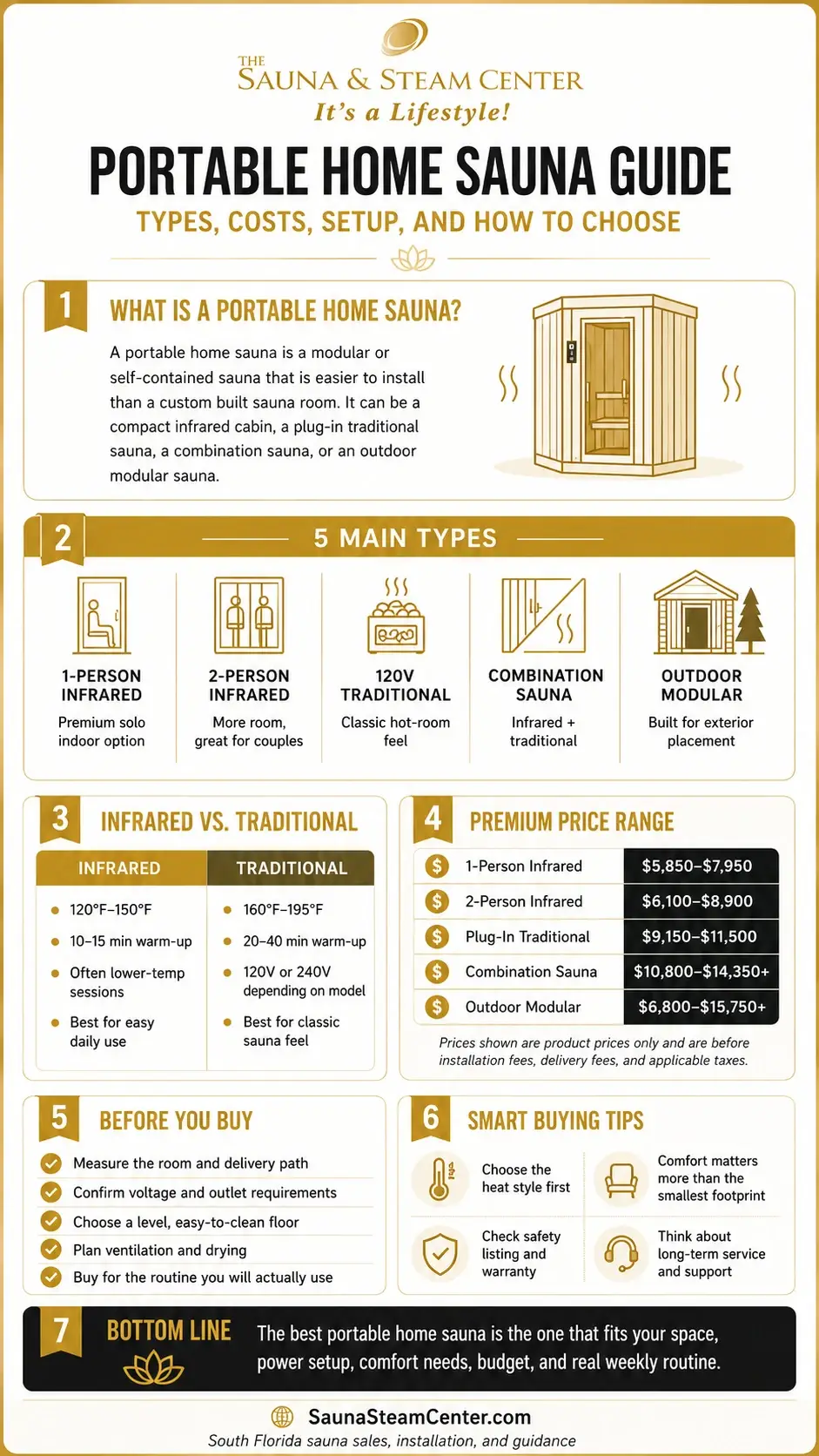
The five main types differ in heat delivery, size, power requirements, and best-fit buyers.
1. Compact infrared cabin saunas (1 person)
Compact infrared cabins are often the easiest entry point for first-time buyers. Infrared emitters warm the body more directly while the air temperature commonly remains lower than in a traditional sauna, often around 120°F to 150°F compared with 160°F to 195°F. Many compact models use 120V power, but the required amperage, receptacle, and dedicated-circuit requirements vary by model. They are well suited to solo users, condos, home gyms, and buyers who want a simple daily routine. A strong example is the Radia IR 100 one-person infrared sauna, which features Canadian Hemlock construction, 120V plug-in convenience, and a compact footprint designed for realistic home use. Confirm the required circuit and receptacle before installation.
2. Two-person infrared saunas
Two-person infrared saunas are a better fit for couples and for buyers who want a roomier solo session. Even if you typically sauna alone, the extra space noticeably improves comfort. One of the most common portable sauna regrets is choosing the smallest model and then wishing for more room within a few months. The Radia IR 200 two-person indoor infrared sauna is a useful model to compare. It accommodates up to two bathers and includes 120V plug-in convenience, Bluetooth audio, LED lighting, and a compact home footprint. Buyers comparing mood-lighting features can review our chromotherapy color chart. Confirm the required amperage, circuit, and receptacle for the exact model before purchase.
3. Plug-in traditional saunas (120V)
Plug-in traditional saunas can suit buyers who want the classic hot-room experience without a full custom-room renovation. A plug-in traditional sauna uses a traditional heater and stones to create hotter, more immersive air heat while retaining a 120V power configuration that makes installation practical for more homes. The Finnleo Hallmark HM44 120V plug-in traditional sauna is a useful example: a 4×4-foot indoor sauna for two bathers with 120V plug-in operation, Canadian Hemlock, SaunaLogic2 WiFi controls, Bluetooth audio, and LED lighting. A 120V model can still require a manufacturer-specified dedicated circuit or receptacle, so verify the installation manual before purchase.
4. Hybrid infrared and traditional saunas
A hybrid sauna combines infrared and traditional heat in one unit. It can suit households whose members prefer different session styles. Hybrid systems typically cost more than single-heat-type models and may require additional circuit planning, so the added flexibility should justify the higher cost and installation requirements.
5. Outdoor modular saunas
Outdoor modular saunas are assembled from prebuilt components rather than built into the home’s structure. They are not always easy to relocate, but they can be more flexible than a permanent indoor build. They require a suitable base, safe electrical access, and careful planning for weather, moisture, sun, pests, drainage, and the manufacturer’s placement restrictions, especially in Florida’s climate.
Benefits of a Portable Home Sauna
The most meaningful benefits are practical. They are about making sauna ownership easier to start, easier to maintain, and more likely to become a real habit.
1. Easier installation than a custom sauna room
A portable sauna arrives with known dimensions and defined setup requirements. That reduces uncertainty around design, materials, labor, and build time. You still need to confirm space, outlet type, clearances, and delivery access, but the process is far more predictable than a custom build.
2. More predictable planning
A defined model lets you compare size, seating, heat style, electrical needs, and features before committing. You can ask precise questions: Will this fit through the doorway? Does it need a dedicated circuit? How long does warm-up take?
3. Higher chance of consistent routine use
A home sauna removes friction from the habit. A 15 to 25 minute evening session is far easier when the sauna is already in your home than when it requires a gym trip.
4. Flexible placement options
Depending on the model, placement options include spare bedrooms, home gyms, garages, wellness rooms, finished basements, large walk-in closets, and protected outdoor areas.
5. A private wellness experience
A home sauna removes scheduling conflicts, shared spaces, and travel. You control the time, temperature, lighting, audio, and cooldown pace. For many buyers, this converts sauna from an occasional luxury into a practical weekly routine.
6. A smarter first step toward custom later
A high-quality portable sauna can help you learn your preferences, including infrared or traditional heat, solo or shared use, and short sessions or longer rituals, before investing in a permanent custom sauna room.
Related routines and home wellness options
Readers comparing dry heat with humid heat can review our guide on how to use a steam room. For exercise-focused routines, our sauna after the gym guide explains timing, hydration, and common post-workout considerations.
If your routine includes contrast therapy, review our sauna and cold plunge protocol. Buyers comparing heat-based relaxation with water-based recovery can also explore hot tub therapy benefits.
Infrared vs. Traditional Portable Sauna: Side-by-Side Comparison
This is the most important comparison for most buyers. For a deeper look, see our full infrared vs. traditional sauna guide.
| Factor | Infrared Portable Sauna | Traditional Portable Sauna |
|---|---|---|
| Heat source | Infrared emitters that provide radiant heat | Heater and stones that warm the air |
| Typical air temperature | 120°F to 150°F (49°C to 66°C) | 160°F to 195°F (71°C to 91°C) |
| Warm-up time | 10 to 15 minutes | 20 to 40 minutes |
| Power (common) | Often 120V; circuit and receptacle requirements vary | Selected 120V plug-in models or a 240V dedicated circuit |
| Humidity option | Generally no steam or water-on-stone option | Only when the manufacturer permits water on the stones |
| Session feel | Gentler, more approachable | Immersive, classic Finnish-style heat |
| Best for | Daily casual use, beginners, smaller spaces | Authentic sauna ritual, higher heat preference |
| Typical price range | $5,850 to $10,900+ | $6,800 to $15,750+ |
Simple rule: Choose infrared for easier everyday use. Choose traditional for the classic sauna feel. Choose hybrid if your household wants both and your space and electrical setup can support it.
Bottom line: Choose infrared when easy daily use, lower room temperature, and simpler placement matter most. Choose traditional when the classic hot-room experience is the priority. Choose hybrid only when the added cost and electrical planning are justified by genuine household demand for both heat styles.
Setup Requirements Before You Buy
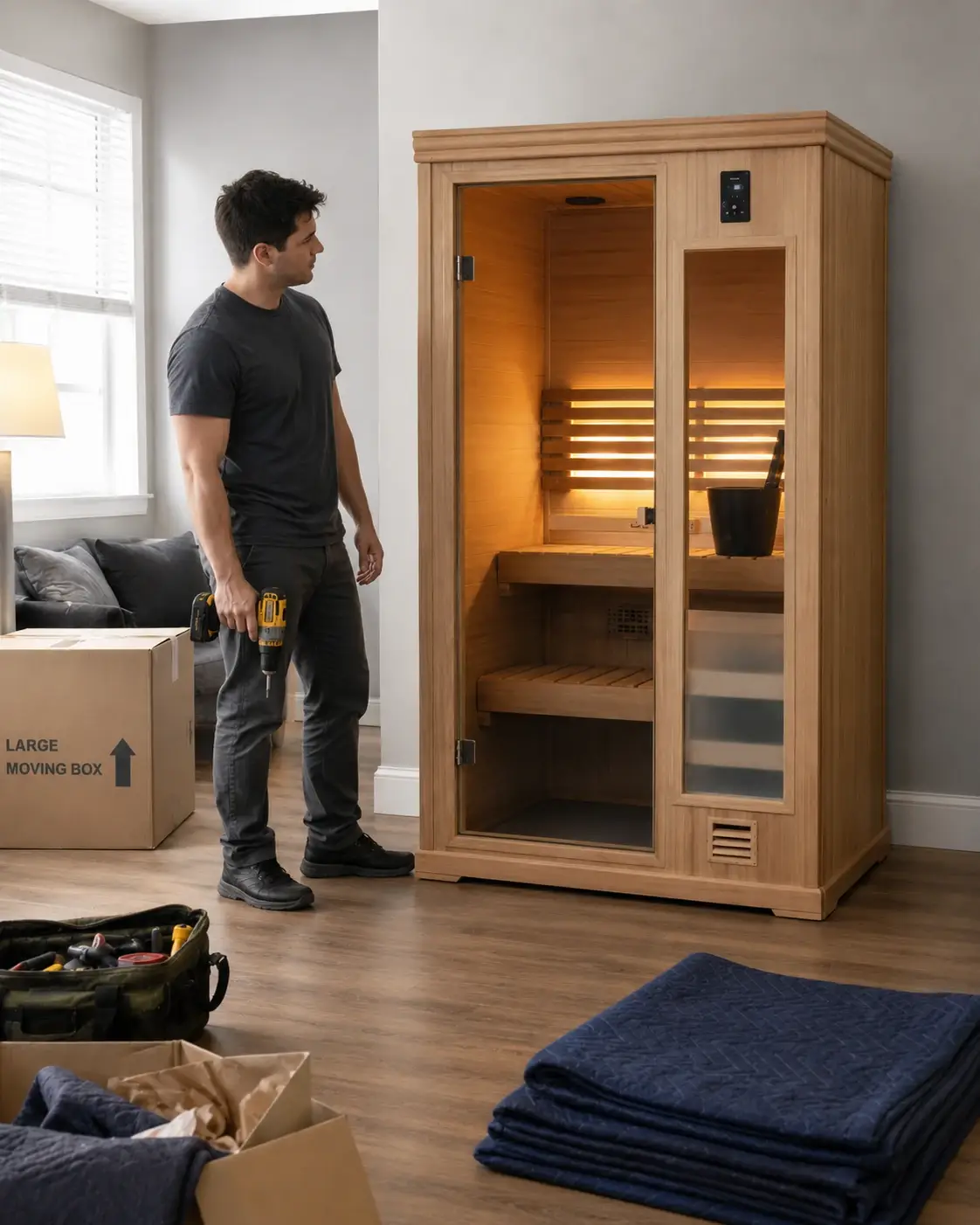
A portable home sauna is simpler than a custom build, but it is still a real home installation decision. Confirming the basics before choosing a model prevents delays and unexpected costs. Buyers planning a larger or more complex project can also review our guide to sauna installation in South Florida.
Measure the sauna space
Measure available width, depth, and ceiling height. Then measure the delivery path, including doorways, hallways, turns, stairs, and elevators when applicable. A sauna can fit in the room but be impossible to deliver if the approach is too tight. Confirm the packaged panel dimensions and compare them with the narrowest doorway, hallway turn, staircase, or elevator on the delivery route.
Confirm electrical requirements early
Do not assume that 120V means any standard household outlet will work. Many compact infrared models use 120V power, but some still require a dedicated circuit, a 20-amp receptacle, or another manufacturer-specified connection. Larger infrared, traditional, and hybrid models may require 240V service. Confirm voltage, amperage, plug or hardwire requirements, receptacle type, and circuit requirements before purchasing. When the requirements are unclear, have a licensed electrician review the installation manual and proposed location.
Choose the right floor surface
The sauna should sit on a stable, level floor appropriate for heat exposure and routine cleaning. Tile and sealed concrete are common choices, while some manufacturers also permit other finished hard surfaces. Follow the flooring and clearance requirements in the model manual. Carpet is generally not recommended unless the manufacturer explicitly allows it. Garage and outdoor placements need extra planning for moisture, drainage, and pests.
Plan ventilation and drying
Saunas last longer and perform better when the space can dry after each session. Traditional saunas need more airflow and heater clearance than infrared models. Even infrared saunas benefit from sensible room ventilation and the habit of leaving the sauna door open to dry after use.
South Florida placement and local project planning
Outdoor placement in this climate requires realistic planning for rain, humidity, summer heat, pests, wind, and salt air. Review our guide to an outdoor sauna in Florida before choosing an exterior model or location.
For area-specific project guidance, see our resources for sauna installation in Miami, an infrared sauna in Fort Lauderdale, and sauna installation in Boca Raton. Homeowners still comparing sauna and steam can also review steam room installation Fort Lauderdale before deciding which experience better fits the space.
Plan the full routine
Where will towels go? Is there a shower nearby for after the session? Where will you cool down? What time of day will you use it? These details influence consistency, and convenience makes a routine easier to maintain.
Portable Home Sauna Cost Breakdown
The total cost of a portable home sauna depends on size, materials, heat type, electrical requirements, delivery, and installation. A one-person infrared sauna and a family combination sauna are completely different budget decisions. For a broader explanation of project costs, see our home sauna cost breakdown. To compare the premium models behind the ranges below, browse our 2026 sauna and wellness catalog.
| Sauna Type | Capacity | Published Product Price Range | Planning Notes |
|---|---|---|---|
| Premium infrared (1 person) | 1 person | $5,850 to $7,950 | Models in this range include the Radia IR100 and S-810. Verify the required amperage, receptacle, and circuit for the selected model. |
| Premium infrared (2 persons) | 2 persons | $6,100 to $8,900 | Models in this range include the G920, Radia IR200, S-820, and Radia TIR200. Specifications and included features vary by model. |
| Plug-in traditional (120V) | 2 persons | $9,150 to $11,500 | Models in this range include HM44 configurations and the ELLA H2 indoor sauna. A 120V sauna may still require a dedicated circuit or specific receptacle. |
| Combination or hybrid sauna | 2 to 5 persons | $10,800 to $14,350+ | Combination systems generally require more electrical planning. The IS565 is one premium example at the upper end of this range. |
| Outdoor modular sauna | 2 to 5 persons | $6,800 to $15,750+ | The range includes compact outdoor models and larger premium Nordic White Spruce plug-and-play saunas such as the NSO46, NSO56, and NSO57. |
Important pricing note: These are product prices shown in our 2026 catalog. Every amount is before installation fees, delivery fees, and applicable taxes. Electrical work, permits, site preparation, accessories, and other project costs are also separate unless they are specifically included in a written quote. Pricing and availability may change.
What buyers often forget to budget
- Delivery and white-glove handling, quoted according to distance, access, stairs, and product size
- Professional assembly or installation, quoted according to the model and site conditions
- Electrical work, outlet changes, panel capacity, permits, and circuit installation
- Floor preparation, leveling, exterior foundations, drainage, or weather protection
- Accessories, backrests, lighting upgrades, cleaning supplies, and control options
- Future service, replacement heaters, controls, and other long-term parts support
Best Portable Home Sauna Options by Buyer Type
There is no single best portable home sauna for every buyer. The right model depends on who will use it, where it will go, and what kind of heat experience you want.
Best for one person and small spaces
A one-person infrared sauna is the clearest fit for solo buyers, condo owners, and anyone with a compact wellness corner. Prioritize electrical requirements that match the available circuit, confirmed dimensions, safety listing, durable wood construction, and a comfortable bench. This buyer values easy routine use over maximum capacity.
Best for couples or roomier solo use
A two-person infrared sauna is the better long-term choice when one person wants more room or two people plan regular sessions together. Starting with a one-person model is one of the most common portable sauna regrets among couples.
Best for traditional sauna enthusiasts
A selected 120V plug-in traditional sauna can be a practical middle ground for classic hot-room atmosphere and stone heat. It may simplify the project compared with a larger 240V system, but the model can still require a dedicated circuit or specific receptacle.
Best for households with mixed preferences
A hybrid infrared and traditional sauna lets different users choose their preferred heat style. It can also future-proof the purchase as preferences sometimes evolve after regular use begins.
Best for larger families
Larger portable infrared or hybrid models serve families and shared wellness spaces better than compact units. The tradeoffs are higher cost, more floor space required, and more installation planning. If three or more people will use the sauna regularly, do not start with the smallest model to save money because you may outgrow it quickly.
Portable Sauna Evidence and Claims at a Glance
Health and performance claims should be separated by evidence strength. The table below distinguishes basic heat responses from findings that remain limited, observational, or overstated.
| Claim or question | What can reasonably be said | Important limitation |
|---|---|---|
| Does sauna cause sweating and temporary cardiovascular responses? | Heat exposure causes sweating and can temporarily increase heart rate and change circulation. See the Cleveland Clinic overview. | The response varies by temperature, session length, hydration, health status, and medication use. |
| Does regular sauna use support long-term heart health? | Some population research has found associations between frequent sauna bathing and cardiovascular outcomes. A systematic review of dry sauna bathing summarizes potential effects. | Much of the long-term evidence is observational and does not prove that sauna use caused the outcome. |
| Are infrared-specific benefits proven? | Infrared sauna research is promising in selected areas, but the evidence base is smaller than many advertisements imply. See the Mayo Clinic infrared sauna review. | Small studies, narrow populations, and different protocols limit broad conclusions. |
| Does sauna produce lasting fat loss or replace detoxification? | Sweating can reduce body weight temporarily through fluid loss. Our guide to sauna and weight loss research explains the difference between temporary water loss and fat loss. | Water-weight change is not fat loss, and sweating does not replace the liver and kidneys. |
Bottom line: Treat relaxation, heat exposure, sweating, and routine convenience as the most defensible benefits. Treat disease prevention, detox, hormone, immune, and weight-loss promises with caution.
Safety, Benefits, and Realistic Expectations
Sauna use can feel deeply relaxing and restorative, but heat exposure should be treated with care. The most honest way to think about sauna benefits is to separate what is well-supported from what is exaggerated.
What is reasonably supported by research
- Relaxation and stress reduction for most users
- Sweating and heat exposure
- Temporary increases in heart rate
- Temporary circulation changes
- Post-session comfort and warmth
- A repeatable wind-down routine that many people maintain long term
What the evidence shows as mixed or conditional
- Sleep improvement, may depend on timing, temperature, and individual response
- Exercise recovery support, may help some routines but is not automatic
- Long-term cardiovascular findings, promising in some population studies (notably Finnish cohort research) but should not be treated as a personal medical guarantee
- Infrared-specific health claims, evidence remains more limited than many advertisements suggest
What is commonly overstated
- Detox claims (the liver and kidneys handle detoxification, not sweat)
- Fat-loss claims (temporary water weight from sweating is not fat loss)
- Guaranteed immune benefits
- Hormone optimization claims
- Any claim that sauna replaces exercise, medical treatment, or medication
Who should speak with a doctor before using a sauna
Consult a healthcare professional before sauna use if you are pregnant, have heart disease, have uncontrolled high blood pressure, faint easily, are heat-sensitive, have respiratory conditions, take medication that affects hydration or blood pressure, or have any condition where heat exposure may carry risk.
Practical safety habits
- Start with 10 to 15 minute sessions if you are new to sauna use
- Hydrate before and after every session
- Avoid alcohol before sauna sessions
- Leave immediately if you feel dizzy, weak, nauseated, short of breath, or uncomfortable
- Cool down gradually, avoid plunging into cold water immediately after very long sessions without experience
- Do not chase extreme temperatures or long sessions just because the heater can reach them

Common Objections and Honest Answers
“Is a portable sauna powerful enough?”
Yes, if you choose the right type for your expectations. A quality infrared sauna produces real sweating and body heat exposure. A compact traditional sauna creates a genuine hot-room feel. The issue is not whether portable saunas work. It is whether the model matches your preferred experience.
“Will it feel cheap?”
Low-cost tent saunas and thin-panel models can feel temporary. Solid wood cabin models from reputable brands feel like a real home wellness upgrade. Materials, bench depth, glass quality, heater design, and warranty support all separate premium portable saunas from budget options.
“Can I use one in a condo?”
Often yes. Compact 120V infrared saunas are the most condo-friendly option because they need no electrical upgrade and fit smaller rooms. Still confirm your building’s association rules, power capacity, ventilation allowances, delivery access, and any lease restrictions before purchasing.
“Should I buy the cheapest option first to test it?”
Only if your goal is a short-term test with no expectation of durability or comfort. If you want something you will use for years, safety listing, construction quality, heater reliability, service access, and parts availability matter far more than saving a few hundred dollars upfront.
“What happens if I buy the wrong size?”
The sauna may still work, but cramped sessions can feel like a chore rather than a routine. If two people may use it, or if you want a more comfortable solo experience, do not underestimate the space you actually want to sit in for 20 minutes.
What Our Experience Since 2004 Has Taught Us
The following points are experience-based installation and ownership guidance, not medical claims.
- Confirm electrical requirements before selecting the model. Choosing first and checking power later is one of the easiest ways to create delays or added cost.
- Measure the full delivery route. A sauna can fit the final room while failing to clear a doorway, hallway turn, staircase, or elevator.
- Do not undersize seating. Buyers who expect shared use or want a roomier solo session are usually better served by planning for comfort instead of choosing the smallest footprint.
- Plan for drying and service access. Ventilation, cleanable flooring, heater clearances, and access to controls and components affect long-term ownership.
- Florida placement needs extra attention. Garages and protected outdoor spaces require realistic planning for humidity, heat, storms, pests, salt air, and manufacturer placement restrictions.
How to Choose the Right Portable Home Sauna: A Step-by-Step Process
Use this process before comparing specific models. It keeps focus on fit, comfort, and real ownership rather than feature lists.
Step 1: Choose the heat style first
Decide whether you want gentle direct infrared heat, classic high-temperature room heat, or both. This choice narrows the field faster than any other factor. Infrared and traditional saunas feel genuinely different, and that difference matters more than most spec comparisons.
Step 2: Match the sauna to your real routine
Will you use it after work? After workouts? Before bed? Alone or with a partner? For 15 minutes or longer? The right sauna fits how you actually live, not an idealized version of what you might do.
Step 3: Confirm power before choosing a model
If you want the simplest path, focus on models whose voltage, amperage, plug, receptacle, and circuit requirements match your existing electrical service. If you are open to electrical work, larger traditional and hybrid options become available. Never choose a model and check the power afterward. The electrical requirements should shape the shortlist from the start.
Step 4: Choose comfort over minimum footprint
Small is useful, but too small creates a frustrating session. If you want to stretch out, share comfortably, or create a relaxing wind-down ritual, size up when room and budget allow.
Step 5: Evaluate build quality
Look for solid wood construction (Canadian Hemlock and Nordic Spruce are common choices), tempered glass, sturdy benches, reliable controls, ETL or UL safety listing, a quality heater, and a meaningful warranty. A portable sauna should still feel like a serious home product, not a temporary box.
Step 6: Buy with long-term service in mind
A sauna has heaters, controls, wiring, wood, glass, and parts that may need attention over the years. Buying from a team that can answer setup and ownership questions, rather than simply process an online order, makes the long-term experience much smoother.
Plan Before You Buy
Choose a Portable Home Sauna That Fits the First Time
Sauna & Steam Center can help you compare indoor infrared, plug-in traditional, hybrid, and larger modular options based on your room, delivery path, electrical service, seating needs, and preferred heat experience.
Portable Home Sauna Frequently Asked Questions
What is the best portable home sauna?
The best portable home sauna depends on your space, power supply, heat preference, budget, and how many people will use it. For one person, a compact infrared sauna such as the Radia IR 100 may be a strong fit. For couples, a two-person infrared sauna can provide more comfort. For a classic hot-room experience, a selected 120V plug-in traditional sauna such as the Finnleo Hallmark HM44 may be practical when the required circuit and receptacle are available. Confirm current pricing and specifications before purchasing.
Are portable home saunas worth it?
They can be worth it for buyers who want a consistent home sauna routine without the cost and complexity of a custom-built sauna room. A quality portable sauna can provide privacy, convenience, and repeatable sessions that may be easier to maintain than gym or spa visits. The value depends on choosing the right size, heat type, power configuration, build quality, and service support for your actual space and schedule.
Are portable home saunas actually portable?
Most quality portable saunas are portable in the modular sense, not in the sense that one person can carry them. They are easier to assemble and relocate than a built-in sauna room, but many still weigh several hundred pounds and require careful planning, disassembly, and handling to move safely.
Can a portable sauna plug into a regular outlet?
Many portable saunas use 120V power, but that does not guarantee compatibility with every household outlet. Some compact infrared and plug-in traditional models require a dedicated circuit, a 20-amp receptacle, or another manufacturer-specified connection. Larger traditional, hybrid, and outdoor models may require 240V service. Always confirm the exact voltage, amperage, plug or hardwire method, receptacle, and circuit requirements for the specific model before purchasing.
How much does a portable home sauna cost?
Based on the premium models shown in our 2026 sauna and wellness catalog, one-person infrared saunas are approximately $5,850 to $7,950, two-person infrared models are approximately $6,100 to $8,900, selected 120V traditional saunas are approximately $9,150 to $11,500, combination saunas can reach $14,350 or more, and outdoor modular models range from approximately $6,800 to $15,750 or more. Every amount is a product price before installation fees, delivery fees, and applicable taxes. Electrical work, permits, site preparation, accessories, and other project costs are separate unless included in a written quote.
How much space do I need for a portable home sauna?
A one-person portable sauna often needs a footprint of roughly 3×3 to 3×4 feet, while a two-person model commonly requires about 4×4 to 4×5 feet. Exact dimensions and ceiling-clearance requirements vary by model. You also need room for the door, ventilation, service access, and the full delivery route. Measure the installation area and compare every doorway, hallway turn, staircase, and elevator with the packaged component dimensions before choosing a model.
Is infrared or traditional better for a portable home sauna?
Infrared is usually the better fit for buyers who prefer gentler heat, faster warm-up, and simpler indoor placement. Traditional is usually the better fit for buyers who want the classic hot-room feel, higher temperatures, and, when the manufacturer permits it, controlled humidity from water on the stones. Actual temperatures, warm-up times, and electrical requirements vary by model. Hybrid systems offer both heat styles but generally cost more and require additional electrical planning.
Can I put a portable sauna in a garage?
Often yes. The garage needs appropriate power access, a level surface, safe clearances around the heater, and protection from excessive moisture, pests, and temperature swings. In Florida, plan carefully for humidity and summer heat. Confirm that your sauna model supports the environmental conditions in your specific garage before placing it there.
Can I put a portable sauna outside?
Only if the model is explicitly rated for outdoor use by the manufacturer. Indoor saunas should not be placed outdoors. If outdoor placement is planned, choose a model designed for it and ensure the installation protects the unit from rain, direct sun, moisture intrusion, and pests. In Florida, storm exposure, high humidity, and corrosive salt air must factor into the decision.
How long should a portable sauna session last?
Beginners should start with 10 to 15 minute sessions and increase gradually. Most regular sauna users settle into 15 to 25 minute sessions. The right length depends on heat level, individual tolerance, hydration, and health context. Leave immediately if you feel dizzy, weak, nauseated, short of breath, or unusually uncomfortable, regardless of how much time has passed.
Do portable saunas help with weight loss?
Sauna use causes temporary water-weight loss from sweating, but that fluid is replaced when you rehydrate. It is not fat loss. A sauna should not be used as a weight-loss method or a replacement for nutrition, movement, or medical guidance. The real value of a home sauna for most buyers is relaxation, recovery comfort, and a consistent wellness routine.
What should I ask before buying a portable home sauna?
Ask about: exact assembled dimensions and weight, seating capacity, voltage and amperage requirements, outlet type needed, warm-up time, heater style and wattage, wood species and construction quality, safety listing (ETL, UL, or equivalent), warranty terms, delivery and installation support, ventilation requirements, maintenance schedule, and what service or parts support looks like after the sale.
Conclusion
A portable home sauna is one of the most practical ways to build a consistent heat routine at home without committing to a full custom sauna room. The right model offers privacy, comfort, convenience, and repeatable sessions that fit your actual schedule, not an idealized one.
The key is to buy for fit, not hype. Choose the heat style you genuinely enjoy, confirm electrical requirements before picking a model, measure the room and delivery path, think honestly about how many people will use it and how often, and compare total ownership cost rather than only the product price. Stay realistic about what sauna use does and does not do for health, and treat safety as non-negotiable.
The practical next step is to measure the available space, confirm the electrical service, and compare models based on the heat style and seating capacity you will actually use. For South Florida planning help, call 954-744-5395 or use the consultation link above.
References
- Cleveland Clinic. Get Your Sweat On: The Benefits of a Sauna.
- Harvard Health Publishing. Sauna Health Benefits: Are Saunas Healthy or Harmful?
- Harvard Health Publishing. Can Regular Sauna Sessions Support a Healthy Heart?
- Mayo Clinic. Do Infrared Saunas Have Any Health Benefits?
- Finnleo. Hallmark 44 Product Information.
- Hussain J, Cohen M. Clinical Effects of Regular Dry Sauna Bathing: A Systematic Review. Evidence-Based Complementary and Alternative Medicine. 2018.
- Sauna & Steam Center. 2026 Sauna and Wellness Catalog.