
Sauna vs. Steam Room for a Cold: Which One May Help You Feel Better?
Medical and commercial disclosure: This article is educational and does not replace diagnosis or medical advice. Sauna & Steam Center sells, designs, installs, and services sauna and steam systems. Wellness guidance is based on published research and public-health sources, while ownership and installation guidance reflects industry experience.
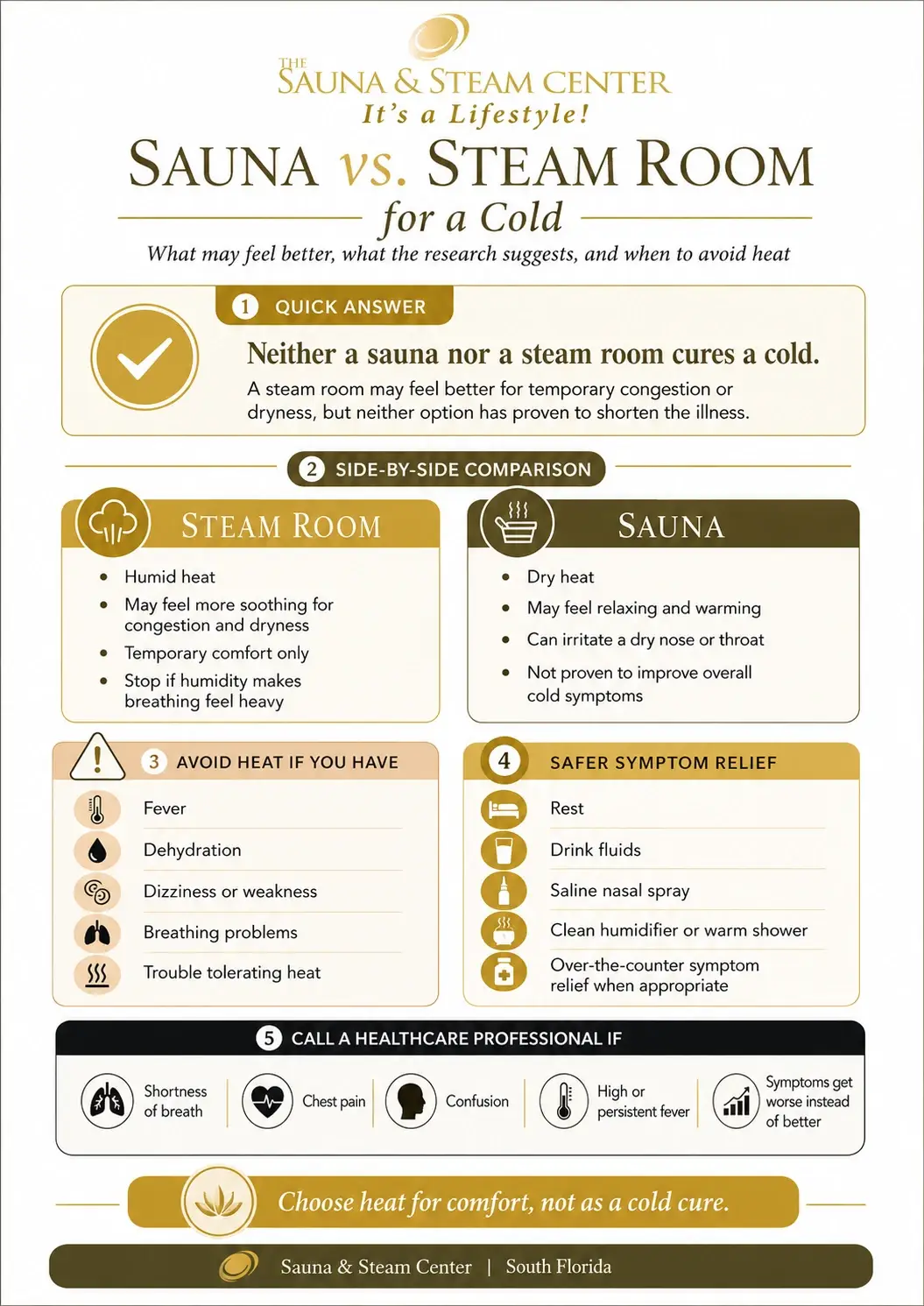
If you are wondering is a steam room good for a cold, the most accurate answer is that warm humidity may temporarily make congestion, throat dryness, or irritated nasal passages feel more comfortable, but research has not shown that steam rooms cure the common cold or reliably shorten the infection. When comparing a sauna or steam room for a cold, steam may feel more soothing for dryness and congestion, while a sauna provides dry heat and relaxation. Neither should be treated as a medical treatment for the virus.
Sauna or Steam Room for a Cold: Quick Answers
| What People Ask | Evidence-Based Answer |
|---|---|
| Is a steam room good for a cold? | It may temporarily soothe dryness or congestion, but it has not been shown to cure the cold or reliably shorten it. |
| Does a steam room help with a cold? | Possibly for temporary comfort. Research on heated humidified air has not demonstrated a clear overall treatment benefit. |
| Will a steam room help a cold? | It may make symptoms feel temporarily easier, especially dryness or stuffiness, but it does not remove the virus. |
| Is sauna or steam room better for a cold? | A steam room may feel better when humidity soothes your nose or throat. A sauna may feel relaxing if you prefer dry heat. Neither is proven to treat the infection. |
| Is a steam room good for a cold and cough? | Humidity may temporarily soothe airway dryness, but steam-room use is not a proven cough treatment and may feel uncomfortable for some people. |
| Is a steam room good for a sore throat? | Humid air may temporarily soothe a dry or irritated throat, but a steam room does not treat the underlying viral or bacterial cause. |
| Is sauna good for a sore throat? | A sauna is not a treatment for a sore throat. Dry heat may actually feel irritating when the throat is already dry. |
| Sauna or steam room when sick? | Skip both when you have fever, dehydration, dizziness, significant weakness, breathing problems, or symptoms that make heat uncomfortable. |
| Does steam cure a common cold? | No. The Cochrane review found no clear evidence that heated humidified air cures a cold or changes viral shedding. |
Sauna vs. Steam Room for a Cold: The Bottom Line
| Question | Steam Room | Sauna |
|---|---|---|
| Can it cure a cold? | No | No |
| Can it shorten the infection? | Not proven | Not proven |
| May it provide temporary comfort? | Possibly, especially when humid air feels soothing | Possibly, if dry heat feels relaxing |
| May it help a dry or irritated throat feel better? | Humidity may temporarily soothe dryness | Dry heat may feel irritating to some people |
| May it help a cough? | Humidity may provide temporary comfort if dryness is contributing | Not proven; dry heat may irritate a dry throat or cough in some users |
| Evidence for treating a cold | Inconsistent, low-quality evidence from heated-humidified-air studies | A randomized sauna study found no meaningful reduction in overall cold symptom severity |
| Main concern while sick | Overheating, dehydration, dizziness, breathing discomfort, and spreading illness in shared spaces | Overheating, dehydration, dizziness, dry-air discomfort, and spreading illness in shared spaces |
For congestion, throat dryness, or a dry cough, a steam room may feel more comfortable than a sauna because humid air adds moisture rather than exposing already irritated airways to dry heat. That does not mean steam treats the infection or makes the virus leave your body faster.
What Is a Common Cold?
The common cold is a viral infection of the upper respiratory tract. Typical symptoms can include:
- Runny nose
- Blocked or stuffy nose
- Sneezing
- Sore throat
- Cough
- Headache
- Mild body aches
- Tiredness
- Sometimes a low-grade fever
There is no universal cure for the common cold, and antibiotics do not treat cold viruses. Most cases improve on their own with time and supportive care.
Cold-like symptoms can also occur with influenza, COVID-19, allergies, sinus infections, strep throat, and other respiratory conditions. This matters because some illnesses may need testing or specific treatment.
Is a Steam Room Good for a Cold?
A steam room can feel good during a mild cold for some people because the environment combines warmth with very high humidity.
Humidity may temporarily reduce the sensation of dryness inside the nose and throat. It may also make thick mucus feel easier to move, which can make breathing through the nose feel more comfortable for a short period.
That distinction is important:
| What Steam May Do | What Steam Has Not Been Proven to Do |
|---|---|
| Temporarily soothe dry nasal passages | Cure the viral infection |
| Temporarily soothe throat dryness | Kill the cold virus inside your body |
| Make congestion feel easier for some people | Reliably shorten the duration of a cold |
| Create a relaxing warm environment | Prevent complications |
| Provide temporary symptom comfort | Replace appropriate medical treatment |
Does a Steam Room Help With a Cold?
A more precise question is whether a steam room can help you feel better temporarily.
For some people, yes.
Warm humidity may make dry nasal passages, congestion, or an irritated throat feel more comfortable. However, controlled research on heated humidified air has produced inconsistent results.
The most important systematic review included six trials involving 387 participants. Researchers found low-quality and inconsistent evidence and concluded that heated humidified air had not demonstrated a clear treatment benefit for the common cold.
Does Steam Make a Cold Go Away Faster?
There is no reliable evidence that it does.
The research has not demonstrated that heated humidified air meaningfully reduces viral shedding or consistently shortens the illness.
Can Steam Kill the Cold Virus?
Not through a normal steam-room session.
Your respiratory tract cannot safely be heated to temperatures that would selectively destroy viruses without also risking injury to your own tissues.
Is a Steam Room Good for a Cold and Cough?
If a cold is accompanied by a cough, a steam room may provide temporary comfort when dryness or irritated airways are contributing to the sensation.
Humidity adds moisture to the air. That can feel soothing when your throat is dry, but it does not mean the steam is treating the cause of the cough.
When Might Humidity Feel Helpful?
- Dry throat
- Dry indoor air
- Mild nasal congestion
- Thick-feeling nasal secretions
- A cough that feels irritated by dryness
When Should You Skip the Steam Room?
Do not force yourself to stay in a humid environment if it makes coughing, wheezing, breathing, dizziness, or discomfort worse.
People with asthma or another respiratory condition may respond differently to hot, humid air and should follow guidance from their healthcare professional.
Is a Steam Room Good for a Sore Throat?
A steam room may temporarily soothe a sore or dry throat because humid air reduces exposure to dry air.
That comfort effect is similar to why clean humidification is commonly recommended when dry air is irritating the nose or throat.
However, a steam room does not tell you what caused the sore throat and does not treat the underlying infection.
Common Causes of a Sore Throat Include:
- Common cold viruses
- Influenza
- COVID-19
- Other viral infections
- Strep throat
- Allergies
- Dry air
- Smoke or other irritants
- Postnasal drainage
Better-Supported Sore Throat Comfort Measures
Public-health and medical guidance commonly recommends:
- Drinking adequate fluids
- Warm beverages
- A clean humidifier or cool-mist vaporizer
- Warm saltwater gargles for appropriate ages
- Throat lozenges or cough drops when age appropriate
- Honey for adults and children at least 1 year old
- Rest
Is a Sauna Good for a Sore Throat and Cough?
A sauna may feel warm and relaxing, but it is not a proven treatment for a sore throat or cough.
Traditional sauna air is much drier than steam-room air. If your throat already feels dry, scratchy, or irritated, that dry environment may feel less comfortable than humid air.
Sauna vs. Steam Room for a Sore Throat
| Factor | Steam Room | Sauna |
|---|---|---|
| Humidity | Very high | Much lower |
| Dry throat comfort | May feel soothing temporarily | May feel drying to some users |
| Treats infection? | No | No |
| Shortens a cold? | Not proven | Not proven |
| Best reason to use | Temporary humidity-related comfort | Relaxation if dry heat feels comfortable |
Cochrane Steam Inhalation and the Common Cold: What Does the Research Actually Say?
One of the most important sources on this subject is the Cochrane systematic review titled Heated, Humidified Air for the Common Cold.
The 2017 update reviewed six randomized trials from five publications involving a total of 387 participants.
What Did the Review Find?
- Results across the studies were inconsistent.
- The overall evidence was considered low quality.
- There was no clear evidence that heated humidified air consistently relieved cold symptoms.
- There was no significant evidence of reduced viral shedding.
- Some participants experienced minor discomfort or nasal irritation.
Does the Cochrane Review Prove That Steam Rooms Do Not Feel Good?
No.
The review examined controlled heated-humidified-air devices, not the subjective experience of sitting inside a modern residential or commercial steam room.
A person may genuinely feel temporary relief from dryness or congestion while still receiving no measurable reduction in the underlying infection.
A Steam Room Is Not the Same as a Steam-Inhalation Device
This distinction is important for interpreting the research.
A steam room differs in:
- Temperature
- Humidity distribution
- Room volume
- Ventilation
- Session duration
- Whole-body heat exposure
- User behavior
Therefore, the Cochrane data should not be stretched into a claim that a steam room medically treats a cold.
Can a Sauna Help a Cold?
A traditional sauna uses hotter, drier air than a steam room.
The warmth may feel relaxing and can temporarily reduce the sensation of stiffness or chills for some people. Dry heat may be less comfortable when the throat or nasal passages already feel dry.
What Does Sauna Research Show?
A randomized controlled trial involving 157 people with newly acquired colds compared inhaled hot dry air in a sauna with room-temperature dry air.
The study found no statistically significant difference in overall cold symptom severity across the study period.
Can You Sweat Out a Cold?
No.
Sweating helps regulate body temperature. It does not remove rhinovirus or another respiratory virus from the body.
What About Preventing Future Colds?
A small older study followed 50 volunteers for six months and reported fewer common-cold episodes among regular sauna users, particularly later in the study.
However, the study was small. It does not establish that sauna bathing reliably prevents respiratory infections, and prevention is different from treating a cold once you already have one.
Sauna or Steam Room When Sick: Which Is Better?
If you have a mild cold and no fever or other reason to avoid heat, comfort should guide the decision.
| Your Main Symptom | May Feel More Comfortable | Why |
|---|---|---|
| Dry nose | Steam room | Humidity adds moisture to the air |
| Dry or scratchy throat | Steam room | Humid air may temporarily feel soothing |
| Congestion | Steam room | Humidity may make mucus feel easier to move |
| Mild body aches | Either, if tolerated | Warmth can feel relaxing |
| Dry cough | Steam may feel more comfortable | Dry sauna heat may irritate some people |
| Dislike high humidity | Sauna or neither | Steam can feel heavy for some users |
| Fever | Neither | Additional heat can increase physiological stress and fluid loss |
| Dehydration or dizziness | Neither | Heat can worsen fluid loss and lightheadedness |
| Breathing difficulty | Neither | Seek appropriate medical guidance instead of adding heat stress |
Which Is Better for Congestion: Sauna or Steam Room?
A steam room is usually the more comfortable option for short-term congestion relief because the humid air may soothe dry nasal passages and make secretions feel less thick.
That does not mean steam is functioning as a decongestant medication or reducing the duration of the illness.
Why Can Humidity Feel Helpful?
Dry air can irritate the lining of the nose and throat. Adding moisture may reduce that sensation and help some people feel that mucus moves more easily.
Should You Use a Sauna or Steam Room With a Fever?
It is safer to avoid both.
A fever already raises body temperature and can increase fluid requirements. A sauna or steam room adds another source of heat stress and may increase sweating, dizziness, weakness, dehydration, or discomfort.
When Should You Seek Medical Care?
Current CDC guidance recommends seeking medical attention for concerning symptoms such as:
- Trouble breathing or fast breathing
- Dehydration
- Fever lasting longer than four days
- Symptoms lasting more than 10 days without improvement
- Symptoms that improve and then return or worsen
- Worsening chronic medical conditions
- Any symptom that feels severe or concerning
Should You Use a Public Sauna or Steam Room When Sick?
A shared sauna or steam room is not a good place to recover from an active respiratory illness.
Even when symptoms are mild, you may be sharing:
- Locker rooms
- Door handles
- Benches
- Showers
- Common walkways
- Close indoor airspace
Stay home while actively sick and follow current public-health recommendations for respiratory illness.
Better Ways to Manage Cold, Cough and Sore Throat Symptoms
If your goal is symptom relief rather than simply enjoying heat, several measures have stronger support in routine cold-care guidance.
- Rest.
- Drink adequate fluids.
- Use a clean humidifier or cool-mist vaporizer.
- Use saline nasal spray or drops.
- Use warm saltwater gargles for a sore throat when appropriate.
- Use throat lozenges or cough drops when age appropriate.
- Use honey for cough in adults and children at least 1 year old.
- Consider warm beverages for throat comfort.
- Use over-the-counter medicines only as directed and when appropriate for you.
- Consider testing if symptoms could be influenza or COVID-19.
What About Steam From a Shower?
Sitting in a steamy bathroom may provide humidity-related comfort without exposing your entire body to the same degree of heat as a sauna or steam-room session.
Avoid Bowls of Boiling Water
Direct steam inhalation over a bowl or pot of very hot water creates a serious scald risk, particularly for children.
If humidity feels helpful, safer alternatives include a clean humidifier, cool-mist vaporizer, or steamy bathroom.

How to Use a Home Sauna or Steam Room More Carefully When Recovering
If your symptoms are mild, you do not have a fever, you are well hydrated, and you have no health reason to avoid heat, an experienced user may choose a short conservative session for comfort.
- Wait until you feel stable. Do not enter if you feel faint, feverish, dehydrated, or unusually weak.
- Hydrate first. Illness and heat can both increase fluid needs.
- Use a shorter session than normal. This is not the time to test your normal heat tolerance.
- Consider a lower temperature. Avoid creating unnecessary heat stress while recovering.
- Do not use alcohol. Alcohol can worsen dehydration and impair judgment.
- Leave if symptoms worsen. Do not try to “push through” dizziness, nausea, weakness, or breathing discomfort.
- Cool gradually afterward. Give your body time to recover from the heat exposure.
- Clean high-touch surfaces. This is particularly important when other household members use the same sauna or steam room.
This is not a complete operating guide. For normal use after you have recovered, see how to use a sauna , how to use a steam room , and our sauna temperature guide .
Homeowners comparing long-term ownership can review our sauna installation guide and steam room design and installation guide . Those pages own project-planning and installation intent rather than cold-related intent.
For Future Wellness Use After You Recover
Compare Sauna and Steam Room Options for Your Home
Sauna & Steam Center helps South Florida homeowners and commercial properties compare traditional saunas, infrared systems, steam rooms, controls, layouts, construction requirements, and maintenance.
Sauna vs. Steam Room for a Cold FAQs
Is a steam room good for a cold?
A steam room may temporarily make congestion, nasal dryness, or throat dryness feel more comfortable because the air is warm and humid. It has not been shown to cure the infection or reliably shorten a cold.
Is steam room good for a cold?
It may feel soothing when a cold causes congestion or dryness, but research does not show that steam rooms treat the virus itself.
Does a steam room help with a cold?
It may provide short-term symptom comfort for some people. The best systematic evidence on heated humidified air has not shown a clear, consistent treatment benefit for the common cold.
Does a steam room help a cold?
A steam room may help you feel temporarily more comfortable, particularly when humidity soothes dry nasal passages or an irritated throat. It does not make the virus leave the body faster.
Will a steam room help a cold?
Possibly for temporary comfort, but not as a cure. Rest, fluids, clean humidification, saline products, and appropriate symptom care have a clearer place in standard cold management.
Can a steam room help with a cold?
It can help some people feel less dry or congested temporarily. Current evidence does not establish steam-room use as a treatment that shortens or cures a cold.
Do steam rooms help with colds?
Steam rooms may provide temporary humidity-related comfort, but clinical research does not show consistent improvement in overall common-cold outcomes.
Is a sauna or steam room better for a cold?
A steam room may feel more comfortable when congestion, nasal dryness, or throat dryness are the main symptoms because the air is humid. A sauna may feel relaxing if you prefer dry heat. Neither cures a cold.
Sauna or steam room for a cold: which should I choose?
If you tolerate heat and have only mild symptoms, steam is generally the more logical comfort choice for dryness or congestion. Choose neither if you have fever, dehydration, dizziness, breathing problems, or heat makes you feel worse.
Is a steam room good for a cold and cough?
Humid air may temporarily soothe a dry throat or a cough that feels irritated by dryness, but steam-room use is not a proven cough treatment. Persistent, severe, or worsening cough should be evaluated appropriately.
Is a steam room good for a sore throat?
Humidity may temporarily soothe a dry or irritated throat. A steam room does not treat the viral or bacterial cause of a sore throat.
Does a steam room help a sore throat?
It may provide short-term comfort by adding moisture to the air, particularly when dryness is contributing to irritation. It should not replace appropriate care for the underlying cause.
Is a sauna good for a sore throat?
A sauna is not a treatment for a sore throat. Its dry air may actually feel irritating if your throat is already dry, although some people still find the warmth relaxing.
Is sauna good for sore throat and cough?
Sauna heat may feel relaxing, but evidence does not show that it treats a sore throat or cough. If dry heat makes the throat or cough feel worse, leave the sauna and use a more appropriate symptom-relief strategy.
Sauna or steam room when sick?
Neither is appropriate when you have a fever, dehydration, significant weakness, dizziness, trouble breathing, or another concerning symptom. With a mild cold and no fever, some experienced users may choose a short home session for comfort.
Can a steam room clear a blocked nose?
Warm humidity may temporarily make a blocked nose feel more comfortable and may make mucus feel easier to move. Research has not demonstrated consistent improvement in common-cold outcomes.
Can a sauna sweat out a cold?
No. Sweating changes fluid balance and body temperature, but it does not remove the virus causing the cold.
Can heat kill a cold virus inside the body?
No practical sauna or steam-room session can safely heat the respiratory tract enough to selectively eliminate a cold virus.
What did the Cochrane review find about steam inhalation for the common cold?
The 2017 Cochrane review included six trials involving 387 participants. The evidence was low quality and inconsistent, and the review did not establish a clear benefit or harm from heated humidified air for treating the common cold.
Should I use a sauna or steam room when I have a fever?
No. Fever increases body temperature and fluid needs, while sauna and steam-room exposure add heat stress and sweating.
Can children use steam for a cold?
Use age-appropriate medical guidance. Avoid bowls or pots of hot water because serious scald injuries can occur. A clean cool-mist humidifier or steamy bathroom may be a safer way to add humidity.
Does regular sauna use prevent colds?
One small older study reported fewer colds among regular sauna users, but the evidence is too limited to promise that sauna use prevents respiratory infections.
Can I use a public sauna if I only have mild cold symptoms?
It is better to stay home while actively sick rather than exposing other guests and employees in a shared sauna, steam room, locker room, or spa.
Conclusion: Is a Steam Room or Sauna Better for a Cold?
When comparing a sauna vs. steam room for a cold, steam has the stronger argument for temporary symptom comfort because humidity may soothe nasal and throat dryness and make congestion feel easier for some people.
A sauna may still feel relaxing if you prefer dry heat, but research has not shown that hot dry sauna air meaningfully reduces overall cold severity.
Most importantly, neither sauna nor steam should be described as a cure for a common cold.
References
-
Centers for Disease Control and Prevention
Manage Common Cold. Updated March 11, 2026.
-
Singh M, Singh M, Jaiswal N, Chauhan A.
Heated, Humidified Air for the Common Cold.
Cochrane Database of Systematic Reviews. 2017.
-
Pach D, Knöchel B, Lüdtke R, Wruck K, Willich SN, Witt CM.
Visiting a Sauna: Does Inhaling Hot Dry Air Reduce Common Cold Symptoms? A Randomised Controlled Trial.
Medical Journal of Australia. 2010;193(11-12):730-734.
-
Ernst E, Pecho E, Wirz P, Saradeth T.
Regular Sauna Bathing and the Incidence of Common Colds.
A small controlled study examining regular sauna use and cold incidence.
-
Centers for Disease Control and Prevention
Sore Throat Basics. Guidance covering supportive symptom care including fluids, humidification, saltwater gargles, lozenges, and honey when age appropriate.
-
Mayo Clinic
Humidifiers: Ease Skin and Breathing Symptoms. Updated July 12, 2026.
Information on dry air, nasal and throat irritation, cool-mist humidification, and safe humidifier use.
-
Royal Devon University Healthcare NHS Foundation Trust and British Burn Association
Public Safety Warning: Steam Inhalation Causes Burns.
Safety guidance concerning burns and scald injuries associated with hot-water steam inhalation.
-
Mayo Clinic
Common Cold: Diagnosis and Treatment.
Guidance on rest, hydration, humidification, warm liquids, honey, saline, and other supportive cold-care measures.