Electric Sauna Heater: kW, 240V, Controls & Installation Guide
Editorial disclosure: Sauna & Steam Center sells, installs, services, and replaces sauna heaters and complete sauna systems. This guide focuses specifically on electric sauna heater planning. Final heater sizing, voltage, amperage, breaker requirements, conductor sizing, controls, sensor placement, clearances, ventilation, and installation must follow the exact manufacturer’s documentation and applicable electrical and building requirements.
If you have already decided that you want a traditional electric sauna heater, the next question is not simply which brand to buy. You need to know what kW range fits the room, whether the property can support the heater electrically, what type of controls make sense, how stone capacity affects the sauna experience, and what must be planned before installation.
Electric Sauna Heater Quick Answers
| Question | Answer |
|---|---|
| What kW electric sauna heater do I need? | Start with the finished room volume, then account for glass, stone, tile, insulation, ceiling height, ventilation, and outdoor exposure. Use the manufacturer’s approved room range for the exact model as the final authority. |
| Does an electric sauna heater need 240V? | Many full-size traditional residential heaters use dedicated 240V service, but not every model does. Confirm voltage, amperage, phase, and breaker requirements from the specification sheet. |
| Does it need a dedicated circuit? | Many full-size electric sauna heaters require dedicated electrical service. Exact circuit and conductor requirements depend on the model and local requirements. |
| Can I pour water on an electric sauna heater? | Yes, if it is a traditional electric heater designed for sauna stones and water use, and the manufacturer permits it. |
| Should I buy the biggest kW heater that fits? | No. The goal is to select a heater that fits the manufacturer’s approved range for the actual room, not simply the most powerful model available. |
What Should You Confirm Before Buying an Electric Sauna Heater?
The most common mistake is choosing a heater before confirming the room and electrical requirements. The heater should be selected as part of the complete sauna system.
| Item to Confirm | Why It Matters |
|---|---|
| Finished interior dimensions | They determine the actual heated room volume. |
| Glass area | Glass can increase heating demand compared with an insulated wood wall. |
| Tile, stone, concrete, or masonry | These surfaces can add thermal load. |
| Insulation | Poor insulation can make a heater perform as though it is undersized. |
| Indoor or outdoor location | Outdoor exposure can change starting temperature and heat loss. |
| Available electrical service | The panel must support the selected heater and controls. |
| Heater location | Clearances, benches, guards, and service access depend on the exact model. |
| Control type | Built-in and external controls have different wiring and placement requirements. |
| Stone capacity | Stone mass affects heat storage, steam response, and heater design. |
| Parts and service | Elements, sensors, controls, and other components may eventually require service. |
How Do You Size an Electric Sauna Heater?
Electric heater sizing starts with the finished sauna room volume:
That number is only the starting point. Glass doors, windows, full glass fronts, tile, stone, concrete, masonry, log construction, poor insulation, unusual ceiling height, outdoor exposure, and ventilation conditions can increase the effective heating load.
After calculating and adjusting the room, compare the result with the manufacturer’s published minimum and maximum room range for the exact electric heater.

For broad sauna-heater sizing and electric-vs-wood comparisons, see our Sauna Heater Guide.
What kW Electric Sauna Heater Do You Need?
kW, or kilowatts, describes heater output. It does not tell you how many people the sauna holds.
You may see residential electric sauna heaters offered in outputs such as 4.5 kW, 6 kW, 8 kW, 9 kW, 10.5 kW, and higher. Those numbers should be matched to the actual room and the manufacturer’s approved range.
Why a “2-person sauna” does not automatically need one specific kW rating
Two saunas that hold the same number of people can have very different heating loads. One may have a full glass front, a taller ceiling, more masonry, different insulation, or an outdoor location.
120V vs. 240V Electric Sauna Heater
Some compact or specialized sauna systems may operate on 120V, but many full-size traditional residential electric sauna heaters use dedicated 240V electrical service. Larger residential and commercial systems may use different voltage or phase configurations.
Do not choose the heater based on the nearest existing outlet. Choose the correct heater for the sauna first, then verify whether the property’s electrical system can support it.
Check the exact model for:
- Voltage
- Phase
- kW output
- Rated amperage
- Breaker or overcurrent protection requirements
- Conductor requirements
- Control-panel requirements
- Disconnect requirements
Does an Electric Sauna Heater Need a Dedicated Circuit?
Many full-size traditional electric sauna heaters require dedicated electrical service. The exact circuit, breaker, conductor, disconnect, and control requirements vary by heater.
A sauna heater is a high-load appliance. It should not be treated like a portable plug-in room heater or added to an existing household circuit without verifying the manufacturer’s requirements and applicable code.
How Many Amps Does an Electric Sauna Heater Use?
There is no universal amperage for electric sauna heaters. Current draw depends on kW, voltage, phase, and the heater’s wiring configuration.
Use the exact heater specification sheet, data plate, and installation manual. A qualified electrician should verify that the panel, circuit protection, conductors, disconnect, and controls match the selected system.
Electric Sauna Heater Electrical Planning Checklist
- What voltage does the heater require?
- Is the heater single-phase or another configuration?
- What is the rated amperage?
- What breaker or overcurrent protection is specified?
- What conductor size and type are required?
- Is a disconnect required?
- Does the control package require a separate power unit or contactor?
- Where will the temperature sensor be installed?
- Does the main electrical panel have sufficient capacity?
- Are there model-specific requirements for GFCI or other protection?
- Does the installation comply with applicable local requirements?
Electric Sauna Heater With Rocks: Why Stone Capacity Matters
Traditional electric sauna heaters use sauna stones to store heat and create the characteristic steam response when water is added. The amount of stone, stone size, placement, and airflow can affect the way the heater performs.
Higher stone capacity may provide:
- More thermal mass
- A fuller steam response
- A different heat feel compared with a compact low-stone heater
That does not mean more stones are always better. Large stone mass can change warm-up behavior and may not be necessary for every small home sauna.
Stone rules to follow
- Use stones appropriate for sauna-heater use
- Follow the exact manufacturer’s stone quantity and size guidance
- Do not pack stones so tightly that airflow is restricted
- Inspect stones for cracking, crumbling, or settling
- Replace degraded stones when necessary
For stone selection, stacking, inspection, and replacement, see our complete Sauna Rocks Guide.
Can You Pour Water on an Electric Sauna Heater?
Yes, if the heater is specifically designed as a traditional sauna heater with approved sauna stones and the manufacturer permits water use. Water applied to hot stones creates the temporary burst of steam known as löyly.
Do not pour water on infrared emitters, control panels, electrical boxes, sensors, or equipment that is not specifically designed for water-on-stone sauna use.
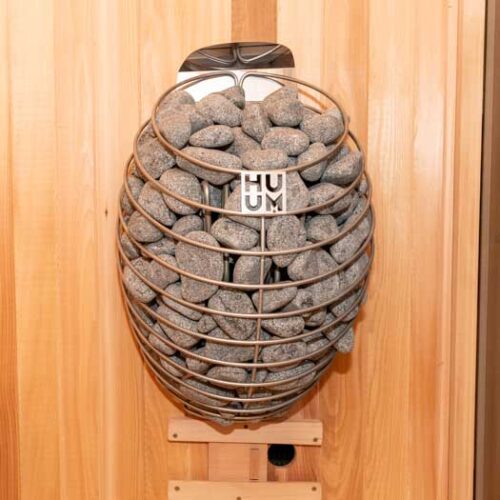
Wall-Mounted vs. Floor-Standing Electric Sauna Heater
| Style | Where It Often Fits Best | What to Verify |
|---|---|---|
| Wall-mounted | Compact residential saunas | Wall clearances, mounting surface, bench spacing, guard requirements |
| Floor-standing | Medium and larger custom saunas | Floor footprint, service access, bench layout, guard clearances |
| Tower or pillar | Design-focused rooms and higher-stone-capacity layouts | Stone loading, bench integration, clearances, service access |
Use the exact manufacturer’s clearance requirements. Do not assume one wall-mounted or floor-standing heater can replace another without rechecking the room.
Built-In, External, and Wi-Fi Electric Sauna Heater Controls
Built-in controls
Built-in controls are located on the heater itself. They can be simple and practical when the heater location keeps the controls easy to access.
External digital controls
External controls can provide more convenient placement and may offer precise temperature setting, timers, scheduling, lighting integration, or other functions depending on the system.
Wi-Fi or app controls
Some electric heater systems support app-based operation. Remote-start capability should only be used when the heater and installation include the manufacturer’s required safety features and safeguards.
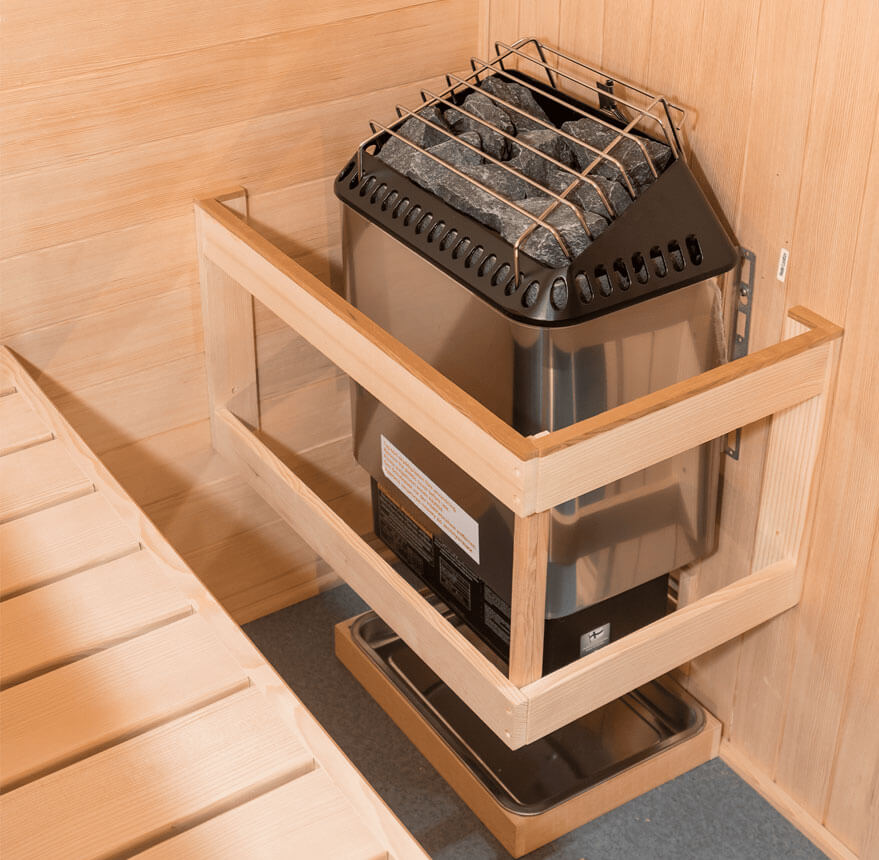
Electric Sauna Heater Installation Planning
The electrical hookup is only one part of a correct installation. Heater position, clearances, ventilation, sensor placement, controls, stones, and service access all affect the finished system.
- Measure the finished room.
- Calculate and adjust the heated volume.
- Select a heater within the approved manufacturer range.
- Verify voltage, amperage, and electrical capacity.
- Confirm heater placement and clearances.
- Plan the intake and exhaust ventilation.
- Confirm control and sensor locations.
- Install any required heater guard.
- Load the correct sauna stones.
- Complete qualified electrical installation.
- Test heater, controls, sensors, and safety functions.
- Commission the sauna and verify normal heating performance.
If you are planning a complete room rather than only the heater, see our Sauna Installation in South Florida page and our How to Build a Sauna at Home guide.
How Much Does an Electric Sauna Heater Cost?
The heater price is only part of the total installed cost. The final budget can include:
- Electric sauna heater
- Sauna stones
- External control or power unit
- Temperature and safety sensors
- Heater guard
- Dedicated electrical circuit
- Electrician labor
- Possible panel upgrade
- Installation labor
- Delivery
For the budget of the complete sauna, read our In-Home Sauna Cost Guide or use the Sauna Cost Calculator.
How Much Electricity Does an Electric Sauna Heater Use?
Electricity consumption varies with heater output, warm-up time, room heat loss, thermostat cycling, starting temperature, insulation, glass area, and session length.
As a simple theoretical example, a 6 kW heater operating continuously at full output for one hour could use up to about 6 kWh during that hour. In normal use, the thermostat may cycle the heater rather than keeping it at full output continuously.
Use that formula only for planning. Actual usage varies by heater and room.
How Long Does an Electric Sauna Heater Take to Heat Up?
There is no universal warm-up time. Heat-up depends on:
- Heater kW
- Room volume
- Insulation
- Glass area
- Tile, stone, or masonry
- Starting room temperature
- Stone mass
- Ventilation
- Outdoor exposure
If the sauna suddenly takes much longer to heat than it used to, check the heater elements, stone condition, controls, sensor placement, ventilation, electrical supply, and room conditions before assuming that the entire heater needs replacement.
Electric Sauna Heater Maintenance
- Inspect sauna stones for cracking and crumbling
- Re-stack or replace stones when needed
- Keep the heater and surrounding area clear
- Check for visible corrosion or damage
- Confirm controls and sensors operate normally
- Investigate repeated breaker trips
- Investigate unusually slow warm-up
- Follow the manufacturer’s maintenance instructions
For broader stone care, see our Sauna Rocks Guide.
Common Electric Sauna Heater Problems
| Symptom | Possible Areas to Check |
|---|---|
| Heater does not turn on | Power supply, breaker, controls, timer, contactor, safety devices |
| Sauna heats very slowly | Heater sizing, failed element, stone loading, sensor location, ventilation, heat loss |
| Breaker trips | Electrical fault, heater element, wiring, moisture, control issue, circuit sizing |
| Uneven or weak heat | Stone condition, element operation, airflow, heater sizing, room design |
| Controls behave erratically | Sensor, control board, wiring, power unit, compatibility |
Should You Repair or Replace an Electric Sauna Heater?
| Repair May Make Sense When | Replacement May Make More Sense When |
|---|---|
| A heating element has failed and parts are available | The heater is obsolete and parts are unavailable |
| A sensor or control component can be serviced | The control platform is no longer supported |
| The heater is correctly sized for the room | The original heater was undersized or mismatched |
| Stone condition or maintenance is the main problem | The heater has severe corrosion or physical damage |
| The electrical system is still appropriate | A larger renovation or electrical upgrade is already planned |
For help diagnosing an existing unit, see our Sauna Heater Repair and Replacement service page.
Home vs. Commercial Electric Sauna Heaters
A commercial electric heater is selected around more than room volume. Hotels, gyms, spas, wellness centers, clubs, and multifamily properties may have longer operating hours, more frequent door opening, more users, and stronger serviceability requirements.

Commercial projects should also evaluate:
- Commercial-use warranty or approval
- Expected daily operating hours
- Recovery after repeated door opening
- Control access and user restrictions
- Parts availability
- Service access
- Maintenance schedule
- Ventilation
For the broader commercial room, design, and installation process, see our Commercial Sauna Installation Guide.
Electric Sauna Heater Buying Checklist
- Finished sauna length, width, and height
- Total room volume
- Glass area
- Tile, stone, concrete, brick, or masonry surfaces
- Indoor or outdoor location
- Manufacturer-approved room range
- Heater kW
- Voltage and phase
- Rated amperage
- Breaker and conductor requirements
- Electrical-panel capacity
- Wall-mounted, floor-standing, or tower design
- Required clearances
- Heater guard requirements
- Stone quantity and size
- Built-in or external controls
- Sensor location
- Water-on-stone approval
- Warranty
- Availability of elements, sensors, controls, and parts
- Local service options
- Total installed cost
Choosing an Electric Sauna Heater?
Send Us Your Sauna Dimensions Before You Order
Sauna & Steam Center can help you evaluate room size, heater kW, voltage, controls, stone capacity, clearances, installation conditions, and replacement compatibility before you commit to a heater.
Send us photographs and the finished length, width, and height of the sauna room. If possible, also include information about glass walls or doors, tile or masonry surfaces, and your available electrical service.
Frequently Asked Questions About Electric Sauna Heaters
What size electric sauna heater do I need?
Start with the finished room volume, then account for glass, masonry, insulation, ceiling height, ventilation, and outdoor exposure. Use the manufacturer’s approved room range for the exact heater as the final sizing reference.
What kW electric sauna heater do I need?
The required kW depends on the actual heated room and construction conditions, not simply the number of people the sauna seats.
Does an electric sauna heater need 240V?
Many full-size traditional residential heaters use dedicated 240V service, but exact voltage, phase, amperage, and circuit requirements vary by model.
Does an electric sauna heater need a dedicated circuit?
Many full-size electric sauna heaters require dedicated electrical service. The exact breaker, conductor, disconnect, and control requirements must follow the selected heater’s documentation and applicable electrical requirements.
Can you pour water on an electric sauna heater?
Yes, when the heater is specifically designed for sauna stones and water use. Follow the manufacturer’s instructions and never pour water on infrared emitters, controls, sensors, or electrical components.
How many amps does an electric sauna heater use?
Amperage depends on the heater’s kW, voltage, phase, and wiring configuration. Use the exact manufacturer’s specification sheet or data plate.
How much electricity does an electric sauna heater use?
Usage depends on kW, warm-up time, thermostat cycling, room heat loss, and session length. A 6 kW heater operating continuously at full output for one hour could theoretically use up to about 6 kWh, but actual consumption varies.
Can I replace my old electric sauna heater with a different model?
Possibly, but you should recheck room sizing, voltage, amperage, controls, sensors, mounting, clearances, and wiring compatibility before replacing it.
What is the best electric sauna heater?
The best electric sauna heater is the properly sized and properly supported model that fits the room, electrical system, controls, stone preference, required clearances, warranty, and service needs.
Conclusion: Match the Electric Heater to the Room and Electrical System
Once you have decided to use electric heat, the most important work is matching the heater to the actual sauna. kW, voltage, amperage, stone capacity, controls, clearances, ventilation, and serviceability all need to work together.
Do not choose the heater only because it looks good, has the highest power rating, or appears inexpensive online. Confirm the room and electrical requirements first, then compare models that fit those conditions.
If you are still deciding between electric and wood-burning heaters, return to our Sauna Heater Guide. If you already know you want electric, Sauna & Steam Center can help you narrow the system down to the heater, controls, stones, and installation plan that fit your project.