
Best Sauna Stones: Best Rocks for Sauna Heaters, Types, Sizes & Stacking
Important: Always follow your heater manufacturer’s instructions for stone material, size, quantity, placement, and water use. Incorrect material or poor stacking can restrict airflow, reduce performance, and place unnecessary stress on heating elements.
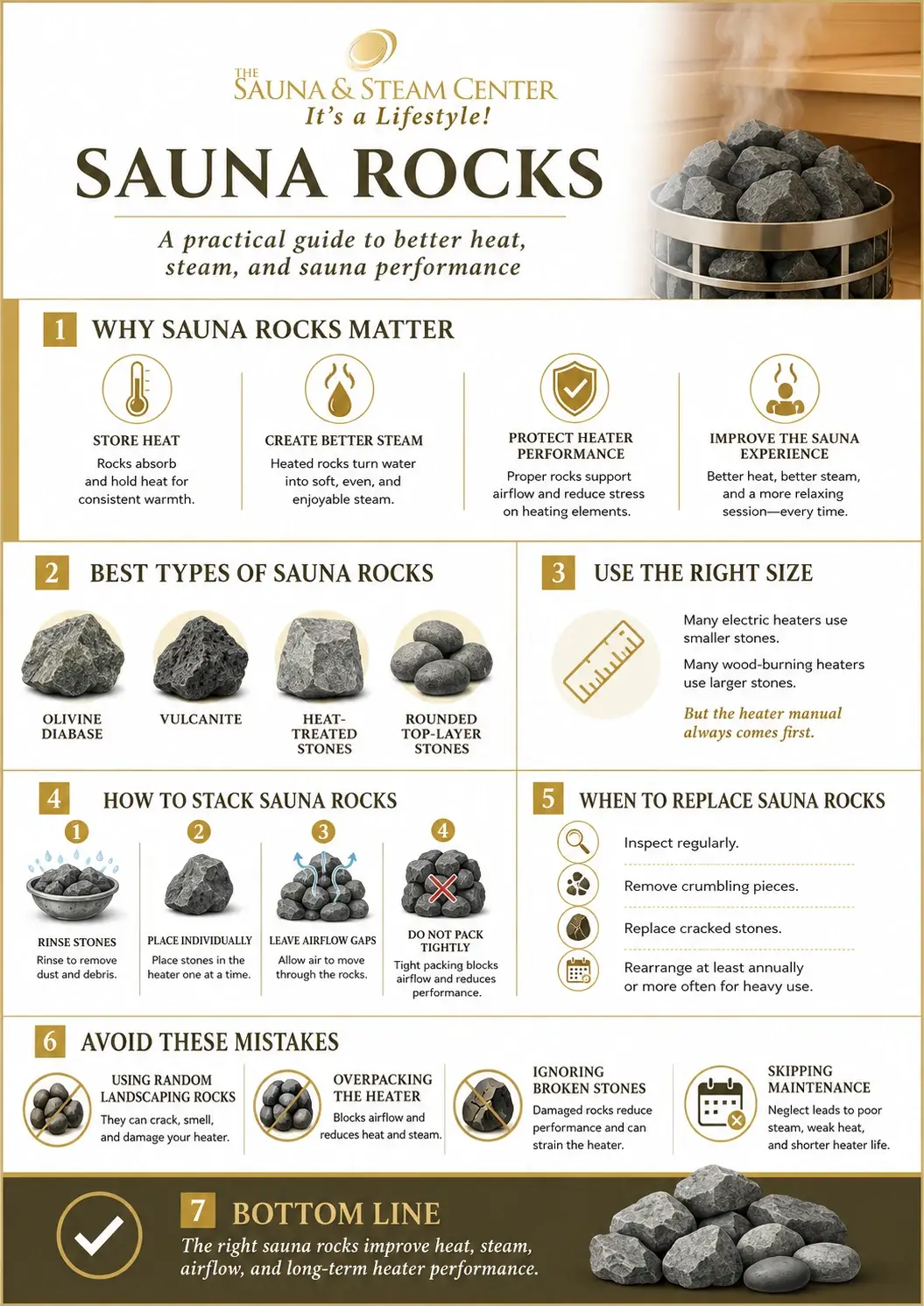
The best stones for sauna heaters are dense, heat-resistant rocks specifically manufactured or approved for high-temperature sauna use. Olivine diabase is one of the most widely used choices because it stores heat effectively and withstands repeated heating and cooling. Vulcanite and heat-treated options are also available, but the correct choice always depends on your heater’s specifications.
If you searched for the best sauna stones, best rocks for sauna, sauna heater rocks, or sauna heater stones, you are probably trying to answer one practical question: what belongs inside the heater?
The rock bed is not decorative filler. It acts as thermal mass, helping store heat and shape the traditional sauna experience. When the heater is designed for water use, hot surfaces also help turn a small amount of water into the temporary increase in humidity known in Finnish sauna culture as löyly.
This guide compares the most common materials, explains how to choose the correct size and quantity, shows why stacking matters, and covers replacement and maintenance.
Best Sauna Stones: Quick Answers
| Search Question | Best Answer |
|---|---|
| What are the best stones for sauna heaters? | Purpose-made, heater-approved material such as olivine diabase is one of the most common choices. |
| What are the best sauna stones? | The best option is the material, size, and quantity specified for your exact heater. |
| What are the best rocks for a sauna? | Use rock specifically intended for high-temperature heater use rather than random natural or landscaping material. |
| What goes inside a sauna heater? | Heat-resistant stone approved by the equipment manufacturer. |
| What rocks are used in saunas? | Common options include olivine diabase, vulcanite, heat-treated material, and approved rounded varieties. |
| Can regular rocks be used? | Random river, beach, landscaping, and field rock should not be used unless explicitly approved by the equipment manufacturer. |
Key Takeaways
- Use material specifically intended and approved for high-temperature heater use.
- Olivine diabase is one of the most common traditional choices.
- Vulcanite and heat-treated options are available for selected models and applications.
- Compatibility is more important than appearance.
- Electric and wood-burning heaters may require different sizes and quantities.
- Avoid unknown landscaping, river, beach, and field rock.
- Correct placement preserves airflow through the heater.
- Repeated heating and cooling eventually causes deterioration, so periodic inspection is important.
What Are the Best Stones for a Sauna?
The best stones for sauna use are dense, durable, heat-resistant materials designed for repeated thermal cycling.
For many traditional electric and wood-burning heaters, olivine diabase is an excellent starting point. Major sauna manufacturers also offer vulcanite, heat-treated material, rounded varieties, and decorative top-layer products for compatible models.
There is no universal winner because the correct product depends on:
- Heater manufacturer
- Exact heater model
- Electric or wood-burning design
- Required rock size
- Required weight or capacity
- Internal heater geometry
What Rocks Are Used in Saunas?
Traditional heaters use dense material capable of tolerating repeated high-temperature cycles and, when the equipment allows it, contact with water.
| Material | Typical Use | Why It Is Used |
|---|---|---|
| Olivine diabase | Many electric and wood-burning heaters | Dense, durable, and effective at storing heat |
| Vulcanite | Selected compatible heaters | Hard material with good resistance to temperature cycling |
| Heat-treated olivine diabase | Heavy-use or commercial applications | Designed for demanding thermal cycles |
| Rounded material | Often used toward the upper layer when approved | Can change how water moves through the rock bed |
| Decorative top stones | Visible upper layer | Primarily selected for appearance |
Not every dark or volcanic-looking rock is appropriate. Visual appearance alone tells you very little about how the material will behave through hundreds of heating cycles.
Why the Rocks Inside a Sauna Heater Matter
The rock bed performs several jobs inside a traditional heater.
Heat Storage
Dense material absorbs energy and releases it gradually, helping create a steadier thermal environment.
Steam Production
When the equipment is designed for water, a small amount poured over hot surfaces creates a temporary burst of humidity.
Airflow
Open spaces between individual pieces allow hot air to move through the heater.
Heater Performance
Quantity, density, and arrangement can change how the system warms up and distributes heat.
Element Protection
With electric heaters, proper placement helps avoid unnecessary pressure on the heating elements.
Best Sauna Stone Types Compared
| Type | Best For | Main Advantage | Important Consideration |
|---|---|---|---|
| Olivine diabase | General traditional use | Dense, durable, and widely available | Choose the correct size for the heater |
| Vulcanite | Compatible traditional heaters | Durability and dark appearance | Confirm manufacturer approval |
| Heat-treated olivine diabase | Frequent-use and commercial systems | Designed for demanding use | May not be necessary for a lightly used home system |
| Rounded material | Upper layers when approved | Can influence water movement | Often used with angular material rather than replacing it completely |
| Decorative material | Visible top layer | Appearance | Not necessarily appropriate for the primary rock bed |
Is Olivine Diabase One of the Best Choices?
Yes. Olivine diabase is one of the best-known materials used in traditional heaters.
Harvia describes its olivine diabase as dense subvolcanic rock that stores and releases heat effectively.
Split-face versions also provide an angular surface that can create useful contact area while allowing individual pieces to be arranged with air gaps between them.
For many systems, this material is an excellent starting point, but the required size still depends on the heater model.
Are Vulcanite Stones Good for a Sauna?
Yes, when the product is specifically manufactured for high-temperature heater use and approved for the equipment.
Vulcanite is another option offered by major sauna manufacturers. It is valued for durability and its darker appearance.
Do not assume that generic volcanic landscape rock is equivalent to purpose-made vulcanite sold for this application.
What Are Heat-Treated Heater Stones?
Some manufacturers offer material that receives additional heat treatment before sale.
These products can be relevant for:
- Commercial installations
- Hotels
- Gyms
- Wellness centers
- Frequently used home systems
A lightly used residential heater does not necessarily need the same solution as equipment operating for many hours each day.
Are Rounded Rocks Better?
Not automatically.
Rounded purpose-made material can change how water travels through the rock bed. Some manufacturers recommend angular pieces in the lower layers and rounded pieces toward the top.
This can allow water to flow farther into the heated mass before vaporizing.
Use rounded material only when your equipment manufacturer allows it.
Can You Use Regular Rocks in a Sauna Heater?
Random natural rocks are not recommended.
Avoid using:
- River rocks
- Beach rocks
- Landscaping material
- Field stone
- Construction aggregate
- Unknown rock collected outdoors
A rock’s appearance does not reveal its mineral composition, internal fractures, moisture characteristics, or resistance to repeated thermal cycling.
Purpose-made products are selected for the conditions they experience inside the heater.
What Makes a Good Sauna Heater Rock?
| Characteristic | Why It Matters |
|---|---|
| Heat resistance | The material experiences repeated high-temperature cycles. |
| Density | Dense material can store a useful amount of thermal energy. |
| Durability | It should resist premature cracking and crumbling. |
| Correct size | Proper dimensions support airflow and heater geometry. |
| Appropriate shape | Shape affects packing, air movement, surface area, and water flow. |
| Equipment compatibility | The heater is designed around a particular load and arrangement. |
What Size Rocks Should You Use in a Sauna Heater?
The correct dimensions depend on the equipment.
Manufacturer guidance commonly identifies:
- 5 to 10 cm pieces for many electric heaters.
- 10 to 15 cm pieces for many wood-burning heaters and selected large electric models.
These are general examples rather than universal specifications. Tower heaters and other specialized designs may require something different.
Electric vs. Wood-Burning Sauna Heater Rocks
| Factor | Electric Heater | Wood-Burning Heater |
|---|---|---|
| Material | Manufacturer-approved | Manufacturer-approved |
| Typical size | Often smaller, depending on model | Often larger, depending on stove |
| Main concern | Airflow and avoiding pressure on elements | Correct loading around the stone chamber |
| Required amount | Model-specific | Stove-specific |
| Best source of instructions | Heater manual | Stove manual |
How Much Rock Does a Sauna Heater Need?
There is no universal number of pieces or boxes.
A compact wall-mounted electric heater may use a relatively small load, while a large tower model can hold substantially more thermal mass.
Wood-burning stoves may use another configuration entirely.
Use the weight or capacity specified in the manual.
Adding extra material does not automatically improve heat. Overpacking can restrict airflow and change how the heater performs.
How to Stack Sauna Heater Rocks Correctly
Correct placement is just as important as choosing the correct material.
The goal is not to create the tightest possible pile. It is to build a stable rock bed while preserving airflow.
General Stacking Principles
- Read the heater manual first.
- Rinse new material if instructed to remove loose dust.
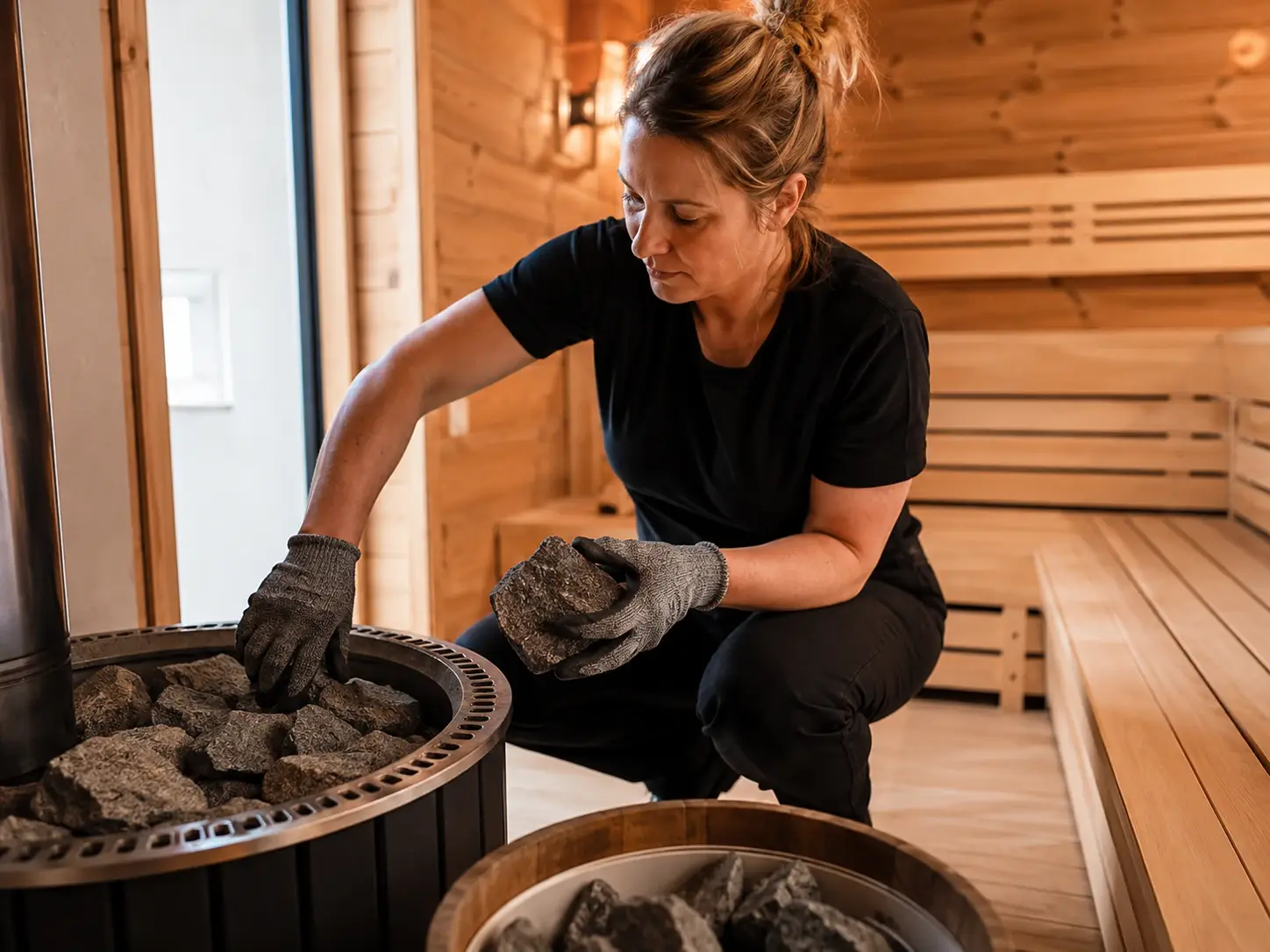
- Place pieces individually. Avoid dumping an entire box into an electric heater.
- Preserve airflow. Do not create a tightly packed solid mass.
- Avoid wedging pieces tightly between heating elements.
- Let the rocks support one another instead of placing excessive load directly on elements.
- Do not build an oversized mound unless the manufacturer specifically instructs you to do so.
Can You Pour Water on Sauna Heater Rocks?
Yes, when a traditional heater is specifically designed for water use.
A small amount of suitable water poured onto the heated rock bed creates the temporary burst of humidity associated with traditional sauna bathing.
Do not assume every sauna heating product is designed for water.
Infrared systems and other products work differently, so always follow the equipment manufacturer’s directions.
When Should Sauna Rocks Be Replaced?
Repeated heating and cooling eventually wears the material down.
Over time, individual pieces may:
- Crack
- Fracture
- Crumble
- Settle more tightly together
- Create debris beneath the heater
Harvia recommends periodically rearranging the rock bed and inspecting it for deterioration. Frequently used equipment generally needs more attention than a lightly used home system.
Signs the Rock Bed Needs Attention
Inspect the heater if you notice:
- Fragments beneath the heater
- Visible cracks
- Crumbling surfaces
- Large amounts of stone dust
- Tightly settled material
- Restricted airflow
- Slower heating than normal
- Weaker steam response
- Heating elements crowded or bent by the load
Do not automatically assume the heater has failed. Rock condition and arrangement should be part of a proper inspection.
How to Choose the Right Sauna Heater Rocks
1. Identify Your Heater
Find the exact manufacturer and model before buying anything.
2. Check the Specification
Confirm:
- Required material
- Size
- Weight or capacity
- Shape restrictions
3. Buy Purpose-Made Material
Choose products sold specifically for high-temperature sauna-heater use.
4. Match the Product to Usage
A heavily used commercial installation may have different needs from a residential sauna used a few times per week.
5. Do Not Buy on Appearance Alone
Dark, white, polished, angular, and rounded products are not necessarily interchangeable.
6. Buy the Correct Quantity
Follow the capacity listed by the manufacturer.
7. Install It Correctly
Selection and stacking should be treated as one process.
Better Heat Starts With the Right Heater Setup
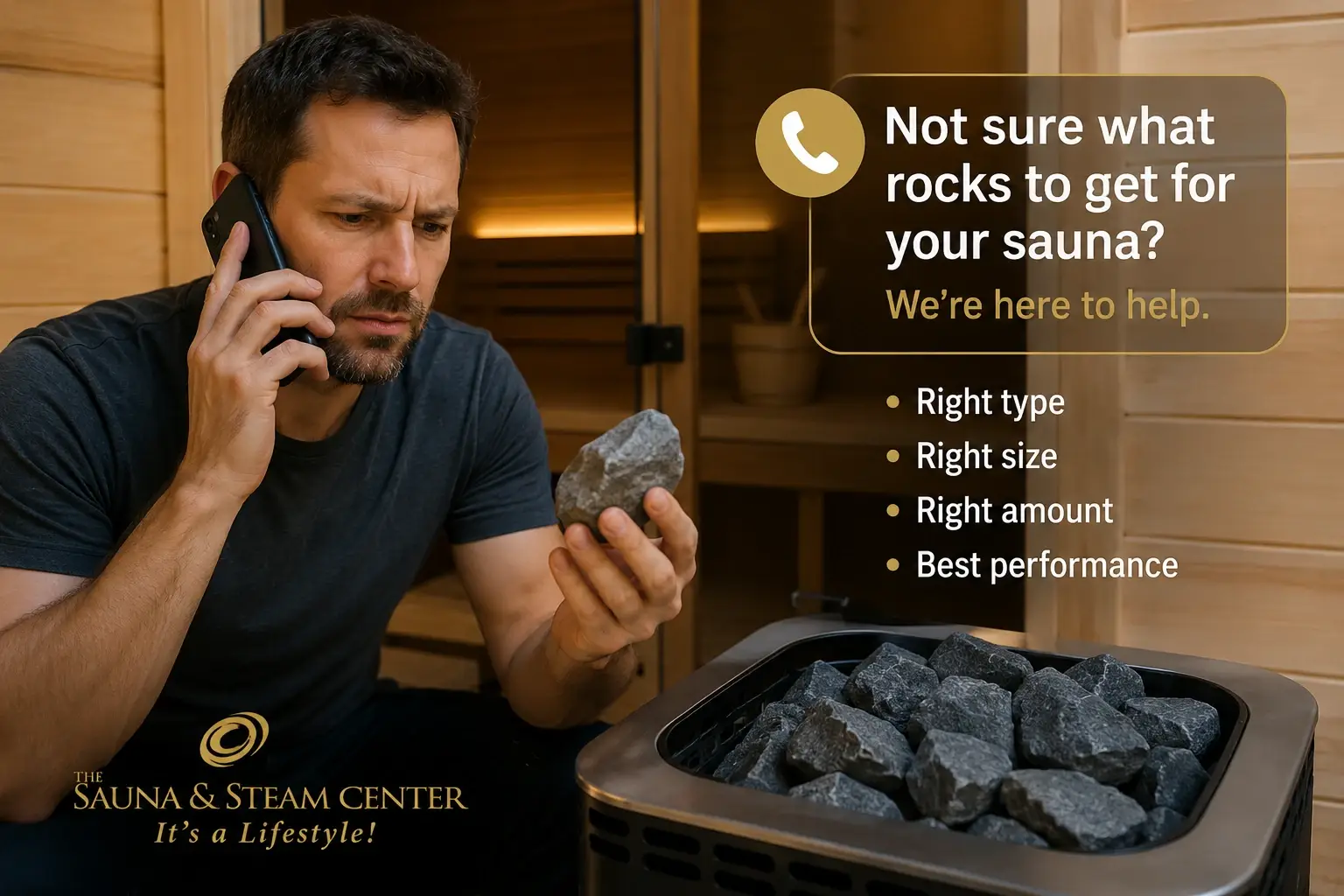
Not Sure What Your Heater Needs?
Sauna & Steam Center can help evaluate heater capacity, rock condition, ventilation, controls, installation, and overall performance.
If your room heats slowly, steam feels weaker than before, or the rock bed is deteriorating, evaluate the entire heater system before replacing equipment unnecessarily.
Frequently Asked Questions About Sauna Heater Stones
What are the best stones for sauna heaters?
Purpose-made, heat-resistant material approved by the heater manufacturer is the best choice. Olivine diabase is one of the most widely used options.
What rocks are commonly used in saunas?
Common purpose-made options include olivine diabase, vulcanite, heat-treated olivine diabase, and approved rounded varieties.
Is olivine diabase good for a sauna?
Yes. It is dense, durable, and widely used for traditional heaters when the size and product are compatible with the equipment.
Is vulcanite a good choice?
It can be when specifically manufactured for high-temperature heater use and approved for the model.
Can I use regular rocks?
Random landscaping, river, beach, field, and construction rocks are not recommended because their composition and behavior under repeated thermal cycling may be unknown.
Can I use river rocks?
Random river rocks are not recommended unless your equipment manufacturer explicitly approves that material.
What size should I buy?
Follow the heater manual. Pieces around 5 to 10 cm are common in many electric heaters, while larger 10 to 15 cm material is common in many wood-burning systems and selected larger electric models.
How much does my heater need?
Use the specified weight or capacity. Heater designs vary too much for one universal amount.
How should the rocks be stacked?
Place them individually and loosely enough to maintain airflow. Avoid tightly wedging material against electric heating elements.
Can water be poured over the rocks?
Yes, when the traditional heater is specifically designed for water. Follow the manufacturer’s instructions for water use.
How often should the rocks be replaced?
Inspect the load periodically and replace pieces that crack, crumble, or deteriorate. Heavy-use installations may require more frequent maintenance.
Do rounded stones work better?
Not universally. They may be useful in the upper portion of certain heaters, while angular material may still be required lower in the rock bed.
Can incorrect rocks damage a heater?
Incorrect size, excessive quantity, unsuitable material, or poor stacking can restrict airflow, stress heating elements, and reduce performance.
Conclusion: Which Rocks Are Best for a Sauna?
The best stones for sauna heaters are purpose-made materials that match the heater manufacturer’s specifications.
Olivine diabase is one of the most widely used choices, while vulcanite, heat-treated products, rounded material, and decorative top stones may also have appropriate applications.
Focus on seven things:
- Compatibility
- Material
- Correct size
- Correct quantity
- Proper stacking
- Airflow
- Regular inspection
Avoid experimenting with unknown outdoor rocks simply because they appear dense or heat resistant.
If you are purchasing a new heater, select the equipment first and then buy the rock type and quantity recommended for that model.
The heater and its rock bed should be treated as one system.
References
-
Harvia
-
Harvia
-
Harvia