
Wood Burning Sauna Stove: Sizing, Chimney & Installation Guide
Editorial and safety disclosure:
Sauna & Steam Center sells, designs, installs, and services sauna systems. This article provides general buying and planning information. Wood-burning sauna stove installation involves fire safety, chimney design, clearances, combustion air, local building requirements, and manufacturer-specific instructions. Always follow the exact stove manual and use qualified professionals where required.
A wood burning sauna stove is the heart of a traditional off-grid or fire-heated sauna. Instead of using electric heating elements, it burns firewood to heat the stove body and sauna stones, which then warm the room and create löyly when water is applied to appropriately heated stones.
The right wood burning sauna stove is selected by sauna room volume, insulation, glass and masonry surfaces, chimney route, required safety clearances, combustion-air needs, stone capacity, and manufacturer installation requirements. Do not choose a stove by firebox size or appearance alone. A correctly sized sauna stove should match the room it is designed to heat, connect to an appropriate dedicated chimney/flue system, have sufficient clearances from combustible materials, and be installed according to the exact manufacturer manual and local code requirements.
This article is for buyers who are specifically considering wood heat. If you are still deciding between heater types, start with our sauna heater guide.
Wood Burning Sauna Stove: Quick Answers
| Question | Practical Answer |
|---|---|
| What is a wood burning sauna stove? | A purpose-built sauna heater that burns firewood and heats sauna stones and the room without electric heating elements. |
| How do I size a wood sauna stove? | Start with the sauna’s cubic volume, then account for insulation, glass, masonry, ceiling height, and the stove manufacturer’s sizing chart. |
| Can I use a regular wood stove in a sauna? | Use a stove specifically designed and listed for sauna use. A generic room-heating wood stove is not automatically suitable for sauna temperatures, stone loading, clearances, or water-on-stones use. |
| Does a wood sauna stove need a chimney? | Yes. Wood combustion requires a properly designed flue/chimney system compatible with the stove and installed according to the manual and local requirements. |
| Can you pour water on a wood burning sauna stove? | Water is typically applied to sauna stones, not directly into the firebox or onto random metal surfaces. Follow the stove manufacturer’s instructions. |
| Can a wood stove heat an outdoor sauna? | Yes. Wood-burning heaters are commonly used in outdoor saunas, but weather exposure, chimney routing, base support, clearances, local rules, and fire safety all matter. |
| What wood should I burn? | Use clean, dry, seasoned firewood that is appropriate for the stove. Avoid treated lumber, trash, plastic, painted wood, and wet or green wood. |
| How long does a wood-fired sauna take to heat? | Heat-up time varies by room size, insulation, outdoor temperature, stove output, chimney draft, firewood quality, and stone mass. |
What Is a Wood Burning Sauna Stove?
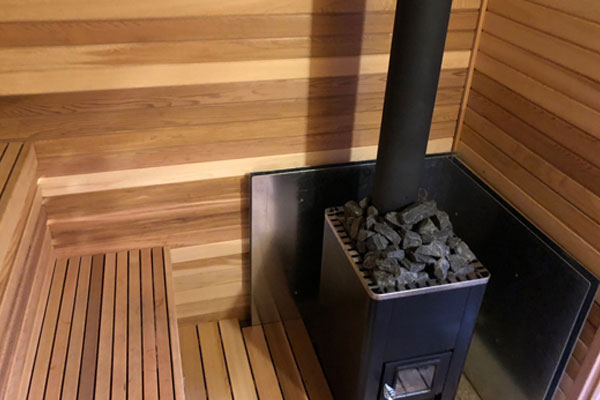
A wood burning sauna stove, also called a wood fired sauna stove, wood burning sauna heater, or sauna wood stove, is designed specifically to heat a sauna room. It normally includes a firebox, combustion-air path, flue connection, stone basket or stone chamber, and protective outer structure.
The fire heats the stove and the stones. The hot stones store thermal energy and help soften the heat experience. When a small amount of water is applied to hot sauna stones, it produces löyly, the burst of steam that temporarily raises perceived heat and humidity.

A sauna stove is not simply a fireplace installed in a wooden room. It is part of a complete heat, ventilation, fire-safety, and chimney system.
Wood Burning Sauna Stove Buying Checklist
| Check Before Buying | Why It Matters |
|---|---|
| Sauna room volume | Determines which stove output range is appropriate. |
| Glass, masonry and uninsulated surfaces | Can increase heat loss and change the effective heating load. |
| Chimney route | Affects stove placement, roof or wall penetrations, clearances and project feasibility. |
| Required safety clearances | Determines whether the stove can fit safely within the room. |
| Combustion-air path | Wood combustion needs adequate air to operate properly. |
| Sauna ventilation | Affects comfort, drying, air quality and room performance. |
| Stone capacity | Influences thermal mass, heat character and löyly experience. |
| Firewood access | Matters for daily convenience and indoor cleanliness. |
| Ash and service access | Makes routine maintenance easier. |
| Local code and permitting | Can determine whether a chimney route and installation are acceptable. |
| Replacement parts and dealer support | Important for long-term ownership. |
Can You Use a Regular Wood Stove in a Sauna?
Do not assume a normal room-heating wood stove is suitable for sauna use. A purpose-built sauna stove is designed around sauna-specific temperatures, stone loading, heat distribution, installation clearances, and intended operating conditions.
A regular wood stove may not be designed to hold sauna stones, may have different clearance requirements, and may not be intended for repeated water exposure near the heater. It can also produce a very different heat profile.
Use a sauna stove that is specifically designed and documented for sauna use, then install it according to the exact manual.
How to Size a Wood Burning Sauna Stove
Room volume is the starting point. Measure the interior length, width, and height of the sauna and calculate the cubic volume. Then compare that volume with the manufacturer’s approved room-volume range for the exact stove model.
Harvia states that sauna size is one of the most important factors when selecting a wood-burning heater. A heater that is too small may struggle to heat the room and can be overworked, while a heater that is too large can create an uncomfortable environment.
| Room Condition | Effect on Stove Selection |
|---|---|
| Well-insulated wood-lined room | Use the actual room volume as the basic starting point. |
| Large glass door or glass wall | May increase effective heating load. |
| Masonry, tile, stone or concrete surfaces | Can absorb heat and increase effective volume. |
| High or sloped ceiling | Adds heated air volume and may change stove sizing. |
| Outdoor sauna in cooler conditions | May require extra attention to insulation and manufacturer sizing guidance. |
Do not size from a generic “X kW per cubic foot” rule alone. Wood-burning heaters are selected by the manufacturer’s tested room-volume range and installation instructions.
Glass, Masonry and Effective Sauna Room Volume
A sauna with the same physical dimensions can require a different heater depending on the amount of glass, stone, tile, masonry, and other heat-absorbing or uninsulated surfaces.
This is why a 6-by-8 sauna with extensive glass may not behave like a fully insulated 6-by-8 wood-lined room. Before choosing a stove, document:
- Interior dimensions
- Ceiling height
- Glass-door size
- Glass-wall area
- Exposed masonry or stone
- Insulation quality
- Outdoor exposure
Send the dealer a simple room sketch, measurements, and photos before ordering the stove. Heater sizing is easier to correct before the sauna is built than after the chimney is installed.
Wood Sauna Stove Chimney and Flue Planning
A wood-fired sauna stove needs a properly designed flue system to remove combustion gases safely. Chimney planning should be treated as part of the stove selection, not as an accessory to figure out later.
Important planning points include:
- Stove flue-outlet location
- Vertical vs. offset chimney route
- Wall or roof penetration
- Required clearances from combustible construction
- Chimney height and draft
- Roof flashing and weather sealing
- Support brackets and structural attachment
- Service and inspection access
- Local building and fire requirements
HUUM’s U.S. HIVE Wood manual states that its sauna stove is connected to a chimney using appropriate metal flue components and that connection should be performed by specialists. The same manual also warns that the stove’s flue gases should go to a separate flue rather than sharing a flue with another furnace.
Use components approved for the stove and installation type, follow the manufacturer’s manual, and use qualified professionals where required.
Wood Burning Sauna Stove Clearances and Heat Shields
Wood sauna stoves operate next to combustible walls, benches, trim, and ceilings, so required clearances are critical. The correct distances vary by stove model and by whether approved heat shields or protective assemblies are used.
Never copy clearances from another stove, a forum post, or a generic sauna diagram. The installation manual for the exact model should control.
Common clearance planning areas
- Side walls
- Rear wall
- Bench edges
- Ceiling
- Floor protection
- Firebox loading door
- Chimney connector
- Roof and wall penetrations
A stove that technically has enough heating capacity may still be wrong for the sauna if its required clearances consume too much usable bench space.
Combustion Air and Sauna Ventilation Are Not the Same Thing
A wood-burning sauna needs air for two separate reasons:
- Combustion air supports the fire inside the stove.
- Sauna ventilation supports occupant comfort, heat distribution, drying, and room performance.
These functions influence one another, but they should not be treated as one generic vent. Poorly planned exhaust fans or negative pressure can interfere with chimney draft and stove combustion.
HUUM specifically warns that forced-exhaust ventilation can create combustion and ventilation problems if the system is not properly designed.
Design the stove, combustion-air path, room ventilation, and mechanical exhaust as one coordinated system.
Wood Burning Sauna Stove With Rocks: What the Stones Do
Sauna stones absorb and store heat from the stove. Their mass helps moderate the heat and provides the surface used to create löyly when water is applied.
Different wood-burning heaters have very different stone capacities. For example, Harvia lists 36 kg of stones for its Linear 16, while HUUM lists much larger stone quantities for some HIVE Wood models. That difference affects thermal mass, warm-up behavior, and the style of heat the sauna produces.
Use stones intended for sauna heaters and follow the manufacturer’s stone-size and placement instructions. For a deeper discussion of stone types, replacement, cracking, stacking, and maintenance, see our sauna rocks guide.
Can you pour water on a wood burning sauna stove?
Water is generally poured onto the hot sauna stones in controlled amounts to create löyly. Do not pour water into the firebox, chimney, or onto surfaces not intended for water exposure. Follow the stove manual.

Wood Stove for an Outdoor Sauna
Wood heat is a natural fit for many outdoor saunas because it can create a traditional experience without relying on electric heating elements. It can also work well in remote properties where electrical capacity is limited.
Outdoor installation adds several considerations:
- Foundation or noncombustible floor system
- Chimney routing through the roof or wall
- Rain and wind exposure
- Outdoor storage of dry firewood
- Ash handling
- Clearances around the building exterior
- Roof flashing and water intrusion prevention
- Local burn restrictions or permitting
- Neighbor and smoke considerations
For Florida-specific outdoor design, humidity, UV, drainage, coastal conditions, and site planning, see our outdoor sauna Florida guide.
Wood Burning Sauna Stove for a Barrel Sauna
A wood stove can work well in a barrel sauna, but barrel geometry makes layout especially important. The curved walls, limited floor area, bench position, chimney route, and clearances all have to work together.
Before selecting a stove for a barrel sauna, confirm:
- Interior cubic volume
- Stove footprint
- Required wall and bench clearances
- Floor protection
- Chimney penetration location
- Door and firewood-loading access
- Stone capacity
- Manufacturer approval for the room size
For broader barrel-sauna design questions, use our cedar barrel sauna guide.
What Kind of Wood Should You Burn in a Sauna Stove?
Use clean, dry, seasoned firewood appropriate for the stove. Dry wood burns more efficiently and produces less smoke than wet or green wood.
The U.S. Environmental Protection Agency recommends burning properly seasoned wood and avoiding garbage, plastics, painted or treated wood, and wet wood in wood-burning appliances.
Avoid burning
- Treated lumber
- Painted or stained wood
- Plywood or engineered wood with adhesives unless specifically approved
- Plastic
- Trash
- Wet or green firewood
- Unknown scrap material
Keep firewood dry and protected from rain while allowing airflow around the stack.
How Long Does a Wood-Fired Sauna Take to Heat?
There is no universal heat-up time. A properly matched wood-burning stove may heat a sauna efficiently, but actual warm-up depends on:
- Room volume
- Insulation
- Glass and masonry
- Outdoor temperature
- Stove capacity
- Stone mass
- Chimney draft
- Firewood moisture and quality
- How the fire is managed
A small well-insulated sauna with a correctly matched stove will usually heat faster than a large outdoor sauna with heavy stone mass and extensive glass.
Instead of asking only “How fast does this stove heat?”, ask whether the stove is correctly matched to your room and whether the chimney, insulation, and ventilation support proper performance.
How Much Wood Does a Sauna Stove Use?
Wood consumption varies significantly. Stove design, firewood species, moisture content, sauna size, insulation, outdoor conditions, stone mass, target temperature, and session length all affect fuel use.
Do not choose a stove based on a generic “logs per session” claim. A more useful ownership question is whether you have convenient access to properly seasoned firewood and a dry place to store it.
Wood Burning Sauna Stove Installation Planning
Installing the stove should be planned before the sauna walls and benches are finalized. The stove affects floor protection, bench layout, chimney routing, ventilation, clearances, and service access.
Pre-installation checklist
- Confirm exact stove model
- Confirm sauna room volume
- Review manufacturer manual
- Plan stove location
- Verify wall, bench and ceiling clearances
- Plan noncombustible floor protection
- Plan chimney route and supports
- Coordinate combustion air
- Coordinate room ventilation
- Confirm local code and permit requirements
- Confirm firewood loading direction
- Confirm ash-removal access
- Leave service access around critical components
This article intentionally does not provide universal chimney dimensions, wall clearances, or fire-protection measurements because those are model-specific and code-dependent.
Wood Burning Sauna Stove Cost: What Affects the Price?
The stove itself is only one part of the project cost. A wood-fired sauna can also require chimney components, roof or wall penetrations, floor protection, heat shields, ventilation work, professional installation, permits, and site modifications.
| Cost Factor | Why It Changes the Project |
|---|---|
| Stove model and capacity | Larger and higher-end heaters cost more. |
| Stone capacity | Large stone-mass heaters require more sauna stones. |
| Chimney system | Height, offsets, roof penetrations, supports and flashing affect cost. |
| Heat protection | Floor and wall protection may be required. |
| Outdoor site conditions | Foundation, weatherproofing and access can add work. |
| Professional labor | Chimney, carpentry, fire-safety and permitting requirements vary. |
| Permitting | Local rules may affect design and inspection requirements. |
For broader sauna project pricing, use our home sauna cost guide and sauna cost calculator.
Wood Sauna Stove Maintenance and Chimney Care
Wood-burning heaters require more hands-on maintenance than electric sauna heaters. A practical maintenance routine should include the stove, stones, chimney, ash area, door, seals, and combustion-air path.
Regular maintenance items
- Remove ash as needed
- Keep the firebox clean
- Inspect the door and latch
- Check visible stove surfaces for deterioration
- Inspect sauna stones and replace damaged stones
- Keep air inlets and vents clear
- Inspect the chimney and flue system regularly
- Address soot or draft problems promptly
- Use only appropriate dry firewood
Harvia recommends checking the chimney regularly, keeping air vents clear, and replacing sauna stones periodically as part of normal wood-heater maintenance.
When Should You Repair or Replace a Wood Burning Sauna Stove?
Minor wear does not automatically require replacement. However, replacement may make more sense if the stove is badly corroded, structurally damaged, difficult to service, incorrectly sized, no longer supported with parts, or incompatible with a safer planned chimney and room layout.
| Condition | Likely Direction |
|---|---|
| Door gasket or small replaceable component issue | Repair may be appropriate. |
| Damaged or crumbling sauna stones | Replace stones and inspect stove condition. |
| Persistent smoke leakage or poor draft | Stop use and have stove/chimney system evaluated. |
| Severe firebox deterioration | Replacement may be safer and more economical. |
| Stove too small for remodeled sauna | Resize and replace rather than overfire the old stove. |
| No replacement parts or support | Replacement may improve serviceability. |
For broader heater service questions, see our sauna heater repair and replacement guide.
Residential vs. Commercial Wood-Fired Sauna
Wood-fired heaters can be excellent for residential and specialty sauna environments, but they require active fire management and fuel handling. That makes them less practical for some high-traffic commercial spaces.
| Factor | Residential | Commercial / High Traffic |
|---|---|---|
| Fire management | Owner-controlled | Requires staffing and clear procedures |
| Fuel storage | Usually manageable | Can require dedicated logistics |
| Automation | Not usually the priority | Electric systems are often easier to automate |
| Atmosphere | Excellent traditional experience | Can be a premium specialty feature |
| Maintenance | Hands-on but manageable | Higher operational burden |
Wood Burning Sauna Stove vs. Electric Sauna Heater
This page is intentionally not a full electric-vs-wood comparison. The short version is:
- Wood burning: traditional fire experience, active fire management, chimney, fuel storage, ash, more hands-on operation.
- Electric: easier startup, thermostat/control options, no chimney, less daily fuel handling, but requires adequate electrical service.
If you have not decided which direction fits your project, use our sauna heater guide. If you already know you want electric heat, see our electric sauna heater guide.
Planning a Wood-Fired Sauna?
Choose the Stove After the Room, Chimney and Clearances Are Planned
Sauna & Steam Center can help you evaluate sauna size, heater type, room layout, outdoor placement, ventilation, materials, installation requirements and long-term service considerations before the project moves forward.
Frequently Asked Questions About Wood Burning Sauna Stoves
What is the best wood burning sauna stove?
The best stove is the one that correctly matches your sauna volume, chimney route, clearances, stone capacity, maintenance preferences and local installation requirements. There is no universal best model for every sauna.
How do I size a wood burning sauna stove?
Measure the sauna’s interior cubic volume, then account for glass, masonry, insulation and outdoor conditions. Use the exact manufacturer’s approved room-volume range for the stove you are considering.
Can I put a wood stove in a sauna?
Use a stove specifically designed and documented for sauna use. Do not assume a generic room-heating wood stove is suitable for a sauna.
Does a wood sauna stove need a chimney?
Yes. A wood-burning sauna stove requires a compatible chimney or flue system designed to safely remove combustion gases.
Can a wood burning sauna stove be used indoors?
Potentially, but the room, chimney, combustion air, floor protection, clearances, local code and manufacturer instructions must all support the installation.
Can a wood burning sauna stove be used outdoors?
Yes. Wood-fired heaters are common in outdoor saunas, but the project must account for chimney routing, weather, clearances, firewood storage, drainage, base support and local requirements.
Can I use a wood burning stove in a barrel sauna?
Yes, if the stove is correctly sized and the barrel layout can satisfy the required clearances, floor protection, chimney route and service access.
What wood should I burn in a sauna stove?
Use clean, dry, seasoned firewood appropriate for the stove. Avoid treated lumber, painted wood, trash, plastic and wet or green firewood.
Can you pour water on a wood burning sauna stove?
Water is normally poured onto hot sauna stones in controlled amounts to create löyly. Follow the exact manufacturer instructions and do not pour water into the firebox or chimney.
How long does a wood fired sauna take to heat?
Heat-up varies by stove size, sauna volume, insulation, glass, outdoor temperature, stone mass, chimney draft and firewood quality. There is no single universal warm-up time.
How much wood does a sauna stove use?
Fuel use varies by stove design, wood moisture, room size, insulation, target temperature and session length. Manufacturer operating instructions are a better guide than generic log-count estimates.
How often should a wood sauna stove chimney be cleaned?
Chimney inspection and cleaning frequency depends on use, fuel quality, chimney design and local requirements. Have the system inspected regularly and follow manufacturer and chimney-professional guidance.
Is a wood burning sauna stove better than electric?
Neither is universally better. Wood offers a traditional fire-heated experience and can work where electrical capacity is limited. Electric heaters are easier to automate and do not require a chimney or firewood handling.
References
- Harvia: Choosing the Right Wood-Burning Heater
- Harvia Linear 16 Wood Burning Heater Specifications
- Harvia Pro 20 Wood Burning Heater Specifications
- HUUM HIVE Wood Stove Specifications and Resources
- HUUM HIVE Wood U.S. Installation and Operation Manual
- U.S. Environmental Protection Agency: Strategies for Reducing Residential Wood Smoke
Conclusion: Choose the Wood Burning Sauna Stove as Part of the Whole Sauna System
A good wood burning sauna stove is not selected in isolation. The stove, sauna room, chimney, ventilation, combustion air, clearances, stones, firewood access and maintenance plan all work together.
Start with the room volume and installation conditions. Then compare purpose-built sauna stoves whose manufacturer-approved sizing range fits the room. Confirm chimney feasibility and required clearances before finalizing benches or walls, and use sauna stones and firewood that meet the stove manufacturer’s instructions.
When those details are planned correctly, a wood-fired sauna can deliver the traditional fire, stone and löyly experience that makes this heating style so appealing.