
What Is an Infrared Sauna?
Editorial disclosure: Sauna & Steam Center sells, installs, and services infrared and traditional sauna systems. Health information is educational and is not medical advice. Product specifications and installation requirements vary by manufacturer and model.
What is an infrared sauna? An infrared sauna is a sauna cabin that uses infrared-emitting heaters or panels to deliver radiant heat to your body and surrounding surfaces. Unlike a traditional sauna, which primarily heats the room air and sauna stones, an infrared sauna can make you feel warm and sweat at a lower air temperature.
Is an Infrared Sauna the Right Type of Sauna for You?
| If This Sounds Like You… | Infrared May Fit Well | Consider Traditional Instead |
|---|---|---|
| You dislike very hot surrounding air. | Yes. Infrared cabins generally operate at lower air temperatures. | Traditional sauna is intentionally hotter and may feel more intense. |
| You want a compact indoor cabin for one or two people. | Often a strong fit. | Traditional can still work, but usually needs more heater and ventilation planning. |
| You want stones, water, and löyly. | No traditional löyly. | Traditional Finnish sauna is the better match. |
| You want a simpler first home-sauna project. | Many prefabricated infrared cabins simplify room planning. | Traditional may involve more electrical, heater-clearance, and ventilation decisions. |
Decision rule: If your priority is lower-temperature radiant heat and a compact home cabin, keep reading about infrared. If your priority is the classic Finnish experience with hot stones and steam bursts, go directly to our infrared vs. traditional sauna comparison.

How Does an Infrared Sauna Work?
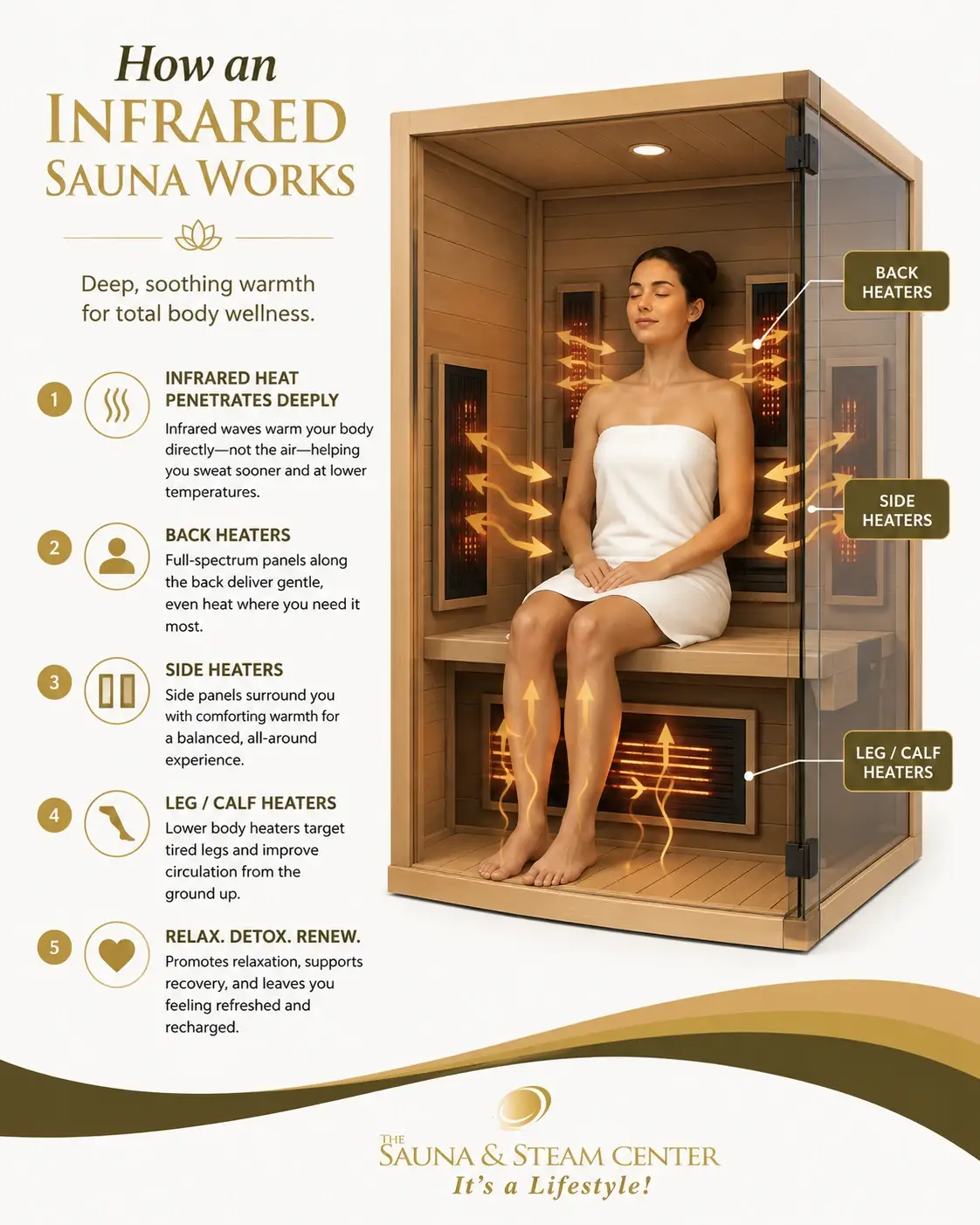
An infrared sauna works by using infrared emitters to produce radiant energy that your body and the cabin surfaces absorb as heat. The surrounding air becomes warm too, but direct radiant heating is a larger part of the experience than in a traditional sauna.
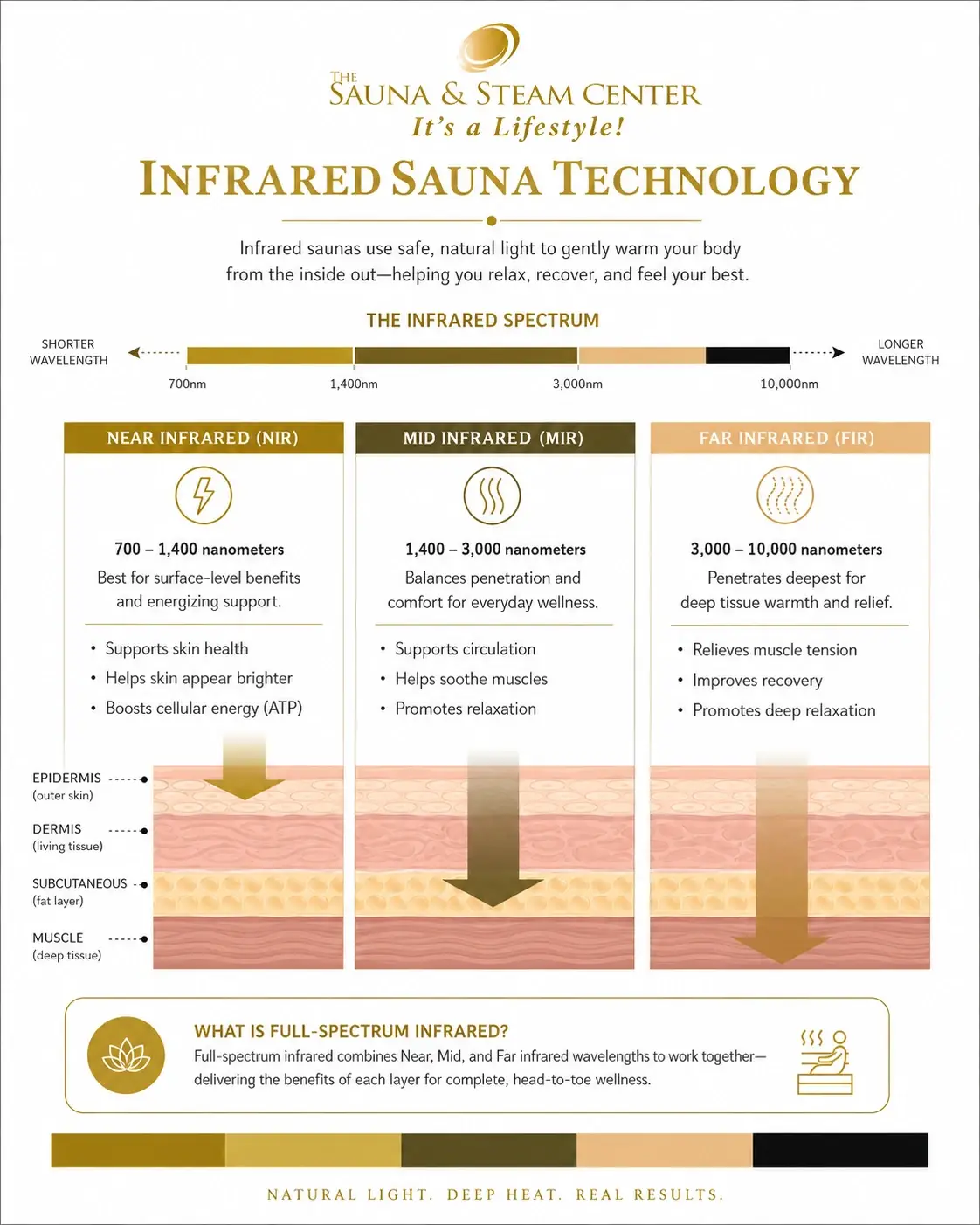
Infrared radiation sits beyond visible red light on the electromagnetic spectrum. The National Library of Medicine describes infrared as the portion of the electromagnetic spectrum commonly sensed as heat.
Infrared Emitters and Panels
Infrared cabins usually place heating panels around the walls, backrests, legs, or other parts of the cabin so the user receives heat from several directions. Depending on the sauna, emitters may use carbon, ceramic, or a combination of technologies.
Why Does It Feel Hot at a Lower Temperature?
Because radiant energy contributes directly to how your body is heated, the cabin does not need to reach the same air temperature as a traditional Finnish sauna. Mayo Clinic explains that infrared saunas can cause sweating at lower surrounding air temperatures than regular saunas.
Example: Imagine two rooms. One heats the air aggressively until the entire room is very hot. The other keeps the air more moderate but places radiant emitters around your body. You can still feel intense warmth in the second room even though the thermometer reads lower.
That explains the heating method. The next question most first-time buyers ask is whether the experience actually feels different once they are sitting inside.
What Does an Infrared Sauna Feel Like?
Most people experience an infrared sauna as a gradual warmth rather than the intense hot-air sensation of a traditional sauna. You may begin sweating even though the room temperature feels more tolerable.
- The cabin feels warm but not overwhelming when you enter.
- The panels continue radiating heat while you sit.
- Your skin temperature rises.
- Sweating becomes more noticeable as the session continues.
- The air often feels easier to tolerate than very high-temperature sauna air.
Individual experiences vary. Someone accustomed to traditional Finnish sauna heat may think infrared feels mild, while someone who dislikes very hot air may prefer it.
Once you understand the feel, temperature becomes easier to interpret because the number on the display does not tell the whole story.
How Hot Does an Infrared Sauna Get?
Many far-infrared saunas operate around 120°F to 140°F, although the exact range depends on the manufacturer and model. This is generally lower than the air temperature in a traditional sauna.
Finnleo describes far-infrared sauna settings commonly in the 120°F to 140°F range. The lower air temperature does not mean the system is ineffective. Infrared emitters are designed to deliver radiant heat while the user remains in a more moderate air environment.
For a broader comparison, see our sauna temperature guide.
Practical takeaway: Do not compare an infrared cabin at 130°F with a traditional sauna at a much higher temperature as though temperature alone determines intensity. Heating method, emitter placement, session length, cabin size, and your own heat tolerance all change the experience.
Types of Infrared Saunas
Near Infrared
Near infrared is the shortest-wavelength portion commonly discussed in consumer infrared products. Some full-spectrum sauna systems include near-infrared emitters as part of a broader heater package.
Mid Infrared
Mid infrared occupies the range between near and far infrared. It appears less often as a stand-alone consumer-sauna category and more often as part of a full-spectrum system.
Far Infrared
Far infrared is the category most commonly associated with dedicated infrared sauna cabins. Many residential infrared saunas are marketed specifically as far-infrared saunas.
What Is a Full-Spectrum Infrared Sauna?
A full-spectrum sauna is designed to provide more than one infrared wavelength range, typically combining near, mid, and far infrared technologies. Our dedicated full-spectrum infrared sauna guide explains this technology in greater depth.
Which Infrared Type Should a Beginner Choose?
For many first-time homeowners, the decision does not need to start with wavelength science. Start with the experience and product quality. A well-built far-infrared cabin from a reputable manufacturer can be a better purchase than a poorly supported full-spectrum cabin that has more impressive marketing language.
Choose far infrared if you want the simplest mainstream infrared-sauna experience. Consider full spectrum if you specifically want multiple emitter types and understand the price, electrical, and service differences. Then verify the actual heater layout and warranty rather than buying from the label alone.
4 Common Infrared Sauna Claims You Should Understand Before Buying
1. “Infrared Penetrates Deep Into Your Body”
Infrared radiation is absorbed by tissue and converted to heat, but consumer marketing often turns this into precise “penetration depth” claims that are difficult to compare across products. Treat exact depth numbers cautiously unless the seller can explain the measurement method and source.
2. “More Sweat Means More Detox”
Sweating shows that your body is responding to heat. It does not prove that a sauna is removing clinically meaningful amounts of toxins. Your liver and kidneys remain the body’s primary detoxification organs.
3. “Infrared Is the Same as Exercise”
Heat exposure can raise body temperature and influence heart rate and circulation, but research does not support treating an infrared sauna session as a replacement for exercise.
4. “Full Spectrum Is Automatically Better”
More wavelength categories can be useful for buyers who specifically want them, but full-spectrum does not automatically mean better construction, better comfort, lower EMF, stronger warranty, or easier service.
Infrared Sauna vs. Traditional Sauna: What’s the Difference?
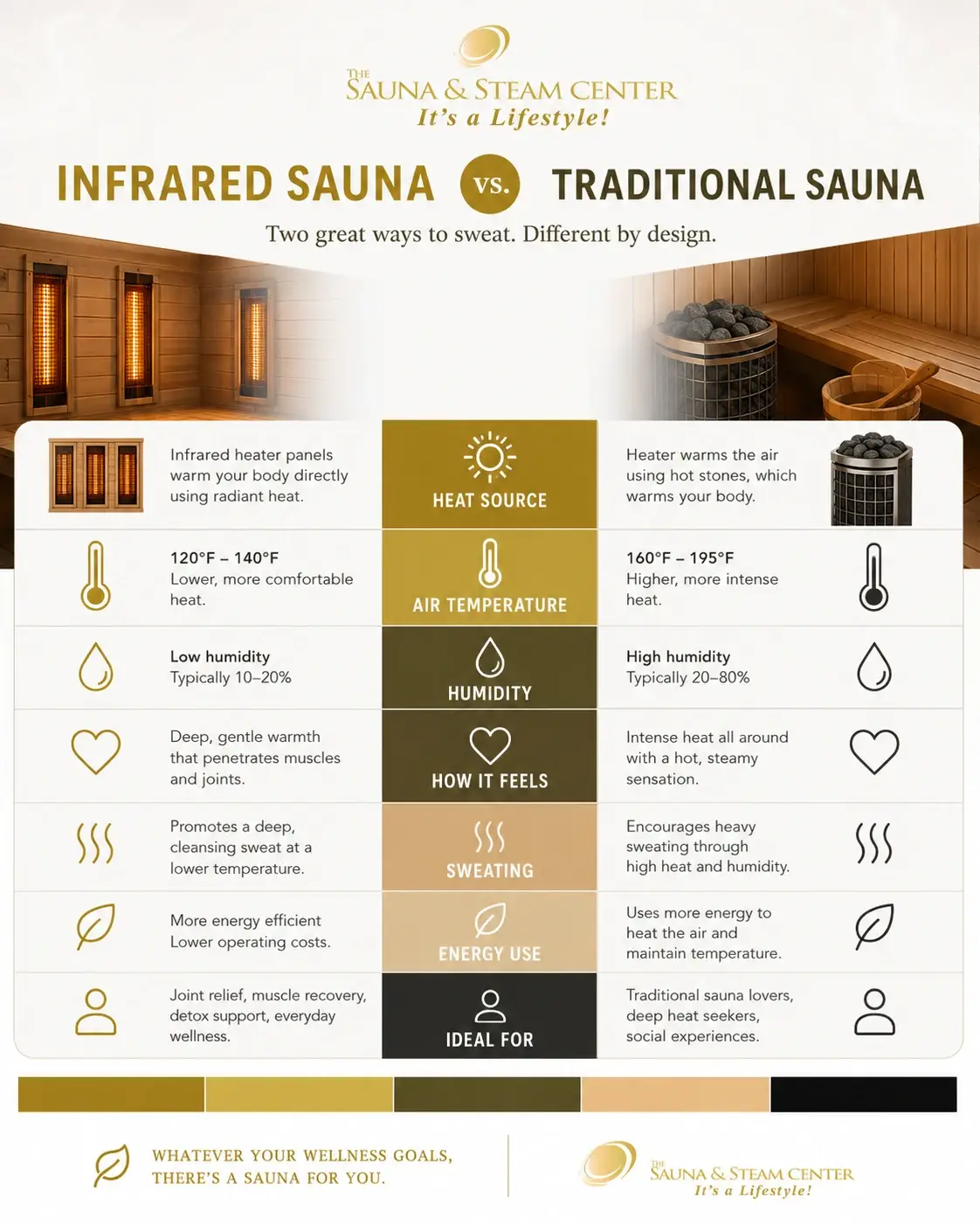
| Factor | Infrared Sauna | Traditional Sauna |
|---|---|---|
| Heat source | Infrared emitters or panels | Electric or wood-burning heater with stones |
| Typical air temperature | Lower, often around 120°F to 140°F | Higher |
| Humidity | Generally dry | Dry heat with temporary humidity from water on approved stones |
| Heating method | Radiant heat | Heated stones and room air |
| Löyly | No traditional löyly | Yes, with a suitable heater |
| Best for | People who prefer lower air temperatures | People who want traditional high heat, stones, and steam bursts |
Neither is universally better. They are different experiences. If this is your main decision, read our complete infrared sauna vs. traditional sauna comparison.
What Does an Infrared Sauna Do to Your Body?
The clearest immediate effect is heat exposure. Your skin warms, you sweat, your blood vessels respond to heat, and your body works to regulate temperature.
A randomized crossover trial in healthy women found that infrared sauna exposure increased body temperature, but the cardiovascular response was not identical to moderate exercise. That matters because claims that sauna is an “exercise replacement” go beyond what the evidence supports.
- Increased skin warmth
- Sweating
- A feeling of relaxation
- Heat-related cardiovascular responses
- Temporary fluid loss through sweat
Sweating is primarily a normal cooling mechanism. It should not be treated as proof that the sauna “detoxes” the body in a medical sense.
Potential Infrared Sauna Benefits
Infrared sauna research is promising in some areas, but the evidence is not strong enough to treat every advertised benefit as established fact.
- Relaxation and comfort
- Responses to passive heat exposure
- Temporary muscle relaxation
- Post-exercise recovery
- Cardiovascular responses to heat
- General wellness routines
Mayo Clinic notes that infrared sauna research has explored several health conditions, but larger and more rigorous studies are still needed. Some broader sauna research involves traditional Finnish sauna rather than infrared technology.
For a deeper evidence review, read our infrared sauna benefits guide.
Are Infrared Saunas Safe?
Infrared saunas are generally used safely by healthy adults, but heat exposure still carries risks. The main practical concerns include dehydration, overheating, dizziness, and using the sauna when heat exposure is medically inappropriate.
- Hydrate before and after your session.
- Leave if you become dizzy, weak, nauseated, confused, or unwell.
- Avoid combining sauna use with alcohol.
- Start with shorter sessions if you are new to heat exposure.
- Follow manufacturer temperature and time guidance.
- Ask a healthcare professional before use if you have a relevant medical condition or take medication that may affect heat tolerance, blood pressure, hydration, or alertness.
Pregnancy, cardiovascular conditions, recent illness, heat intolerance, and certain medications can change what is appropriate. For the fuller safety discussion, see our guide to infrared sauna dangers.
How Long Should You Stay in an Infrared Sauna?
Beginners should start with shorter sessions and increase gradually only if they tolerate the heat well. There is no universal ideal session length because temperature, health status, hydration, and manufacturer guidance all matter.
Cleveland Clinic recommends a conservative “start low and slow” approach for new infrared-sauna users. For a detailed session-length guide, see how long you should stay in a sauna.
What Should You Wear in an Infrared Sauna?
Wear as little as is comfortable and appropriate for the setting. At home, many people use a towel or lightweight breathable clothing. Avoid heavy clothing that traps unnecessary heat.
Our guide on what to wear in an infrared sauna covers towels, clothing, jewelry, footwear, and etiquette in more detail.
What Does “Low EMF” Mean in an Infrared Sauna?
EMF stands for electromagnetic field. All powered electrical devices create electromagnetic fields to some degree, including sauna heaters, wiring, controls, appliances, and electronics.
Some infrared-sauna shoppers compare measured electric and magnetic fields near the seating position. When evaluating claims, ask how the measurement was taken, at what distance, and whether independent documentation is available. Our low EMF sauna guide explains the topic in more detail.
Infrared Sauna Blanket vs. Infrared Sauna Cabin
An infrared sauna blanket and an infrared sauna cabin are different experiences. A blanket wraps closely around the body, while a cabin creates an enclosed room where you sit upright and receive radiant heat from installed emitters.
Blankets are portable and need less space. Cabins provide a more complete sauna environment, permanent seating, controls, lighting, and easier shared use. See our infrared sauna blanket guide if portability is your priority.
How Much Does an Infrared Sauna Cost?
Infrared sauna pricing depends on capacity, heater package, wood, controls, glass, lighting, electrical requirements, delivery, assembly, and brand.
Based on our current South Florida planning ranges, a small professionally installed indoor infrared sauna commonly falls around $3,500 to $7,000. Broader infrared projects can range roughly from $2,200 to $10,000 depending on capacity and equipment. These are planning figures, not binding quotes.
- 1-person vs. 2-person vs. larger cabin
- Far infrared vs. full spectrum
- Wood species and finish quality
- Amount of glass
- Lighting and chromotherapy
- Audio or Bluetooth
- Controls
- Electrical requirements
- Delivery and assembly
- Manufacturer reputation and warranty
Example: Two cabins with similar dimensions can have very different installed costs if one uses a standard household connection and the other requires new electrical work, or if one arrives as easy-to-assemble panels while the other has difficult access or custom finish work.
If pricing is your main question, our guide to how much a home sauna costs explains the full installed budget.
What We Look at When Helping a Homeowner Choose an Infrared Sauna
After more than two decades working with sauna systems, the questions that prevent expensive mistakes are usually practical, not glamorous.
| What We Check | Why It Matters |
|---|---|
| Actual interior bench width | A “2-person” label does not guarantee two adults will be comfortable. |
| Delivery path | The cabin or panels still have to fit through doors, hallways, elevators, and turns. |
| Electrical requirement | Some buyers discover too late that the selected model needs a dedicated circuit. |
| Panel placement | Good coverage around the back, sides, and legs affects how balanced the heat feels. |
| Controls and electronics | These are common service items, so replacement availability matters. |
| Warranty and parts support | A low-cost cabin becomes expensive if a proprietary component fails and cannot be sourced. |
| Room environment | Humidity, floor condition, surrounding temperature, and access affect long-term ownership. |
One of the most common homeowner mistakes: buying by exterior dimensions and feature count before checking whether the cabin is comfortable, serviceable, and electrically practical in the actual room.
Is an Infrared Sauna Worth It?
An infrared sauna can be worth it if you prefer lower surrounding air temperatures, want a compact home wellness setup, and expect to use it regularly. It is less compelling if what you really want is the classic Finnish sauna experience with high room heat, sauna stones, and löyly.
| Infrared May Fit Better If… | Traditional May Fit Better If… |
|---|---|
| You dislike very hot surrounding air. | You want traditional Finnish heat. |
| You want a compact prefabricated cabin. | You want sauna stones and löyly. |
| You expect personal or couple use. | You want a larger social sauna room. |
| You prioritize straightforward home placement. | You are willing to plan around a traditional heater and ventilation system. |
Choosing an Infrared Sauna for Your Home
1. Measure the Space
Measure width, depth, ceiling height, door clearance, and the delivery path. A cabin that fits the floor plan still has to reach the room.
2. Choose Capacity Based on Real Use
If only one person will use it most days, a compact 1-person infrared sauna can preserve space. Couples should compare interior bench width in a 2-person infrared sauna rather than trusting the capacity label alone.
3. Verify Electrical Requirements
Some smaller cabins have relatively simple electrical needs, while larger models may need a dedicated circuit. Use the exact installation manual for the model you buy.
4. Compare Heater Technology
Decide whether you want far infrared only or a full-spectrum system. Then compare emitter layout, controls, warranty, serviceability, and documentation.
5. Think About Service Before the Sale
Ask what happens if a control, emitter, power supply, light, or door component fails several years from now. A low purchase price is less attractive when replacement parts and technical support do not exist.
6. Ask These 8 Questions Before Buying
- What is the exact exterior footprint and interior bench width?
- What electrical circuit does this exact model require?
- Which infrared wavelengths does it use, and where are the emitters located?
- Is the electrical system certified for the U.S. market?
- What parts are covered by warranty, and for how long?
- Where do replacement controls, emitters, and power components come from?
- Who services the sauna locally if something fails?
- What does the total installed cost include beyond the cabin?
If the seller cannot answer those questions clearly, you probably do not have enough information to compare the product fairly.
Infrared Saunas in South Florida
South Florida homeowners should pay particular attention to location, room dimensions, electrical access, humidity around the cabin, delivery access, and service support.
A prefabricated infrared cabin can work well in a home gym, bedroom suite, wellness room, large bathroom, or other properly prepared interior space.
If you are shopping locally, see our current infrared saunas in Miami guide and available models, or visit our Hollywood showroom to compare actual cabin size, wood, seating, controls, and heater layouts.
Frequently Asked Questions About Infrared Saunas
Is an infrared sauna actually a sauna?
Yes. It is a sauna that uses infrared emitters as its primary heat source rather than a traditional heater and sauna stones.
Does an infrared sauna heat the air?
Yes, the air warms, but radiant heating is a major part of how the user experiences heat.
Do you sweat in an infrared sauna?
Yes. Infrared sauna heat can raise skin temperature and trigger sweating even though the air temperature is generally lower than in a traditional sauna.
What is the difference between infrared and far infrared?
Infrared is the broad category. Far infrared is one portion of that spectrum and is the range commonly associated with many infrared sauna cabins.
Is infrared heat the same as red light therapy?
No. Red light therapy is generally discussed as photobiomodulation using red and/or near-infrared light, while an infrared sauna is primarily designed to create a whole-body heat experience.
Is an infrared sauna better than a traditional sauna?
Not universally. Infrared often suits people who prefer lower air temperatures. Traditional sauna suits people who want high room heat, stones, and löyly.
How quickly does an infrared sauna heat up?
Warm-up time varies by model, room temperature, emitter design, and target setting. Follow the exact manufacturer guidance.
Can you use an infrared sauna every day?
Some experienced users sauna frequently, but there is no universal schedule appropriate for everyone. Heat tolerance, hydration, health status, and session length matter.
How long should beginners stay in an infrared sauna?
Start with a short session at a moderate setting, see how you feel, and increase gradually rather than beginning with the longest or hottest session possible.
What temperature should an infrared sauna be?
Many far-infrared cabins operate roughly around 120°F to 140°F, but the correct setting depends on the sauna and user.
Do infrared saunas need special wiring?
Some compact models use simpler household electrical configurations, while others require a dedicated circuit. Use the exact model’s installation manual.
Can an infrared sauna go inside a house?
Yes. Many infrared saunas are designed as indoor prefabricated cabins, provided the location meets the model’s space and electrical requirements.
What size infrared sauna should I buy?
Buy for normal use. A 1-person cabin is efficient for solo use, while couples should compare 2-person bench width carefully.
Are infrared saunas worth the money?
They can be if you value a lower-temperature sauna experience, expect frequent use, and buy a well-supported model that fits your home.
So, Should You Choose an Infrared Sauna?
Choose infrared if you want a lower-air-temperature sauna experience, prefer a compact indoor cabin, expect mostly solo or couple use, and value relatively straightforward home placement.
Choose traditional if the experience you actually want is very hot room air, sauna stones, water, and löyly.
Compare both before buying if you are attracted mainly by health claims. The differences in experience and installation are clearer and more useful buying criteria than assuming one technology is medically superior.
The best next step is not necessarily requesting a quote. It is identifying which question is still unresolved for you, then using the appropriate guide below.
Now You Know What an Infrared Sauna Is. The Next Question Is Which One Fits You.
Choose Your Next Step
- Want the health research? Read our infrared sauna benefits guide.
- Comparing sauna types? Read infrared vs. traditional sauna.
- Concerned about safety? Review infrared sauna dangers and side effects.
- Comparing heater technology? Explore our full-spectrum infrared sauna guide.
- Ready to see real models? Explore our infrared sauna collection.
If you are considering one for your home, send us photographs and approximate measurements of the space. We can help you compare cabin size, heater technology, electrical requirements, installation needs, and long-term service before you buy.
References