Full Spectrum Infrared Sauna: What It Is, Is It Worth It & What to Buy
Quick Answer: What Is a Full Spectrum Infrared Sauna?
A full spectrum infrared sauna is generally a sauna designed or marketed to produce energy across multiple infrared ranges, commonly described as near, mid, and far infrared.
That does not automatically make it better than a far infrared sauna. “Full spectrum” describes claimed wavelength coverage. It is not a recognized quality grade, safety certification, medical certification, high-temperature rating, or guarantee of better health results.
Is a full spectrum infrared sauna worth it? It can be when the manufacturer documents the infrared output, heater coverage is good, the cabin is comfortable, the electrical requirements work for your space, and the additional technology supports how you actually plan to use the sauna.
A full spectrum infrared sauna can sound automatically superior because it promises near, mid, and far infrared energy in one cabin. The reality is more complicated. Buyers should compare the actual wavelength ranges, radiant output, heater placement, temperature capability, session controls, electrical requirements, warranty, service support and construction of the complete sauna rather than choosing one solely because the words “full spectrum” appear on the product page.
Full Spectrum Infrared Sauna: Quick Answers for Buyers
| What Buyers Are Searching | Direct Answer |
|---|---|
| What is a full spectrum infrared sauna? | An infrared sauna designed or marketed to produce multiple infrared wavelength ranges, usually described as near, mid, and far infrared. |
| What does full spectrum sauna mean? | It generally means intentional infrared output across more than one part of the infrared spectrum. Ask for actual wavelength and output documentation rather than relying only on the label. |
| Is a full spectrum infrared sauna worth it? | It can be when the added emitters are documented, useful at normal seating distance, covered by a strong warranty and important to your preferred sauna experience. It is not automatically worth paying more for the label alone. |
| Is full spectrum better than far infrared? | Not automatically. Strong comparative human evidence has not established that near, mid, and far infrared together provide superior general health outcomes compared with a well-designed far infrared sauna. |
| Should I buy a full spectrum or far infrared sauna for my business? | Consider full spectrum when customers specifically request it and the manufacturer can document the technology. Far infrared may be preferable when simplicity, broad radiant coverage, staff training, uptime and serviceability are higher priorities. |
| What types of infrared saunas offer full spectrum and high-heat sessions? | Some premium infrared cabins combine multiple infrared emitter types with higher cabin-temperature capabilities. Other high-heat products are actually infrared-plus-traditional hybrids. Full spectrum and high temperature are separate features and should be verified independently. |
| Can full spectrum infrared saunas have programmable sessions? | Some premium systems offer digital temperature and timer controls, presets, scheduling, Wi-Fi controls or independently controlled heater zones. These functions are model-specific and are not automatically included because a sauna is full spectrum. |
| Does full spectrum mean red light therapy? | No. Red light therapy requires its own wavelength, irradiance, treatment distance and dose documentation. |
| Do different infrared sauna models produce different toxin levels in sweat? | Sweat composition can vary, but current research does not establish that one consumer far infrared sauna model produces a superior toxin-removal profile compared with another. |
| How should I compare infrared sauna warranties? | Compare commercial versus residential coverage, heater warranty, controls, electronics, cabin construction, labor, shipping, parts availability, exclusions and local service support. |
Key Takeaways
- Full spectrum usually refers to a claimed combination of near, mid, and far infrared output.
- Near, mid, and far infrared are useful descriptions, but their exact boundaries can vary by application.
- Full spectrum is not a safety certification, quality grade or medical designation.
- No strong comparative human evidence currently shows that a commercial three-band sauna is automatically more beneficial than a quality far infrared sauna.
- A high-temperature infrared sauna is not automatically full spectrum, and a full spectrum sauna is not automatically high temperature.
- Programmable sessions, Wi-Fi, temperature presets and independent heater controls are separate product features.
- Hybrid, short-wave infrared, chromotherapy, and red light therapy should not be treated as synonyms for full spectrum.
- Commercial buyers should prioritize uptime, commercial warranty coverage, parts availability and local service in addition to heater technology.
- Current research does not establish meaningful model-to-model differences in “detox” performance among consumer far infrared saunas.
- Heater placement, output at seating distance, cabin comfort, electrical planning, safety listings, warranty coverage and service support often matter more in daily ownership than the marketing label.
What Is a Full Spectrum Infrared Sauna?
In the consumer sauna market, a full spectrum infrared sauna generally means a cabin that claims to intentionally emit near, mid, and far infrared energy.
A manufacturer may use separate lamps, ceramic elements, carbon panels, short-wave emitters, LEDs or combination heaters to produce different portions of the infrared spectrum.
What Does “Full Spectrum” Actually Describe?
It describes the claimed range of infrared energy produced by the equipment.
It does not automatically tell you:
- How much infrared energy reaches your body
- How evenly the energy reaches different body areas
- Whether all infrared ranges operate simultaneously
- Whether each range can be independently controlled
- How hot the cabin becomes
- Whether the sauna includes red light therapy
- Whether the sauna is safer than far infrared
- Whether the sauna creates superior health outcomes
Full Spectrum Is Not a Certification
Full spectrum is not an electrical safety listing, medical-device classification, performance standard, commercial-use rating or warranty category.
Those factors need to be evaluated separately.
Is a Full Spectrum Infrared Sauna Worth It?
A full spectrum infrared sauna can be worth it, but only when the additional technology provides something you actually value.
Paying more simply because the words “full spectrum” appear on a product page is not a strong buying strategy.
| Your Situation | Full Spectrum May Be Worth It | Far Infrared May Be the Better Value |
|---|---|---|
| You want several infrared emitter technologies | The manufacturer documents what each emitter produces | You mainly want broad, comfortable radiant warmth |
| You want premium technology | The added technology is measurable and useful | The full spectrum premium is mostly marketing language |
| You want simple daily operation | The controls remain intuitive despite multiple emitters | You prefer straightforward heat, temperature and timer controls |
| You are buying for a business | Customers specifically request full spectrum | Uptime, training and service simplicity matter more |
| You care about high temperatures | The manufacturer separately documents the maximum operating temperature | You are assuming full spectrum automatically means hotter |
| You want long-term ownership value | Warranty, parts and local service justify the premium | A simpler system has stronger service support |
Is a Full Spectrum Infrared Sauna Mostly Marketing?
It is a real technical description that is frequently used as a marketing shortcut.
A sauna can legitimately use technology designed to emit energy across several infrared ranges.
The problem begins when the words “full spectrum” are presented as automatic proof of better quality, deeper penetration, broader detoxification, faster recovery or superior health results without supporting measurements or comparative research.
What Should a Credible Product Page Show?
Ideally, the manufacturer should identify:
- The infrared ranges being produced
- Which heater or component produces each range
- Spectral output data
- Radiant output or irradiance at realistic user distances
- Heater placement
- Whether individual heater types can be controlled separately
- Maximum operating temperature
- Electrical requirements
- Safety documentation
Without those details, buyers may not be able to determine whether the full spectrum label describes a meaningful design or simply broad incidental infrared output.
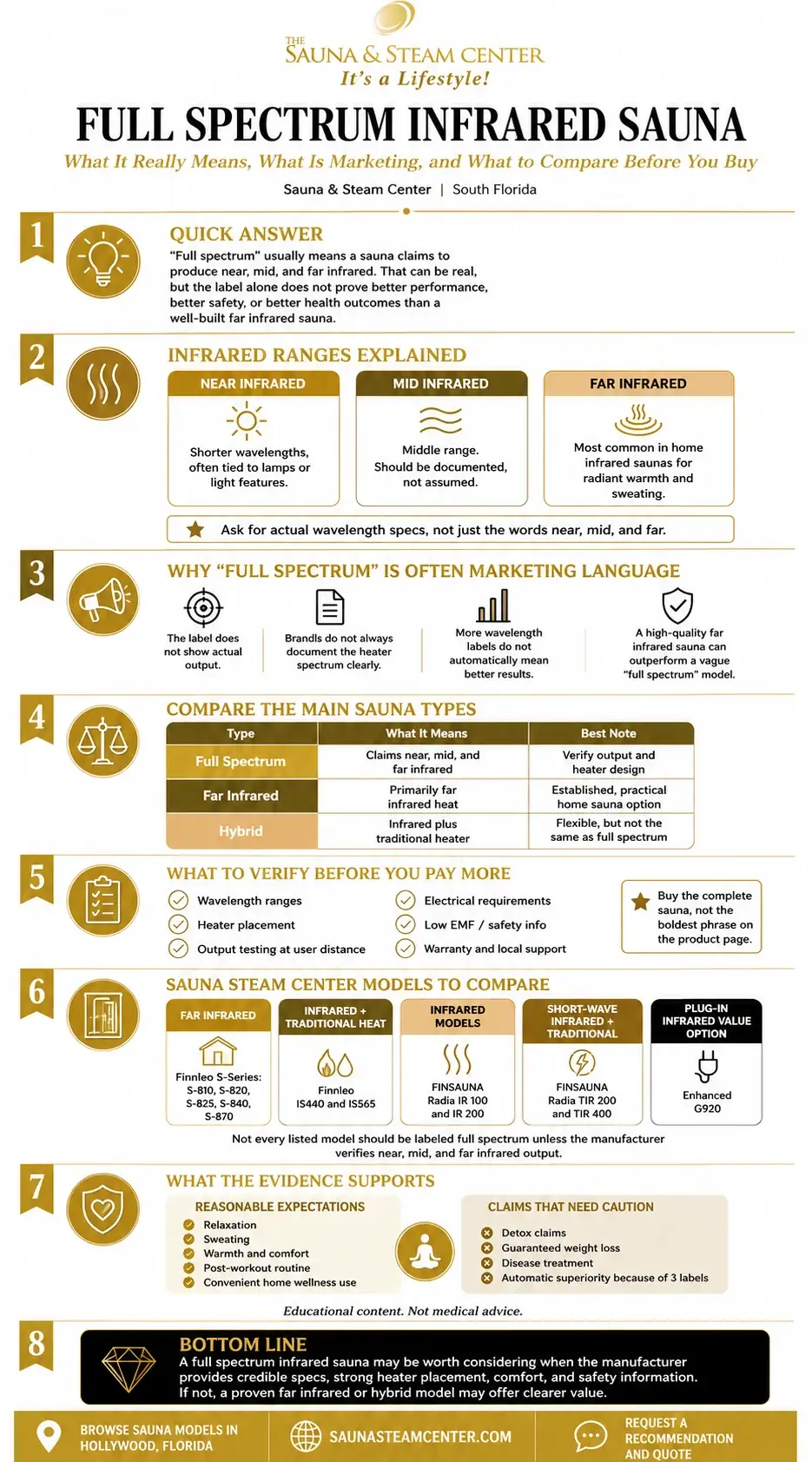
What the Label Does Not Prove
- That useful amounts of energy are emitted in all three ranges
- That the output was measured from the finished sauna
- That the energy reaches the user evenly
- That the sauna delivers red light therapy
- That the cabin reaches traditional sauna temperatures
- That the system is safer than far infrared
- That the sauna removes more toxins
- That the sauna produces better clinical outcomes
How Does a Full Spectrum Infrared Sauna Work?
An infrared sauna uses radiant energy from heated emitters or lamps.
That energy is absorbed by surfaces and the body while the cabin air also becomes warmer over time.
This differs from a traditional sauna, where an electric or wood heater primarily warms the room, stones and surrounding surfaces to create a higher-air-temperature environment.
Why Can Full Spectrum Systems Use Several Heater Types?
One heater technology does not necessarily produce the same output across the complete infrared range.
Shorter-wave sources may operate at higher surface temperatures and feel more directional. Far infrared panels often provide broader radiant coverage.
The actual experience depends on:
- Source temperature
- Wavelength distribution
- Distance from the body
- Heater angle
- Power
- Duty cycle
- Body coverage
- Cabin air temperature
Why Distance and Placement Matter
Radiant exposure changes with distance and geometry.
A heater behind the back can create excellent local warmth without necessarily producing equal front-body exposure.
Likewise, a high-output lamp can lose practical value when positioned too far from the user, blocked by seating or aimed at only a small body area.
Why Total Wattage Is Not Enough
Total wattage describes electrical input. It does not tell you how evenly infrared energy reaches a seated user.
A lower-wattage design with thoughtful heater placement may create a more balanced experience than a higher-wattage design with poor coverage.
Near, Mid, and Far Infrared Explained Without the Sales Hype
Infrared radiation begins beyond visible red light.
The International Commission on Illumination commonly subdivides infrared into:
- IR-A: approximately 780 to 1,400 nanometers
- IR-B: approximately 1,400 to 3,000 nanometers
- IR-C: approximately 3,000 nanometers to 1 millimeter
Consumer sauna companies frequently translate these categories into near, mid and far infrared, although the boundaries used for those terms can vary by application.
| Consumer Term | General Description | Common Sauna Source | What a Buyer Should Verify |
|---|---|---|---|
| Near infrared | Shorter infrared wavelengths closest to visible red light | High-temperature lamps, LEDs or specialty emitters | Exact wavelength, irradiance, distance, coverage and whether the feature is heat or photobiomodulation |
| Mid infrared | Intermediate infrared wavelengths | Broad-spectrum or combination emitters | Published range, spectral graph, output level and which component produces it |
| Far infrared | Longer infrared wavelengths commonly used for radiant cabin heating | Carbon panels, ceramic emitters and other heated surfaces | Coverage, distance, warmup performance and safety documentation |
Be Careful With Exact Penetration-Depth Charts
Sales graphics frequently assign a precise tissue depth and a separate list of health benefits to each infrared band.
Human tissue interaction is more complicated.
Absorption depends on wavelength, output, exposure time, distance, skin properties, water content and source design.
A colored penetration chart is not clinical proof that a commercial sauna treats a medical condition.
What Types of Infrared Saunas Offer Full Spectrum and High-Heat Sessions?
Searchers often assume that full spectrum and high heat describe the same sauna category.
They do not.
Spectrum describes the infrared wavelengths a system claims to produce. Temperature describes the thermal environment the complete cabin can maintain.
| Product Category | Infrared / Heat Format | High-Heat Potential | What to Verify |
|---|---|---|---|
| Full spectrum infrared cabin | Multiple infrared ranges | Model specific | Near, mid and far output plus published maximum cabin temperature |
| High-temperature infrared cabin | Infrared heaters optimized for greater thermal output | Potentially higher than conventional infrared cabins | Actual operating temperature and whether the infrared spectrum is documented |
| Far infrared sauna | Primarily far infrared panels or emitters | Model specific | Coverage, warmup time and published operating temperature |
| Infrared + traditional hybrid | Infrared emitters plus conventional sauna heater | Traditional mode can provide sauna-style high air temperatures | Do not assume the infrared portion is full spectrum |
| Short-wave infrared + traditional sauna | Directional short-wave infrared plus traditional heater | High-temperature traditional mode available | Short-wave infrared does not automatically equal full spectrum |
| Full spectrum + red light system | Infrared heat plus separate light emitters | Depends on sauna heating system | Verify the light wavelengths, irradiance and independent controls separately |
Does Higher Temperature Mean Better Infrared Performance?
No.
Higher cabin temperature can produce a more intense heat experience, but it does not prove better infrared coverage or superior health results.
Choose temperature based on the heat experience you prefer rather than treating maximum temperature as a quality score.
What Infrared Saunas Offer Programmable Full Spectrum and High-Temperature Sessions?
Programmable operation is becoming an important buying feature, especially for home wellness rooms, spas and commercial recovery facilities.
However, “programmable” can mean very different things depending on the manufacturer.
Programmable Features May Include:
- Target temperature settings
- Session timers
- Automatic shutoff
- Preheating schedules
- Saved session presets
- Wi-Fi or app-based controls
- Independent heater zones
- Independent infrared emitter types
- Lighting presets
- Commercial session timers
- User lockouts or administrator controls
Questions to Ask About Programmable Sessions
- Can temperature and time be programmed independently?
- Can individual infrared heater types be turned on or off?
- Are there separate near, mid and far infrared controls?
- Can heater zones be independently adjusted?
- Can sessions be scheduled before the user arrives?
- Does the sauna support Wi-Fi or app controls?
- Can presets be stored?
- Does commercial mode limit session length?
- Is automatic shutdown included?
- What happens after a power interruption?
Are Full Spectrum Infrared Sauna Benefits Scientifically Proven?
Heat exposure and sauna bathing create measurable physiological responses, but the superiority of full spectrum sauna systems has not been established.
An infrared sauna study in healthy women found that the acute response was primarily thermoregulatory, including increased skin temperature, core temperature and sweating.
The study did not establish that three infrared bands outperform far infrared alone.
See the infrared sauna physiological-response study .
A systematic review of dry sauna bathing found potential health benefits but concluded that better-quality research is still needed to clarify adverse effects, optimal frequency, duration, sauna type and the populations most likely to benefit.
Importantly, much of the strongest long-term sauna research involves traditional Finnish sauna bathing rather than commercial full spectrum infrared cabins.
See the systematic review of regular dry sauna bathing and the review focused on Finnish sauna bathing .
The Mayo Clinic notes that infrared sauna research has explored several health conditions but that larger and more precise studies are needed.
What Is Reasonable to Say?
- Infrared sauna use exposes the body to heat.
- Heat exposure can produce sweating.
- Many users find a warm, quiet session relaxing.
- Heat may temporarily soothe tired or tight muscles.
- A home sauna can make a regular heat routine more convenient.
- Lower cabin air temperatures may feel more comfortable to some people than traditional high-temperature sauna bathing.
What Does the Evidence Not Establish?
- That near, mid, and far infrared together produce superior general health outcomes
- That a full spectrum sauna removes clinically meaningful amounts of specific toxins better than other sauna types
- That one consumer infrared sauna brand has a superior detox effect
- That sweating produces permanent fat loss
- That full spectrum sauna use prevents or treats disease
- That chromotherapy or red-colored lighting equals red light therapy
For a broader evidence review, read our Infrared Sauna Benefits Guide .

Full Spectrum Infrared Sauna Evidence at a Glance
| Claim | Evidence Assessment | Practical Interpretation |
|---|---|---|
| Infrared sauna causes warming and sweating | Well supported as an acute thermoregulatory response | This is a realistic core function of the product. |
| Sauna can provide relaxation and temporary muscle comfort | Reasonable, with individual variation | Present it as a wellness experience rather than a guaranteed medical outcome. |
| Full spectrum is better than far infrared | Not established by strong comparative human research | Compare the complete sauna and verified output instead of assuming three bands are superior. |
| Full spectrum plus higher temperature creates greater benefits | Not established | Temperature intensity and wavelength coverage are separate product characteristics. |
| Each infrared band has a unique guaranteed benefit | Overstated | Wavelength alone does not predict a clinical outcome. |
| Full spectrum automatically includes red light therapy | Incorrect | Dedicated light therapy requires specified wavelengths, output, distance and dose. |
| One infrared sauna model detoxifies better because sweat contains more toxins | Not established | Sweat composition studies do not establish model-to-model consumer sauna superiority. |
| Sauna permanently burns fat | Unsupported | Sweating changes fluid balance, not body-fat mass in the way sustained energy balance does. |
Do Far Infrared Sauna Models Produce Different Sweat Toxin Profiles?
This is an increasingly common search question because many sauna products are marketed around “detox” claims.
Human sweat can contain measurable substances including minerals and some environmental contaminants.
However, that observation does not prove that one consumer infrared sauna removes toxins better than another.
What Has Research Actually Measured?
Published research has measured substances such as arsenic, cadmium, lead and mercury in sweat.
A systematic review found substantial variation in:
- Study populations
- Environmental exposure
- Sweat collection methods
- Sweat concentration
- Exercise versus heat exposure
- Measurement techniques
Another small study measured inorganic elements in sweat from people using water-filtered infrared-A heat.
These studies help demonstrate that sweat can contain measurable compounds. They do not establish that one consumer far infrared cabin, heater layout or brand produces a clinically superior detox result.
Why Model-to-Model Claims Are Difficult
A valid comparison would need to control factors such as:
- The same participants
- Hydration status
- Previous environmental exposure
- Session temperature
- Session duration
- Body surface area exposed
- Sweat volume
- Sweat collection technique
- Laboratory analysis
- Diet
- Exercise
- Medication and health status
Full Spectrum vs. Far Infrared, Traditional, and Hybrid Saunas
| Sauna Format | How It Heats | Best For | Main Limitation |
|---|---|---|---|
| Full spectrum infrared | Claims intentional near, mid, and far infrared output | Buyers who want several emitter types and receive credible output documentation | The label alone does not prove dose, even coverage, safety, high temperature or better results |
| Far infrared | Primarily far infrared panels or emitters | Buyers prioritizing even radiant warmth, lower-air-temperature sessions and simpler operation | Does not provide verified red or near-infrared light therapy unless a separate documented system is installed |
| Traditional sauna | Electric or wood heater warms the room and stones | Buyers who want higher air temperatures, sauna stones and the traditional sauna ritual | Often needs more electrical planning and operates at higher room temperatures |
| Far infrared plus traditional hybrid | Far infrared panels plus an electric sauna heater | Households wanting two distinct heat styles in one cabin | Hybrid does not mean near, mid, and far infrared |
| Short-wave infrared plus traditional | Short-wave infrared sources plus a traditional heater | Buyers wanting directional infrared and traditional high heat | Two heat sources do not verify a full spectrum output profile |
Is Full Spectrum Better Than Far Infrared?
Not automatically.
A quality far infrared sauna with broad coverage, documented safety testing, comfortable seating, reliable controls and accessible service can be a better purchase than a full spectrum product with poor documentation or uneven heater placement.
Does Hybrid Mean Full Spectrum?
No.
A hybrid sauna generally combines an infrared heating system with a traditional sauna heater.
For example, Finnleo describes its InfraSauna format as infrared plus traditional sauna heat rather than a verified near, mid and far infrared system.
For a deeper heat-style comparison, read our Infrared vs. Traditional Sauna Guide .
Should I Buy a Full Spectrum or Far Infrared Sauna for My Business?
For a business, the right choice depends more on customer demand, operating cost and serviceability than on the number of infrared bands.
A verified full spectrum sauna may make sense for a spa, wellness studio or recovery business where customers specifically ask for multi-band infrared.
A quality far infrared sauna may be the stronger purchase when you want broad radiant warmth, straightforward operation, easier employee training and fewer specialty components to maintain.
| Business Priority | Full Spectrum May Fit Better | Far Infrared May Fit Better |
|---|---|---|
| Marketing differentiation | Customers specifically search for full spectrum and you can document it accurately | You prefer simple messaging around comfortable infrared heat |
| Customer education | Your staff can accurately explain multiple infrared ranges | You want a simpler experience for staff and guests |
| Session programming | The model offers useful presets or independently controlled heating features | Simple temperature and time controls are sufficient |
| Capital cost | The added technology supports your pricing model | You prefer investing in more capacity, installation quality or additional rooms |
| Session consistency | The manufacturer documents output and heater placement | You prioritize even radiant warmth and repeatability |
| Maintenance and downtime | You have dependable service for the multi-emitter system | You prefer fewer specialty components |
| Warranty | Commercial coverage applies to the complete system | A simpler system offers stronger commercial protection |
Full Spectrum Makes More Sense for a Business When:
- Your customers already ask for full spectrum infrared by name.
- The manufacturer documents near, mid and far infrared output.
- The cabin capacity matches expected appointment volume.
- Your staff can explain the feature without unsupported detox or medical claims.
- Commercial warranty coverage is clear.
- Parts and service are readily available.
- The price premium does not compromise installation or capacity.
Far Infrared Makes More Sense for a Business When:
- You want straightforward operation.
- You value broad heater coverage.
- Staff training should remain simple.
- Uptime and serviceability are priorities.
- Your customers primarily want warmth, sweating, relaxation and private sessions.
- You would rather invest the difference in capacity, room design or service support.
For larger wellness facilities, hotels, gyms and amenity spaces, also review our Commercial Sauna Installation Guide .
How to Compare Warranties and Service Plans for Infrared Saunas
Warranty and service can matter more to long-term ownership than whether the sauna is marketed as full spectrum, far infrared, detox-focused or high heat.
1. Confirm Residential or Commercial Coverage
A warranty that applies to residential ownership may not apply when the sauna is installed in a spa, gym, hotel, recovery facility or other commercial setting.
2. Compare Coverage by Component
Ask separately about:
- Infrared heaters
- Traditional heater, if applicable
- Control boards
- Touchscreens
- Power supplies
- Lighting systems
- Audio components
- Wood cabin construction
- Glass
- Door hardware
- Electrical components
3. Ask Whether Labor Is Included
A replacement component may be covered while diagnostic labor, removal, installation or technician travel is excluded.
4. Ask Who Pays for Shipping
Warranty coverage can become less valuable when the owner must pay substantial freight costs for replacement parts.
5. Ask How Quickly Parts Are Available
For a business, a two-week parts delay can have a much larger financial impact than it would for a residential owner.
6. Verify Local Service
Ask whether the dealer provides service locally or whether troubleshooting is handled remotely by the manufacturer.
7. Read the Environmental Exclusions
Warranties may exclude inappropriate outdoor placement, water exposure, excessive humidity, improper circuits or unauthorized modifications.
8. Ignore “Detox” Language When Comparing Warranty Quality
A sauna marketed around detoxification should be evaluated using the same practical warranty standards as any other electrical appliance.
Marketing claims about sweat or detoxification do not strengthen the equipment warranty.
| Warranty Question | Why It Matters |
|---|---|
| Does commercial use void the warranty? | Critical for gyms, spas and wellness studios. |
| How long are heaters covered? | Heaters are core components of the sauna. |
| How long are electronics covered? | Controls and boards can be expensive service items. |
| Is labor included? | Parts-only warranties may still leave significant repair cost. |
| Who performs service? | Local support can reduce downtime. |
| Are replacement parts stocked? | Availability matters more than warranty length when the sauna cannot operate. |
| What installation conditions are excluded? | Incorrect electrical or environmental placement may void coverage. |
Full Spectrum Infrared Sauna vs. Red Light Therapy
A full spectrum infrared sauna is primarily a heat product. Red light therapy is a light-dose product.
Dedicated photobiomodulation equipment is evaluated using:
- Wavelength
- Irradiance
- Treatment distance
- Exposure time
- Total dose
- Body coverage
Questions to Ask About a Red or Near Infrared Feature
- What exact wavelengths does the source produce?
- What is the measured irradiance at normal seating distance?
- How far is the user’s skin from the source?
- Is the feature designed for heating, ambiance or photobiomodulation?
- Can the light source operate independently from the heaters?
- Does testing apply to the finished sauna or only to an individual component?
Red LEDs, colored ceiling lights and chromotherapy can improve atmosphere, but color alone does not establish a therapeutic light dose.
For more information, read our Red Light Therapy Sauna Guide .
Which Sauna & Steam Center Models Should Full Spectrum Shoppers Compare?
The current Sauna & Steam Center sauna collection includes infrared, far infrared, short-wave infrared plus traditional, and far infrared plus traditional models.
None should be advertised as verified full spectrum unless manufacturer documentation confirms intentional near, mid and far infrared output.
| Model | Documented Heat Format | Capacity and Planning Highlights | Best Fit | Full Spectrum Status |
|---|---|---|---|---|
| Enhanced G920 | Infrared sauna; current product documentation does not publish a verified three-band spectrum | 2 people; compact plug-in configuration | Buyers wanting a compact two-person infrared cabin | Not verified |
| Finnleo S-810 | Finnleo S-Series infrared with wall-to-wall emitter coverage | Compact one-person indoor sauna | Solo users with limited floor space | Not identified as full spectrum |
| Finnleo IS440 InfraSauna | Far infrared panels plus traditional sauna heater | Compact two-person hybrid | Households wanting infrared and traditional heat | Hybrid, not full spectrum |
| Finnleo IS565 InfraSauna | Far infrared coverage plus traditional heater | Larger hybrid format | Families wanting two heat experiences | Hybrid, not full spectrum |
| FINSAUNA Radia IR 100 | Infrared heaters; published product information should be checked for current spectral documentation | Compact solo configuration | Solo infrared use | Not verified |
| FINSAUNA Radia IR 200 | Infrared heaters; no verified three-band spectrum assumed | Two-person configuration | Compact two-user infrared ownership | Not verified |
| FINSAUNA Radia TIR 200 | Short-wave infrared plus traditional heater | Two-person dual-heat format | Couples wanting infrared and traditional heat choices | Dual heat, not automatically full spectrum |
| FINSAUNA Radia TIR 400 | Short-wave infrared plus traditional heater | Larger dual-heat format | Households wanting flexible seating and two heat styles | Dual heat, not automatically full spectrum |

How to Verify a Real Full Spectrum Infrared Sauna Claim
1. Request the Actual Wavelength Ranges
Ask for numbers rather than only the words near, mid and far.
2. Ask for a Spectral Output Graph
The graph should identify the test equipment and operating conditions and clarify whether measurements represent one heater or the complete system.
3. Request Output at Normal User Distance
The presence of a wavelength does not show how much energy reaches the user.
4. Identify Which Component Produces Each Range
Determine whether the ranges come from lamps, LEDs, panels, ceramic emitters or another heating technology.
5. Ask Whether Emitters Can Be Controlled Independently
This is especially important when a seller promotes programmable full spectrum sessions.
6. Inspect Heater Coverage
Review coverage around the back, sides, calves, feet, bench and front of the body.
7. Verify Maximum Operating Temperature
If high-heat sessions matter to you, ask for the manufacturer’s published operating-temperature range.
8. Verify Electrical Safety and Installation Requirements
Confirm voltage, amperage, plug type, dedicated-circuit requirements, cord location, clearances and indoor or outdoor approval.
9. Ask How EMR and EF Were Tested
Request the measurement distance, operating condition and test locations.
Our Low EMF Sauna Guide explains why test conditions matter.
10. Separate Chromotherapy From Red Light Therapy
Colored mood lighting is not proof of a photobiomodulation dose.
What Our Experience Since 2004 Has Taught Us
This section is experience-based guidance, not medical evidence.
Sauna & Steam Center has designed, sold, installed, maintained and repaired sauna and steam systems in South Florida since 2004.
Buyers Often Focus on the Label Before the Room
Customers may begin with full spectrum, low EMF, high-temperature or maximum-wavelength language, but the final fit usually depends on space, seating comfort, electrical access, delivery path, serviceability and preferred heat style.
Capacity Labels Can Be Misleading
A two-person cabin may be comfortable for one user who wants extra room but tight for two larger adults.
Electrical Planning Should Happen Before Delivery
Plug-in does not necessarily mean every household receptacle is appropriate.
Circuit capacity, cord location, breaker size and manufacturer requirements should be confirmed before installation.
South Florida Placement Requires Extra Attention
Humidity, salt air, water intrusion, storms and high ambient temperatures can affect cabins placed in garages, patios or other nonconditioned areas.
The Sauna People Use Regularly Usually Wins
Easy access, comfortable seating, predictable warmup, straightforward controls and convenient towels and water frequently matter more to long-term satisfaction than a long list of technical features.
Full Spectrum Infrared Sauna Buying Guide
Choose Full Spectrum When Documentation Is Strong
Consider a verified full spectrum system when you specifically want several intentional emitter types and the manufacturer supplies credible wavelength and output information.
Choose Far Infrared When Simplicity and Coverage Matter Most
A far infrared model can be a strong fit when your priorities are radiant warmth, sweating, relaxation, straightforward controls and broad heater coverage.
Choose a Hybrid When You Want Higher Heat Too
An infrared plus traditional hybrid can make sense when one user prefers infrared while another wants classic high-temperature sauna bathing.
Do Not Choose a Sauna Solely for “Detox”
Sweating is a normal physiological response to heat, but detox marketing should not replace evaluation of the sauna’s actual construction, heaters, electrical requirements, comfort, warranty or serviceability.
Measure the Room and Complete Delivery Path
Check:
- Final room dimensions
- Doorways
- Hallways
- Stairs
- Elevators
- Turns
- Ceiling height
- Assembly clearance
- Door swing
- Delivery route
Confirm the Electrical Plan
Verify voltage, amperage, plug type, dedicated-circuit requirements, control location, heater requirements and cord reach.
Evaluate Complete Ownership Cost
- Sauna cabin
- Heating system
- Freight
- Delivery
- Assembly
- Electrical work
- Room preparation
- Accessories
- Warranty
- Future parts
- Service
For budget planning, use our Sauna Cost Calculator and review our Home Sauna Cost Guide .
Risks, Limitations, and Overstated Full Spectrum Claims
Well Supported
Infrared sauna use creates heat exposure, increases skin temperature and promotes sweating.
Mixed or Conditional
Research has explored cardiovascular, pain and other outcomes, but study designs, sauna formats, populations and protocols vary.
Results from traditional Finnish sauna research should not automatically be assigned to a commercial full spectrum infrared cabin.
Overstated or Unproven
Claims that three infrared bands guarantee deeper detoxification, permanent fat loss, immune enhancement, disease prevention or superior medical outcomes are not established.
Practical Heat Risks
Immediate concerns can include overheating, dehydration, dizziness, nausea and faintness.
Follow the manufacturer’s instructions, stay hydrated and stop a session if you feel unwell.
Who Should Seek Professional Guidance Before Sauna Use?
Speak with a qualified healthcare professional before beginning sauna use if you are pregnant, have cardiovascular disease or unstable blood pressure, have difficulty regulating body temperature, have a condition affected by dehydration, take medication that changes heat tolerance or fluid balance, or have another medical concern.
Seek qualified electrical or installation guidance when the circuit capacity is uncertain, the sauna requires hard wiring, the intended location is outdoors or nonconditioned, the floor is uneven or moisture-prone, or local permitting requirements may apply.
Compare real specifications, not just labels
Find the Right Infrared or Hybrid Sauna for Your Home or Business
Sauna & Steam Center can help you compare heater formats, temperature capability, programmable controls, dimensions, electrical requirements, seating comfort, warranties, delivery, installation and long-term support.
Full Spectrum Infrared Sauna Frequently Asked Questions
What is a full spectrum infrared sauna?
A full spectrum infrared sauna is a consumer term for a sauna designed or marketed to emit multiple infrared ranges, commonly described as near, mid and far infrared.
What does full spectrum sauna mean?
Full spectrum generally means a sauna claims intentional output across several infrared ranges. Buyers should request actual wavelength and output information rather than relying only on the term.
What is a full spectrum infrared sauna and is it worth it?
It is an infrared sauna that claims to produce near, mid and far infrared energy. It can be worth the additional cost when the manufacturer documents that output, the heater placement is useful, controls meet your needs and warranty and service support are strong. The label alone does not justify a premium.
Is full spectrum infrared better than far infrared?
Not automatically. Strong comparative human evidence has not established that three infrared bands produce better general health outcomes than a quality far infrared sauna.
Should I buy a full spectrum or far infrared sauna for my business?
Choose full spectrum when customers specifically value the feature, the manufacturer documents the system, commercial warranty coverage is strong and the premium supports your business model. Choose far infrared when simplicity, staff training, uptime, serviceability and broad radiant coverage matter more.
What types of infrared saunas offer full spectrum and high-heat sessions?
Some premium infrared cabins combine multiple infrared emitter technologies with higher cabin-temperature capabilities. Other products reach higher temperatures by combining infrared with a traditional sauna heater. Full spectrum and high heat are separate specifications and should be verified independently.
What types of infrared cabins combine full spectrum with sustained high heat?
Some specialized infrared cabins are designed for both multi-band infrared output and higher operating temperatures, while hybrid cabins add a traditional heater to achieve higher air temperatures. Ask the manufacturer to document both the spectrum and temperature range rather than assuming one proves the other.
What product categories include full spectrum infrared cabins that reach sauna-style temperatures?
Potential categories include higher-temperature infrared cabins and infrared-plus-traditional hybrids. However, a hybrid is not automatically full spectrum, and a full spectrum cabin is not automatically capable of traditional sauna temperatures.
What infrared saunas offer programmable full-spectrum high-temperature sessions?
Programmability is model specific. Premium systems may include temperature presets, timers, scheduling, Wi-Fi controls, heater zones or independently controlled emitters. Verify exactly which functions can be programmed and whether different infrared sources can actually be controlled separately.
How do I compare warranties and service plans for an infrared sauna?
Compare residential versus commercial coverage, heater warranty, electronics and control coverage, cabin construction, labor, shipping, parts availability, exclusions, local service and expected repair turnaround.
How should I compare warranties for detox-focused infrared saunas?
Ignore the detox marketing when evaluating warranty quality. Compare the same practical factors you would for any sauna: heaters, electronics, cabin, labor, parts, freight, commercial-use restrictions, exclusions and access to qualified service.
Are there measurable differences in sweat toxin profiles between far infrared sauna models?
Current evidence does not establish clinically meaningful head-to-head differences among consumer far infrared sauna models. Research shows that some substances can be measured in sweat, but study methods and participant exposure vary and should not be used to claim that one consumer sauna detoxifies better than another.
Does full spectrum mean the sauna includes red light therapy?
No. Red light therapy requires specified wavelengths, irradiance, distance, exposure time and dose. Chromotherapy or red-colored cabin lighting is not equivalent to a documented photobiomodulation system.
Does a hybrid sauna count as full spectrum?
No. Hybrid normally means a cabin combines infrared emitters with a traditional sauna heater. The infrared portion may still be far infrared or short-wave infrared rather than verified near, mid and far infrared.
Are full spectrum infrared sauna health benefits proven?
Heat exposure and sweating are well established, and many users enjoy sauna bathing for relaxation and temporary comfort. Current evidence does not prove that commercial three-band infrared saunas are automatically more beneficial than quality far infrared systems.
Is a hotter full spectrum sauna better?
Not automatically. Higher air temperature creates a more intense heat experience but does not prove better infrared output or superior health results.
Do infrared saunas need a special electrical outlet?
Some compact models use 120V plug-in connections, while larger infrared or hybrid models may require dedicated circuits or 240V hard-wired service. Confirm the exact model specifications before installation.
Conclusion: Is a Full Spectrum Infrared Sauna the Right Choice?
A full spectrum infrared sauna can be a legitimate premium product when the system intentionally produces documented infrared output across multiple wavelength ranges.
The mistake is treating the words “full spectrum” as automatic proof of better performance, higher temperatures, stronger detoxification or better health outcomes.
For homeowners, compare heater coverage, comfort, temperature range, electrical requirements, controls, construction, warranty and service.
For commercial buyers, add customer demand, programmable operation, daily usage, downtime, parts availability and commercial warranty coverage to the decision.
References
-
International Commission on Illumination (CIE)
Infrared radiation definition and spectral subdivisions, including IR-A, IR-B and IR-C.
-
Hussain J, et al.
Infrared Sauna as Exercise-Mimetic? Physiological Responses to Infrared Sauna and Exercise.
Research examining acute physiological responses to infrared sauna exposure.
-
Hussain J, Cohen M.
Clinical Effects of Regular Dry Sauna Bathing: A Systematic Review.
Evidence review examining published research on sauna bathing and health outcomes.
-
Laukkanen JA, et al.
Review of sauna bathing and health with emphasis on Finnish sauna research.
-
Mayo Clinic
Do Infrared Saunas Have Any Health Benefits?
Overview of infrared sauna evidence and the limitations of current research.
-
Genuis SJ, Birkholz D, Rodushkin I, Beesoon S.
Arsenic, Cadmium, Lead, and Mercury in Sweat: A Systematic Review.
Review of human studies measuring toxic elements in sweat and the substantial variation in populations, collection techniques and measurements.
-
Water-Filtered Infrared-A Sweat Study
Study measuring inorganic ions in sweat from 22 participants exposed to water-filtered infrared-A sauna conditions.
-
Cleveland Clinic
Infrared sauna wellness and safety guidance, including hydration and heat-tolerance considerations.
Full Spectrum Infrared Sauna: What It Means, How It Works & What to Buy
Quick Answer: What Does Full Spectrum Infrared Sauna Mean?
Full spectrum infrared sauna usually means a sauna designed or marketed to produce near, mid, and far infrared energy. The phrase describes claimed wavelength coverage, not a recognized quality grade, medical certification, or guarantee that the sauna is better than a well-designed far infrared model.
For a home buyer: choose full spectrum only when the manufacturer documents actual wavelength ranges, output at normal seating distance, heater placement, safety testing, warranty and service support. For a business: full spectrum can make sense when customers specifically ask for it and the premium is supported by credible specifications. Far infrared can be the stronger commercial choice when simplicity, broad radiant coverage, predictable operation, staff training and serviceability matter more.
A full spectrum label tells you what spectral range a seller claims the equipment produces. It does not tell you how much energy reaches your body, whether all three ranges are intentionally generated, whether the sauna provides a therapeutic light dose, or whether three wavelength categories create better outcomes than one.
This evidence-first guide explains what the term means, why it is frequently oversold, what sauna research actually supports, how full spectrum differs from far infrared, red light therapy, and hybrid heat, and which models in the current Sauna Steam Center sauna collection are the closest practical alternatives.
Full Spectrum Infrared Sauna: Quick Answers for Buyers
| Question | Direct Answer |
|---|---|
| What does full spectrum sauna mean? | It generally means the sauna claims intentional output across near, mid and far infrared ranges. |
| What is a full spectrum infrared sauna? | An infrared sauna using one or more emitter technologies intended to produce multiple infrared wavelength ranges instead of far infrared alone. |
| Is full spectrum better than far infrared? | Not automatically. Strong comparative human evidence has not established that adding all three ranges produces superior general health outcomes. |
| Should I buy full spectrum or far infrared for my business? | Choose full spectrum when verified multi-band output supports your positioning and customers value it. Choose far infrared when simplicity, broad coverage, predictable operation, serviceability and value matter more. |
| Does full spectrum include red light therapy? | No. A sauna needs separate wavelength, irradiance, distance and dose documentation before a light feature should be treated as photobiomodulation. |
| What should I verify before buying? | Actual wavelength ranges, spectral output, irradiance at user distance, heater coverage, electrical requirements, complete-unit safety listings, warranty, parts and service. |
Key Takeaways
- Full spectrum usually refers to a claimed combination of near, mid, and far infrared output.
- The International Commission on Illumination notes that near, middle, and far infrared boundaries can vary by application, so actual wavelength data matter more than the label.
- No strong clinical evidence currently shows that a commercial three-band sauna is automatically more beneficial than a quality far infrared sauna.
- Hybrid, short-wave infrared, chromotherapy, and red light therapy are separate concepts and should not be treated as synonyms for full spectrum.
- Heater placement, output at seating distance, cabin comfort, electrical planning, safety listings, warranty coverage, and service support usually matter more in daily ownership.
- The models currently shown in Sauna Steam Center’s 2026 collection should be described by their documented heater formats, not automatically grouped under the full spectrum label.
Is a Full Spectrum Infrared Sauna Mostly Marketing?
It is a real technical description that is often used as a marketing shortcut. A system can intentionally produce energy across several infrared ranges. The problem begins when the words full spectrum are presented as proof of better quality, deeper penetration, broader detoxification, faster recovery, or superior health results without supporting measurements or comparative research.
A trustworthy product page should explain which components produce each range, provide the wavelength ranges, show radiant output or irradiance at a realistic distance, identify the testing method, and describe whether each source operates simultaneously or separately. Without those details, shoppers cannot tell whether the label describes a meaningful design or simply a small amount of incidental output across a broad spectrum.
Why the Label Sounds More Definitive Than It Is
The phrase combines three scientific-sounding categories and suggests completeness. In practice, infrared categories are classification tools, not benefit scores. The International Commission on Illumination divides infrared into IR-A, IR-B, and IR-C and specifically notes that the boundaries used for near, middle, and far infrared vary depending on the application.
What the Label Does Not Prove
- That useful amounts of energy are emitted in all three ranges
- That the output was measured from the finished sauna
- That the energy reaches the user evenly
- That the sauna delivers red light therapy
- That the system is safer than far infrared
- That the sauna produces better clinical outcomes
Bottom line: Full spectrum is meaningful only when the seller can show what the system emits and how the complete sauna performs.
What Does Full Spectrum Infrared Sauna Mean?
In the consumer sauna market, a full spectrum infrared sauna generally means a cabin that claims to emit near, mid, and far infrared energy. A manufacturer may use separate lamps, ceramic elements, carbon panels, short-wave emitters, LEDs, or combination heaters to create that output.
The term does not require one universal heater design. One product may use intense short-wave lamps in front of the user and far infrared panels behind the user. Another may use broad-spectrum ceramic emitters. A third may add near infrared LEDs to a far infrared cabin. These designs can feel different, warm the body differently, and require different distances and controls even though all three are sold under the same label.
Full Spectrum Is Not a Certification
Full spectrum is not an electrical safety listing, medical-device classification, performance standard, or warranty category. Safety listings, manufacturer documentation, electrical requirements, and construction details must be evaluated separately.
How Does a Full Spectrum Infrared Sauna Work?
An infrared sauna uses radiant energy from heated emitters or lamps. That energy is absorbed by surfaces and the body, while the cabin air also becomes warmer over time. This differs from a traditional sauna, where an electric or wood heater primarily warms the room, stones, and surrounding surfaces to create a high-temperature environment.
In a full spectrum design, different emitters may be used because one heater technology does not necessarily deliver the same output across the complete infrared range. Shorter-wave sources often run hotter and may feel more directional. Far infrared panels commonly provide broader, gentler radiant coverage. The user’s experience depends on source temperature, distance, angle, power, duty cycle, and body coverage, not simply the number of wavelength categories listed.
Why Distance and Placement Matter
Radiant exposure changes with distance and geometry. A heater behind the back can create excellent local warmth but may not provide balanced front-body coverage. A high-output lamp can lose practical value if it is positioned too far away, blocked by a bench, or aimed at a small area. Compare where the heaters are placed around the back, sides, calves, feet, and front of the body.
Why Total Wattage Is Not Enough
Total wattage describes electrical input, not how evenly the energy reaches a seated user. A lower-wattage design with thoughtful coverage can feel more balanced than a higher-wattage design with poor placement. Ask how the system was tested from normal seating positions.
Near, Mid, and Far Infrared Explained Without the Sales Hype
Infrared radiation begins beyond visible red light. The CIE commonly subdivides it into IR-A from 780 to 1,400 nanometers, IR-B from 1,400 to 3,000 nanometers, and IR-C from 3,000 nanometers to 1 millimeter. Consumer sauna brands often translate these into near, mid, and far infrared, but the category borders are not applied identically in every field.
| Consumer term | General description | Common sauna source | What a buyer should verify |
|---|---|---|---|
| Near infrared | Shorter infrared wavelengths closest to visible red light | High-temperature lamps, LEDs, or specialty emitters | Exact wavelength, irradiance, distance, coverage, and whether the feature is heat or photobiomodulation |
| Mid infrared | Intermediate infrared wavelengths | Broad-spectrum or combination emitters | Published range, spectral graph, output level, and which component produces it |
| Far infrared | Longer infrared wavelengths commonly used for radiant cabin heating | Carbon panels, ceramic emitters, and other heated surfaces | Coverage, distance, warmup performance, EMR and EF test conditions, and safety documentation |
Be Careful With Exact Penetration-Depth Charts
Sales graphics often assign one precise tissue depth and a separate list of medical benefits to each band. Human tissue interaction is more complex. Absorption depends on wavelength, output, exposure time, distance, skin properties, water content, and source design. A colored penetration chart is not clinical proof that a commercial sauna treats a condition.
Are Full Spectrum Infrared Sauna Benefits Scientifically Proven?
Heat exposure and sauna bathing create measurable physiological responses, but the superiority of full spectrum sauna systems has not been established. An infrared sauna study in healthy women found that the acute response was driven mainly by thermoregulation rather than an exercise-like cardiovascular stimulus. The authors described increased skin and core temperature and sweating, but their findings do not establish that three infrared bands outperform far infrared alone. See the 2022 infrared sauna study.
A systematic review of dry sauna bathing found potential health benefits but concluded that higher-quality data are needed to clarify adverse effects, optimal frequency, duration, sauna type, and the populations most likely to benefit. Importantly, much of the strongest long-term evidence involves traditional Finnish sauna bathing, not commercial full spectrum cabins. See the systematic review of regular dry sauna bathing and the 2024 review focused on Finnish sauna.
The Mayo Clinic notes that studies have explored infrared sauna use for several chronic conditions but that larger and more precise studies are needed, and some evidence comes from regular rather than infrared saunas. This supports a careful conclusion: sauna use may be a reasonable wellness practice for many people, but the full spectrum label should not be treated as a treatment claim.
What Is Reasonable to Say
- Infrared sauna use exposes the body to heat and can produce sweating.
- Many users find a warm, quiet session relaxing.
- Heat may temporarily soothe tired or tight muscles.
- A home sauna can make a regular heat routine more convenient.
- Lower cabin temperatures may feel more tolerable to some users than traditional high-air-temperature sauna bathing.
What the Evidence Does Not Establish
- That near, mid, and far infrared together produce superior general health outcomes
- That a full spectrum sauna removes specific toxins in clinically meaningful amounts
- That sweating creates permanent fat loss
- That full spectrum sauna use prevents or treats disease
- That chromotherapy or red-colored lighting equals red light therapy
For a broader review of realistic wellness claims, read our infrared sauna benefits guide.
Evidence at a Glance
| Claim | Evidence assessment | Practical interpretation |
|---|---|---|
| Infrared sauna causes warming and sweating | Well supported as an acute thermoregulatory response | This is a realistic core function of the product. |
| Sauna can provide relaxation and temporary muscle comfort | Reasonable, with individual variation | Present it as a wellness experience, not a guaranteed medical result. |
| Full spectrum is better than far infrared | Not established by strong comparative human research | Compare the complete sauna and verified output instead of assuming three bands are superior. |
| Each infrared band has a unique guaranteed benefit | Overstated | Wavelength alone does not predict a clinical outcome. |
| Full spectrum automatically includes red light therapy | Incorrect | Dedicated light therapy requires specified wavelengths, output, distance, and dose. |
| Sauna permanently burns fat or creates medical detoxification | Unsupported or misleading as commonly advertised | Sweating changes fluid balance; it is not a substitute for fat loss or medical treatment. |
Bottom line: The strongest evidence supports heat exposure and its immediate physiological effects. It does not prove that the full spectrum label creates an extra tier of health benefit.
Full Spectrum vs. Far Infrared, Traditional, and Hybrid Saunas
| Sauna format | How it heats | Best for | Main limitation |
|---|---|---|---|
| Full spectrum infrared | Claims intentional near, mid, and far infrared output | Buyers who want multiple emitter types and receive credible output documentation | The label alone does not prove dose, even coverage, safety, or better results |
| Far infrared | Primarily far infrared panels or emitters | Buyers prioritizing even radiant warmth, a lower-air-temperature experience, and simpler operation | Does not provide verified red or near infrared light therapy unless a separate documented system is installed |
| Traditional Finnish sauna | Electric or wood heater warms the room and stones | Buyers who want classic higher air temperatures, stones, and the traditional sauna ritual | Often needs more electrical planning and operates at higher room temperatures |
| Far infrared plus traditional hybrid | Far infrared panels plus an electric sauna heater | Households that want two distinct heat styles in one cabin | Hybrid does not mean near, mid, and far infrared |
| Short-wave infrared plus traditional | Short-wave infrared sources plus a traditional heater | Buyers who want directional infrared and traditional heat options | Two heat sources still do not verify a full spectrum output profile |
Is Full Spectrum Better Than Far Infrared?
Not automatically. A quality far infrared sauna with broad coverage, documented safety testing, comfortable seating, reliable controls, and accessible service can be a better purchase than a full spectrum product with weak documentation and uneven heaters.
Does Hybrid Mean Full Spectrum?
No. Finnleo describes its InfraSauna format as a combination of infrared heat and traditional sauna heat in one room. The official IS440 and IS565 documentation identifies dual heating modes, not a near, mid, and far infrared certification.
For a deeper heat-style comparison, read infrared vs. traditional sauna.
Should I Buy a Full Spectrum or Far Infrared Sauna for My Business?
For most commercial buyers, the right choice depends more on the customer experience and operating model than on the number of infrared bands. A verified full spectrum sauna can be useful when your spa, wellness studio, recovery business or premium amenity specifically markets multi-band infrared and customers understand what they are paying for. A quality far infrared sauna can be the better business purchase when you want broad radiant coverage, straightforward operation, easier staff training and fewer features to explain or service.
| Business Priority | Full Spectrum May Fit Better | Far Infrared May Fit Better |
|---|---|---|
| Marketing differentiation | Your market actively searches for full spectrum and you can document it accurately | You prefer simple, evidence-aware messaging around infrared heat |
| Customer education | Your staff can explain near, mid and far infrared without medical promises | You want a simpler experience that is easy for staff and guests to understand |
| Capital cost | The added emitter technology and premium support your business model | You want to invest more in cabin quality, capacity, installation or additional units |
| Session consistency | The manufacturer documents output and heater placement from normal user positions | You prioritize even radiant warmth and repeatable sessions |
| Maintenance and downtime | You have reliable parts and service for the specific multi-emitter system | You prefer a simpler heater system with fewer specialty components |
| Premium service menu | You want a premium infrared feature without unsupported treatment claims | Your revenue comes mainly from access, memberships or general heat sessions |
Full Spectrum Makes More Sense for a Business When…
- Your customers already ask for full spectrum infrared by name.
- The manufacturer documents near, mid and far infrared output from the finished system.
- The cabin capacity matches your expected appointment or membership volume.
- Your staff can explain the feature accurately without detox, disease-treatment or guaranteed recovery claims.
- The price premium does not compromise installation quality, electrical work, warranty or service support.
Far Infrared Makes More Sense for a Business When…
- You want a straightforward infrared experience employees can operate and explain easily.
- You value broad heater coverage and comfortable repeatable heat more than a multi-band marketing feature.
- Uptime, serviceability and operating simplicity are major priorities.
- Your customers mainly want warmth, sweating, relaxation and a quiet private session.
- You would rather spend the difference on capacity, room design, warranty or local support.
Questions a Business Owner Should Ask Before Ordering
- Is the model approved for the intended commercial environment?
- What commercial warranty applies?
- What are the voltage, amperage and dedicated-circuit requirements?
- What exact wavelengths and output levels are documented?
- How many paid sessions or users per day is the cabin designed to support?
- Can staff control different emitters independently?
- What parts commonly require replacement?
- Who services the unit locally?
- How quickly can parts be sourced?
- How much downtime would a repair create?
For larger wellness facilities, hotels, gyms and amenity spaces, also review our commercial sauna installation guide.
Full Spectrum Infrared Sauna vs. Red Light Therapy
A full spectrum infrared sauna is primarily a heat product. Red light therapy is a light-dose product. Dedicated photobiomodulation equipment is evaluated by wavelength, irradiance, treatment distance, exposure time, and total dose. Sauna lighting marketed as chromotherapy or mood lighting should not be assumed to provide the same exposure.
Questions to Ask About a Red or Near Infrared Feature
- What exact wavelengths does the source produce?
- What is the measured irradiance at the normal seating distance?
- How far is the user’s skin from the source?
- Is the feature designed for cabin heating, ambiance, or photobiomodulation?
- Can the light source operate independently from the heaters?
- Does the testing apply to the finished sauna or only to an individual component?
Red LEDs, colored ceiling lights, and a chromotherapy panel can improve atmosphere, but color alone does not establish a therapeutic light dose.
Which Sauna Steam Center Models Should Full Spectrum Shoppers Compare?
The current Sauna Steam Center sauna collection includes infrared, far infrared, short-wave infrared plus traditional, and far infrared plus traditional models. The table below summarizes the specifications currently published on the linked collection and product pages. None of these models should be advertised as full spectrum unless additional manufacturer documentation verifies intentional near, mid, and far infrared output.
| Model | Documented heat format | Capacity and planning highlights | Best fit | Full spectrum status |
|---|---|---|---|---|
| Enhanced G920 | Infrared sauna; the product page does not publish a three-band spectrum | 2 people; approximately 40 x 48 x 75 inches; 15-amp plug-in; Canadian Hemlock; interior control and Bluetooth audio | Value-focused buyers wanting a compact plug-in two-person cabin | Not verified |
| Finnleo S-810 | Finnleo S-Series infrared with wall-to-wall emitter coverage; Finnleo markets the S-Series as infrared sauna technology rather than full spectrum | 1 person; 36 x 36 x 76.5 inches; 120V, 15 amp; indoor use; Wi-Fi-capable control | Solo users with limited floor space who value established heater coverage | Not identified as full spectrum |
| Finnleo IS440 InfraSauna | Wall-to-wall low EMR and low EF far infrared panels plus a Piccolo Mini traditional heater | 2 people; 48.25 x 48.25 x 80 inches; 120V plug-in with 15-amp or 20-amp configurations listed | Compact households wanting infrared and traditional heat in one unit | Hybrid, not full spectrum |
| Finnleo IS565 InfraSauna | Low EMR and low EF far infrared coverage plus a 6.0 kW traditional heater | Up to 5 seated adults or 2 lying down; approximately 72.75 x 61.75 x 80 inches; 240V hard-wired, 30 amp | Families wanting room and two selectable heat experiences | Hybrid, not full spectrum |
| FINSAUNA Radia IR 100 | High-emissivity infrared heaters; the product page does not publish near, mid, and far output | 1 person; exterior approximately 38 x 38 x 78 inches; standard-outlet positioning; product page lists UL safety and up to 170 degrees Fahrenheit in under one hour | Solo buyers prioritizing compact dimensions and fast warmup claims | Not verified |
| FINSAUNA Radia IR 200 | High-emissivity infrared heaters; no published three-band spectrum on the product page | 2 people; exterior approximately 48 x 44 x 78 inches; standard-outlet positioning; product page lists UL safety and up to 170 degrees Fahrenheit in under one hour | Two users wanting a compact indoor infrared cabin with straightforward controls | Not verified |
| FINSAUNA Radia TIR 200 | Short-wave infrared heaters plus a traditional heater | 2 people; exterior approximately 48 x 48 x 83 inches; two-tier seating; product page lists standard-outlet operation | Couples wanting short-wave infrared and traditional heat choices | Dual heat, not verified full spectrum |
| FINSAUNA Radia TIR 400 | Short-wave infrared heaters plus a traditional heater | Up to 4 people; exterior approximately 75 x 64 x 83 inches; two-tier seating; product page lists standard-outlet operation | Larger households wanting flexible seating and two heat formats | Dual heat, not verified full spectrum |
Best Choice by Buyer Priority
- Smallest solo footprint: Finnleo S-810 or Radia IR 100
- Compact plug-in value: Enhanced G920
- Two heat styles in a compact cabin: Finnleo IS440
- Family-size infrared plus traditional heat: Finnleo IS565
- Short-wave infrared plus traditional heat: Radia TIR 200 or TIR 400
Review the complete 2026 sauna collection and the individual product pages before ordering because availability and specifications can change.
How to Verify a Real Full Spectrum Infrared Sauna Claim
A buyer does not need specialized laboratory training, but a manufacturer or seller should be able to answer the following questions without relying on a benefit chart.
1. Request the Actual Wavelength Ranges
Ask for numbers, not only the words near, mid, and far. Confirm which classification system the company uses.
2. Ask for a Spectral Output Graph
The graph should identify the test equipment, operating condition, and whether the measurement represents the complete heater, an individual component, or the finished cabin.
3. Request Output at Normal User Distance
The presence of a wavelength does not show how much energy reaches the user. Ask for radiant output or irradiance at the seating distance used in the sauna.
4. Identify Which Component Produces Each Range
Determine whether the ranges come from separate lamps, LEDs, panels, ceramic emitters, or incidental heat. Ask whether they can be controlled independently.
5. Inspect Heater Coverage
Review the back, sides, calves, feet, bench, floor, and front-body coverage. Evenness may matter more to comfort than the broadness of the label.
6. Verify Electrical Safety and Installation Requirements
Confirm the safety listing for the complete unit, voltage, amperage, plug type, dedicated-circuit requirement, cord location, clearances, and indoor or outdoor approval.
7. Ask How EMR and EF Were Tested
Request the measurement distance, operating condition, locations tested, and whether the results apply to the assembled cabin. Our low EMF sauna guide explains why test conditions matter.
8. Separate Chromotherapy From Red Light Therapy
Colored mood lighting is not proof of a photobiomodulation dose. Ask for wavelength and irradiance data for any red light or near infrared therapy claim.
What Our Experience Since 2004 Has Taught Us
This section is experience-based guidance, not medical evidence. Sauna & Steam Center has designed, sold, installed, maintained, and repaired sauna and steam systems in South Florida since 2004. Our practical experience is most relevant to product selection, placement, electrical planning, delivery, climate, assembly, service, and long-term use.
Buyers Often Focus on the Label Before the Room
A customer may begin with full spectrum, low EMF, or maximum-temperature language, but the final fit usually depends on available space, comfortable seating, electrical access, delivery path, serviceability, and preferred heat style. A technically impressive feature does not help if the cabin is cramped or difficult to use.
Capacity Labels Can Be Misleading
A two-person cabin may be comfortable for a solo user who wants extra room but close for two larger adults. Interior bench dimensions and legroom are more useful than the capacity number alone. Sit in a comparable cabin when possible.
Electrical Planning Should Happen Before Delivery
Plug-in does not always mean any receptacle will work. Shared circuits, older wiring, cord location, breaker capacity, and manufacturer requirements can affect placement. Confirm the exact model with a licensed electrician when the circuit is uncertain.
South Florida Placement Requires Extra Attention
Humidity, salt air, water intrusion, storms, insects, and high ambient temperatures can affect cabins placed in garages, patios, or nonconditioned rooms. Use only locations approved by the manufacturer and avoid assuming an indoor sauna can be moved outdoors under a simple cover.
The Sauna People Use Regularly Usually Wins
Easy access, comfortable seating, predictable warmup, straightforward controls, and nearby towels and water often contribute more to long-term satisfaction than a long feature list. Choose a system that fits your actual routine.
Our Hollywood showroom gives buyers a place to compare cabin sizes, materials, seating, controls, and installation requirements before ordering.
Full Spectrum Infrared Sauna Buying Guide: How to Choose the Right System
Choose This When Full Spectrum Documentation Is Strong
Consider a verified full spectrum model when you specifically want several intentional emitter types, the manufacturer supplies wavelength and output documentation, the heater coverage is appropriate, and the price premium still makes sense after comparing construction, warranty, and support.
Choose Far Infrared When Simplicity and Coverage Matter Most
A far infrared model can be a strong fit when your goals are radiant warmth, sweating, relaxation, compact installation, and straightforward controls. Do not treat far infrared as inferior merely because it uses fewer marketing categories.
Choose a Hybrid When Household Preferences Differ
A true infrared plus traditional hybrid can be useful when one user prefers lower-temperature radiant sessions and another prefers a traditional high-heat experience. Confirm whether the modes operate separately and what electrical service the traditional heater requires.
Not Ideal When Your Main Goal Is Dedicated Red Light Therapy
A sauna may not be the most efficient purchase when your primary goal is a measured photobiomodulation dose rather than heat exposure. Compare dedicated devices using wavelength, irradiance, distance, treatment area, and dose.
Measure the Room and Complete Delivery Path
Check the final room, doorways, hallways, turns, stairs, elevators, ceiling height, assembly clearance, door swing, and the route from the delivery point. Finished dimensions do not always show how much space is needed to raise wall or ceiling panels during assembly.
Confirm the Electrical Plan
Verify voltage, amperage, plug type, dedicated-circuit needs, control location, heater requirements, and cord reach. Larger hybrid models may require 240V hard-wired service even when smaller infrared cabins are plug-in.
Evaluate the Complete Ownership Cost
- Sauna cabin and heating system
- Freight or local delivery
- Inside delivery and final placement
- Professional assembly when needed
- Electrical work
- Floor or room preparation
- Accessories and control upgrades
- Future parts and service
For budget planning, use our sauna cost calculator and review the home sauna cost breakdown. For placement and setup support, see our sauna installation in South Florida page.
Risks, Limitations, and Overstated Full Spectrum Claims
Well Supported
Infrared sauna use creates heat exposure, increases skin temperature, and promotes sweating. Users may experience relaxation and temporary comfort, but individual tolerance varies.
Mixed or Conditional
Research has explored cardiovascular, pain, and other outcomes, but study designs, sauna formats, populations, and protocols vary. Observational findings do not prove causation, and results from traditional Finnish sauna studies should not automatically be assigned to a commercial full spectrum cabin.
Overstated or Unproven
Claims that three infrared bands guarantee deeper detoxification, permanent fat loss, immune enhancement, disease prevention, or superior medical outcomes are not established. Claims about red light therapy also require their own wavelength and dose documentation.
Practical Heat Risks
The main immediate concerns are overheating, dehydration, dizziness, nausea, faintness, and problems related to unsafe electrical installation or inappropriate placement. Stop the session if you feel unwell. The Cleveland Clinic infrared sauna guidance recommends beginning conservatively, staying hydrated, avoiding alcohol, and leaving if dizziness or nausea occurs.
Bottom line: More heat, more session time, and more wavelength categories are not automatically better. Use a gradual, comfortable routine and follow the manufacturer’s instructions.
Who Should Seek Professional Guidance Before Sauna Use?
Speak with a qualified healthcare professional before beginning sauna use if you are pregnant, have cardiovascular disease or unstable blood pressure, have difficulty regulating body temperature, have a condition affected by dehydration, take medication that changes heat tolerance or fluid balance, or have another medical concern. This is especially important when you are considering frequent or high-temperature sessions.
Seek qualified electrical or installation guidance when the circuit capacity is uncertain, the sauna requires hard wiring, the intended location is outdoors or nonconditioned, the floor is uneven or moisture-prone, or local permitting and code requirements may apply.
Compare real specifications, not just labels
Find the Right Infrared or Hybrid Sauna for Your Home
Sauna & Steam Center can help you compare verified heater formats, dimensions, electrical requirements, seating comfort, delivery access, installation, and long-term support. Visit our Hollywood showroom or request a recommendation based on your space and preferred heat style.
Frequently Asked Questions
What does full spectrum sauna mean?
Full spectrum sauna generally means an infrared sauna that claims intentional output across near, mid and far infrared ranges. The label does not by itself prove quality, safety, even output or superior health results.
What does full spectrum infrared sauna mean?
It means the sauna is designed or marketed to emit multiple infrared wavelength bands, usually near, mid and far infrared. Buyers should ask which component produces each range and request wavelength and output documentation from realistic seating distances.
Should I buy a full spectrum or far infrared sauna for my business?
Choose a verified full spectrum model when customers specifically value the feature, the manufacturer documents the output, commercial warranty and service are strong, and the premium supports your business model. Choose far infrared when broad radiant coverage, simplicity, staff training, uptime, serviceability and value are higher priorities.
Is full spectrum infrared worth the extra cost?
It can be when the added emitters are documented, useful at normal seating distance and important to your buying goals. It is not automatically worth a premium when the seller cannot provide credible spectral output, warranty or service information.
What is a full spectrum infrared sauna?
A full spectrum infrared sauna is a consumer term for a sauna that claims to emit near, mid, and far infrared energy. A credible claim should be supported by wavelength ranges, output measurements, heater details, and test conditions.
Is full spectrum infrared sauna a marketing term?
Yes, it is frequently used in marketing, although it can describe a real heater configuration. The term alone does not prove quality, safety, therapeutic dose, even coverage, or better results than far infrared.
Is full spectrum infrared better than far infrared?
Not automatically. Strong comparative human evidence has not established that three infrared bands produce better general outcomes. A quality far infrared sauna may offer better coverage, comfort, documentation, service, and value.
Does full spectrum mean the sauna includes red light therapy?
No. Red light therapy requires specified wavelengths, irradiance, distance, exposure time, and dose. Chromotherapy or red-colored cabin lighting is not equivalent to a documented photobiomodulation system.
Does a hybrid sauna count as full spectrum?
No. Hybrid commonly means the cabin combines infrared emitters with a traditional sauna heater. The infrared portion may still be far infrared or short-wave infrared rather than verified near, mid, and far infrared.
Are full spectrum infrared sauna health benefits proven?
Heat exposure and sweating are well established, and sauna bathing may support relaxation and temporary comfort. Current evidence does not prove that a commercial three-band sauna is automatically more beneficial than a quality far infrared sauna.
Which Sauna Steam Center model is full spectrum?
The current published specifications do not provide enough evidence to label the listed collection models as verified near, mid, and far infrared full spectrum saunas. They include infrared, far infrared, far infrared plus traditional, and short-wave infrared plus traditional formats.
Do infrared saunas need a special electrical outlet?
Some compact models use a 120V plug-in connection, while larger or traditional-heater hybrids may require a dedicated circuit or 240V hard-wired service. Confirm the exact model, amperage, plug type, circuit capacity, and manufacturer instructions before delivery.
Conclusion
A full spectrum infrared sauna can be a legitimate product when the system intentionally produces documented near, mid, and far infrared output. The problem is treating the phrase as automatic proof of better performance or better health results.
Compare measurable output, heater placement, seating comfort, electrical needs, safety documentation, warranty coverage, and local support. When a seller cannot document the spectrum, choose based on the features and specifications that can be verified.
Your next practical step is to measure your available space, confirm the circuit, decide whether you prefer infrared, traditional, or both, and compare models using their documented heater formats rather than the boldest claim.
References
- International Commission on Illumination: Infrared radiation definition and spectral subdivisions
- Hussain et al.: Infrared sauna as exercise-mimetic? Physiological responses to infrared sauna and exercise
- Hussain and Cohen: Clinical effects of regular dry sauna bathing, a systematic review
- Laukkanen et al.: Sauna bathing and health, a comprehensive review with a focus on Finnish sauna
- Mayo Clinic: Do infrared saunas have any health benefits?
- Cleveland Clinic: Infrared sauna benefits and safety guidance
- Finnleo: Official infrared sauna and InfraSauna overview
- Finnleo: Official IS440 InfraSauna specifications
- Finnleo: Official IS565 InfraSauna specifications