
Red Light Therapy Saunas: What to Know Before You Buy
Editorial disclosure:
Sauna & Steam Center sells, designs, installs, and services premium traditional, infrared, hybrid, and wellness sauna systems. This article explains red light therapy sauna technology, buying considerations, installation issues, and current evidence. It is educational and is not medical advice. Product specifications, wavelengths, output, electrical requirements, warranties, and recommended use vary by manufacturer and model.
A sauna red light system combines a sauna or infrared cabin with dedicated red and, in many products, near-infrared light emitters. The important distinction is that true red light therapy is not simply a sauna with red-colored ambient lighting. A properly specified system should identify the wavelengths being delivered, the emitter or panel design, treatment distance, power output, controls, intended use, and installation requirements.
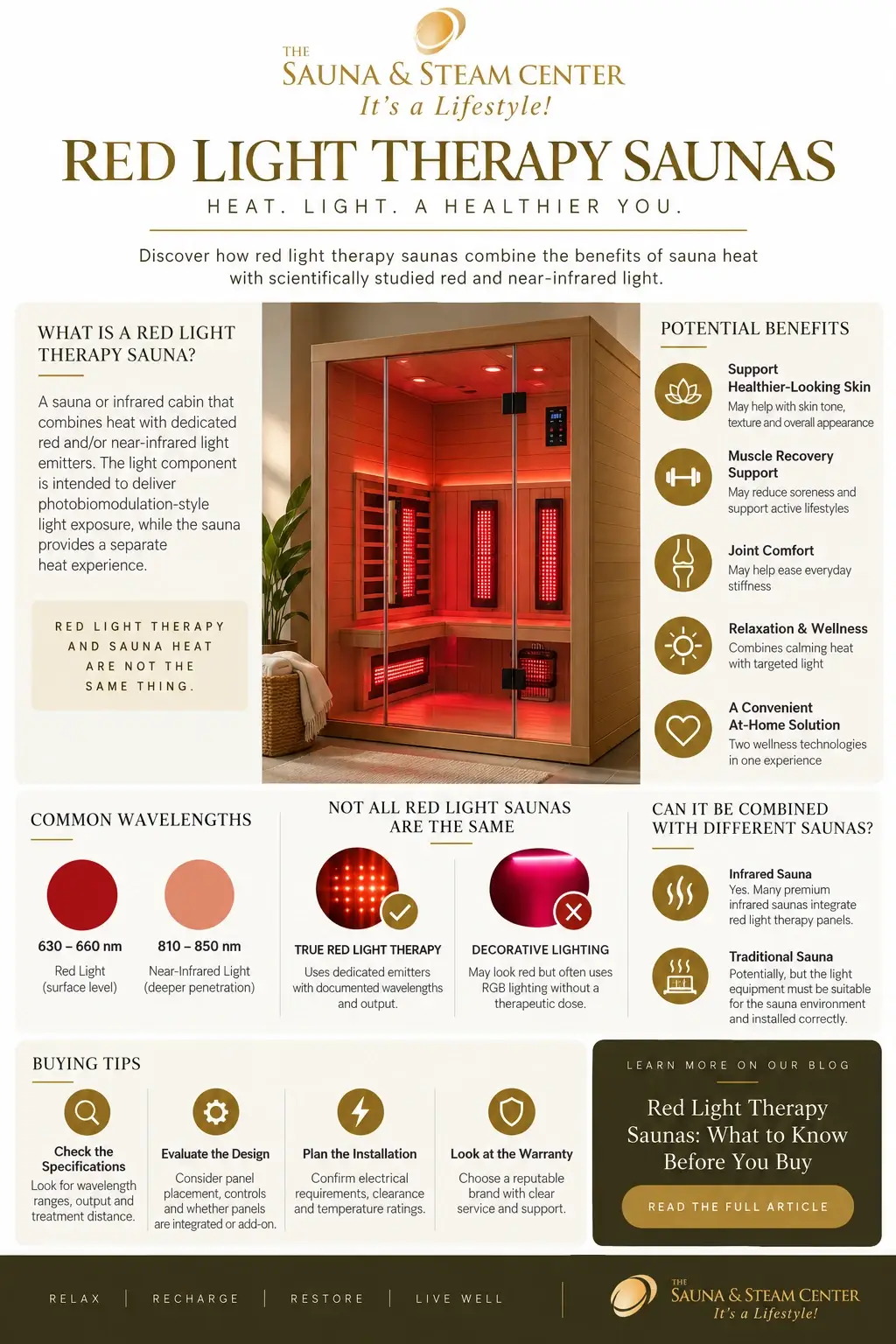
What is a red light therapy sauna?
A red light therapy sauna is a sauna or infrared cabin that incorporates dedicated red and/or near-infrared light emitters in addition to the sauna’s heating system. The light component is intended to deliver photobiomodulation-style light exposure, while the sauna provides a separate heat experience.
The two technologies may be packaged together, but red light therapy and sauna heat are not the same thing.
This matters because people searching for a sauna with red light therapy are often comparing very different products.
One sauna may include a purpose-built red and near-infrared panel with documented wavelengths and output.
Another may simply include RGB lighting that can turn the cabin red.
Those should not automatically be treated as equivalent.
Most important buying rule:
Do not buy a “red light sauna” based only on the fact that the interior glows red. Ask for the actual wavelength specifications, emitter type, output information, recommended exposure distance, treatment controls, warranty, electrical requirements, and whether the light system is designed to operate safely in that sauna environment.
Red Light Therapy Sauna: Quick Answers
| Question | Quick Answer |
|---|---|
| What is a sauna with red light therapy? | A sauna that combines heat with dedicated red and/or near-infrared light emitters. |
| Is red light therapy the same as an infrared sauna? | No. Red light therapy is a light-based modality. An infrared sauna primarily uses infrared energy to create heat. |
| Is red sauna lighting red light therapy? | Not necessarily. Decorative RGB or chromotherapy lighting may produce a red color without delivering a documented photobiomodulation dose. |
| What wavelengths are commonly used? | Commercial red light therapy systems commonly use red wavelengths around 630 to 660 nm and near-infrared wavelengths around 810 to 850 nm, although products vary. |
| Why combine red light and near-infrared? | The wavelengths interact differently with tissue, and many commercial systems use both to provide broader coverage. |
| Can an infrared sauna include red light therapy? | Yes. Some premium infrared saunas integrate separate red light therapy emitters into the cabin. |
| Can a traditional sauna include red light therapy? | Potentially, but the light equipment must be suitable for the sauna environment and installed according to manufacturer temperature, electrical, and clearance requirements. |
| Are integrated panels better than add-on panels? | Not automatically. Integration can improve convenience, but panel specifications, placement, distance, output, controls, and serviceability matter more. |
| Does red light therapy replace sauna heat? | No. They create different experiences and should be evaluated separately. |
| What should I compare before buying? | Wavelength, irradiance, coverage, treatment distance, panel placement, controls, sauna type, electrical needs, certifications, warranty, and service support. |
Key Takeaways
- A red light therapy sauna combines two separate technologies: sauna heat and photobiomodulation-style light exposure.
- Red-colored sauna lighting is not automatically red light therapy.
- Commercial red light systems commonly use wavelengths in the red and near-infrared portions of the spectrum.
- Common product pairings include approximately 660 nm red light and 850 nm near-infrared light, but wavelength alone does not determine performance.
- Output, distance, treatment time, panel placement, body coverage, and dose also matter.
- Infrared sauna heat and near-infrared photobiomodulation are related to the electromagnetic spectrum but are not interchangeable technologies.
- Integrated red light panels can make treatment convenient, but convenience should not replace evaluation of specifications.
- Chromotherapy usually refers to colored ambient lighting and should not automatically be marketed as therapeutic red light.
- A high-quality sauna should still be evaluated for materials, construction, electrical design, heater quality, warranty, parts availability, and service.
- Health claims should be evaluated carefully because research varies substantially by wavelength, dose, treatment protocol, and condition studied.
What Is a Red Light Therapy Sauna?
A red light therapy sauna combines a heated sauna environment with a separate light-based system.
Depending on the product, the heat may come from:
- Far-infrared heaters
- Full-spectrum infrared emitters
- Traditional electric sauna heaters
- Hybrid heating systems
The red light component is generally delivered through:
- LED panels
- LED arrays
- Integrated light modules
- Dedicated red and near-infrared emitters
Simple definition:
A red light therapy sauna is not a new type of heat. It is a sauna that combines a heat system with a separate red or near-infrared light system.
How Does Red Light Therapy Work?
Red light therapy is commonly discussed under the broader scientific term photobiomodulation, or PBM.
PBM uses specific visible red and near-infrared wavelengths at controlled energy levels.
The biological response depends on multiple treatment variables, including:
- Wavelength
- Power density or irradiance
- Total energy dose
- Distance from the light source
- Exposure time
- Body area being treated
- Emitter design
- Continuous or pulsed delivery
- Frequency of sessions
Why this matters when buying:
Two panels advertising the same wavelength can still deliver very different exposure because their irradiance, panel size, distance, beam angle, treatment time, and emitter layout may differ.
What Wavelengths Are Used in Red Light Therapy Saunas?
Red light therapy products commonly use wavelengths within the visible red and near-infrared ranges.
| Light Type | Common Commercial Range | What You Should Know |
|---|---|---|
| Red light | Approximately 620 to 700 nm | Visible red light and commonly used in photobiomodulation products |
| Near-infrared | Approximately 700 to 1100 nm | Invisible to the eye and commonly paired with red light in wellness devices |
| Common commercial pairing | Approximately 660 nm + 850 nm | Frequently used combination, but not a universal standard |
Is 660 nm the Best Red Light Wavelength?
Not automatically.
660 nm is common in commercial systems and research, but there is no single wavelength that is universally ideal for every treatment goal.
Is 850 nm the Best Near-Infrared Wavelength?
850 nm is also widely used, but the same principle applies.
The usefulness of a system depends on more than the number printed on the specification sheet.
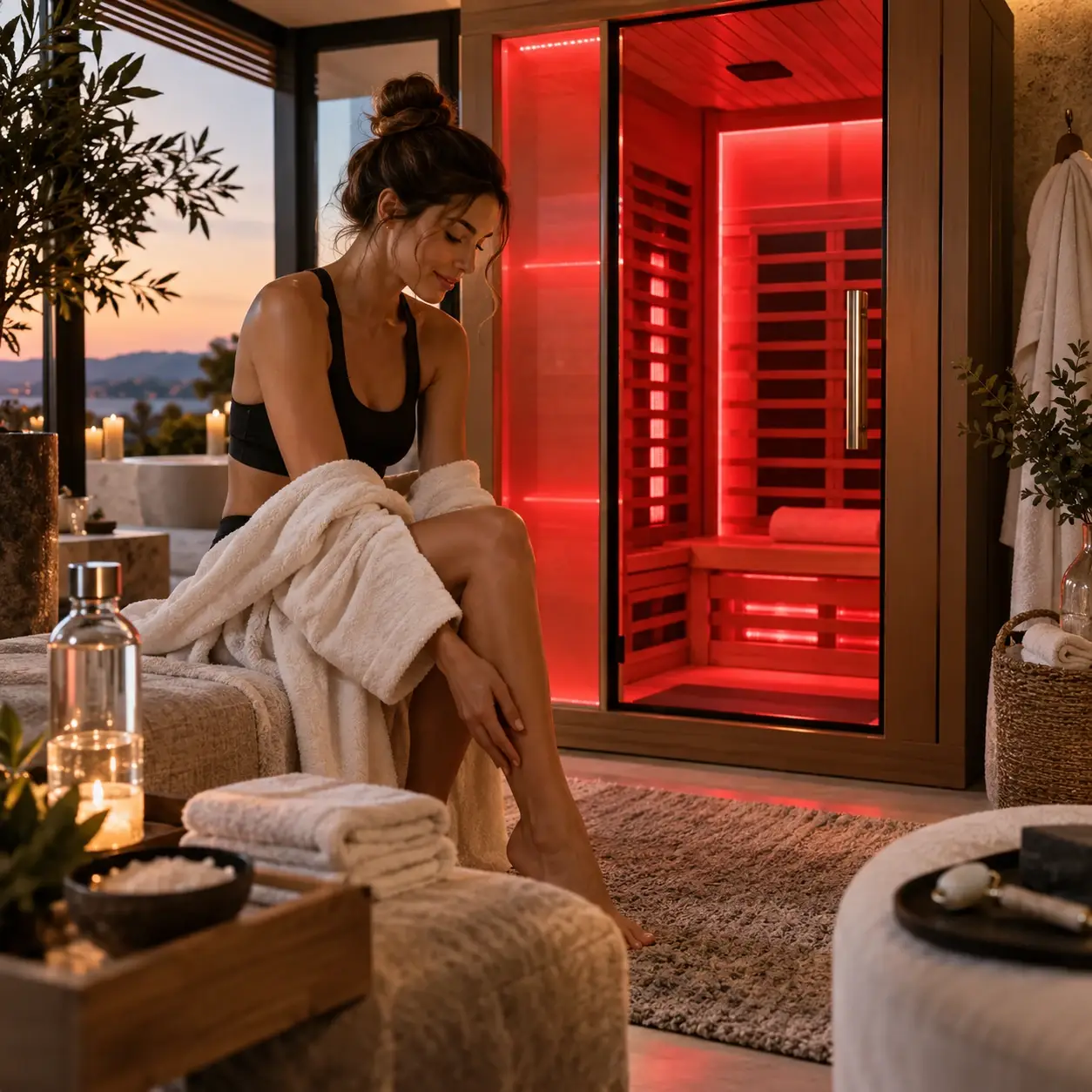
What wavelength should you look for in a sauna red light system?
Look for a manufacturer that clearly documents its wavelength output rather than relying on vague descriptions such as “therapeutic red glow.” Red wavelengths around the 630 to 660 nm region and near-infrared wavelengths around the 810 to 850 nm region are common in commercial photobiomodulation systems, but the complete dose and delivery system matter too.
Red Light vs Near-Infrared Light: What Is the Difference?
Visible red and near-infrared light are neighboring portions of the electromagnetic spectrum, but they interact differently with tissue.
| Feature | Red Light | Near-Infrared Light |
|---|---|---|
| Visible? | Yes | No |
| Typical wavelength | Approximately 620 to 700 nm | Approximately 700 to 1100 nm |
| Common product use | Skin-facing PBM applications | Often included for deeper-target applications |
| Heat source? | PBM systems are generally designed around light exposure rather than heating the sauna | PBM NIR should not automatically be confused with an infrared sauna’s primary heating system |
Important:
Near-infrared light therapy and an infrared sauna are not the same thing simply because both use the word “infrared.”
Red Light Therapy vs Infrared Sauna: What Is the Difference?
An infrared sauna is designed primarily to create heat. Red light therapy is designed primarily to deliver controlled light exposure.
An infrared sauna uses infrared emitters to warm the body and cabin. Red light therapy uses specific red and near-infrared wavelengths at lower energy levels for photobiomodulation-style exposure.
| Feature | Infrared Sauna | Red Light Therapy |
|---|---|---|
| Primary purpose | Create a sauna heat experience | Deliver controlled light exposure |
| Main sensation | Warmth and sweating | Bright light, often little additional heat from the PBM panel itself |
| Session environment | Enclosed sauna cabin | Can be delivered by panels, masks, lamps, or integrated sauna emitters |
| Important specifications | Heater power, temperature, construction, electrical system | Wavelength, irradiance, dose, distance, exposure time |
For a deeper sauna-type comparison, see our
Infrared vs Traditional Sauna Guide
.
Chromotherapy vs Red Light Therapy in a Sauna
This is one of the most important distinctions for shoppers.
What Is Chromotherapy?
Chromotherapy in sauna marketing generally refers to colored ambient lighting.
An RGB or RGBW lighting system may allow the cabin to display:
- Red
- Blue
- Green
- Violet
- Warm white
- Other color combinations
This can enhance the atmosphere of the sauna.
What Is Red Light Therapy?
Red light therapy uses a purpose-built light source with defined wavelengths and treatment parameters.
| Feature | Chromotherapy | Red Light Therapy |
|---|---|---|
| Main purpose | Atmosphere and colored lighting | Photobiomodulation-style light exposure |
| Specified wavelengths | May not be provided as treatment wavelengths | Should be documented |
| Power density | Not usually specified for PBM dosing | Important performance parameter |
| Session distance | Generally irrelevant | Can materially affect dose |
| Treatment timing | Not typically dose-based | Often part of manufacturer instructions |
Is a red chromotherapy light the same as red light therapy?
No. A sauna can glow red because its RGB lighting is set to red without providing a documented red light therapy treatment. If you want photobiomodulation, ask for the wavelength, irradiance, distance, treatment protocol, and device specifications.
Integrated Red Light Therapy vs Add-On Panels
Red light can be incorporated into a sauna in two main ways.
Integrated System
The sauna manufacturer designs the red light system as part of the cabin.
Potential Advantages
- Clean installation
- Convenient controls
- Designed panel placement
- Less equipment clutter
- Potentially easier electrical integration
- Single manufacturer support structure
Add-On Panel
A separate red light panel is installed or positioned inside or near the sauna.
Potential Advantages
- More panel choices
- Potentially larger treatment area
- Easier future replacement
- Ability to use the panel outside the sauna
Important Add-On Warning
Do not place a conventional red light therapy panel inside a hot sauna unless the manufacturer specifically approves that use.
Heat and humidity can exceed the operating conditions for electronics designed for normal indoor environments.
Before installing an add-on panel:
Confirm the manufacturer’s maximum operating temperature, humidity limits, electrical requirements, required clearances, mounting orientation, and whether sauna installation affects the warranty.
Infrared Sauna With Red Light Therapy: Does the Combination Make Sense?
For many premium home wellness projects, infrared sauna and red light therapy are a natural combination because both can be integrated into a compact indoor cabin.
Some current premium sauna systems incorporate:
- Far-infrared heat
- Near-infrared wavelengths
- Mid-infrared wavelengths
- Dedicated red light therapy
- Programmable wellness settings
Is an infrared sauna with red light therapy better than a standard infrared sauna?
It offers more functionality, but “more technology” does not automatically mean a better sauna. The red light component should have credible specifications, while the sauna itself should still be evaluated for heating performance, materials, electrical design, comfort, controls, warranty, and serviceability.
For more information on multiple infrared wavelengths, see our
Full-Spectrum Infrared Sauna Guide
.
Can a Traditional Sauna Have Red Light Therapy?
Potentially, yes.
However, a traditional sauna can operate at much higher room temperatures than many infrared cabins.
That makes equipment compatibility particularly important.
Before Combining Red Light With Traditional Sauna Heat, Confirm:
- Maximum operating temperature of the light system
- Humidity tolerance
- Electrical requirements
- Mounting clearances
- Distance from the sauna heater
- Manufacturer approval
- Warranty implications
- Wire and power-supply location
Do not assume that any LED panel can safely operate inside a traditional sauna.
Use equipment specifically designed or approved for the installation conditions.
What Are the Potential Benefits of a Red Light Therapy Sauna?
A red light therapy sauna combines two wellness experiences, but the evidence for each component should be evaluated separately.
Potential Red Light Therapy Applications Being Studied Include:
- Skin appearance and photorejuvenation
- Collagen-related skin changes
- Wound-healing applications
- Musculoskeletal recovery
- Inflammation-related pathways
- Some pain-related applications
Evidence varies considerably by condition, wavelength, dose, device, and study design.
Sauna Heat Provides a Different Experience
The sauna component provides:
- Heat
- Sweating
- Relaxation
- A warm wellness environment
- A repeatable home routine
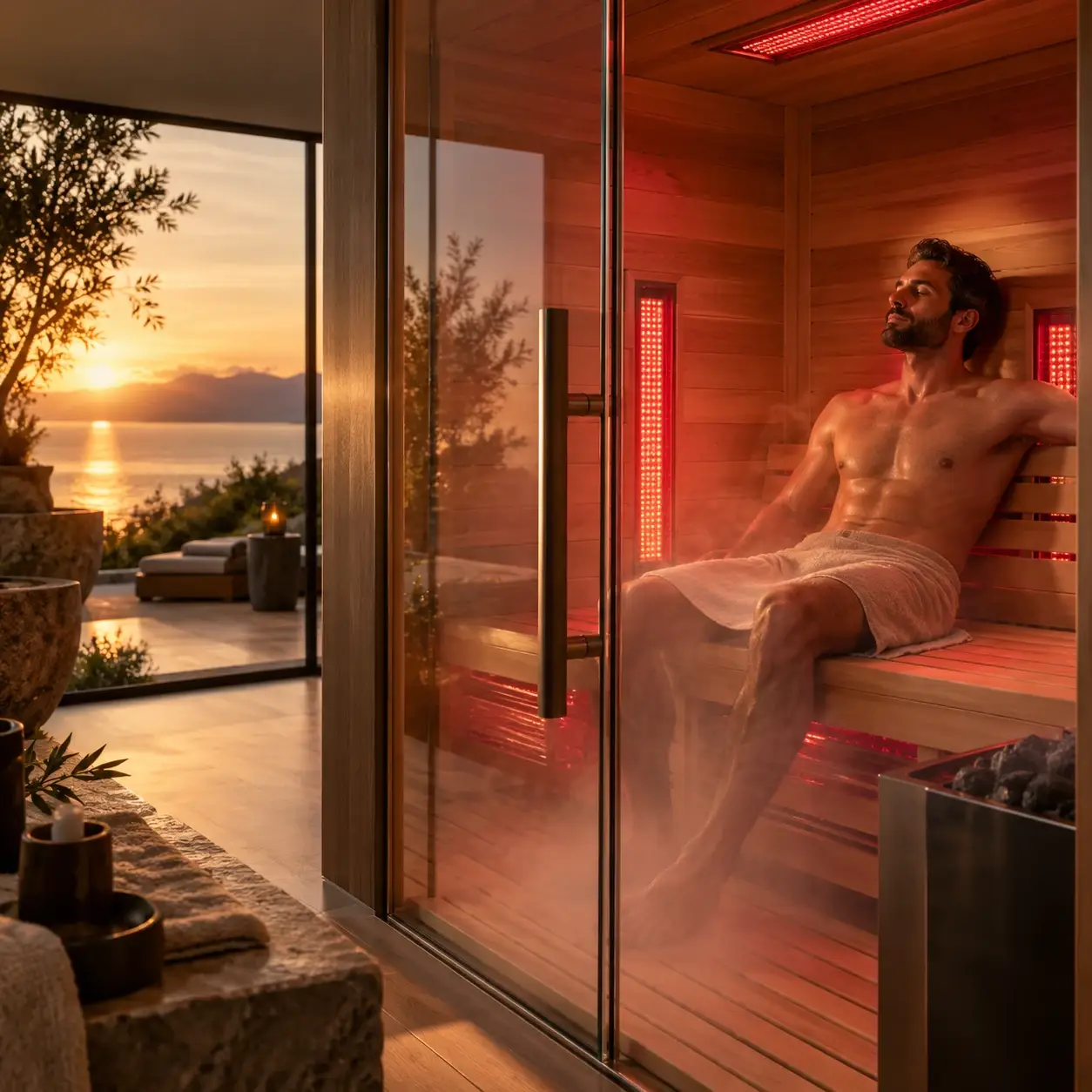
Important evidence distinction:
A study involving a clinical photobiomodulation device does not automatically prove that every red light sauna delivers the same treatment. Device specifications and dose matter.
Red Light Therapy Sauna for Skin: What Should You Know?
Skin-related searches are one of the biggest reasons consumers become interested in red light therapy.
Published research has investigated red and near-infrared photobiomodulation for areas including skin rejuvenation, collagen-related changes, fine lines, redness, and wound-healing applications.
However, results depend on the treatment parameters used.
For Skin-Focused Use, Compare:
- Wavelength
- Irradiance
- Distance from the panel
- Exposure time
- Skin area exposed
- Frequency of use
- Eye-protection instructions
For a deeper discussion focused specifically on skin intent, see our
Red Light Therapy Benefits for Skin Guide
.
Why Panel Placement and Body Coverage Matter
A red light sauna can advertise excellent wavelengths but still provide poor whole-body exposure if the emitters are badly positioned.
Questions to Ask
- Is the panel in front of the body or behind it?
- Are there emitters on both sides?
- Does the lower body receive light?
- How far is the user from the panel?
- Does the normal seating position match the intended treatment distance?
- Does one person block the panel when two people use the sauna?
- Can individual light zones be controlled?
Buying principle:
Coverage can matter as much as headline power. A very powerful panel aimed at only one small portion of the body may provide a different experience from a lower-output array designed for broad, even exposure.
Irradiance, Dose and Distance: Why the Numbers Matter
Wavelength is only one part of red light therapy.
Irradiance
Irradiance describes the amount of optical power reaching a given area, commonly expressed as milliwatts per square centimeter.
Distance
The amount of light reaching the body can change significantly as you move farther away from the panel.
Exposure Time
A longer session increases the total energy delivered.
Total Dose
Total dose depends on more than simply how bright the panel looks.
Do not judge a red light system by visual brightness.
Visible brightness does not tell you the near-infrared output or the treatment dose reaching the body.
What Should the Manufacturer Provide?
- Wavelength specifications
- Irradiance at a defined distance
- Recommended exposure distance
- Recommended session duration
- Panel dimensions
- Emitter layout
- Operating temperature limits
- Safety instructions
What Should You Look for in a Red Light Therapy Sauna?
If red light therapy is one of the main reasons you are purchasing the sauna, do not evaluate the cabin using ordinary sauna criteria alone.
| Buying Factor | What to Look For |
|---|---|
| Documented wavelengths | Specific red and near-infrared wavelength information rather than vague “red light” claims |
| Irradiance | Output measured at a defined distance |
| Body coverage | Panel positioning that actually exposes the intended areas |
| Distance | Normal seating position should make sense for the manufacturer’s treatment specifications |
| Independent controls | Ability to control red light separately from sauna heat can improve flexibility |
| Timer | Useful for repeatable light sessions |
| Heat compatibility | Light system must tolerate the cabin’s operating environment |
| Electrical design | Sauna heaters and light panels need properly planned power |
| Materials | Premium wood, glass, benches and hardware suitable for repeated sauna use |
| Manufacturer support | Technical documentation, warranty and replacement components |
| Serviceability | Ability to replace a panel, driver, control or emitter if something fails |
| Installation support | Clear requirements for room, electrical service, ventilation and delivery |
Red Light Therapy Sauna Installation Considerations
A premium sauna with integrated lighting and advanced infrared equipment is an electrical and installation project, not simply furniture placed in a room.
Plan for:
- Required voltage
- Circuit amperage
- Dedicated circuits where required
- Panel location
- Controls
- Heat clearances
- Ventilation
- Service access
- Room dimensions
- Delivery path
- Doors, hallways and stairs
- Condo or HOA requirements where applicable
Can You Add Red Light Therapy to an Existing Sauna?
Sometimes.
The first question should not be whether the panel physically fits.
It should be whether the panel is designed to tolerate the temperature and humidity of the location where it will be installed.
Never modify a sauna’s electrical system or mount third-party electronics inside a high-temperature cabin without confirming compatibility and installation requirements.
Is Red Light Therapy in a Sauna Safe?
Red and near-infrared photobiomodulation is generally considered noninvasive and does not use ultraviolet light.
However, safe use still depends on the specific device and instructions.
Follow Manufacturer Guidance for:
- Eye protection
- Exposure duration
- Treatment distance
- Maximum session frequency
- Skin exposure
- Operating temperature
- Electrical use
Talk With an Appropriate Healthcare Professional If You:
- Have a photosensitivity disorder
- Take medication that increases light sensitivity
- Have a concerning skin lesion
- Are undergoing treatment for a medical condition
- Have a condition for which you are specifically seeking therapeutic red light treatment
- Are unsure whether red light exposure is appropriate for you

Eye safety:
Do not assume that because red light therapy does not use UV light it can be stared into safely. Follow the manufacturer’s eye-protection instructions.
Red Light Therapy Sauna Claims to Treat Carefully
Red light therapy is an active area of research, but commercial wellness claims often run ahead of the evidence.
Be Cautious With Claims That a Red Light Sauna:
- Cures disease
- Guarantees dramatic weight loss
- Replaces exercise
- Replaces medical treatment
- Detoxifies the body through light
- Automatically balances hormones
- Reverses aging
- Guarantees injury healing
- Provides the same results as every clinical PBM device
Better way to evaluate claims:
Ask what wavelength, dose, treatment protocol, device, population and outcome were studied. Then determine whether the sauna you are considering actually delivers comparable treatment parameters.
Who Should Consider a Sauna With Red Light Therapy?
A combined system may make sense if you:
- Already want a premium home sauna
- Are specifically interested in red light therapy
- Prefer one integrated wellness system rather than separate equipment
- Want a sauna in a home gym or wellness room
- Value programmable wellness features
- Want red and near-infrared exposure in addition to sauna heat
- Have limited space for separate wellness devices
A Separate Red Light Panel May Make More Sense If:
- You already own a sauna
- You want to use red light without sauna heat
- You need more flexible treatment distance
- You want to move the panel between rooms
- You want specialized whole-body panel coverage
A Sauna Without Red Light May Be Better If:
- Your priority is simply traditional sauna bathing
- You prefer high heat and sauna stones
- You have little interest in PBM
- You would rather spend the budget on sauna size, wood, glass or heater upgrades
The decision comes down to use:
If you genuinely plan to use both sauna heat and red light therapy regularly, integration can be extremely convenient. If red light is only a feature you may occasionally use, prioritize the quality of the sauna first.
Looking for a Premium Sauna With Red Light Therapy?
Compare the Complete System, Not Just the Red Glow
Sauna & Steam Center can help you compare premium infrared, hybrid and custom sauna options that incorporate advanced wellness technologies, including red and near-infrared light systems where available.
We can review your room, electrical capacity, preferred heat style, sauna size, red light goals, product specifications and installation requirements before you choose a system.
Red Light Therapy Sauna Frequently Asked Questions
What is a red light therapy sauna?
A red light therapy sauna combines a sauna heating system with dedicated red and/or near-infrared light emitters. The sauna heat and photobiomodulation-style light system are separate technologies that may be integrated into one cabin.
What does sauna red light mean?
The phrase can refer either to a sauna containing actual red light therapy equipment or simply to red-colored ambient lighting. Shoppers should verify wavelengths, output and treatment specifications before assuming a red sauna light provides photobiomodulation.
Is red light therapy the same as an infrared sauna?
No. Infrared saunas are primarily designed to produce heat. Red light therapy uses specific red and near-infrared wavelengths at controlled energy levels for light exposure.
Can an infrared sauna have red light therapy?
Yes. Some premium infrared sauna systems include dedicated red light therapy emitters in addition to the sauna’s infrared heating system.
Can a traditional sauna have red light therapy?
Potentially, but the light system must be approved for the sauna’s temperature and humidity conditions. Conventional panels should not be placed inside a traditional sauna unless the manufacturer specifically allows it.
What wavelengths are used in red light therapy saunas?
Commercial systems commonly use visible red wavelengths around 630 to 660 nm and near-infrared wavelengths around 810 to 850 nm. Exact systems vary, and wavelength alone does not determine the delivered dose.
Is 660 nm red light good?
660 nm is a commonly used wavelength in commercial photobiomodulation systems and research. It should still be evaluated together with irradiance, distance, exposure time and total dose.
What is 850 nm near-infrared light?
850 nm is an invisible near-infrared wavelength commonly used in commercial red light therapy systems. It is frequently combined with visible red wavelengths such as approximately 660 nm.
Is chromotherapy the same as red light therapy?
No. Chromotherapy generally refers to colored ambient lighting. Red light therapy uses purpose-built emitters with defined wavelengths and treatment parameters.
If my sauna has red LED lights, does it have red light therapy?
Not necessarily. RGB or decorative LEDs can make the room appear red without delivering a documented photobiomodulation dose. Check the wavelength, irradiance and manufacturer specifications.
What is the difference between red light and near-infrared light?
Red light is visible and generally falls around 620 to 700 nm. Near-infrared light is invisible and generally falls above the visible red spectrum. Both are commonly used in photobiomodulation research and commercial devices.
Is full-spectrum infrared the same as red light therapy?
No. Full-spectrum infrared generally refers to sauna heating systems using multiple infrared ranges. Red light therapy refers to controlled red and near-infrared photobiomodulation-style exposure. Some products combine both technologies.
Are integrated red light panels better?
Integrated panels can provide a cleaner installation and convenient controls, but their effectiveness depends on wavelength, output, distance, panel placement and body coverage. Integration by itself does not guarantee better performance.
Can I put a red light therapy panel inside my sauna?
Only if the panel manufacturer approves use at the sauna’s expected temperature and humidity. Many ordinary wellness panels are designed for room-temperature environments rather than high-heat sauna cabins.
What should I look for when buying a red light therapy sauna?
Compare documented wavelengths, irradiance, treatment distance, body coverage, panel placement, independent controls, electrical requirements, heat compatibility, sauna materials, construction, warranty, parts availability and service support.
Does higher irradiance always mean better red light therapy?
No. Photobiomodulation depends on appropriate dose rather than simply maximizing output. Irradiance, distance, exposure time and treatment goal need to work together.
Does red light therapy use UV light?
No. Red and near-infrared photobiomodulation does not use ultraviolet radiation.
Do I need eye protection for red light therapy?
Follow the specific device manufacturer’s instructions. Bright light and some higher-output systems may require or recommend eye protection, and users should not assume that looking directly at a panel is appropriate.
Can red light therapy help your skin?
Research has investigated red and near-infrared photobiomodulation for skin rejuvenation, collagen-related changes, wrinkles and other skin applications. Results depend on wavelength, dose, protocol and device design.
Is a red light therapy sauna worth it?
It can be worthwhile if you already want a premium sauna and expect to use red light therapy regularly. If red light is only a minor interest, investing first in sauna quality, materials, heater performance and professional installation may provide more value.
Conclusion: Should You Buy a Red Light Therapy Sauna?
A sauna red light system can be an attractive home wellness option when it combines two technologies you genuinely plan to use: sauna heat and red or near-infrared light exposure.
The most important thing is understanding exactly what you are buying.
A red light therapy sauna should be evaluated for:
- Wavelengths
- Irradiance
- Distance
- Body coverage
- Panel placement
- Controls
- Operating temperature
- Electrical requirements
- Sauna construction
- Materials
- Heater quality
- Warranty
- Serviceability
Do not confuse decorative red sauna lighting with photobiomodulation.
Do not assume that every infrared sauna automatically provides red light therapy.
And do not assume that the sauna with the longest wavelength list is automatically the best system.
Bottom line:
The best red light therapy sauna is a well-designed sauna first and a credible light-therapy system second. Look for documented light specifications, purposeful panel placement, quality materials, professional installation requirements, manufacturer support and a sauna heat experience you actually enjoy.
If you are comparing premium infrared, hybrid or red-light-equipped sauna systems,
contact Sauna & Steam Center
for help evaluating the equipment and installation requirements for your home.
References
Photobiomodulation: A Systematic Review of the Oncologic Safety of Low-Level Light Therapy for Aesthetic Skin Rejuvenation
Review of Light Parameters and Photobiomodulation Efficacy
Unlocking the Power of Light on the Skin: A Comprehensive Review on Photobiomodulation
Photobiomodulation in Human Muscle Tissue: An Advantage in Sports Performance?
Cleveland Clinic: Red Light Therapy, Benefits, Side Effects & Uses
U.S. Food & Drug Administration: Photobiomodulation Devices Guidance
Harvia: Infrared Sauna With Full-Spectrum Radiator and Chromotherapy Lighting
Harvia: RGBW Sauna Lighting Specifications
Sunlighten: Red and Near-Infrared Light System Specifications