Red Light Therapy Benefits: Skin, Face, Wrinkles, Recovery, Hair Growth & Safety
Editorial and health disclosure: Sauna & Steam Center sells, designs, installs, and services sauna and wellness systems. This article provides general educational information about red light therapy and photobiomodulation. It is not medical advice and should not be used to diagnose or treat a medical condition. Results vary by device, wavelength, dose, treatment area, routine, and individual health factors. Consult a qualified healthcare professional when appropriate.
Red light therapy benefits may include smoother-looking skin, support for fine lines and wrinkles, calmer-looking redness, improved skin texture, muscle recovery, joint comfort, and support for some types of hair thinning. Red light therapy, also called photobiomodulation or PBM, uses specific red and near-infrared wavelengths rather than ultraviolet light or the heat-based infrared energy associated with an infrared sauna.
Red Light Therapy Benefits: Quick Answers
| Question | Practical Answer |
|---|---|
| What are the main benefits of red light therapy? | Potential benefits include smoother-looking skin, support for fine lines and wrinkles, calmer redness, improved skin texture, muscle recovery, joint comfort, and support for certain types of hair thinning. |
| What does red light therapy do for skin? | It may support cellular processes involved in collagen production, tissue repair, inflammation control, and skin renewal, potentially improving texture, fine lines, wrinkles, redness, and overall appearance. |
| What does red light therapy do for your face? | Facial red light therapy is commonly used to support smoother skin texture, fine lines, wrinkles, redness, tone, and overall skin appearance. |
| Does red light therapy help wrinkles? | Research suggests red light therapy may modestly improve fine lines, skin roughness, and some wrinkle appearance with repeated treatment. It should not be expected to erase deep wrinkles. |
| Does red light therapy increase collagen? | Photobiomodulation may influence fibroblast activity and biological processes associated with collagen production, which may contribute to gradual improvements in skin texture and fine lines. |
| What is near-infrared light used for? | Near-infrared light penetrates more deeply than visible red light and is commonly included in photobiomodulation devices designed for deeper tissue, recovery, muscles, joints, and combined skin and wellness applications. |
| Is infrared light safe for skin? | Red and near-infrared photobiomodulation are generally considered low risk when appropriately used according to device instructions. Eye safety, photosensitive medications, skin conditions, dose, and individual risk factors still matter. |
| How long does red light therapy take to work? | Some people notice subtle changes within several weeks, while improvements involving wrinkles, texture, hair, or other longer-term goals may require consistent use for several months. |
| Is red light therapy the same as an infrared sauna? | No. Red light therapy primarily delivers targeted light wavelengths. An infrared sauna primarily creates a heat-based whole-body experience. |
What Are the Main Red Light Therapy Benefits?
Red light therapy is used for several different goals, but not every claimed benefit has the same level of evidence. Skin appearance is one of the most researched and popular applications, particularly for fine lines, wrinkles, texture, redness, and signs of photoaging.
Other applications include hair-growth support, muscle recovery, joint comfort, and tissue repair.
| Potential Benefit | What Red Light Therapy May Support |
|---|---|
| Skin texture | May help skin appear smoother and reduce visible roughness over time. |
| Fine lines and wrinkles | May support collagen-related processes and modestly improve the appearance of mild fine lines and wrinkles. |
| Skin redness | May help calm visible redness or irritation in some people. |
| Skin tone | May contribute to a more even and healthier-looking complexion. |
| Hair thinning | Certain red light and low-level light therapy devices may support some forms of mild to moderate hair thinning. |
| Muscle recovery | May support recovery and help some people manage post-exercise soreness. |
| Joint comfort | May support comfort in some situations but should not replace diagnosis or medical treatment. |
| Tissue repair | Photobiomodulation is being studied and used in some medical settings for tissue-repair and wound-healing applications. |
Red Light Therapy Benefits for Skin
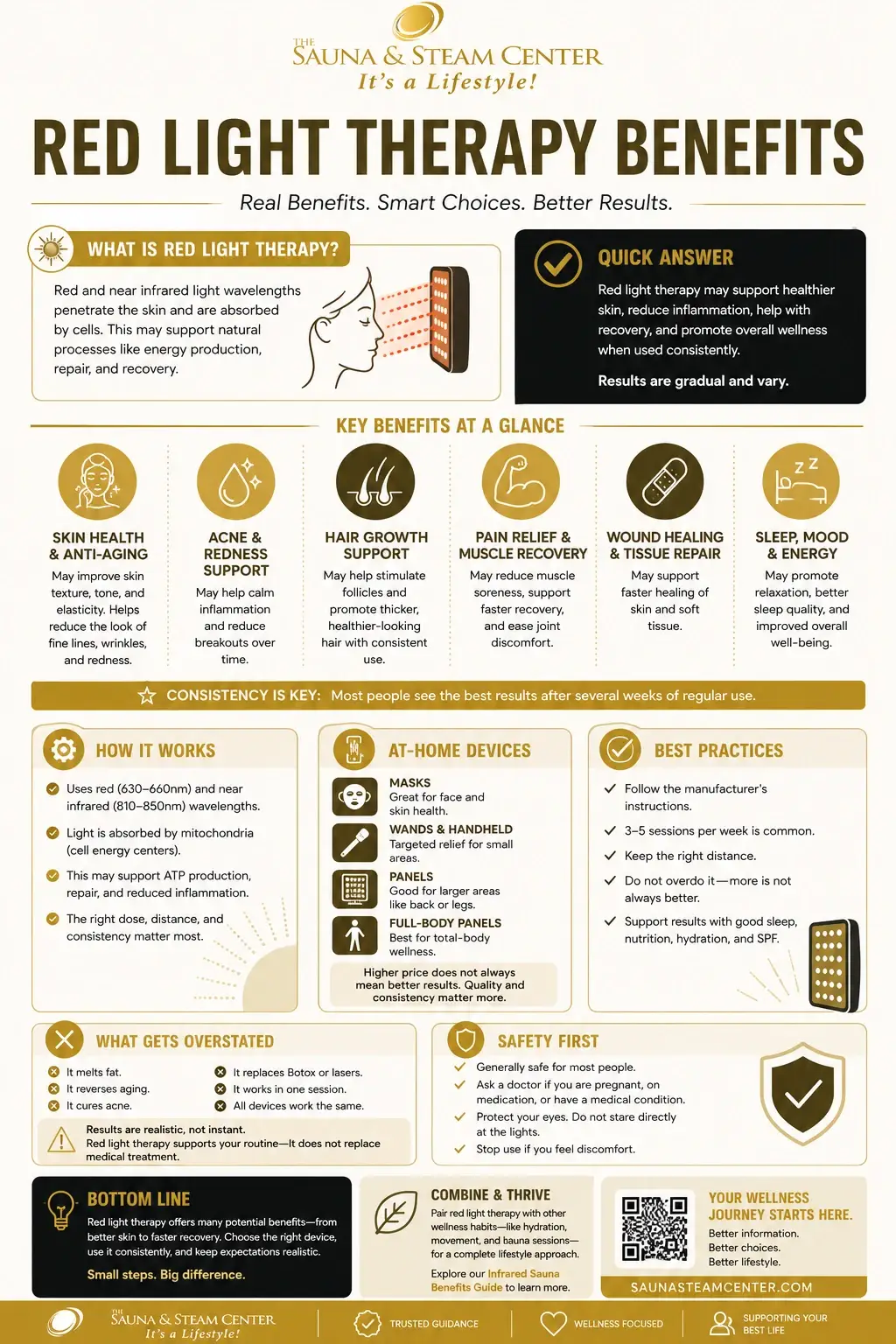
Red light therapy may support healthier-looking skin by influencing cellular processes involved in energy production, collagen formation, inflammation, circulation, and tissue repair. This is why red light therapy is commonly used for fine lines, wrinkles, rough texture, redness, and other visible signs of skin aging.
Results should generally be viewed as gradual rather than dramatic. Red light therapy does not replace sunscreen, a good skin-care routine, dermatologist-directed treatment, injectables, resurfacing procedures, or surgery when those treatments are more appropriate.
Red Light Therapy Skin Benefits at a Glance
| Skin Concern | Potential Benefit | Realistic Expectation |
|---|---|---|
| Fine lines | May support collagen-related processes and smoother-looking skin. | Gradual, usually modest improvement. |
| Wrinkles | May reduce the appearance of some mild wrinkles. | Deep wrinkles are unlikely to disappear. |
| Skin texture | May help reduce visible roughness. | Skin may appear smoother with consistent use. |
| Redness | May help calm visible inflammation or irritation in some users. | Results depend on the cause of the redness. |
| Skin tone | May support a more even-looking complexion. | Persistent pigmentation problems may require dermatologic care. |
| Collagen support | May influence fibroblast activity and collagen-related processes. | Changes require repeated treatment and time. |
| Skin repair | May support normal cellular repair processes. | Not a replacement for medical wound care. |
| Acne-related inflammation | May complement an acne-care routine in certain situations. | Severe or scarring acne requires appropriate treatment. |
1. Collagen and Skin Firmness
One reason red light therapy receives attention for skin care is its potential effect on fibroblasts and processes associated with collagen production.
Collagen is a structural protein that helps give skin firmness and support. Collagen changes naturally with age and environmental exposure, which contributes to fine lines, wrinkles, and changes in skin texture.
Photobiomodulation may support biological processes involved in collagen formation. This does not mean red light therapy can rebuild severely loose skin or produce the same tightening effect as surgery.
2. Smoother Skin Texture
Red light therapy may help improve the appearance of skin roughness and texture over time. Some users notice that the skin looks smoother or feels less dull after following a consistent treatment routine.
Texture improvements are generally gradual. Lighting, hydration, skin-care products, sun exposure, and other treatments can also influence how the skin looks.
3. Calmer-Looking Skin and Redness
Red light therapy may help some people with visible redness because photobiomodulation can influence inflammatory processes.
However, redness has many possible causes. Persistent flushing, painful redness, rosacea-like symptoms, infection, allergic reactions, or unexplained changes should be evaluated appropriately rather than treated based only on appearance.
4. Skin Tone and Dark Spots
Some research has reported improvements in overall skin appearance, tone, and signs of photoaging following red light treatment.
However, dark spots and pigmentation are complex. Sun damage, post-inflammatory pigmentation, melasma, hormonal changes, and other conditions do not all respond the same way.
Red light therapy should therefore not be marketed as a universal treatment for pigmentation.
Red Light Therapy for Face: What Are the Benefits?
Red light therapy for the face is primarily used to support smoother skin texture, mild fine lines and wrinkles, redness, skin tone, collagen-related processes, and overall skin appearance.
Facial devices include LED masks, handheld devices, and panels. The best choice depends on the treatment area, wavelengths, output, recommended distance, session length, and how consistently the device can be used.
What Does Red Light Therapy Do for Your Face?
When red or near-infrared wavelengths reach tissue, they may influence cellular processes associated with energy production, repair, inflammation, and collagen formation.
For the face, potential benefits may include:
- Smoother-looking skin
- Improved appearance of mild fine lines
- Support for some wrinkles
- Calmer-looking redness
- More even-looking skin tone
- Support for collagen-related processes
- Improved appearance of skin roughness
- Support for normal skin repair
Red light therapy is not expected to remove deep wrinkles, dramatically lift loose skin, eliminate severe acne scars, or replace medical cosmetic procedures.
How Long Does Red Light Therapy Take to Work on the Face?
There is no universal timeline because devices and treatment protocols vary.
Some users may notice subtle changes in skin appearance within several weeks. Fine lines, texture, wrinkles, and other structural changes may require consistent use over a longer period.
The important factors include:
- Wavelength
- Light output
- Treatment distance
- Session duration
- Frequency of use
- Skin condition
- Age and sun exposure
- Other skin-care treatments
- Consistency
Red Light Therapy for Wrinkles and Fine Lines
Red light therapy may modestly improve the appearance of fine lines, skin roughness, and certain wrinkles by supporting cellular processes associated with collagen production and skin repair.
This is one of the more established cosmetic reasons people use red light therapy.
How Does Red Light Therapy Help Wrinkles?
Skin gradually changes as collagen and other structural components change with age, sun exposure, and environmental factors.
Photobiomodulation may stimulate cellular activity associated with fibroblasts and collagen production. Over time, these changes may contribute to smoother-looking skin and a reduction in the appearance of mild fine lines.
That does not mean red light therapy reverses aging.
What Red Light Therapy Cannot Do for Wrinkles
- Erase deep wrinkles
- Produce an immediate facelift
- Replace Botox or injectable fillers
- Remove severe sun damage
- Tighten substantial loose skin like surgery
- Produce major changes after one session
How Does Red Light Therapy Help Skin?
Red light therapy is a form of photobiomodulation, often abbreviated as PBM. Related terminology includes red light therapy, near-infrared light therapy, LED light therapy, and low-level light or laser therapy.
Photobiomodulation exposes tissue to specific wavelengths of non-ionizing light. The goal is to influence biological processes rather than burn, remove, or intentionally damage the skin.
One proposed mechanism involves light absorption by cellular components associated with mitochondrial activity. This can influence cellular signaling and processes related to energy production, inflammation, circulation, and repair.
For skin, these biological effects may contribute to:
- Collagen-related activity
- Fibroblast activity
- Skin repair
- Inflammatory regulation
- Skin texture
- Fine-line appearance
- Overall skin quality
Red Light vs. Near-Infrared Light: What Is the Difference?
Red and near-infrared light are often combined in photobiomodulation devices, but they are not identical.
Visible red light is commonly associated with more superficial skin applications. Near-infrared light, often abbreviated NIR, can penetrate more deeply and is frequently used when the treatment goal includes deeper tissue, muscles, joints, or broader recovery applications.
| Feature | Red Light | Near-Infrared Light |
|---|---|---|
| Visibility | Visible to the human eye | Usually invisible or barely visible |
| General wavelength category | Visible red spectrum | Beyond visible red into near-infrared |
| Relative penetration | More superficial | Generally penetrates more deeply |
| Common applications | Skin appearance, face, fine lines and texture | Deeper tissue, recovery, muscles and joints |
| Used together? | Frequently | Frequently |
Is Near-Infrared Light the Same as an Infrared Sauna?
No.
This distinction is particularly important when comparing wellness products.
Near-infrared photobiomodulation delivers targeted wavelengths at controlled doses. An infrared sauna uses infrared energy primarily to create a heat-based experience.
A red light therapy panel may produce some warmth, but heating the body is not its primary purpose.
Red and Near-Infrared Light Therapy Benefits
Many modern photobiomodulation panels combine visible red and near-infrared wavelengths.
The reason is practical: the wavelengths interact with tissue at different depths, allowing one device to target more superficial skin concerns while also delivering near-infrared light to deeper tissue.
Potential applications of combined red and near-infrared light include:
- Skin appearance
- Fine lines and wrinkles
- Skin texture
- Collagen-related support
- Muscle recovery
- Joint comfort
- Tissue repair
- Post-exercise recovery
A device containing both wavelengths is not automatically better. Treatment quality also depends on output, wavelength selection, distance, dose, treatment area, construction quality, and the evidence supporting the device.
Red Light Therapy for Acne, Redness and Scars
Red light therapy may support certain acne-care routines, particularly when inflammation is part of the concern.
However, acne is complex. Oil production, clogged pores, bacteria, hormones, medications, genetics, skin-care products, and other factors can contribute.
Can Red Light Therapy Help Acne?
Red light may help support inflammatory aspects of acne, but it should not automatically be considered a stand-alone acne treatment.
Different light wavelengths can also have different applications in acne treatment. A red-light-only device should not be assumed to produce the same effect as a professional acne treatment using multiple wavelengths.
Can Red Light Therapy Help Acne Scars?
Red light therapy may support overall skin quality and repair, but established acne scars can be difficult to treat.
Indented scars, raised scars, persistent dark marks, and severe textural changes may require dermatologist-directed treatment.
When Acne Needs Professional Evaluation
- Acne is painful
- Deep cysts or nodules are present
- Breakouts are leaving scars
- Acne suddenly becomes severe
- Over-the-counter treatment is not helping
- The skin appears infected
Red Light Therapy for Hair Growth: Does It Help?
Red and low-level light therapies are also used for certain types of hair thinning.
Hair devices commonly include caps, helmets, combs, and other systems designed to expose the scalp to light.
The most realistic use case is usually certain forms of mild to moderate hair thinning rather than unexplained or advanced hair loss.
What to Know Before Using Red Light Therapy for Hair
- Hair results take time.
- Consistency matters.
- Scalp coverage matters.
- Device design and wavelengths vary.
- Hair loss has many possible causes.
- Sudden or patchy hair loss should be medically evaluated.
Red Light Therapy for Pain, Inflammation and Muscle Recovery
Red and near-infrared photobiomodulation are also used for recovery-related applications.
Near-infrared wavelengths are particularly relevant here because they can reach deeper tissue than visible red light.
Potential applications include:
- Post-workout soreness
- Muscle recovery
- Exercise recovery routines
- Joint comfort
- Temporary stiffness
- General wellness and recovery routines
Results depend heavily on the condition being treated and the protocol being used.
Red Light Therapy for Wound Healing and Tissue Repair
Photobiomodulation has been studied for wound healing and tissue-repair applications.
However, medical wound treatment is very different from casually using an at-home red light panel.
Do not use a consumer device as a substitute for appropriate medical wound care.
Get Medical Guidance for These Situations
- Open wounds
- Infections
- Burns
- Surgical sites
- Diabetic wounds
- Slow-healing wounds
- Severe skin damage
How Often Should You Use Red Light Therapy?
Follow the instructions for the exact device you are using. There is no universal treatment schedule that applies to every red light therapy product.
Frequency depends on:
- Wavelength
- Device output
- Distance from the device
- Treatment area
- Session duration
- Treatment goal
- Total light dose
Many consumer routines involve several sessions per week, but that does not mean the same schedule is appropriate for every device.
Does More Red Light Therapy Work Better?
Not necessarily.
Photobiomodulation depends on dose. Doubling session time does not automatically double the benefit.
Use the manufacturer-recommended treatment distance and duration rather than increasing exposure in an attempt to get faster results.
Red Light Therapy Before and After: What Results Are Realistic?
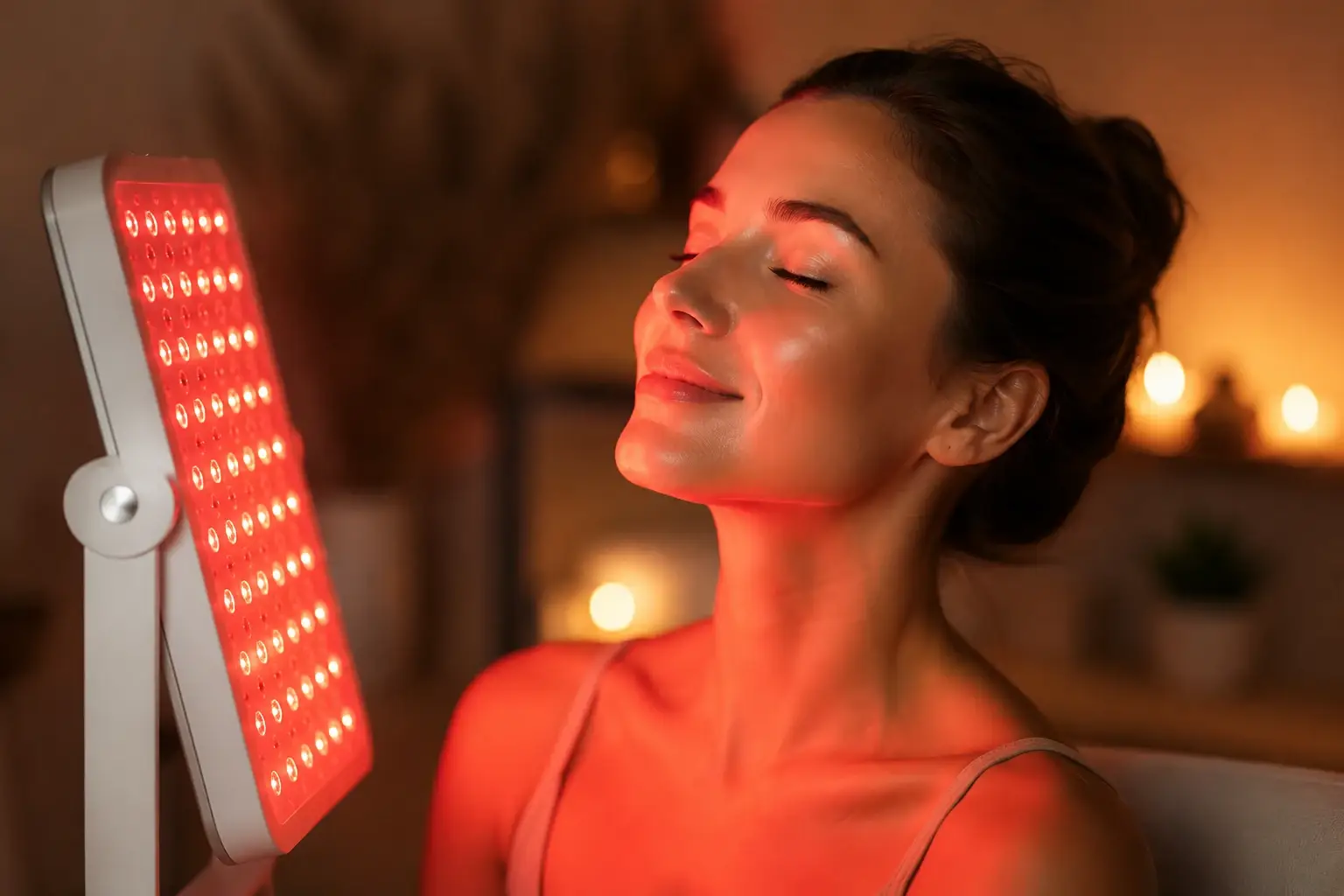
Before-and-after photos can help document progress, but they can also be misleading.
Lighting, camera exposure, makeup, filters, hydration, angles, skin-care products, and facial expression can change how skin appears.
What You May Notice First
- Skin may appear calmer.
- Skin may look less dull.
- Texture may begin to appear smoother.
- A consistent treatment routine may feel relaxing.
Changes That May Take Longer
- Fine-line appearance
- Wrinkle appearance
- Skin-texture changes
- Collagen-related changes
- Hair-growth support
- Scar appearance
At-Home Red Light Therapy Devices vs. Professional Treatments
At-home devices provide convenience and make consistency easier. Professional treatment can provide supervision, more controlled equipment, and guidance for specific skin or medical concerns.
| Factor | At-Home Device | Professional Treatment |
|---|---|---|
| Convenience | High | Requires appointments |
| Consistency | Easy to build into a routine | Depends on treatment schedule |
| Supervision | Self-directed | Professional supervision |
| Device selection | Buyer must evaluate specifications | Selected by provider |
| Complex skin concerns | May not be appropriate | Professional evaluation may be preferable |
| Long-term cost | Higher initial purchase, repeated home use | Cost per appointment |
Common At-Home Red Light Therapy Devices
- LED face masks
- Handheld wands
- Small panels
- Large panels
- Full-body panels
- Hair caps and helmets
Red Light Therapy Safety: Is Red and Infrared Light Safe for Skin?
Red and near-infrared photobiomodulation are generally considered low risk when appropriately used according to device instructions. Unlike ultraviolet radiation, therapeutic red light does not work by exposing the skin to UV radiation.
However, low risk does not mean risk free.
Common Red Light Therapy Safety Considerations
- Follow the exact device instructions.
- Use the recommended treatment distance.
- Do not intentionally overexpose the skin.
- Follow eye-protection recommendations.
- Do not stare directly into high-intensity LEDs.
- Check medications for photosensitivity.
- Stop treatment if irritation develops or worsens.
- Do not use consumer devices as substitutes for medical treatment.
Who Should Ask a Healthcare Professional First?
Consider medical guidance before treatment if:
- You take photosensitizing medication.
- You have significant light sensitivity.
- You have an eye condition.
- You have a history of skin cancer.
- You have a changing or suspicious mole.
- You have an active skin infection.
- You have a diagnosed skin disease.
- You want to treat an open wound or surgical site.
- You are pregnant and are unsure whether your device is appropriate.
Can Red Light Therapy Damage Your Skin?
Red light therapy is not designed to burn or intentionally damage tissue. However, inappropriate device use, excessive exposure, heat from certain devices, incorrect distance, or failure to follow manufacturer instructions can increase the risk of irritation or unwanted effects.
Red Light Therapy vs. Infrared Sauna
Red light therapy and infrared sauna therapy are often mentioned together because both involve wavelengths in or near the infrared spectrum, but they serve different primary purposes.
| Feature | Red Light Therapy | Infrared Sauna |
|---|---|---|
| Primary mechanism | Photobiomodulation | Heat |
| Typical experience | Targeted light exposure | Full-body heated environment |
| Sweating | Not the main goal | Common |
| Skin applications | Common | Primarily a heat and wellness experience |
| Muscle recovery | Potential targeted application | Heat-based relaxation and recovery routine |
| Treatment area | Face, scalp, joint, muscle or full body | Usually whole body |
If you are comparing heat-based wellness options, read our infrared sauna benefits guide. You can also compare infrared vs. traditional sauna if you are deciding which sauna experience fits your goals.
Can You Combine Red Light Therapy and an Infrared Sauna?
Potentially. Because the technologies work differently, some wellness setups incorporate both red light therapy and sauna heat.
The ideal configuration depends on the equipment, room design, temperature, manufacturer requirements, electrical planning, mounting position, and intended use.
How to Choose the Right Red Light Therapy Device
The right device depends first on what you want to treat.
A face mask may be practical for facial skin. A scalp device may make more sense for hair. A larger panel may be more useful for muscles, joints, or broader body coverage.
Red Light Therapy Buying Checklist
| Check Before Buying | Why It Matters |
|---|---|
| Wavelengths | Confirm which red and near-infrared wavelengths the device actually produces. |
| Treatment area | A small face device and full-body panel serve different purposes. |
| Output information | Helps determine how the manufacturer designed the treatment protocol. |
| Treatment distance | Distance affects the amount of light reaching the treatment area. |
| Session duration | The recommended treatment needs to fit your routine. |
| Eye-safety instructions | Bright LEDs may require specific precautions. |
| Warranty | Important for higher-cost panels and systems. |
| Return policy | Results and user experience vary. |
| Claims | Avoid products promising instant or miraculous results. |
If your goal is a larger home wellness environment rather than only a small light device, review our home sauna buying guide and best home sauna guide.
Planning a Home Wellness Space?
Combine Red Light Therapy and Sauna Design Around Your Goals
Sauna & Steam Center can help you plan a complete home or commercial wellness environment that may include red light therapy panels, custom saunas, prefab sauna systems, infrared saunas, steam rooms, and other wellness features.
Frequently Asked Questions About Red Light Therapy Benefits
What are the main benefits of red light therapy?
Potential red light therapy benefits include smoother-looking skin, support for fine lines and wrinkles, calmer redness, improved skin texture, muscle recovery, joint comfort, tissue-repair support, and support for certain forms of hair thinning. The evidence and expected results vary by application.
What are the benefits of red light therapy for skin?
Red light therapy may support smoother skin texture, mild fine lines and wrinkles, collagen-related activity, calmer-looking redness, more even-looking skin, and normal repair processes. Results are generally gradual and vary between people and devices.
What does red light therapy do for skin?
Red light therapy exposes skin to specific wavelengths that may influence cellular energy, signaling, inflammation, repair, fibroblast activity, and collagen-related processes. These effects may contribute to gradual improvements in texture, fine lines, wrinkles, redness, and overall skin appearance.
What does red light therapy do for your face?
Red light therapy for the face is commonly used to support skin texture, mild wrinkles and fine lines, redness, collagen-related processes, tone, and overall skin appearance. It does not produce the same results as surgery, injectables, or resurfacing procedures.
Does red light therapy increase collagen?
Photobiomodulation may influence fibroblast activity and cellular processes associated with collagen production. This is one proposed reason repeated red light treatments may gradually improve skin texture and the appearance of some fine lines.
Does red light therapy help wrinkles?
Red light therapy may modestly improve mild fine lines, skin roughness, and some wrinkle appearance over time. It should not be expected to erase deep wrinkles or produce an immediate lifting effect.
How does red light therapy help skin?
Red light therapy uses photobiomodulation to influence biological processes associated with cellular energy, signaling, inflammation, collagen, and repair. These mechanisms may help explain its potential effects on skin texture, fine lines, redness, and overall appearance.
What is the difference between red light and near-infrared light?
Red light is visible and is commonly used for more superficial skin applications. Near-infrared light is generally invisible and can penetrate more deeply, making it relevant to deeper tissue, muscles, joints, and recovery. Many devices combine both.
What are the benefits of red and near-infrared light therapy together?
Combining red and near-infrared wavelengths allows a device to deliver light to tissues at different depths. Potential applications include skin appearance, fine lines, collagen-related support, muscle recovery, joint comfort, and tissue repair.
Is near-infrared light safe for skin?
Red and near-infrared photobiomodulation are generally considered low risk when appropriately used according to device instructions. Device quality, dose, treatment distance, eye safety, medications, photosensitivity, and individual skin conditions still matter.
Is red light therapy the same as infrared therapy?
Not always. The term infrared therapy can describe several technologies. Near-infrared photobiomodulation delivers targeted light wavelengths, while infrared saunas primarily use infrared energy to create heat.
How long does red light therapy take to show skin results?
Some people may notice subtle skin changes within several weeks, while fine lines, wrinkles, texture, and other longer-term changes may require consistent use for several months. Results depend on the device and treatment protocol.
How often should you use red light therapy on your face?
Follow the instructions for your specific device. Appropriate frequency depends on wavelength, output, treatment distance, session duration, and total dose. More frequent or longer sessions do not automatically produce better results.
Can red light therapy help acne?
Red light therapy may support certain acne-care routines, particularly when inflammation is involved. Severe, painful, cystic, or scarring acne should be evaluated and treated appropriately rather than relying on red light alone.
Can red light therapy help hair growth?
Certain red and low-level light therapy devices may support some forms of mild to moderate hair thinning. Sudden, severe, or patchy hair loss should be evaluated to determine the cause.
Can red light therapy help pain?
Red and near-infrared photobiomodulation may support comfort and recovery in some situations. New, severe, persistent, or unexplained pain should be evaluated rather than treated only with a wellness device.
Is red light therapy safe?
Red light therapy is generally considered low risk when used appropriately. Users should follow device instructions, consider eye protection, avoid excessive exposure, and seek medical guidance when photosensitive medications, skin disease, eye conditions, suspicious lesions, wounds, or other medical concerns are present.
Is red light therapy the same as an infrared sauna?
No. Red light therapy primarily uses targeted wavelengths for photobiomodulation. Infrared saunas primarily use infrared energy to produce heat and create a whole-body sauna experience.
References
-
Wunsch A, Matuschka K.
A Controlled Trial to Determine the Efficacy of Red and Near-Infrared Light Treatment in Patient Satisfaction, Reduction of Fine Lines, Wrinkles, Skin Roughness, and Intradermal Collagen Density Increase. Photomedicine and Laser Surgery.
-
Jagdeo J, et al.
Safety of Light Emitting Diode-Red Light on Human Skin: Two Randomized Controlled Trials. Journal of Biophotonics.
-
Hernández-Bule ML, et al.
Unlocking the Power of Light on the Skin: A Comprehensive Review on Photobiomodulation. International Journal of Molecular Sciences.
-
Harvard Health Publishing
-
American Academy of Dermatology
-
Cleveland Clinic
-
Stanford Medicine
Conclusion: What Are the Real Benefits of Red Light Therapy?
Red light therapy may provide useful benefits when the treatment goal, device, wavelength, dose, and expectations are properly matched.
For skin and the face, the most realistic potential benefits include smoother-looking texture, support for mild fine lines and wrinkles, collagen-related activity, calmer-looking redness, and improvements in overall skin appearance. Red and near-infrared wavelengths are also used for applications involving recovery, muscles, joints, hair thinning, and tissue repair.
Red light therapy is not a cure-all and does not replace sunscreen, appropriate skin care, medical diagnosis, or professional treatment when those options are necessary.
Start with the outcome you want. Then evaluate the wavelengths, treatment area, device specifications, safety instructions, dose, and realistic evidence for that particular use.
When used appropriately and consistently, red light therapy can be a practical addition to a broader skin-care, recovery, or home wellness routine.