How Much Does It Cost to Run a Sauna? Electricity Cost Calculator
Editorial disclosure: Sauna & Steam Center sells, designs, installs, and services sauna systems. Electricity examples below are estimates, not utility quotes. Actual cost depends on the sauna’s rated wattage, total powered time, thermostat cycling, insulation, room design, local electricity price, weather, and how often you use it.
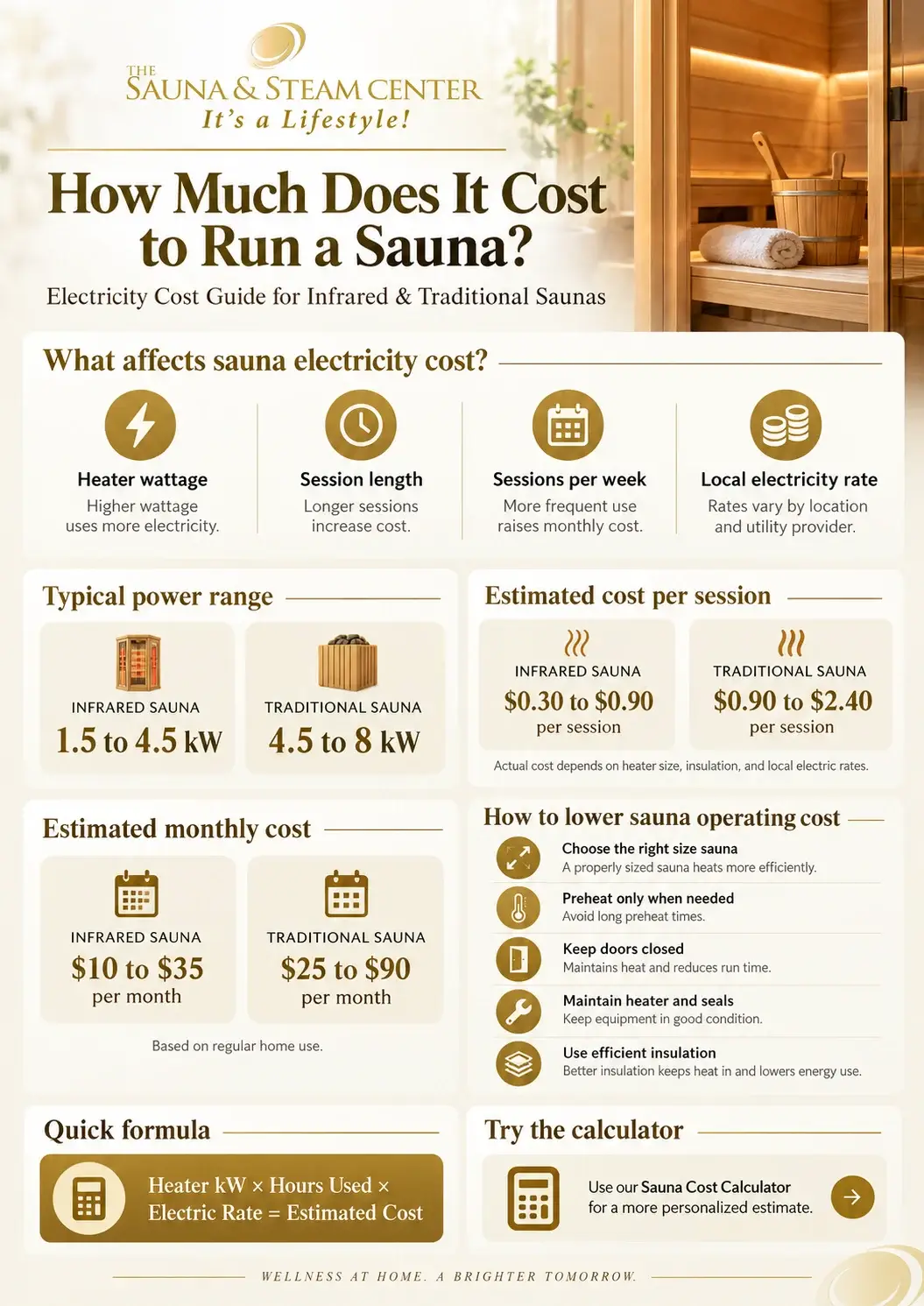
How much does it cost to run a sauna? For many home saunas, the electricity cost is measured in cents to a few dollars per session rather than tens of dollars. Infrared cabins generally draw less power than traditional electric sauna heaters, while traditional saunas use higher-wattage heaters and usually require more preheating. The most accurate way to estimate your own sauna electricity cost is to use the heater’s actual wattage, how long the sauna is powered on, how often you use it, and the electricity rate from your utility bill.
Sauna Electricity Cost Calculator
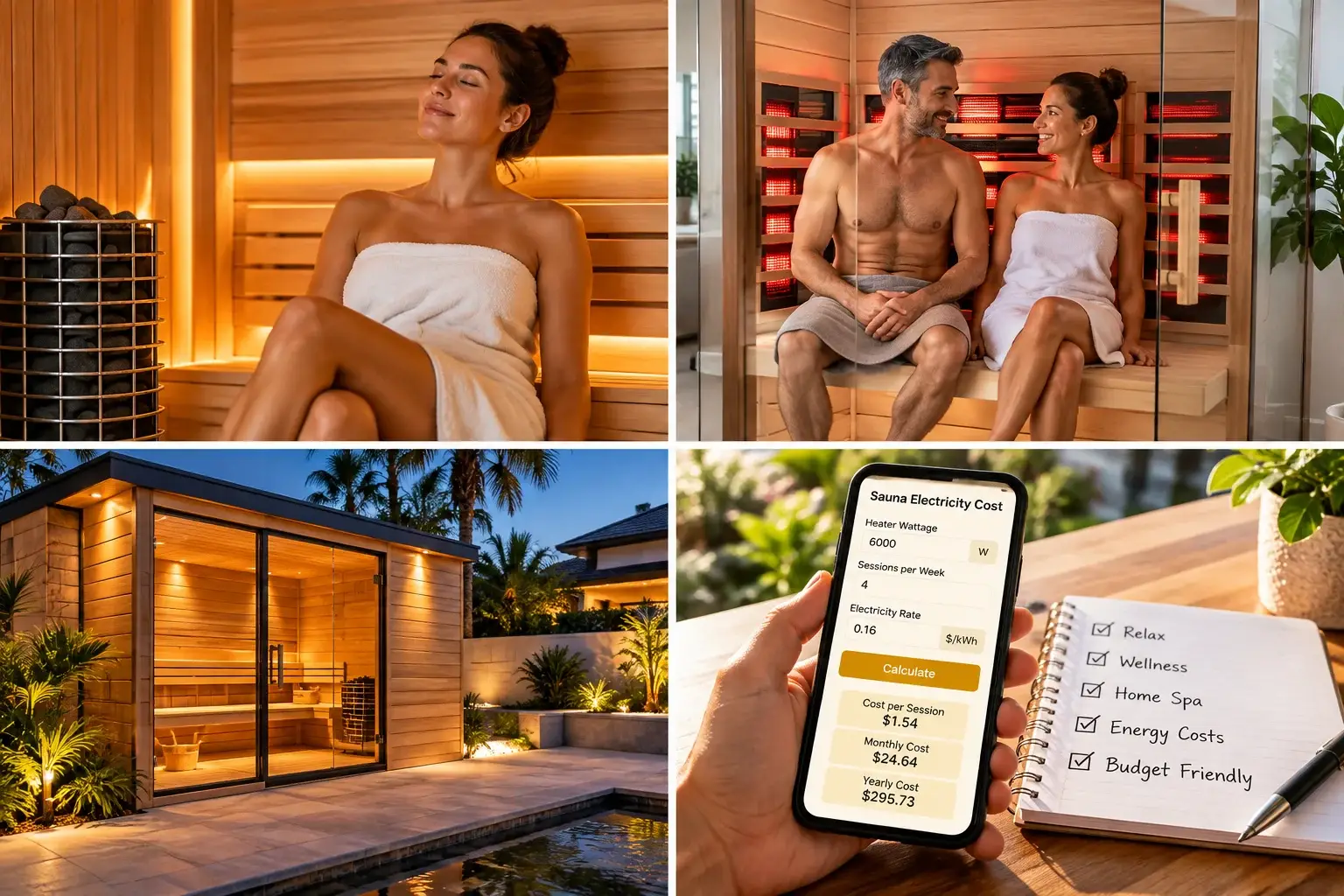
Enter your heater wattage, total powered time, sessions per week, electricity rate, and an estimated average heater load. The calculator shows an operating estimate plus a full-rated-power comparison. Use 100% load if you want a conservative ceiling.
Use the rated wattage from the heater or sauna specification sheet.
Include preheat time plus the time the sauna remains switched on.
Florida July 2026 YTD residential average: 15.30¢/kWh.
Use 100% for a conservative full-power estimate. Traditional heaters often cycle after warm-up.
Formula: watts ÷ 1,000 × hours × electricity rate × estimated load. Monthly use is estimated at 52 weeks ÷ 12 months. This calculator estimates electricity only, not wiring, equipment, maintenance, or fixed utility fees.
Sauna Running Cost: Quick Answers
| Question | Quick Answer |
|---|---|
| How much does it cost to run a sauna per session? | Infrared can cost only a few dimes per session, while a traditional electric sauna commonly costs around $1 or more depending on heater size, preheat time, local rates, and thermostat cycling. |
| How much electricity does a sauna use? | Smaller infrared home cabins commonly use roughly 1.5-2.2 kW of rated power. Traditional home electric heaters commonly fall around 4.5-9 kW depending on room size. |
| Is infrared cheaper to run? | Usually yes because infrared cabins generally have lower rated power and shorter warm-up requirements. |
| Does 240V automatically cost more than 120V? | No. Voltage alone does not determine the bill. Kilowatt-hours consumed do. |
| What electricity rate should I use? | Use your utility bill if possible. For a benchmark, July 2026 YTD EIA data show 18.19¢/kWh nationally and 15.30¢/kWh in Florida. |
| Does the heater run at full power the whole time? | Not necessarily. Traditional heaters usually cycle after the room reaches temperature. |
Key Takeaways
- Your cost is driven mainly by power draw, powered time, frequency, and electricity rate.
- July 2026 YTD EIA data put residential electricity at 18.19¢/kWh nationally and 15.30¢/kWh in Florida.
- Infrared generally costs less to operate because power draw and warm-up requirements are lower.
- Traditional electric heaters are commonly several kilowatts larger, but thermostats cycle the elements after the room reaches temperature.
- 120V vs. 240V does not by itself determine operating cost. Kilowatt-hours do.
- Room volume, glass, insulation, door openings, outdoor conditions, heater sizing, and session habits all affect consumption.
How Do You Calculate Sauna Electricity Cost?
If your sauna is rated in watts, divide by 1,000 first. A 6,000-watt heater is 6 kW. If it is powered for 90 minutes, that is 1.5 hours.
At 15.30¢/kWh, the full-load calculation is 6 kW × 1.5 hours × $0.153 = $1.38. That is a useful upper-bound estimate, but actual meter consumption can be lower because the thermostat cycles once temperature is reached.
kW vs. kWh: What Is the Difference?
| Term | Meaning | Sauna Example |
|---|---|---|
| kW | Power, or how quickly equipment can use energy. | A heater may be rated at 6 kW. |
| kWh | Energy consumed over time. This is what utilities bill. | A 6 kW heater at full output for 30 minutes uses 3 kWh. |
How Much Does an Infrared Sauna Cost to Run?
Infrared saunas generally have lower electrical demand than traditional electric saunas. Finnleo’s comparison of common two-person systems describes infrared heating around 1.5-1.7 kW, while a current Finnleo portable sauna manual lists 1.7 kW and 2.2 kW heater options.
| Infrared Power | Energy for 45 Minutes | Florida 15.30¢/kWh | U.S. 18.19¢/kWh |
|---|---|---|---|
| 1.7 kW | 1.28 kWh | About $0.20 | About $0.23 |
| 2.2 kW | 1.65 kWh | About $0.25 | About $0.30 |
These are full-rated-power examples. Actual consumption can be lower if the system cycles. If you are comparing heat types, read our infrared vs. traditional sauna guide.
How Much Does a Traditional Electric Sauna Cost to Run?
Traditional sauna heaters are larger because they heat the air, stones, wood surfaces, and room. Harvia uses a 6-8 kW family sauna heater as a representative example.
In a well-insulated sauna, Harvia estimates roughly 7-9 kWh for a 6 kW heater over one hour of heating plus one hour of bathing, and about 9-13 kWh for an 8 kW heater over the same period.
| Heater Example | Energy | Florida 15.30¢/kWh | U.S. 18.19¢/kWh |
|---|---|---|---|
| 6 kW | 7-9 kWh | $1.07-$1.38 | $1.27-$1.64 |
| 8 kW | 9-13 kWh | $1.38-$1.99 | $1.64-$2.36 |
For heater sizing, see our sauna heater guide and electric sauna heater kW and 240V guide.
Infrared vs. Traditional Sauna Running Cost
| Factor | Infrared | Traditional Electric |
|---|---|---|
| Common home power | Often around 1.5-2.2 kW for smaller cabins | Often around 4.5-9 kW |
| Warm-up | Usually shorter | Usually longer |
| Operating temperature | Lower | Higher |
| Electricity cost | Usually lower per session | Usually higher per session |
| Main variables | Actual wattage and session duration | Heater size, preheat, insulation, room construction and cycling |
How Much Does a Sauna Cost to Run in Florida?
EIA year-to-date data through July 2026 list Florida residential electricity at 15.30¢ per kWh, compared with 18.19¢ per kWh for the U.S. overall.
| Example at 3 Sessions/Week | Per Session | Per Month | Per Year |
|---|---|---|---|
| 1.7 kW infrared, 45 min at full output | $0.20 | $2.54 | $30.43 |
| 2.2 kW infrared, 45 min at full output | $0.25 | $3.28 | $39.38 |
| 6 kW traditional, Harvia 7-9 kWh example | $1.07-$1.38 | $13.92-$17.90 | $167.08-$214.81 |
| 8 kW traditional, Harvia 9-13 kWh example | $1.38-$1.99 | $17.90-$25.86 | $214.81-$310.28 |
The traditional examples use Harvia’s one-hour heat-up plus one-hour bathing scenario. The infrared examples use 45 minutes at full rated output, so they are planning examples rather than identical session protocols.
Why Does Preheat Time Matter?
A traditional sauna begins using electricity before you sit down because the heater must warm the stones, air, wood surfaces, and other room materials. Infrared systems generally have less room mass to heat and operate at lower cabin temperatures.
Does a Sauna Heater Use Its Full Rated Wattage the Whole Time?
Usually not. A traditional electric heater may draw near rated output during much of warm-up, then cycle on and off after reaching the thermostat setpoint. This is why the calculator shows both an adjustable estimated load and a full-rated-power comparison.
If you do not know the real duty cycle, use 100% for a conservative ceiling and treat it as an estimate rather than a meter reading.
What Factors Change Sauna Electricity Use?
| Factor | Effect |
|---|---|
| Heater size | Higher kW increases instantaneous draw. |
| Room volume | Larger rooms normally need more heating capacity. |
| Glass and uninsulated surfaces | Increase heating demand. Harvia specifically accounts for these when sizing heaters. |
| Insulation | Better insulation reduces heat loss. |
| Preheat time | Adds energy before bathing begins. |
| Set temperature | Higher targets usually require more heating. |
| Door opening | Releases hot air and can trigger extra heater operation. |
| Indoor vs. outdoor | Ambient conditions, wind, construction and insulation can change heat loss. |
| Frequency | More sessions directly increase monthly and yearly cost. |
| Utility rate | The same kWh can cost very different amounts by location and plan. |
Does a 240V Sauna Cost More to Run Than a 120V Sauna?
Not simply because it uses 240 volts. Utilities bill energy in kilowatt-hours, not volts. A 1.7 kW load consumes approximately the same energy over the same time whether the equipment is designed around 120V or 240V.
Traditional home saunas are often 240V because their heaters have substantially higher kW ratings than smaller plug-in infrared cabins. The higher power is what changes operating cost.
How Do You Find the Right Electricity Rate?
- Look for your energy charge in cents per kWh or dollars per kWh.
- If you have time-of-use pricing, use the rate that applies when you normally run the sauna.
- If variable fuel or delivery charges are billed per kWh, include them for a closer incremental-cost estimate.
- Do not automatically divide the entire bill by kWh if large fixed monthly customer charges are included, because those fixed charges do not rise when you run one extra sauna session.
How Can You Reduce Sauna Running Cost?
- Use it when it is ready. Avoid leaving a fully heated sauna empty.
- Size the heater correctly. Follow manufacturer guidance for room volume and glass.
- Insulate properly. Construction quality affects heat retention.
- Keep the door closed.
- Use an appropriate powered time.
- Use timers and controls.
- Check time-of-use pricing. Off-peak sessions may cost less where available.
- Maintain the heater and controls.
Running Cost vs. the Cost to Buy and Install a Sauna
Electricity is only one part of ownership. Equipment, room construction, electrical circuits, ventilation, glass, benches, heater, controls, delivery and installation can be much larger expenses than the annual power bill.
Use our Sauna Cost Calculator for the upfront project budget, then use the electricity calculator on this page for ongoing operating cost. For more detail, see our in-home sauna cost guide.
Plan the Whole Sauna Budget
Compare the Purchase Price and the Cost to Run It
Sauna & Steam Center can help you compare infrared, traditional, prefab and custom sauna options based on heater requirements, electrical needs, installation and long-term ownership.
Frequently Asked Questions About Sauna Electricity Cost
How much does it cost to run a sauna for one hour?
At 15.30¢/kWh, a 6 kW heater running continuously at full output for one hour would cost about $0.92. Actual use can be lower after thermostat cycling begins.
How much does it cost to run a sauna per month?
It depends on power, powered time, frequency and electricity rate. At Florida’s July 2026 YTD average, a 1.7 kW infrared sauna used 45 minutes three times a week at full rated power is about $2.54 per month.
How much electricity does an infrared sauna use?
Smaller home infrared cabins are commonly around 1.5-2.2 kW. Actual kWh depends on duration and cycling.
How much electricity does a traditional sauna use?
Home traditional electric heaters commonly fall around 4.5-9 kW depending on room size. Harvia gives an example of 7-9 kWh over two hours for a 6 kW heater and 9-13 kWh for an 8 kW heater.
Is infrared cheaper to run than a traditional sauna?
Usually. Infrared cabins generally have lower rated power and shorter warm-up requirements.
Does a 240V sauna cost more than a 120V sauna?
Voltage alone does not determine cost. Utilities bill kilowatt-hours. Traditional 240V saunas often cost more because their heaters have higher kW ratings.
What is the average residential electricity rate in Florida?
EIA data year-to-date through July 2026 list Florida residential electricity at 15.30 cents per kWh. Your utility rate may differ.
What is the average U.S. residential electricity rate?
EIA data year-to-date through July 2026 list the U.S. residential average at 18.19 cents per kWh.
Does adding glass increase sauna energy use?
It can. Harvia’s heater-sizing guidance treats glass and other uninsulated or heat-storing surfaces as additional heating load.
Conclusion: What Will Your Sauna Actually Add to the Electric Bill?
The answer becomes straightforward once you use your sauna’s own numbers. Find its rated wattage, include the full powered time including preheat, enter your sessions per week, and use the electricity rate from your bill.
Infrared saunas generally cost less to operate because their power draw is lower. Traditional electric saunas use larger heaters and require more room heating, but thermostat cycling means rated kW should not automatically be treated as continuous consumption.
For many homeowners, purchase and installation costs are much larger than the yearly electricity expense. Choose the sauna experience and build quality you want, size it correctly, then use the calculator to budget the ongoing cost accurately.
References
U.S. Energy Information Administration
Electric Power Monthly, Average Price of Electricity to Ultimate Customers by State, Year-to-Date Through July 2026.