
Hot Tub Cost in 2026: Prices, Installation & In-Ground Cost
Pricing disclosure: Hot tub prices vary by brand, model, site conditions, access, foundation requirements, electrical scope, permits, taxes, accessories, and local labor. The ranges in this guide are planning estimates, not fixed quotes. Always confirm the complete installed price for your specific property.
How much does a hot tub cost? In 2026, a new permanent hard-shell hot tub commonly costs about $4,000 to $20,000+ for the spa itself, while many complete above-ground projects land around $7,000 to $20,000+ after delivery, foundation work, electrical installation, accessories, and site preparation. The price of a hot tub varies widely by size, construction, features, brand, electrical requirements, and installation complexity.
The biggest content gap for many buyers is in-ground hot tub cost. An above-ground self-contained spa and a custom in-ground spa are very different projects. A portable hot tub can often be installed on a prepared pad with electrical service, while an in-ground project may require excavation, structural work, plumbing, waterproofing, drainage, decking, equipment access, and custom finishes. At Sauna & Steam Center, we help South Florida homeowners compare hot tubs based on product cost, installation requirements, access, electrical planning, long-term serviceability, and total ownership cost. This guide explains what to expect for hot tub cost, hot tub with installation, and in-ground hot tub cost without treating every project as if it has the same scope.How Much Does a Hot Tub Cost? Quick Answer
| What You Are Pricing | 2026 Planning Range | What the Number Includes |
|---|---|---|
| Hot tub unit only | About $4,000 to $20,000+ for many permanent hard-shell models | Spa cabinet, shell, pumps, controls, filtration and standard factory equipment |
| Average practical unit budget | About $5,000 to $15,000 for many homeowners | A useful shopping range, not a national mathematical average |
| Hot tub with installation | Many complete above-ground projects: about $7,000 to $20,000+ | Unit plus some combination of delivery, base, electrical work, accessories and site preparation |
| Installation work alone | Highly site-dependent; published 2026 guides commonly place installation projects in the low-thousands to five figures | Foundation, electrical, delivery, access, permits, trenching and related site work |
| In-ground hot tub | Often about $5,000 to $25,000, with custom or complex projects reaching $35,000+ | Excavation, shell or structure, plumbing, equipment, electrical, waterproofing, decking and finishes |
Hot Tub Cost: Quick Answers to the Most Common Price Searches
| Search Query | Best Practical Answer |
|---|---|
| Hot tub cost | Many permanent hard-shell spas cost about $4,000 to $20,000+ before site-specific installation. |
| How much does a hot tub cost? | A practical unit budget is often $5,000 to $15,000, while many complete above-ground projects reach $7,000 to $20,000+. |
| How much is a hot tub? | Prices range from a few hundred dollars for inflatable products to $20,000+ for premium permanent spas. |
| Price of a hot tub | The spa price depends on size, materials, pumps, controls, insulation, water care, features, brand, warranty and dealer support. |
| Average cost of a hot tub | For permanent home spas, $5,000 to $15,000 is a useful shopping range for the unit, but the total installed budget is often higher. |
| How much is a new hot tub? | Many new hard-shell models fall around $4,000 to $20,000+, depending on quality, size and features. |
| Hot tub price range | Inflatable: hundreds to about $1,500; entry-level hard shell: roughly $2,500 to $6,000; mid-range: $5,000 to $12,000; premium: $10,000 to $20,000; luxury/custom: $20,000+. |
| Hot tub installation cost | Installation depends on delivery, foundation, electrical work, trenching, access, permits and whether a crane or panel upgrade is needed. |
| Cost to install a hot tub | Simple prepared sites can cost far less than projects requiring a new pad, long electrical run, trenching, crane placement or electrical service upgrades. |
| Hot tub with installation | Ask whether the quote is truly turnkey. Many complete above-ground projects fall around $7,000 to $20,000+, but inclusions vary. |
| In-ground hot tub cost | Published 2026 estimates often place in-ground spas around $5,000 to $25,000, with an average near $15,000 in one current cost guide and complex projects exceeding $35,000. |
Key Takeaways
- Hot tub cost should be evaluated as a complete project, not only the advertised spa price.
- Hot tub with installation often includes delivery, placement, foundation work, electrical, permits, startup, and accessories, but quotes vary.
- In-ground hot tub cost is usually less predictable than above-ground pricing because construction and site work become major cost drivers.
- A recessed portable spa is not the same project as a custom concrete or pool-integrated in-ground spa.
- Electrical distance, trenching, panel capacity, difficult access, crane placement, drainage, and deck work can materially change the final budget.
- The best quote is the one that clearly defines the full scope, exclusions, warranty, service access, and final installed price.
What Is the Average Cost of a Hot Tub in 2026?
If you search average cost of a hot tub, the answer depends heavily on what type of spa you mean. There is no single average that fairly represents inflatable products, entry-level hard-shell spas, premium acrylic hot tubs, and custom in-ground construction.
For a homeowner shopping for a new permanent hard-shell hot tub, a practical unit budget is often around $5,000 to $15,000. Entry-level options can cost less, while premium and luxury spas can cost $20,000 or more before installation.
| Budget Level | Typical Unit Price | What Buyers Commonly Find |
|---|---|---|
| Very low cost / temporary | $300 to $1,500 | Inflatable and basic seasonal products |
| Entry-level permanent | $2,500 to $6,000 | Rotomolded or simpler hard-shell spas, often with fewer premium features |
| Mid-range permanent | $5,000 to $12,000 | Broader seating choices, stronger insulation and more refined components |
| Premium | $10,000 to $20,000 | Higher-end materials, hydrotherapy, controls and water-care features |
| Luxury / custom | $20,000 to $35,000+ | Flagship models, custom design, premium finishes or complex product categories |
In-Ground Hot Tub Cost: How Much Does an In-Ground Hot Tub Cost?
In-ground hot tub cost varies much more than portable hot tub pricing because you are paying for both the spa and a construction project. Current 2026 consumer cost guides place many in-ground hot tub projects around $5,000 to $25,000. Angi reports an average around $15,000 and notes that complex projects can exceed $35,000. These are national planning figures, not South Florida quotes. The phrase “in-ground hot tub” can also describe very different installations, so the first step is identifying which type you mean.| In-Ground Style | What It Is | Main Cost Drivers |
|---|---|---|
| Recessed or partially recessed portable spa | A factory-built self-contained hot tub installed into or beside a deck | Spa price, structural support, access panels, decking, electrical, drainage, delivery |
| Prefabricated in-ground spa | A manufactured shell installed into a prepared excavation | Excavation, shell, plumbing, base, electrical, decking, equipment access, permits |
| Custom concrete / gunite spa | A site-built permanent spa with custom shape and finishes | Engineering, excavation, steel, concrete, waterproofing, tile, plumbing, heating, controls, decking |
| Pool-integrated spa | A spa designed as part of a pool or major backyard project | Pool hydraulics, automation, structural work, finish selections, deck design, site complexity |
Why an in-ground hot tub can cost more than expected
- Excavation: access for machinery, soil conditions, hauling, and existing utilities affect labor.
- Structural construction: custom concrete or engineered support adds material and labor.
- Plumbing and equipment: pumps, heaters, filters, drains, suction lines, jets, and equipment access must be planned as a system.
- Waterproofing and finish: tile, stone, plaster, membranes, sealants, and edge details can materially change the budget.
- Decking and restoration: pavers, concrete, coping, landscaping, and drainage around the spa are often separate line items.
- Electrical and controls: dedicated circuits, bonding, automation, disconnects, trenching, and panel capacity must be considered.
- Serviceability: pumps, heaters, controls, plumbing unions, and valves still need future access after the spa is built in.
How to get a realistic in-ground hot tub estimate
- Decide whether you want a recessed portable spa, prefabricated in-ground shell, or custom concrete spa.
- Measure the available area and access route.
- Identify existing pool, deck, plumbing, drainage, and electrical conditions.
- Determine whether excavation, engineering, permits, or HOA approval may be required.
- Price the spa equipment and the surrounding construction separately.
- Confirm how future equipment service will be performed.
- Request a written scope that separates allowances, exclusions, and change-order items.
Why Hot Tub Prices Vary So Much
Two hot tubs can look similar online and still be priced thousands of dollars apart. The difference is often hidden inside the cabinet and in the service package surrounding the product. Shell construction, frame materials, insulation, pumps, controls, plumbing design, filtration, warranty coverage, and replacement-part access all affect long-term value.What usually drives the price up or down
- Shell and frame construction: Stronger materials and better structural support generally cost more but may provide a longer useful life.
- Insulation: Better insulation helps the spa retain heat and can reduce energy use.
- Hydrotherapy design: Jet placement, pump performance, seat shape, and adjustability matter more than jet count alone.
- Size and water capacity: Larger spas require more material, water, heating capacity, and structural support.
- Electrical configuration: A 120V plug-and-play model is usually easier to install than a 240V hard-wired spa.
- Water-care system: Upgraded filtration, ozone, UV, or compatible salt systems can increase the initial price.
- Cabinet and finish options: Premium colors, textures, lighting, waterfalls, audio, and Wi-Fi controls add cost.
- Warranty and dealer support: Delivery coordination, startup help, local service, parts access, and warranty labor have real value.
Bottom line: Hot tub pricing combines product quality, installation complexity, included services, and long-term support. The lowest advertised price is not always the lowest total ownership cost.
Hot Tub Price Ranges by Type
These broad price ranges help establish a starting budget. Actual pricing changes by brand, size, construction, included features, and dealer package.| Hot Tub Type | Typical Unit Price | Example Brands | Best For | What to Expect |
|---|---|---|---|---|
| Inflatable | $300 to $1,500 | Intex, Coleman, Lay-Z-Spa | Renters, seasonal use, and very limited budgets | Soft-sided construction, air jets, basic insulation, and a shorter expected life |
| Entry-level or rotomolded hard shell | $2,500 to $6,000 | Essential Hot Tubs, American Spas, Lifesmart | Buyers seeking a permanent spa at a lower price | Simpler controls, fewer premium finishes, and many 120V options |
| Mid-range acrylic | $5,000 to $12,000 | Hot Spring Pace, Caldera Kauai, Sundance Optima, Bullfrog A Series | Most homeowners and regular family use | Better insulation, stronger hydrotherapy, more seating choices, and better long-term value |
| Premium | $10,000 to $20,000 | Jacuzzi J-300 series, Hot Spring Highlife, Sundance Maxxus, Caldera Utopia | Frequent use, stronger comfort, and advanced features | Higher-end materials, refined seating, upgraded controls, and enhanced water care |
| Luxury or custom | $20,000 to $35,000+ | Jacuzzi J-500 series, Hot Spring Envoy NXT, Master Spa H2X | Premium outdoor projects and buyers prioritizing design and performance | Flagship components, advanced therapy, premium finishes, and extensive customization |
| Swim spa | $20,000 to $50,000+ | Master Spa, Endless Pools, Hot Spring Endless | Exercise, aquatic training, and large outdoor spaces | A larger footprint, higher site-preparation costs, and more complex delivery |
What Is the Price of a New Hot Tub?
If you searched price of hot tub or how much is a new hot tub, many new permanent hard-shell models fall between about $4,000 and $20,000+. The wide range reflects differences in construction, insulation, pumps, hydrotherapy, controls, filtration, warranty, size, and dealer support.
What Is the Average Cost of a New Hot Tub?
For homeowners shopping for a permanent hard shell spa, a practical unit budget is often $5,000 to $15,000. Once delivery, foundation work, electrical installation, accessories, and startup items are included, many complete projects fall between $7,000 and $20,000+. A small 120V model and a premium 240V six-person spa are both called hot tubs, but they provide different heating, jet performance, seating, installation, and ownership experiences. Our plug-and-play hot tub guide explains where a simpler 120V model makes sense.Hot Tub Prices by Size and Seating Capacity
Seating capacity affects price, but it should not be used by itself to judge value. A well-built four-person spa can cost more than a basic seven-person model because construction, insulation, pumps, controls, warranty coverage, and hydrotherapy design also matter.| Advertised Capacity | Broad Unit Price Range | Common Use |
|---|---|---|
| 2 to 3 people | $2,000 to $7,000+ | Couples, small patios, and compact installations |
| 4 to 5 people | $3,000 to $12,000+ | Small families and regular home use |
| 6 to 7 people | $5,000 to $16,000+ | Families, entertaining, and more varied seating |
| 8 or more people | $8,000 to $20,000+ | Large households, entertaining, and premium backyard projects |
Above-Ground vs. In-Ground Hot Tub Cost
The cost difference is not only the spa shell. Above-ground hot tubs arrive with most major equipment integrated into the cabinet. In-ground spas usually require more site construction and coordination.| Cost Factor | Above-Ground Hot Tub | In-Ground Hot Tub |
|---|---|---|
| Primary product | Self-contained spa | Prefabricated shell or custom-built spa |
| Excavation | Usually none | Often required |
| Plumbing | Mostly integrated | Often site-built |
| Equipment access | Cabinet panels | Must be designed into the project |
| Foundation / structure | Prepared pad, deck, or structural surface | Excavation, shell support, structural work |
| Finish work | Factory shell and cabinet | May include tile, coping, stone, plaster, decking |
| Budget predictability | Generally higher | Lower because site conditions matter more |
Hot Tub vs. Pool Cost Comparison
Homeowners who are deciding between a hot tub and a pool — or evaluating whether to add both — often find the cost difference is larger than expected. A hot tub delivers hydrotherapy, year-round usability, and a compact footprint at a fraction of the cost of a pool installation.| Factor | Hot Tub | In-Ground Pool |
|---|---|---|
| Typical installed cost | $7,000 to $20,000+ | $35,000 to $80,000+ |
| Footprint | 35 to 75 sq ft typical | 300 to 600+ sq ft typical |
| Annual operating cost | $700 to $2,500+ | $1,500 to $5,000+ |
| Electrical requirement | 120V or 240V dedicated circuit | 240V equipment circuit, multiple loads |
| Permitting complexity | Typically simpler | More complex; zoning and setback rules apply |
| Year-round use in South Florida | Yes | Yes, but heating adds cost in cooler months |
| Hydrotherapy jets | Yes — designed for therapy | Only with separate spa addition |
| Relocation possible? | Yes, above-ground units can move | No |
Hot Tub Installation Cost: How Much Does It Cost to Install a Hot Tub?
Hot tub installation cost is separate from the advertised spa price unless the dealer specifically offers a turnkey package. Published 2026 cost guides show that installation projects can range from the low thousands into five figures depending on the type of hot tub and the site conditions. A current Angi guide reports roughly $2,000 to $11,000 for hot tub and spa installation, while another Angi guide places the average installation near $6,000. These national figures are useful for context, but your actual property may be lower or higher.
The cost to install a hot tub is usually driven by the following items:
| Installation Item | Why It Changes Cost |
|---|---|
| Delivery and placement | Distance, gates, stairs, walls, roofs, landscaping and crane access affect labor and equipment. |
| Foundation or supporting surface | Concrete pads, pavers, engineered pads and reinforced decks have different preparation requirements. |
| Electrical work | Voltage, panel capacity, wire distance, disconnect, GFCI protection, trenching and permits can change the quote. |
| Trenching and restoration | Long underground electrical runs may require excavation and repair of landscaping, pavers or concrete. |
| Panel or service upgrade | An existing electrical service may need additional capacity before a 240V spa can be connected. |
| Permit and inspection | Municipal requirements vary by location and electrical scope. |
| Crane or specialty placement | Waterfront, rooftop, courtyard and blocked-access properties may require specialized equipment. |
| Accessories and startup | Steps, cover lifter, handrails, filters, chemicals and orientation may be separate charges. |
For electrical work specifically, a 2026 Angi cost guide reports approximately $1,900 to $4,200 for hot tub wiring, depending heavily on panel capacity and distance. Your licensed electrician should provide the property-specific quote.
Hot Tub With Installation: Price, Installation Cost & What Is Included?
If you searched for a hot tub with installation, ask whether the quoted number is truly turnkey. Dealers and contractors may define “installation” differently. One quote may include only delivery and placement, while another may coordinate the foundation, electrical connection, permits, startup, accessories, and old-spa removal.| Installed Cost Item | Could Be Included? | What to Confirm |
|---|---|---|
| Delivery | Often | Curbside, driveway, or final placement? |
| Crane or special access | Sometimes separate | Who arranges it and who pays? |
| Foundation | Often separate | Concrete, pavers, engineered pad, deck reinforcement? |
| Electrical | Often separate | Circuit, GFCI disconnect, trenching, panel work, permit? |
| Accessories | Varies | Cover, lifter, steps, handrail, filters? |
| Startup | Varies | Filling, water balancing, orientation, chemicals? |
| Old spa removal | Usually separate | Disconnect, haul-away, disposal, restoration? |
 The installed price is the number buyers should focus on. The spa itself may be the largest line item, but delivery conditions, the foundation, electrical capacity, permits, and accessories can change the final budget substantially.
Common installation costs buyers forget
- Delivery and placement: Narrow side yards, stairs, walls, gates, landscaping, rooftop locations, or crane placement can add cost.
- Foundation: The spa may require a concrete pad, engineered spa pad, pavers, compacted gravel system, or reinforced deck.
- Electrical installation: A 240V spa usually requires a dedicated circuit, GFCI protection, disconnect, wiring, and licensed installation.
- Trenching: Underground conduit between the electrical panel and spa can increase labor and restoration costs.
- Panel or service upgrade: A full or undersized electrical panel may need additional work before the spa can be connected.
- Permit and inspection: Requirements and fees vary by municipality and project type.
- Accessories: Steps, handrails, cover lifter, startup chemicals, filters, and privacy features may be separate. Premium spa packages may also include lighting, water-care upgrades, Wi-Fi controls, audio, or other accessories that should be itemized separately.
- Removal: Hauling away an old spa may require additional labor, disposal fees, or a crane.
Plug-and-play vs. 240V hard-wired installation
A plug-and-play spa can be less expensive to install when a suitable outdoor receptacle and safe foundation already exist. A 240V spa generally supports faster heating and stronger simultaneous heater-and-jet operation, but it requires more planning and licensed electrical work. Review our plug-and-play hot tub cost and performance comparison before deciding.Three Example Hot Tub Budgets
These examples show how a reasonable product price can become a different installed total. They are planning examples, not quotes.| Cost Item | Compact 120V Example | Mid-Range 240V Example | Premium Complex-Site Example |
|---|---|---|---|
| Hot tub | $4,500 | $9,000 | $18,000 |
| Delivery and placement | $300 | $500 | $1,500 |
| Foundation or site preparation | $1,000 | $1,500 | $4,000 |
| Electrical work | $0 to $300 | $1,600 | $4,000 |
| Accessories and startup | $400 | $600 | $1,000 |
| Example total | $6,200 to $6,500 | $13,200 | $28,500 |
Big-Box vs. Specialty Dealer Hot Tub Prices
Warehouse and online hot tubs can appear cheaper because their pricing model is designed around volume, standardized products, and fewer bundled services. A specialty dealer may include or coordinate services that are not reflected in a big-box product price.Why a warehouse price can look lower
- High-volume retail model: Large retailers can sell standardized models at scale.
- Basic delivery: Delivery may stop at the curb or driveway instead of placing the spa at its final location.
- Limited site planning: The buyer may be responsible for measuring access, arranging the foundation, and coordinating electrical work.
- Different model specifications: A product built for a warehouse channel may not be identical to a dealer model that looks similar.
- Remote support: Warranty administration and service may be handled by a third party rather than a nearby specialist.
- Separate accessories: Steps, cover lifters, startup supplies, and upgraded covers may not be included.
New vs. Used Hot Tub Prices
A used hot tub may have a much lower listing price, but transportation, placement, electrical work, repairs, a new cover, filters, and replacement components can erase the apparent savings. Used spas also may not include a transferable warranty.Before buying a used hot tub
- Inspect it while it is filled, heated, and operating.
- Run every pump, jet, light, blower, control, and water-care feature.
- Look inside the equipment compartment for active leaks, corrosion, damaged insulation, and evidence of repeated repairs.
- Confirm the exact model, serial number, voltage, amperage, dimensions, dry weight, filled weight, and manufacturing date.
- Ask whether replacement parts are still available.
- Confirm whether the warranty transfers to a second owner.
- Get a separate quote for removal, transportation, placement, electrical work, and repairs before agreeing to the purchase.
Hot Tub Financing and Monthly Payments
Many dealers and lenders offer hot tub financing, commonly using fixed monthly payments over a set term. Your payment depends on the amount financed, down payment, annual percentage rate, loan term, taxes, fees, and whether installation costs are included.| Amount Financed | 24-Month Term (0% example) | 48-Month Term (0% example) | 60-Month Term (6.9% APR example) |
|---|---|---|---|
| $6,000 | $250/mo | $125/mo | ~$118/mo |
| $10,000 | $417/mo | $208/mo | ~$197/mo |
| $15,000 | $625/mo | $313/mo | ~$296/mo |
| $20,000 | $833/mo | $417/mo | ~$394/mo |
Questions to ask before financing
- What is the annual percentage rate after any promotional period?
- Is interest deferred, and can it be charged retroactively if the balance is not paid by a deadline?
- Are there origination, documentation, or early-payment fees?
- Does the financed amount include delivery, electrical work, the foundation, accessories, and sales tax?
- What is the total amount paid over the full term?
- Can you make additional principal payments without a penalty?
How Much Should You Spend on a Hot Tub?
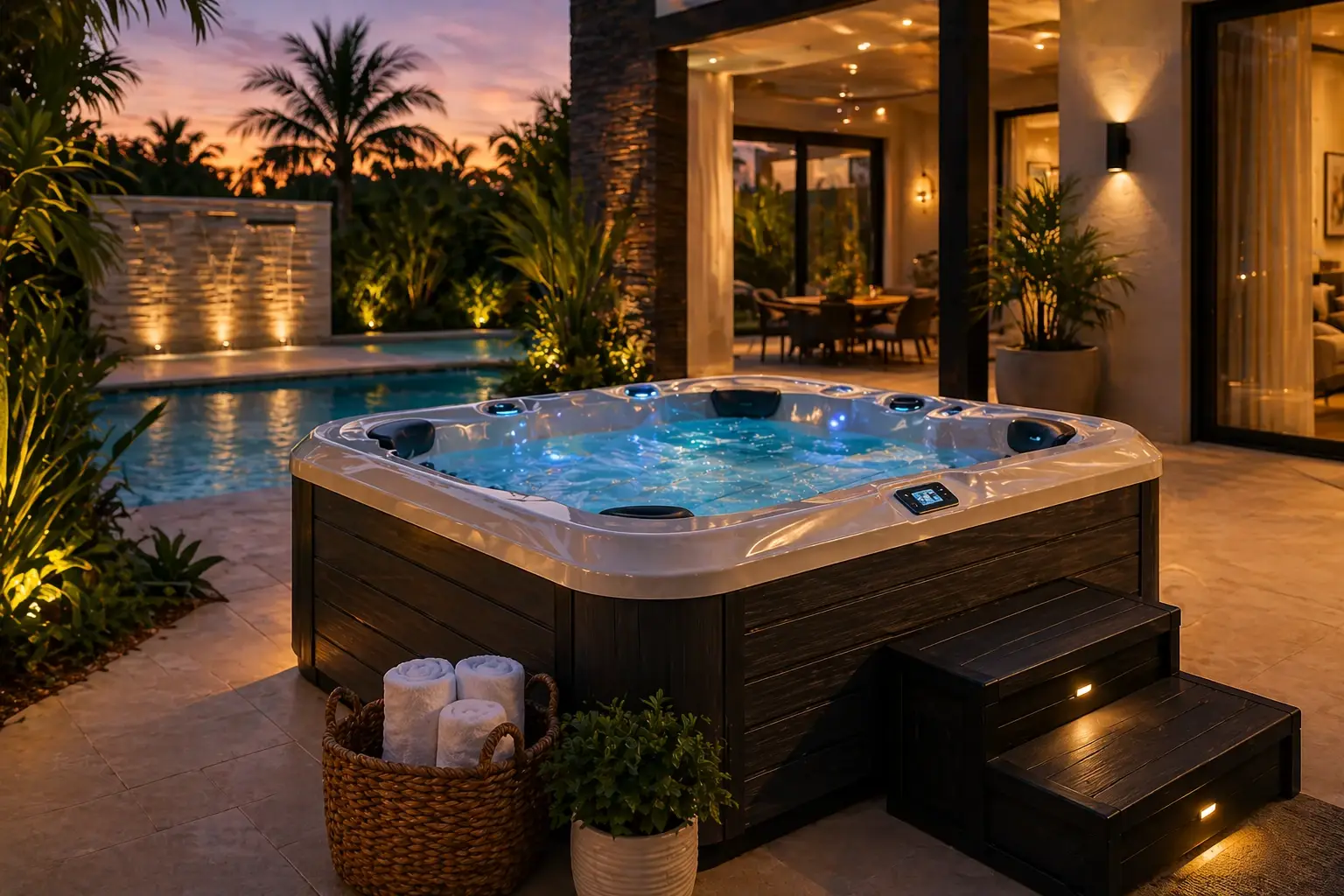 The right budget depends on how often you will use the spa, how many people need comfortable seating, the type of hydrotherapy you want, and how long you expect to keep it. Many homeowners find the strongest balance of price and performance in the $5,000 to $12,000 unit range.
A practical budget guide
- Under $5,000: Best for inflatable, entry-level, compact, or simpler plug-and-play options.
- $5,000 to $10,000: Often a strong value range for homeowners seeking a permanent hard shell spa.
- $10,000 to $15,000: Appropriate when comfort, insulation, component quality, hydrotherapy, and finish options matter more.
- $15,000 to $20,000: Common for premium models, larger spas, and advanced feature packages.
- $20,000+: Usually associated with flagship spas, custom design, luxury finishes, swim spas, or complex installations.
Where spending more may provide value
- Better insulation and heat retention
- Stronger shell, cabinet, and frame construction
- More comfortable and better-positioned hydrotherapy
- Quieter pumps and better equipment access
- Stronger warranty coverage and local service support
- More dependable replacement-part availability
Where you may be able to save
- Choose the seating capacity you will actually use.
- Skip decorative features that do not improve comfort or maintenance.
- Do not pay more only for a higher jet count.
- Consider a floor model or prior-year model from a reputable dealer.
- Prepare access and the installation area before delivery day.
Compare Real Hot Tub Options
Build a Hot Tub Budget That Includes the Whole Project
Visit our South Florida showroom to compare sizes, seating, features, installation requirements, and complete project costs before you buy.
Visit Our ShowroomHow to Save Money Without Buying the Wrong Spa
- Start with the installed budget: Decide what you can spend after electrical work, the foundation, delivery, accessories, and tax.
- Measure the route: Confirm gates, corners, roof overhangs, stairs, landscaping, and final service clearance before choosing a model.
- Buy the right size: Extra seats increase purchase, foundation, water, and operating costs.
- Compare insulation: A lower purchase price can be offset by higher operating costs.
- Ask about package pricing: Delivery, steps, cover lifter, startup products, and an upgraded cover may cost less when bundled.
- Consider floor models: A cosmetically imperfect or prior-year spa may offer better value than a lower-quality new model.
- Check service access: A model with available parts and local technicians can reduce future downtime and repair expense.
- Get the final scope in writing: Avoid assuming that delivery, placement, setup, electrical work, permits, or removal are included.
Monthly and Yearly Hot Tub Ownership Costs
The purchase and installation are only part of the budget. Electricity, water care, filters, replacement covers, and occasional service should also be considered.| Ongoing Cost | Planning Estimate | What Changes It |
|---|---|---|
| Electricity | About $20 to $80 per month | Climate, insulation, cover condition, water temperature, electricity rate, and use |
| Water-care products | About $20 to $50 per month | Spa size, use frequency, sanitizer system, and maintenance habits |
| Filters and small replacement items | About $60 to $250 per year | Filter design, cleaning schedule, brand, and water conditions |
| Professional maintenance or service | About $150 to $500+ per year | Maintenance plan, service frequency, warranty, and repair needs |
| Cover replacement reserve | Varies by size and quality | Sun exposure, weather, handling, material, and care |
| Total annual planning range | Often about $700 to $2,500+ | Efficiency, climate, use, maintenance, and unexpected repairs |
5-Year Total Cost of Ownership
The unit price and installation are a one-time expense. The more revealing number is the total you will spend over five years, including energy, water care, maintenance, and eventual repairs. The example below uses a mid-range 240V spa at a prepared South Florida site.| Cost Category | Year 1 | Year 2 | Year 3 | Year 4 | Year 5 | 5-Year Total |
|---|---|---|---|---|---|---|
| Hot tub unit (mid-range) | $9,000 | — | — | — | — | $9,000 |
| Installation (electrical, foundation, delivery) | $4,200 | — | — | — | — | $4,200 |
| Accessories and startup | $600 | — | — | — | — | $600 |
| Electricity (~$55/mo) | $660 | $660 | $660 | $660 | $660 | $3,300 |
| Water care (~$35/mo) | $420 | $420 | $420 | $420 | $420 | $2,100 |
| Filters and small parts | $120 | $120 | $150 | $150 | $150 | $690 |
| Service and maintenance | $150 | $200 | $200 | $250 | $300 | $1,100 |
| Cover replacement (year 5 estimate) | — | — | — | — | $500 | $500 |
| Example 5-Year Total | $15,150 | $1,400 | $1,430 | $1,480 | $2,030 | ~$21,490 |
When Is the Best Time to Buy a Hot Tub?
Timing a hot tub purchase can produce meaningful savings, but the best opportunity depends more on dealer relationships and model availability than a single sale calendar.- Late summer and early fall (August–October): Many dealers clear prior-year and current-year inventory before new models arrive. This is historically the strongest window for floor model and end-of-season discounts.
- End of quarter and end of year: December and March can bring motivated dealer pricing as sales targets approach.
- New model year introductions: When a manufacturer releases a new model, the outgoing version often drops in price. Ask your dealer when new inventory is expected.
- Floor model and trade-in availability: These appear throughout the year and are not limited to seasonal promotions.
- Bundled package promotions: Dealers occasionally offer accessories — steps, cover lifters, startup kits, or extended warranty upgrades — at no added cost during specific windows.
Hot Tub Prices in South Florida: Local Cost Factors
South Florida buyers face some installation conditions that may not appear in national price guides. The spa price may be similar, but the property and placement plan can change the installed total.- Access: Narrow side yards, privacy walls, dense landscaping, waterfront properties, and rooftop locations may require special equipment or crane placement.
- Outdoor electrical work: Distance from the panel, trenching, surface restoration, and existing panel capacity affect cost.
- Permits and approvals: Requirements vary by municipality, project type, electrical scope, HOA, and condominium association.
- Foundation and drainage: The installation area must remain level, stable, and suitable for the filled weight of the spa.
- Sun, humidity, and coastal exposure: Cover quality, cabinet materials, equipment protection, and routine care are important for long-term durability.
- Year-round use: Many South Florida owners use their spas throughout the year, making comfort, water care, and service access especially important.
- Sauna installation in Miami — placement, electrical, and access considerations for Miami-Dade properties
- Infrared sauna in Fort Lauderdale — infrared cabin options and installation planning for Broward County
- Steam room installation Fort Lauderdale — steam room design, tiling, and generator placement for Fort Lauderdale homes
- Sauna installation in Boca Raton — sauna and spa planning for Boca Raton and Palm Beach County
- Outdoor sauna in Florida — material, placement, and climate considerations for Florida outdoor installations
How to Compare Hot Tub Quotes
Do not compare two quotes until both describe the same scope. A lower quote may simply leave more work and expense to the buyer. Use the checklist below to align each proposal before evaluating the price.| Quote Item | What to Confirm |
|---|---|
| Exact spa | Brand, model, model year, shell color, cabinet color, voltage, and included options |
| Delivery | Curbside, driveway, final placement, mileage, difficult access, and crane charges |
| Foundation | Who designs, builds, approves, and pays for the supporting surface |
| Electrical | Circuit, GFCI disconnect, wiring distance, trenching, panel capacity, permit, and inspection |
| Accessories | Cover, upgraded cover, cover lifter, steps, handrail, filters, and startup supplies |
| Setup | Placement, assembly, filling, startup, water balancing, orientation, and packaging removal |
| Warranty | Parts, labor, travel charges, exclusions, registration, and who performs local service |
| Old spa removal | Disconnection, removal route, hauling, disposal, and site restoration |
| Final price | Sales tax, permit fees, financing fees, deposits, exclusions, and change-order rates |
Questions Smart Buyers Ask Before They Buy
- Is this price for the spa only or for a complete installed package?
- Is final placement included, or does delivery stop at the curb or driveway?
- Will the route require a crane, temporary fence removal, or landscaping changes?
- What foundation does the manufacturer require?
- Is the model 120V or 240V, and what electrical work is needed?
- Who obtains permits and coordinates inspection when required?
- Which cover, steps, lifter, filters, and startup supplies are included?
- Who performs warranty service locally?
- Are labor and travel included during the warranty period?
- What are realistic monthly operating costs for this model and climate?
- How long are replacement pumps, controls, jets, covers, and filters expected to remain available?
Planning a Hot Tub Project?
Get a Budget Based on the Spa and the Installation
Send us photos, approximate measurements, and the location where you want the hot tub installed. Sauna & Steam Center can help you identify delivery access, foundation, electrical, placement, and project considerations before you choose the final spa.Frequently Asked Questions About Hot Tub Cost
What is the average cost of a hot tub?
For a permanent hard-shell spa, about $5,000 to $15,000 is a useful shopping range for the unit itself. Many complete projects cost more after delivery, foundation, electrical work and accessories.
What is the average price of a new hot tub?
New hard-shell hot tubs commonly range from about $4,000 to $20,000+, while mid-range models often fall around $5,000 to $12,000 before site-specific installation.
What is the normal hot tub price range?
Inflatable models can cost a few hundred dollars, entry-level permanent spas roughly $2,500 to $6,000, mid-range models $5,000 to $12,000, premium spas $10,000 to $20,000, and luxury or custom options $20,000+.
How much does it cost to install a hot tub?
Installation varies by foundation, electrical work, delivery access, trenching, permits and crane requirements. Published 2026 national guides commonly place installation work in the low-thousands to five figures, but the property-specific quote is what matters.
What is the hot tub installation cost without the hot tub itself?
There is no universal number. Foundation work, electrical, delivery, trenching, crane placement, permits and accessories can make installation relatively simple or several thousand dollars. Get each line item quoted separately.
How much does an in-ground hot tub cost in 2026?
Current published planning figures often place in-ground hot tubs around $5,000 to $25,000. One 2026 Angi guide reports an average around $15,000 and notes that complex projects can exceed $35,000.
How much does a hot tub cost?
A permanent hard-shell hot tub commonly costs about $4,000 to $20,000+ for the spa itself. Many complete above-ground installations fall around $7,000 to $20,000+ after delivery, foundation work, electrical installation, accessories, and site preparation.What is the cost for an in-ground hot tub?
In-ground hot tub cost varies widely because the project can include excavation, structural work, plumbing, waterproofing, equipment, electrical, decking, drainage, and custom finishes. A recessed portable spa, prefabricated in-ground shell, and custom concrete spa should not be priced as the same type of project.Why does in-ground hot tub cost vary so much?
Site access, excavation, soil conditions, structural design, shell type, plumbing, heating equipment, tile or stone, decking, drainage, permits, automation, electrical work, and future service access can all change the final price.Is an in-ground hot tub more expensive than an above-ground hot tub?
Usually, yes. Above-ground spas arrive with most equipment integrated into the cabinet, while in-ground projects often require more excavation, plumbing, structural work, finish materials, and site construction.How much is a hot tub with installation?
Many complete above-ground hot tub installations fall around $7,000 to $20,000+, but difficult access, crane placement, long electrical runs, trenching, panel upgrades, custom foundations, and premium spas can push the total higher.Does the hot tub price include installation?
Not always. Confirm whether the quote includes final placement, foundation work, electrical, permits, accessories, filling, startup, orientation, packaging removal, sales tax, and old-spa removal.How much does hot tub electrical installation cost?
A simple connection near a suitable panel may cost hundreds of dollars, while long wire runs, trenching, a new subpanel, or a service upgrade can cost several thousand dollars. A licensed electrician should quote the actual property.Do in-ground hot tubs require permanent plumbing?
Custom in-ground spas generally require dedicated site-built plumbing. Portable above-ground hot tubs are usually self-contained and are commonly filled with a hose rather than permanently plumbed to household water.What should I ask for in a hot tub installation quote?
Ask for the exact model, delivery scope, final placement, foundation responsibility, electrical scope, permit responsibility, accessories, startup, warranty labor, local service, old-spa removal, taxes, and exclusions in writing.Conclusion: Compare the Complete Hot Tub Cost, Not Just the Spa Price
The best answer to how much does a hot tub cost depends on whether you are pricing the unit alone, a complete above-ground installation, or a true in-ground construction project. For many above-ground hot tubs, the spa itself is the largest line item, but delivery, foundation work, electrical installation, access, and accessories can materially change the final price. For an in-ground hot tub, excavation, structural work, plumbing, waterproofing, decking, drainage, finishes, and service access become equally important parts of the budget. Before choosing a model, build the complete project scope and ask for the total installed price in writing. That is the most reliable way to compare quotes and avoid being surprised by costs that were never included in the advertised spa price.References
- U.S. Department of Energy, Portable Electric Spas
- U.S. Consumer Product Safety Commission, Electrical Safety In and Around Pools, Spas and Hot Tubs
- Centers for Disease Control and Prevention, Staying Healthy in Hot Tubs
- Centers for Disease Control and Prevention, Home Pool and Hot Tub Water Treatment and Testing
- Hot Spring Spas, Hot Tub Installation Requirements
- Angi, How Much Does a Hot Tub Cost? 2026 Data
- HomeGuide, Hot Tub Installation Cost
- Jacuzzi, Hot Tub Installation Costs and Planning Guide
- Caldera Spas, Financing a Hot Tub
- Angi, How Much Does an In-Ground Hot Tub Cost? 2026 Data
- Angi, Hot Tub and Spa Installation Guide
- Angi, 2026 Hot Tub Electrical Installation Cost Guide