
Does Sauna Burn Calories? Exact Estimates by Time and Body Weight
Quick Answer: Does Sauna Burn Calories?
Yes, a sauna burns calories, but the number is probably modest for a normal session. Your body uses energy even while sitting, and heat can temporarily increase metabolic demand as circulation and cooling responses rise. A practical conservative estimate is roughly 12 to 76 total calories during 10 to 30 minutes, depending mainly on body weight and time.
A widely repeated 2019 study reported about 73 calories in the first 10-minute exposure and more than 134 calories in the fourth. Those figures should not be applied to everyone. The study involved 45 young sedentary men with overweight, used four rounds at 194°F to 196°F, and estimated calories indirectly with heart-rate monitors rather than measuring metabolism directly. Most immediate weight change after a sauna is water loss from sweating, not body-fat loss.
What the Calorie Number Really Means
Does sauna burn calories in a way that meaningfully changes weight or replaces exercise? The accurate answer has two parts. First, every minute of life uses energy, including minutes spent sitting on a sauna bench. Second, heat may raise that energy use above ordinary sitting, but current research cannot give one exact number that applies to every person, sauna, temperature, and session.
This guide separates measured findings from estimates. It shows a conservative calorie table by body weight and session length, explains the formula behind it, examines the study responsible for the often-quoted 73-to-134-calorie figures, and compares sauna time with walking, cycling, running, and weight training. It also explains why a smartwatch reading can look precise while still being wrong.
Key Takeaways
- A sauna uses some calories because the body is always using energy, and heat may raise energy demand temporarily.
- A conservative 10- to 30-minute estimate for adults in the 120- to 240-pound range is approximately 12 to 76 total calories.
- Only part of that total is additional heat-related expenditure. The rest would have been used while sitting at room temperature.
- The popular 73-to-134-calorie figures come from one narrow study that used repeated extreme-heat exposures and heart-rate-based estimates.
- No strong evidence proves that infrared, traditional, steam, or hotter sauna conditions produce a predictable calorie advantage.
- Sweating measures fluid loss, not fat loss or exact calorie expenditure.
- Walking, cycling, running, and resistance training burn more calories and provide adaptations that passive heat cannot replace.
How Many Calories Does a Sauna Burn in 10, 15, 20, and 30 Minutes?
For an average-size adult, a defensible estimate is in the tens of calories, not hundreds, during a normal session. Using the conservative method explained below, a 180-pound person would use approximately:
- 10 minutes: 18 to 19 total calories
- 15 minutes: 27 to 29 total calories
- 20 minutes: 36 to 38 total calories
- 30 minutes: 54 to 57 total calories
These figures include baseline energy expenditure. A 180-pound person would use about 29 calories simply sitting for 20 minutes at a standard 1-MET resting estimate. Raising the total to 36 to 38 calories means the heat-related increase is only about 7 to 10 additional calories in this model.
That distinction matters. Articles and fitness trackers sometimes present the entire session total as if every calorie came from the sauna. The more honest comparison is sauna versus sitting at rest, because the body would have used energy during those minutes either way.
Sauna Calorie Burn Chart by Session Length and Body Weight
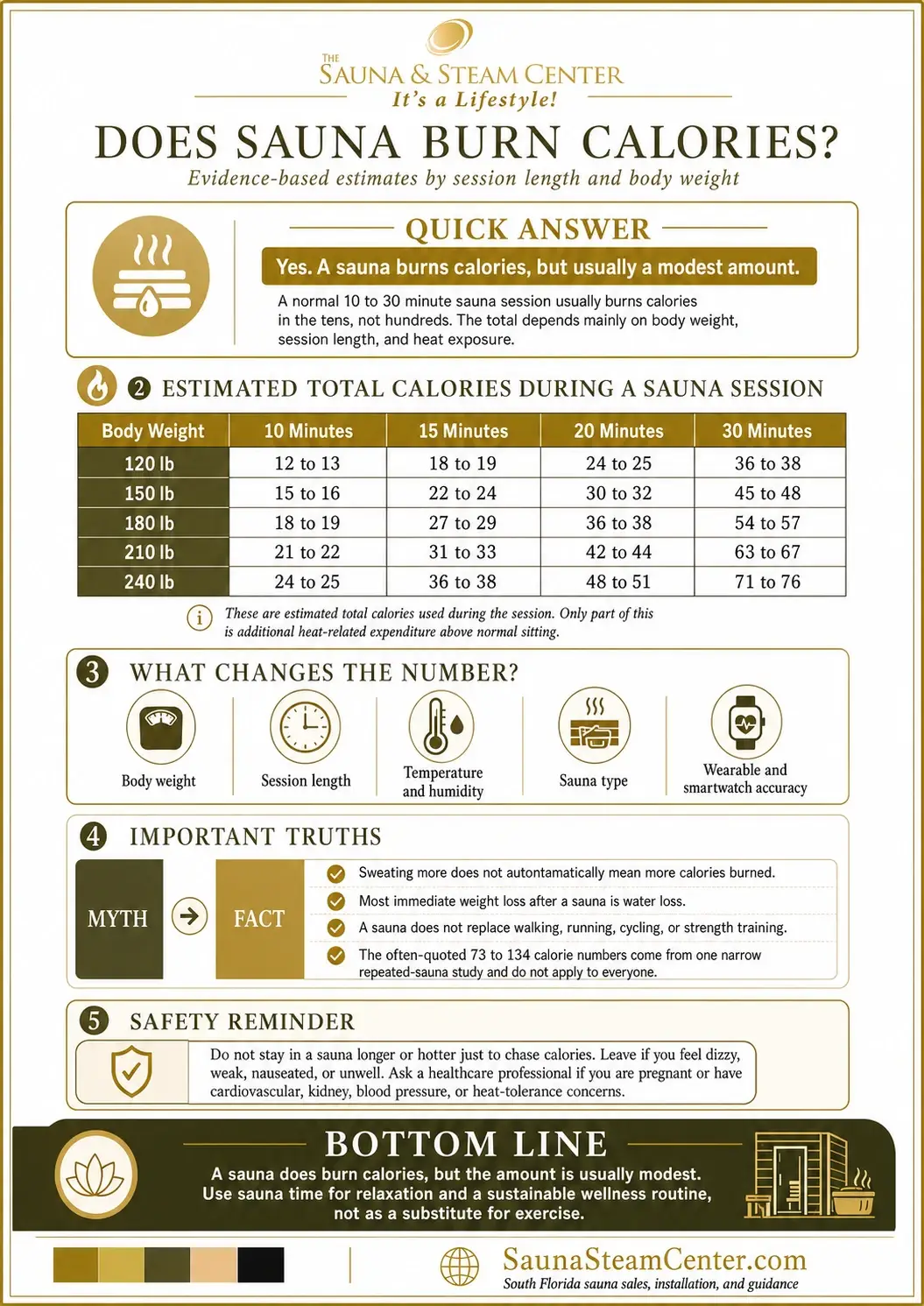
The table gives a conservative range of total calories used during the session. It uses a standard resting-energy equation and applies a temporary 25% to 33% increase reported in an older repeated-sauna study. It is an educational estimate, not a personal metabolic measurement.
| Body Weight | 10 Minutes | 15 Minutes | 20 Minutes | 30 Minutes |
|---|---|---|---|---|
| 120 lb | 12 to 13 | 18 to 19 | 24 to 25 | 36 to 38 |
| 150 lb | 15 to 16 | 22 to 24 | 30 to 32 | 45 to 48 |
| 180 lb | 18 to 19 | 27 to 29 | 36 to 38 | 54 to 57 |
| 210 lb | 21 to 22 | 31 to 33 | 42 to 44 | 63 to 67 |
| 240 lb | 24 to 25 | 36 to 38 | 48 to 51 | 71 to 76 |
How to read this table: The range is useful for planning and comparison, not for deciding how much food to eat or how long to remain in the heat. Age, sex, lean mass, fitness, medications, sauna temperature, acclimatization, and individual thermoregulation can shift real energy expenditure.
Use This Sauna Calorie Calculator Formula to Estimate Your Session
The estimate begins with the standard MET equation used to convert body weight and time into calories:
Resting calories = 3.5 × body weight in kilograms × minutes ÷ 200
One MET represents an adult resting energy rate of approximately 3.5 milliliters of oxygen per kilogram per minute. The 2024 Compendium of Physical Activities uses MET values to standardize the energy cost of activities.
To produce a cautious sauna estimate, multiply the resting result by 1.25 to 1.33:
Estimated sauna calories = resting calories × 1.25 to 1.33
Example for a 180-pound person in a 20-minute session
- Convert 180 pounds to approximately 81.6 kilograms.
- Calculate resting energy: 3.5 × 81.6 × 20 ÷ 200 = approximately 28.6 calories.
- Apply the heat factor: 28.6 × 1.25 to 1.33 = approximately 35.8 to 38.0 calories.
- Round to a practical range of 36 to 38 total calories.
The 25% to 33% factor comes from a small older study in which metabolic rate increased after initial sauna heat exposure. It is not a validated universal multiplier, so the result should always be labeled an estimate. Direct calorimetry or indirect calorimetry measuring oxygen and carbon dioxide exchange would be needed for a more individualized laboratory result.
Where Did the 73 and 134 Calorie Numbers Come From?
The most frequently cited high calorie numbers come from a 2019 study of repeated dry-sauna exposure. Researchers studied 45 sedentary men with overweight whose average age was about 21. Participants completed four 10-minute seated sauna exposures at 194°F to 196°F, separated by 5-minute cooling periods.
The researchers reported an average energy expenditure of about 73 calories during the first 10-minute round and more than 134 during the fourth. Some participants with the highest body measurements reached an estimated 153 calories in a 10-minute round.
| Study Feature | What Was Done | Why It Matters |
|---|---|---|
| Participants | 45 young sedentary men with overweight | The results may not represent women, older adults, trained athletes, or people at lower body weights. |
| Heat protocol | Four 10-minute rounds at 194°F to 196°F with cooling breaks | This was not one ordinary 10- or 20-minute session. |
| Measurement | Energy expenditure estimated indirectly with Suunto heart-rate monitors | The study did not directly measure breath gases with metabolic equipment. |
| Reported result | About 73 calories in round one and more than 134 in round four | The values describe this protocol and sample, not a universal sauna rule. |
| Body-mass change | Average loss of about 0.65 kilograms during the full protocol | The immediate scale change primarily reflected fluid loss from sweating. |
The study itself identified heart-rate-monitor measurement as a limitation. That matters because heat can elevate heart rate even when the person is not performing mechanical work. Independent validation research has also found that wrist devices often estimate heart rate more accurately than energy expenditure. In one study, calorie-estimate errors ranged widely across devices and exercise intensities when compared with a metabolic cart.
Bottom line: The 73 and 134 calorie figures are real reported study estimates, but they are not dependable personal predictions. They should be presented with the participants, protocol, and measurement limitation attached.
Why Sauna Calorie Estimates Vary So Much
No two users experience the same heat load. Even if two people sit in the same room for the same amount of time, their heart rate, sweat rate, skin blood flow, and energy use can differ.
Body weight and body composition
A larger body generally uses more energy at rest and during activity. The 2019 study also found relationships between estimated expenditure and body mass, body surface area, fat mass, and muscle mass. That does not make body weight a perfect predictor, but it explains why a single number cannot fit everyone.
Session length and repeated exposure
Heat strain can build across a session. The high estimates in the 2019 study rose during four successive rounds, not during one isolated exposure. Extrapolating the final round to every first-time 10-minute session would be misleading.
Temperature, humidity, and airflow
Traditional saunas, infrared cabins, and steam rooms transfer heat differently. Air temperature alone does not describe the full thermal load. Humidity can limit sweat evaporation, while radiant heat, air movement, bench height, and contact with hot surfaces affect how the body responds.
Heat adaptation and fitness
People who use saunas regularly may respond differently from occasional users. Aerobic fitness, resting heart rate, hydration status, and recent exercise can also change the heart-rate response without producing the same change in true metabolic expenditure.
Measurement method
A laboratory metabolic cart measures oxygen consumption and carbon dioxide production. A wearable usually estimates calories from heart rate, movement, body data, and a proprietary algorithm. Those methods are not interchangeable, especially in a hot room where heart rate rises while movement remains minimal.
Does an Infrared Sauna Burn More Calories Than a Traditional Sauna?
There is not enough high-quality head-to-head research to give either sauna type a proven calorie-burning advantage. Traditional saunas usually heat the room to a higher air temperature. Infrared systems operate at lower air temperatures and transfer radiant heat toward the user. Both can raise skin temperature, sweating, and heart rate, but those responses do not translate into a predictable calorie total.
The practical choice should be based on the heat experience you will use consistently, not a marketing claim about calories. Readers comparing the two formats can review our infrared vs. traditional sauna guide for differences in temperature, humidity, warm-up, electrical needs, and ownership.
Best for calorie accuracy: Neither format has enough evidence to support an exact promise. Choose infrared when you prefer lower air temperatures and direct radiant heat. Choose traditional when you prefer the classic hot-room experience and controlled water-on-stone humidity where the manufacturer permits it.
Does a Hotter Sauna Temperature Burn More Calories?
A hotter room can create a stronger cardiovascular and thermoregulatory response, but it does not follow that hotter is better or that the calorie increase can be predicted safely. A 2024 study comparing 20-minute sauna exposures at 176°F and 248°F reported higher heart-rate-based energy estimates at the extreme temperature. It also found substantially greater physiological strain and worse mood-state responses at 248°F.
That study used indirect wearable estimates, and 248°F is beyond the temperature many users should consider practical. It should not be interpreted as advice to raise the heat. Increasing temperature or session length for calories can raise dehydration and heat-illness risk faster than it produces any meaningful weight-management benefit.
Do You Burn More Calories in a Sauna Than Sitting at Rest?
Probably yes, but the difference may be small. An older study found metabolic rate increased by approximately 25% to 33% after initial sauna heat exposure. Applying that range to a 180-pound person sitting for 20 minutes changes the estimate from about 29 resting calories to about 36 to 38 total calories.
That is an increase of roughly 7 to 10 calories, not an extra 36 to 38. This is the cleanest way to understand the practical effect: compare the heated session with what the same person would have burned sitting elsewhere during those minutes.
Sauna Calorie Burn Compared With Walking, Running, Cycling, and Weight Training
Exercise produces much more dependable energy expenditure because muscles perform physical work. The CDC publishes approximate 30-minute calorie values for a 154-pound person. The sauna figure below uses the conservative heat-adjusted estimate from this guide.
| Activity | Approximate Calories | What It Provides |
|---|---|---|
| Sauna sitting | About 46 to 49 | Passive heat exposure and sweating, with limited calorie evidence |
| Light weight training | About 110 | Muscular work, strength practice, and loading |
| Walking at 3.5 mph | About 140 | Moderate aerobic activity and movement |
| Bicycling under 10 mph | About 145 | Moderate aerobic work |
| Running at 5 mph | About 295 | Vigorous aerobic work and substantially higher energy use |
The activity figures come from the CDC physical activity calorie table. Individual expenditure varies, but the comparison makes the main point clear: sauna use is not a calorie-burning substitute for movement.
Does Sweating More Mean You Are Burning More Calories?
No. Sweat is the body’s cooling fluid. A high sweat rate can occur because the environment is hot, humidity is high, the person is acclimatized, or body size and genetics favor heavier sweating. It does not reveal how many calories were used.
A study of sauna-induced body-mass loss found that body size and BMI were related to how much mass participants lost during dry-sauna exposure. The immediate change was fluid loss. Once the person drinks and restores normal hydration, much of the scale change returns.
Calorie expenditure, water weight, and fat loss are three different measurements:
- Calories used: Energy the body expends during a period of time.
- Water weight: Short-term fluid change from sweating and rehydration.
- Body-fat loss: A longer-term change requiring sustained energy imbalance, not one sweaty session.
For the broader weight-management question, see our evidence-based guide addressing do saunas help you lose weight. This article stays focused on the narrower calorie-count question.

Does Using a Sauna After the Gym Increase Calorie Burn?
A post-workout sauna may increase total energy use slightly, but the exercise remains the meaningful calorie-burning activity. Heart rate can stay elevated after training and rise further with heat, which may cause a watch to assign too many calories to the sauna portion.
Do not add a wearable’s workout calories and sauna calories together as if both measurements are exact. The algorithms may count the same elevated heart-rate period in ways that exaggerate the total. Use your exercise session to pursue fitness and use sauna time for a comfortable heat routine that does not compromise hydration or recovery.
Our guide to using a sauna after the gym covers timing, hydration, and practical post-workout considerations in more detail. Gym and wellness-facility operators planning shared heat amenities can also review our commercial sauna installation guidance.
Can a Smartwatch Accurately Count Sauna Calories?
A smartwatch may show a precise number, but precision on the screen is not proof of accuracy. A 2017 validation study compared seven wrist devices with electrocardiography for heart rate and indirect calorimetry for energy expenditure. Most devices measured heart rate reasonably well, but no device estimated calories well. Even the most accurate had an average error of 27%, while the least accurate was off by 93%.
A later systematic review also found poor energy-expenditure accuracy across brands. Sauna conditions create an additional challenge because heart rate rises from heat stress without the limb movement that many activity algorithms expect.
Use wearables to observe trends such as session time and heart-rate response, not to decide that you earned a specific meal or created a precise calorie deficit. Stop the session based on symptoms and comfort, not because the watch has not reached a target.
Sauna Calorie Evidence at a Glance
| Claim | Evidence Assessment | Practical Interpretation |
|---|---|---|
| The body uses calories in a sauna | Well supported as basic physiology | The body uses energy at rest and may use somewhat more while managing heat. |
| Heat raises metabolic demand | Supported, but the exact increase varies | A modest temporary increase is plausible; no universal multiplier is proven. |
| A sauna burns 73 to 134 calories per 10 minutes | Reported in one narrow repeated-exposure study | Do not generalize the figures to ordinary users or single sessions. |
| Infrared burns more than traditional | Insufficient direct comparative evidence | Choose based on preferred heat experience, not calorie promises. |
| More sweat means more calories | Unsupported | Sweat mainly indicates fluid loss and thermoregulation. |
| Sauna can replace cardio | Unsupported | Passive heat does not provide the training effects of physical activity. |
| Wearable calorie readings are exact | Contradicted by validation research | Treat the reading as a rough trend, especially in heat. |
Sauna Calorie Burn Safety, Hydration, and Florida Heat Considerations
Florida users should consider the heat exposure that happened before the sauna. Outdoor work, running, beach time, yard work, and training in a hot garage can leave a person warmer and less hydrated before the sauna begins. The CDC notes that people who exercise or work in heat have a higher risk of dehydration and heat-related illness.
Heat exhaustion can include headache, nausea, dizziness, weakness, thirst, heavy sweating, elevated body temperature, and decreased urine output. Leave the sauna and move to a cooler environment if symptoms appear. Confusion, fainting, seizures, inability to drink, or suspected heatstroke require urgent medical help.
Practical safety habits
- Enter the sauna reasonably hydrated rather than trying to replace a large fluid deficit afterward.
- Start with a shorter session if you are new, recently exercised outdoors, or already feel overheated.
- Avoid alcohol before or during sauna use.
- Stand slowly after sitting because heat and dehydration can contribute to light-headedness.
- Do not copy an extreme study protocol to reproduce a calorie estimate.
- Ask a healthcare professional about heat exposure when medication, pregnancy, heart disease, kidney disease, blood-pressure problems, fainting, or fluid restrictions are relevant.
South Florida planning resources
Homeowners creating a consistent indoor routine can review our guidance for sauna installation in South Florida. Local planning resources also cover an outdoor sauna in Florida, sauna installation in Miami, an infrared sauna in Fort Lauderdale, steam room installation Fort Lauderdale, and sauna installation in Boca Raton.
What Our Sauna Experience Since 2004 Has Taught Us About Calorie Claims
The following observations come from sauna sales, installation, service, and ownership conversations. They are not medical research.
- Sweat is commonly mistaken for calorie burn. Customers often assume that a soaked towel or a lower post-session scale reading means substantial fat loss. In practice, those signs mainly reflect heat response and fluid loss.
- The hottest room is not automatically the right room. Comfortable seating, usable controls, ventilation, and a heat style the owner enjoys usually matter more for consistent use than chasing the highest temperature.
- Wearable totals can create false confidence. A watch may show a large calorie number because heart rate is elevated, even though the person is sitting still. The number should not become the reason to extend a session.
- Convenience supports routine use. Appropriate placement, easy controls, realistic warm-up expectations, nearby water, and a comfortable cooldown area make a home sauna easier to use consistently.
- Florida changes the starting point. A customer coming inside after outdoor exercise or work may already carry a heat and hydration burden that someone in a cooler climate does not.
How to Choose a Sauna Without Buying Into Calorie Hype
Choose a sauna for heat preference, comfort, available space, electrical service, maintenance, and the routine you can sustain. Do not choose a model because an advertisement promises a specific calorie number.
| Example | Format | Key Specification | Published Product Price |
|---|---|---|---|
| Radia IR100 | One-person infrared indoor sauna | 120V, 15 amps, Hemlock construction | $5,850 |
| Finnleo Hallmark HM44 | Two-person traditional indoor sauna | 120V, available 15-amp and 20-amp configurations | Approximately $9,150 to $9,250 |
| IS565 | Five-person combination indoor sauna | 240V, 30 amps, infrared and traditional heat | $14,350 |
These are product prices shown in the 2026 Sauna & Steam Center catalog. Prices are before installation fees, delivery fees, and applicable taxes. Electrical work, permits, site preparation, accessories, and other project costs are separate unless included in a written quote. Pricing, availability, and specifications can change.
For budget planning, review the home sauna cost breakdown. The article explains total project costs beyond the equipment price.
Plan for Consistent Use, Not Calorie Promises
Compare Sauna Options for Your Space and Routine
Sauna & Steam Center can help you compare infrared, traditional, combination, indoor, and outdoor options based on heat preference, room dimensions, electrical service, seating, and long-term support.
Frequently Asked Questions About Sauna Calorie Burn
Does sauna burn calories?
Yes. Your body already burns calories at rest, and heat exposure can raise energy use temporarily. The extra amount is probably modest for a typical 10- to 30-minute session. A conservative estimate for many adults is roughly 12 to 76 total calories depending on body weight and session length, but no formula can provide an exact personal result without metabolic testing.
How many calories does a sauna burn in 20 minutes?
Using the conservative estimate in this guide, a 150-pound person may use about 30 to 32 total calories during 20 minutes, while a 210-pound person may use about 42 to 44. These totals include the calories the body would have burned while sitting at rest. The additional amount attributable to heat is smaller.
How many calories does a sauna burn in 30 minutes?
A conservative estimate is about 36 to 38 total calories for a 120-pound person, 45 to 48 for a 150-pound person, 54 to 57 for a 180-pound person, and 63 to 67 for a 210-pound person. Thirty minutes may be too long for some users, so session length should be based on safety and tolerance rather than a calorie target.
Can you burn 300 to 500 calories in a sauna?
That should not be treated as a normal or dependable expectation. One narrow study reported high heart-rate-based estimates during four repeated 10-minute dry-sauna exposures, but the participants were young sedentary men with overweight, the protocol included extreme heat, and energy expenditure was estimated indirectly by a heart-rate monitor. The findings do not prove that a typical person burns hundreds of calories in one ordinary session.
Does an infrared sauna burn more calories than a traditional sauna?
There is not enough direct comparative research to say that infrared or traditional sauna reliably burns more calories. Traditional rooms generally use hotter air, while infrared cabins operate at lower air temperatures and heat the user differently. Session length, body size, hydration, heat tolerance, and measurement method may matter more than the label on the sauna.
Does sweating more mean you are burning more calories?
No. Sweat is mainly a cooling response. Heavy sweating shows that the body is losing fluid, not that it is burning a specific amount of energy or body fat. A temporary drop on the scale after sauna use is primarily water loss and usually returns after rehydration.
Is sitting in a sauna the same as doing cardio?
No. Sauna heat can raise heart rate and circulation, but sitting in a sauna does not provide the muscular work, movement skills, bone loading, or cardiorespiratory training of walking, cycling, running, or resistance exercise. Sauna use may complement an active routine, but it does not replace exercise.
Can a smartwatch accurately count sauna calories?
Treat the number as a rough estimate. Wrist devices can measure heart rate reasonably well in many settings, but research has found much larger errors when they estimate energy expenditure. Heat can elevate heart rate without the movement patterns used by many calorie algorithms, so a confident-looking calorie total may still be inaccurate.
Does using a sauna after the gym increase calorie burn?
The workout is responsible for most of the meaningful calorie expenditure. A sauna afterward may add a small amount of energy use because the body is managing heat, but elevated post-workout heart rate can also cause wearables to overestimate the sauna portion. Use the sauna for a comfortable heat routine, not to inflate an exercise calorie total.
Who should ask a healthcare professional before using a sauna?
Ask a qualified healthcare professional before sauna use if you are pregnant, have cardiovascular disease, uncontrolled blood pressure, kidney disease, a history of fainting or heat illness, a fluid restriction, or take medication that affects sweating, hydration, blood pressure, or heat tolerance. Do not use a sauna when you are already dehydrated, feverish, or feeling ill.
Conclusion
A sauna does burn calories, but an honest estimate for a typical session is usually measured in tens of calories. For adults weighing 120 to 240 pounds, the conservative table in this guide estimates about 12 to 76 total calories across 10 to 30 minutes. Only a portion of that total is additional heat-related expenditure because the body would burn calories while sitting anywhere.
The much higher 73-to-134-calorie numbers came from one specific repeated-exposure study in young sedentary men with overweight, using extreme dry heat and indirect heart-rate-monitor estimates. Those results are worth discussing, but not copying into a universal calculator.
Use sauna time for a heat experience you tolerate and enjoy. Use walking, cycling, running, resistance training, and nutrition for dependable fitness and weight-management work. The practical next step is to select a session length based on safety and comfort, not a wearable target or marketing promise.
References
- Podstawski R, et al. Correlations Between Repeated Use of Dry Sauna for 4 × 10 Minutes, Physiological Parameters, Anthropometric Features, and Body Composition in Young Sedentary and Overweight Men. BioMed Research International. 2019.
- Leppäluoto J, et al. Some Cardiovascular and Metabolic Effects of Repeated Sauna Bathing. Acta Physiologica Scandinavica. 1986.
- Podstawski R, et al. Sauna-Induced Body Mass Loss in Young Sedentary Women and Men. Scientific World Journal. 2014.
- Shcherbina A, et al. Accuracy in Wrist-Worn, Sensor-Based Measurements of Heart Rate and Energy Expenditure in a Diverse Cohort. Journal of Personalized Medicine. 2017.
- Germini F, et al. Accuracy and Acceptability of Wrist-Wearable Activity-Tracking Devices: Systematic Review. JMIR mHealth and uHealth. 2022.
- Compendium of Physical Activities. 2024 Adult Compendium and MET Resources.
- Centers for Disease Control and Prevention. Physical Activity and Your Weight and Health.
- Centers for Disease Control and Prevention, NIOSH. Heat-Related Illnesses.
- Centers for Disease Control and Prevention. Heat and Athletes.
- Centers for Disease Control and Prevention. Heat and Medications: Guidance for Clinicians.
- Hussain J, Cohen M. Clinical Effects of Regular Dry Sauna Bathing: A Systematic Review. Evidence-Based Complementary and Alternative Medicine. 2018.
- Podstawski R, et al. The Influence of Extreme Thermal Stress on Physiological and Psychological Characteristics. Frontiers in Public Health. 2024.