
Sauna Wood Guide: How to Choose the Best Wood for Walls, Benches, and Outdoor Builds
Quick Answer
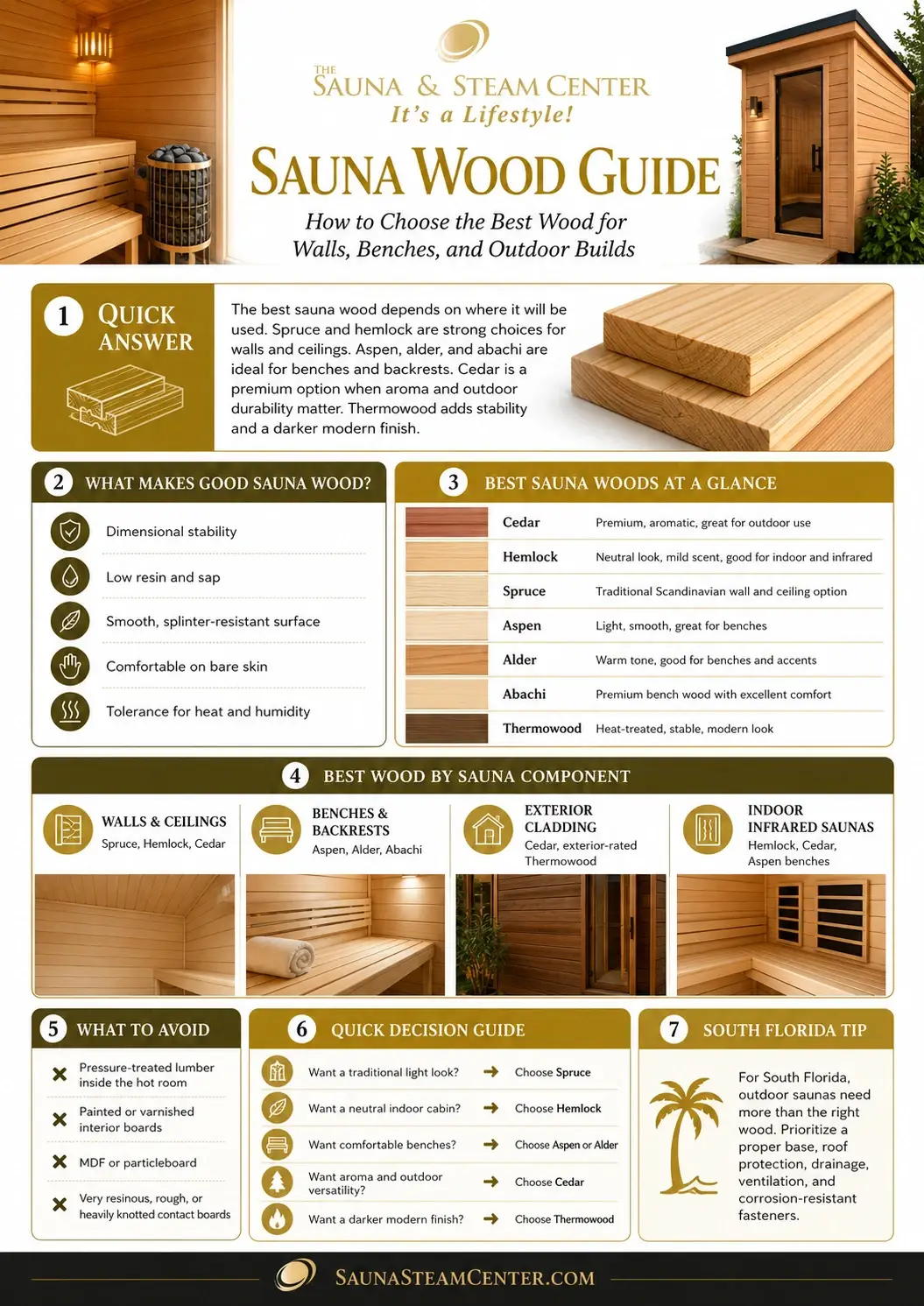
Sauna Wood should be selected by application, not by one universal ranking. Nordic spruce and Canadian hemlock are practical choices for interior paneling, while aspen, alder, and abachi are especially well suited to benches and backrests. Cedar can be a premium option for walls, ceilings, and outdoor applications, but homeowners researching cedar specifically should review the dedicated cedar guide. Thermally modified wood can improve dimensional stability and create a darker finish, although it normally costs more and requires careful handling. The best sauna often combines two or more species rather than using one wood everywhere.
Choosing wood is one of the most important design decisions in a sauna. It affects how the room looks and smells, how the benches feel against bare skin, how much movement occurs through repeated heating and cooling, how easily the interior can be cleaned, and how well an outdoor structure handles South Florida weather. Species matters, but grade, moisture condition, board profile, installation method, ventilation, drainage, and maintenance can matter just as much.
Key Takeaways
- Best premium aromatic option: Western red cedar when appearance, natural scent, dimensional stability, and outdoor versatility are priorities.
- Best traditional light interior: Nordic spruce for walls and ceilings, often paired with aspen or abachi benches.
- Best neutral-looking value option: Canadian hemlock for indoor and infrared cabins when a mild scent and clean grain are preferred.
- Best skin-contact choices: Aspen, alder, and abachi for benches, backrests, and headrests.
- Best modern premium finish: Thermo-aspen, thermo-alder, or thermo-spruce when darker color and improved dimensional stability justify the added cost.
- Best strategy: Choose the wood by location inside the sauna and verify the grade, milling, moisture condition, and manufacturer-approved use.
What Is the Best Wood for a Sauna?
The best sauna wood depends on where it will be used. Nordic spruce and Canadian hemlock are practical wall-and-ceiling materials for many indoor saunas. Aspen, alder, and abachi are particularly useful for benches, backrests, and headrests because they are commonly selected for smooth skin-contact surfaces. Thermally modified woods can add dimensional stability and a darker modern appearance, while cedar remains a premium option when aroma, color, and outdoor versatility matter.
A well-designed sauna may use one species for walls and ceilings, another for bench tops, and a thermally modified accent wood. That mixed-material approach often produces better comfort, performance, and value than insisting that every visible board be the same species.
Homeowners specifically considering cedar can read our complete guide to cedar wood saunas, including cedar types, costs, maintenance, and indoor and outdoor options. This page remains focused on comparing sauna materials by application.
What Makes a Wood Suitable for Sauna Use?
A suitable sauna wood must tolerate repeated heat and moisture changes while remaining comfortable, cleanable, and structurally predictable. Wood naturally gains and loses moisture as surrounding conditions change, and those moisture cycles cause dimensional movement. The USDA Forest Products Laboratory explains that moisture content is a major driver of wood shrinkage and swelling, which is why species selection, seasoning, panel orientation, fastening, and ventilation all matter in a hot room.
1. Dimensional Stability
Dimensional stability describes how much a board changes shape or size as moisture conditions change. More stable material is less likely to cup, twist, or open noticeable joints when the sauna repeatedly heats, cools, absorbs humidity, and dries. Stability does not eliminate movement, so proper expansion gaps, fastening, ventilation, and acclimation still matter.
2. Low Resin and Sap on Hot Surfaces
Resin pockets can soften or bleed when heated. This is most concerning on bench tops, backrests, or other places where skin may touch the wood. Sauna-grade material should be selected and milled for its intended location, with clear or carefully graded boards preferred on contact surfaces. Thermory summarizes the same practical rule: sauna bench wood should not overheat or secrete resin, while interior paneling should resist heat and moisture.
3. Smooth Texture and Low Splinter Risk
Bench boards need rounded edges, smooth sanding, sound grain, and careful fastening. Species alone cannot guarantee comfort. A poorly milled premium board can be less comfortable than a correctly selected, well-finished mid-priced board.
4. Appropriate Surface Temperature
Sauna manufacturers commonly use aspen, abachi, and alder for seating surfaces because they are comfortable materials for direct contact in the hot room. Finnleo, for example, pairs Nordic white spruce walls with aspen or abachi benches in its NorthStar indoor sauna line. Harvia offers benches in aspen, alder, abachi, and heat-treated aspen.
5. Proper Grade and Moisture Condition
“Cedar,” “spruce,” or “hemlock” is not a complete specification. Ask about the exact species, clear versus knotty grade, tongue-and-groove profile, board thickness, whether the material is kiln-dried, and whether it is approved by the sauna manufacturer for walls, benches, exterior cladding, or structural framing.
6. Compatibility with Maintenance Requirements
Interior sauna wood is generally left unpainted and unvarnished. Finnleo specifically advises against painting, varnishing, or staining interior sauna surfaces, while allowing suitable protection on certain handles, floorboards, doors, or exterior surfaces. Harvia recommends paraffin oil for appropriate bench materials to reduce moisture and dirt absorption. Always follow the instructions for the actual sauna and wood product rather than applying a household finish by default.
Sauna Wood Comparison Chart: Cedar, Hemlock, Spruce, Aspen, Alder, Abachi, and Thermowood
| Wood | Best for | Main strengths | Main tradeoffs | Relative material cost |
|---|---|---|---|---|
| Western red cedar | Premium walls, ceilings, many outdoor builds, coordinated interiors | Natural durability, low weight, good stability, recognizable color and aroma | Higher price, scent is not for everyone, color variation between boards | High |
| Canadian hemlock | Indoor and infrared cabins, light neutral interiors | Clean appearance, mild scent, commonly offered by established manufacturers | Outdoor suitability depends on the exact product and protective assembly | Moderate |
| Nordic spruce | Traditional walls and ceilings, light Scandinavian interiors | Traditional look, broad manufacturer use, generally good value | Knot and resin quality must be controlled, especially near contact areas | Low to moderate |
| Aspen | Benches, backrests, headrests, bright modern interiors | Smooth, light-colored, mild scent, widely used for skin-contact surfaces | Softer surface can show dents or staining if neglected | Moderate |
| Alder | Benches, backrests, wall accents, warmer-toned interiors | Smooth texture, attractive reddish tone, established sauna use | May be less available in South Florida and can carry higher freight cost | Moderate to high |
| Abachi | Premium bench tops, backrests, headrests | Smooth, light, comfortable for contact surfaces, traditional premium bench material | Imported availability, higher cost, source and sustainability should be verified | High |
| Thermally modified wood | Premium interiors, outdoor cladding, design accents, stable paneling | Reduced equilibrium moisture content, improved dimensional stability, darker color | Higher cost, can be more brittle, product-specific fastening rules matter | High |
Bottom line: Spruce and hemlock are strong wall-panel choices, aspen, alder, and abachi are usually better candidates for skin-contact components, cedar is a premium aromatic option, and thermally modified wood is a performance and design upgrade rather than an automatic requirement.
When Is Cedar the Right Sauna Wood?
Cedar is a strong choice when aroma, warm color, natural durability, and outdoor versatility are priorities. It can work well for walls, ceilings, trim, exterior cladding, and selected bench components when the exact grade and profile are approved for sauna use.
Cedar is not automatically the best material for every component. Homeowners who prefer a milder scent, lighter Scandinavian appearance, or lower material cost may prefer hemlock or spruce for paneling. Aspen, alder, and abachi may also be better choices for benches and backrests.
For detailed cedar-specific information, including Western Red Cedar, clear versus knotty grades, costs, maintenance, and cedar sauna types, visit our cedar wood sauna guide.
How Do Hemlock and Spruce Perform in a Sauna?
Canadian Hemlock
Canadian hemlock is a practical choice for indoor and infrared saunas. It offers a pale, relatively uniform appearance and a milder scent. Finnleo includes vertical-grain Canadian hemlock among its established wood offerings for custom saunas and InfraSaunas, confirming that it is not merely a budget substitute used by unknown manufacturers.
Hemlock is most compelling when the project is indoors, the owner wants a neutral visual style, and the sauna model or kit has been engineered around that material. For an outdoor installation, do not assume that any hemlock product can be exposed directly to tropical weather. The exterior wall assembly, roof, finish, thermal modification, drainage, and manufacturer warranty are more important than the species name alone.
Nordic Spruce
Nordic spruce is an excellent traditional sauna wood for walls and ceilings. Finnleo uses Nordic white spruce for interior walls and ceilings in its NorthStar indoor series, then pairs it with aspen or abachi benches. Harvia also identifies spruce as a traditional bench material and notes its strong moisture-handling performance among common sauna woods.
Spruce is often a smart choice when the goal is a bright Finnish look and a more controlled budget. The main caution is grade. Large knots, loose knots, rough grain, or resin pockets are less desirable near seating and backrests. High-quality paneling and careful board placement make a major difference.
Aspen, Alder, and Abachi: Which Wood Is Best for Sauna Benches?
Aspen is the best broadly available light bench wood, alder is ideal when you want a warmer color, and abachi is a premium option for maximum skin-contact comfort. All three are used by established sauna manufacturers for benches, backrests, or interior components.
Aspen
Aspen has a pale, clean appearance, uniform texture, and good dimensional stability for a light, soft wood. USDA wood data describes aspen as straight-grained, light, soft, and relatively stable. It is a practical choice for bench tops, backrests, and headrests in both traditional and infrared rooms.
Alder
Alder gives the interior more warmth and visual depth than aspen. Harvia and Thermory both offer alder sauna components, including bench systems and interior materials. It works well when the design calls for reddish-brown tones without the strong aroma associated with cedar.
Abachi
Abachi is a traditional premium bench material used for seating and backrests. It is usually chosen for feel rather than for exterior durability. Because it may be imported from tropical regions, buyers should ask about responsible sourcing, product documentation, and replacement availability before specifying it throughout a large room.
Practical recommendation: For most homeowners, aspen offers the easiest combination of light appearance, comfort, manufacturer support, and replaceability. Choose alder for a warmer modern interior and abachi when premium bench feel is worth the added sourcing and material cost.
What Is Thermowood, and Is It Worth the Higher Price?
Thermowood is solid wood that has been thermally modified with controlled heat and steam, without added chemical preservatives in the ThermoWood process. The treatment permanently changes the wood’s moisture behavior, reducing equilibrium moisture content and improving dimensional stability and resistance to biological degradation. “Thermo-aspen,” “thermo-alder,” and “thermo-spruce” identify the original species plus the thermal modification.
Thermal modification can be worth the premium when the design requires darker color, improved stability, reduced resin behavior, or an exterior product specifically rated for the intended exposure. It is also useful when the owner wants a modern luxury interior without stain.
The tradeoff is that modified wood is not simply “stronger wood.” The 2025 ThermoWood Handbook explains that thermal modification can reduce certain mechanical properties, especially as treatment intensity increases. Independent testing on thermally modified western hemlock also found lower fracture energy and hardness in modified samples, which supports careful fastening, drilling, and handling rather than aggressive on-site fabrication.
Choose Thermowood when: the exact product is rated for your application, the visual finish matters, improved stability has real value, and the installer will follow the supplier’s fastening and maintenance instructions. Do not pay extra only because “thermo” sounds more advanced.
What Is the Best Wood for Walls, Ceilings, Benches, Backrests, and Floors?
| Sauna component | Strong wood choices | What matters most |
|---|---|---|
| Walls and ceiling | Cedar, Nordic spruce, Canadian hemlock, alder, thermo-aspen, thermo-spruce | Stable tongue-and-groove profile, proper acclimation, concealed fastening, ventilation gap, clean appearance |
| Bench tops | Aspen, abachi, alder, clear cedar, thermo-aspen | Smooth surface, rounded edges, low resin, sound grain, replaceable boards, no exposed hot fasteners |
| Backrests and headrests | Aspen, abachi, alder, clear cedar | Comfort against skin, smooth milling, easy removal for cleaning or service |
| Bench framing | Manufacturer-specified spruce, cedar, hemlock, or engineered sauna framing | Structural capacity, hidden fasteners, moisture tolerance, access for inspection |
| Duckboard or removable floor platform | Cedar, hemlock, thermally modified wood, manufacturer-approved alternatives | Drainage, removability, cleanability, slip awareness, compatibility with the finished floor below |
| Exterior cladding | Cedar, exterior-rated Thermowood, other manufacturer-approved cladding systems | Rain screen, roof overhang, UV protection, drainage, salt-air exposure, fasteners, warranty |
Do not use the bench board as a structural assumption. Bench framing, spans, support points, fasteners, and load capacity must follow the sauna design or manufacturer documentation. A beautiful board does not replace a properly engineered support system.
What Is the Best Wood for Indoor, Outdoor, Traditional, and Infrared Saunas?
Indoor Traditional Sauna
For an indoor traditional sauna, cedar, Nordic spruce, and Canadian hemlock are proven wall-and-ceiling choices. Pair them with aspen, alder, or abachi seating when comfort and a clean contrast are priorities. Traditional rooms experience higher air temperatures and periodic humidity spikes, so ventilation, vapor management, and drying after use matter as much as the species.
Outdoor Sauna
For an outdoor sauna, cedar and exterior-rated thermally modified wood are strong candidates, but the enclosure design controls long-term performance. Finnleo’s outdoor Euro saunas, for example, use a cedar exterior with sauna-appropriate interior choices, illustrating that exterior and interior material roles should be separated.
Infrared Sauna
For infrared saunas, hemlock and cedar are common because established manufacturers offer both in complete engineered cabins. Infrared units generally operate differently from traditional heater-and-stone rooms, but the wood still needs to tolerate repeated heating cycles and remain stable around emitters, controls, wiring channels, and ventilation openings. Choose the complete sauna’s documented material and construction quality rather than buying based only on a “low-EMF” label or wood name.
Commercial Sauna
For high-use environments, serviceability can be more important than an exotic finish. Removable bench sections, replaceable contact boards, accessible heaters and controls, durable fastening, and a cleaning plan should be designed from the beginning. Our guide to commercial sauna installation explains planning considerations for hotels, gyms, spas, and other shared-use spaces.
What Sauna Wood Works Best in South Florida?
In South Florida, the best wood is the wood used within a complete moisture, weather, and service plan. Miami-Dade, Broward, Palm Beach County, and the Florida Keys combine high ambient humidity, intense sun, heavy rain, and, in coastal locations, salt-laden air. Those conditions can slow drying and stress exterior finishes, fasteners, doors, controls, and heater components.
For indoor rooms, control the surrounding room’s air conditioning, ventilation, and post-use drying. For outdoor structures, prioritize a stable base, roof and overhang, drainage away from the sauna, exterior-rated cladding, corrosion-appropriate fasteners, sealed penetrations, safe electrical routing, and access for future service. A premium species cannot compensate for standing water or a leaking roof.
Cedar and thermally modified exterior products are usually the first materials we compare for exposed South Florida projects. Spruce and hemlock may still be excellent interior materials when protected by a correctly designed shell. This is why the phrase “outdoor sauna wood” is incomplete unless the seller also explains the wall assembly, roof, exterior finish, warranty, and maintenance schedule.
Local planning differs by property and municipality. Our regional guides cover an outdoor sauna in Florida, sauna installation in Miami, an infrared sauna in Fort Lauderdale, steam room installation Fort Lauderdale, and sauna installation in Boca Raton.
What Sauna Woods and Materials Should You Avoid?
Avoid materials with unknown adhesives, finishes, preservatives, or heat ratings inside the hot room. The safest purchasing approach is solid sauna-grade wood or a complete product whose manufacturer documents the interior materials and intended operating environment.
- Pressure-treated lumber on exposed interior surfaces: Do not substitute exterior deck lumber for sauna paneling or benches. Preservative-treated structural material should only be used where a qualified design specifically permits it and where it is isolated from hot-room contact.
- Painted, varnished, or conventionally stained interior paneling: Household coatings may not be intended for sauna heat. Finnleo advises leaving interior surfaces unpainted and unvarnished.
- Exposed MDF, particleboard, or unidentified composite panels: Composite wood uses adhesives, and EPA regulates formaldehyde emissions from hardwood plywood, MDF, and particleboard. Compliance with a general emissions standard does not make an exposed composite board a suitable sauna bench or wall liner.
- Very resinous or heavily knotted boards on contact surfaces: Knots may become hotter, loosen, crack, or contain resin pockets. Place appearance-grade knotty material away from direct skin contact unless the sauna manufacturer specifically uses and warrants it there.
- Rough, splintered, checked, or poorly fastened boards: Replace or repair damaged contact surfaces rather than trying to hide them with an unsuitable coating.
- Dense decorative hardwood selected only for appearance: Some hardwoods can feel uncomfortably hot and may move or check differently in sauna conditions. Use them only when a sauna supplier documents the intended application.
- Wet or poorly acclimated lumber: Even a good species can shrink, cup, or open joints when installed at the wrong moisture condition.
How Do Heat, Humidity, Knots, Sap, and Splinters Affect Sauna Wood?
| Condition | What can happen | How to reduce the risk |
|---|---|---|
| Repeated heat cycles | Drying, checking, joint movement, brittleness in unsuitable or overtreated material | Use sauna-grade boards, follow temperature limits, provide correct fastening and ventilation |
| Humidity and water | Swelling, staining, slow drying, mildew on dirty or persistently damp surfaces | Ventilate, dry after use, clean correctly, prevent standing water and exterior leaks |
| Knots | Localized heat, cracking, loose pieces, roughness, resin release | Use clear or carefully graded boards on benches and backrests |
| Sap or resin | Sticky spots and possible contact discomfort when heated | Select low-resin material and reject visible resin pockets on contact boards |
| Splinters or raised grain | Uncomfortable or unsafe contact surfaces | Round edges, sand according to manufacturer guidance, replace damaged boards |
| Trapped moisture below benches | Odor, staining, hidden deterioration, difficult cleaning | Use removable sections and preserve access for cleaning and inspection |
After use, allow the sauna to dry as the manufacturer directs. Finnleo recommends leaving the door and vents open so residual heat can dry the wood, while Harvia recommends periodic cleaning and appropriate paraffin-oil treatment for suitable bench surfaces.
How Much Does Sauna Wood Cost, and Which Type Offers the Best Long-Term Value?
Sauna wood does not have one dependable national price per square foot. The cost changes with species, clear versus knotty grade, board thickness, tongue-and-groove profile, bench dimensions, thermal modification, freight, waste allowance, local availability, and whether the wood arrives as loose material or as part of a prefabricated kit.
As general project-planning guidance from our installation experience, knotty spruce is usually among the lower-cost sauna finishes. Hemlock and aspen often fall in the middle. Premium clear-grade woods, alder, abachi, and thermally modified profiles usually cost more. A custom room with premium paneling and upgraded bench material can add hundreds or several thousand dollars over a basic wood package, depending on room size and detail level. This is not a retail quote, and local availability can reverse the normal ranking.
| Budget priority | Likely best fit | Value strategy |
|---|---|---|
| Lowest responsible material cost | Sauna-grade spruce or a complete hemlock kit | Spend on correct installation, ventilation, heater sizing, and clear bench-contact boards |
| Balanced quality and appearance | Hemlock walls with aspen benches, or spruce walls with aspen benches | Mix species instead of paying for one premium wood everywhere |
| Premium natural finish | Clear Western red cedar with aspen, alder, or abachi contact surfaces | Use cedar where its aroma, color, and durability provide visible value |
| Modern high-design finish | Thermo-aspen, thermo-alder, or thermo-spruce | Confirm the product’s application and fastening requirements before paying the premium |
| Outdoor South Florida project | Cedar or exterior-rated thermally modified cladding | Budget for the roof, base, drainage, electrical work, fasteners, delivery, and maintenance, not only the wood shell |
Before comparing wood upgrades, establish a broader project range. Then review our home sauna cost breakdown so the wood package is compared alongside delivery, electrical work, site preparation, heater, controls, and installation.

What Our Experience Since 2004 Has Taught Us About Sauna Wood
In our installation experience, buyers rarely regret choosing a proven sauna-grade wood. They do regret selecting material before confirming the room, heater, ventilation, electrical requirements, delivery route, exterior exposure, and future service access.
The most common mistake is comparing wood names instead of complete assemblies. Two saunas labeled with the same species may still use different grades, wall thicknesses, bench construction, fasteners, insulation, vapor control, roofs, doors, and exterior finishes. The lower-priced unit may not be comparable at all.
We also see better long-term results when bench boards can be removed, cleaned, sanded according to manufacturer guidance, or replaced without dismantling the room. Owners use their saunas more consistently when the bench feels comfortable, the controls are simple, the room dries properly, and maintenance does not become a major chore.
Sauna & Steam Center has served South Florida since 2004 and maintains a showroom at 2801 Greene Street, Suite 1, in Hollywood. The company publishes a count of more than 500 sauna and steam-room installations. The Better Business Bureau lists Florida Hot Tub & Sauna Center, Inc. with an A+ rating and 20 years in business, while also stating that the business is not BBB accredited.
That distinction matters because local support continues after the wood is selected. Our team can evaluate the space, compare prefabricated and custom options, coordinate material selection with heater and bench design, and plan the installation around South Florida access, moisture, and service conditions.
Wood also influences the atmosphere of a broader home wellness area. Owners choosing lighting, accessories, and finishes may find our chromotherapy color chart useful, while homeowners comparing several relaxation investments can review the hot tub therapy benefits before deciding how to allocate space and budget.
How to Choose the Perfect Sauna Wood for Your Project
- Start with the sauna type. Decide whether the room is traditional, infrared, hybrid, indoor, or outdoor before comparing finishes.
- Separate interior and exterior requirements. Outdoor cladding needs weather performance, while interior benches need contact comfort and cleanability.
- Choose walls and benches independently. A spruce or hemlock interior with aspen benches may outperform a single-species room for the same budget.
- Confirm the exact species and grade. Ask for clear versus knotty, board profile, thickness, moisture condition, thermal-modification class, and intended application.
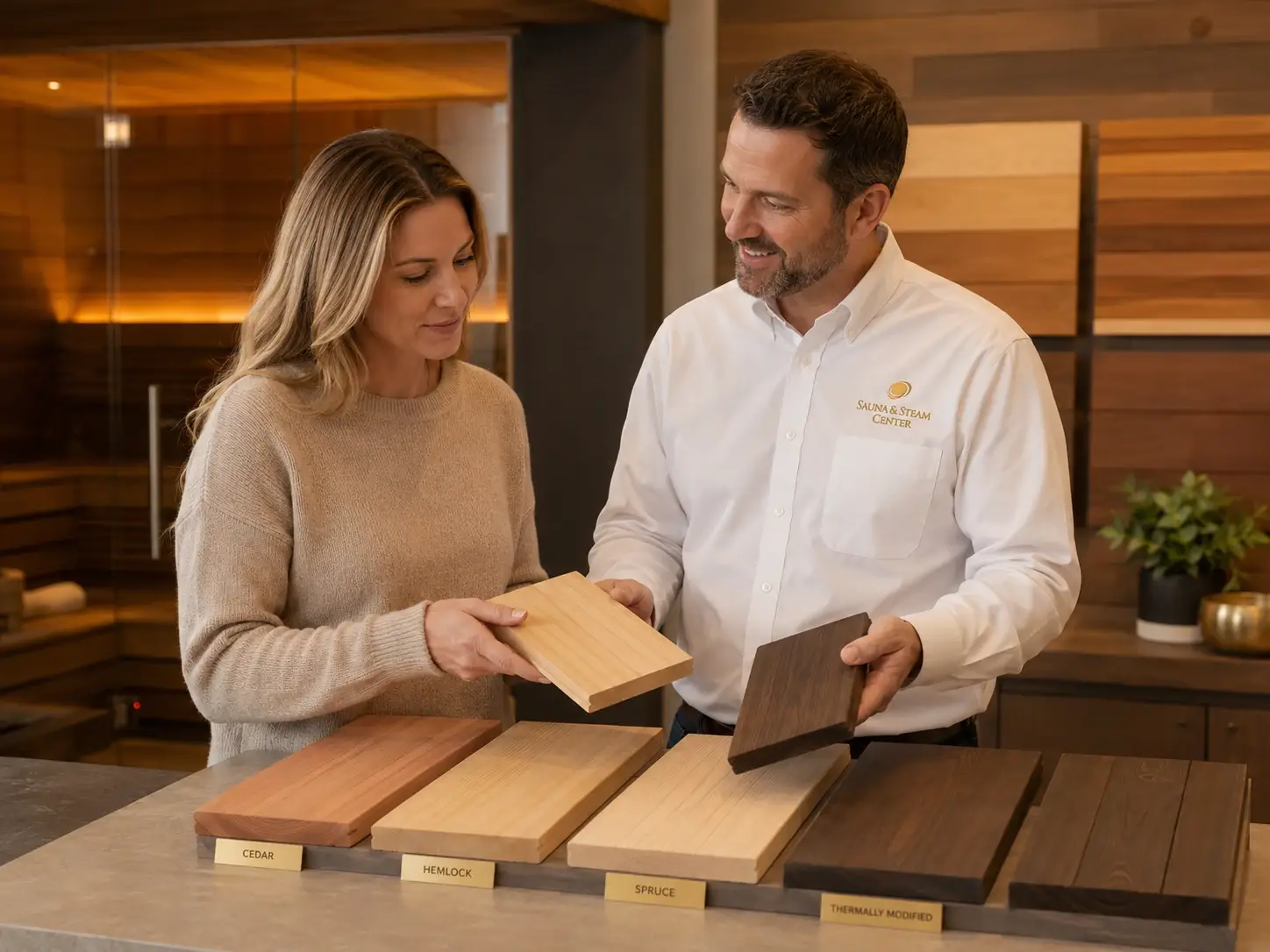
- Evaluate the scent in person. Cedar aroma is a benefit to some owners and a distraction to others. A showroom comparison is more useful than guessing from product photos.
- Check the complete installation plan. Verify room measurements, bench layout, heater clearances, ventilation, electrical service, floor, delivery access, and future service access.
- Compare maintenance requirements. Ask which surfaces remain unfinished, which can receive paraffin oil, how the room dries, and how damaged bench boards are replaced.
- Calculate installed cost, not lumber cost. Freight, waste, custom milling, bench labor, electrical work, site preparation, and exterior weather protection can outweigh the difference between species.
- Review samples before approval. Natural color, knots, grain, and thermal-treatment tone vary. Approve a representative sample and understand that solid wood is not visually uniform.
Plan the complete sauna, not just the wood
Compare Wood Options for Your Space and Climate
Bring your room dimensions, project photos, preferred sauna style, and any wood samples you like. Sauna & Steam Center can help you compare species, bench materials, heater requirements, indoor or outdoor placement, delivery access, and the complete installed cost before you commit.
Frequently Asked Questions About Sauna Wood
What is the best wood for a sauna?
There is no single best wood for every sauna. Western red cedar is a versatile premium choice, Nordic spruce and Canadian hemlock work well for walls and ceilings, and aspen, alder, or abachi are strong choices for benches and backrests.
Can pine be used in a sauna?
Sauna-grade pine can be used in some wall, ceiling, framing, or thermally modified applications. Avoid resin pockets, loose knots, rough boards, and unverified construction lumber on benches or other skin-contact surfaces.
What wood is best for sauna benches?
Aspen, abachi, and alder are among the best bench woods because established sauna manufacturers use them for smooth skin-contact surfaces. Clear cedar and thermo-aspen can also work when the exact product is approved for benches.
Is Thermowood worth the extra cost?
Thermowood can be worth the extra cost when you want improved dimensional stability, reduced equilibrium moisture content, darker natural color, or an exterior-rated modified product. It is not necessary for every sauna and can require more careful fastening because heat treatment may increase brittleness.
Should sauna wood be sealed?
Do not apply ordinary paint, varnish, or household stain to sauna interiors. Some manufacturers permit paraffin oil on suitable benches and specific sealants on handles, removable floorboards, doors, or exterior surfaces. Follow the instructions for the exact sauna and wood product.
What is the best wood for an outdoor sauna in Florida?
Cedar and exterior-rated thermally modified wood are strong starting points for an outdoor Florida sauna. Long-term performance also depends on the roof, base, drainage, fasteners, exterior finish, electrical protection, ventilation, and maintenance plan.
What is the best wood for sauna walls and ceilings?
Nordic spruce, Canadian hemlock, cedar, alder, and thermally modified paneling can all work well for sauna walls and ceilings. The best choice depends on appearance, scent, budget, grade, moisture condition, and whether the sauna is indoors or outdoors.
Should sauna walls and benches use the same wood?
Not necessarily. Many high-quality saunas use one species for walls and ceilings and another for benches, backrests, and headrests. Mixing woods can improve comfort, appearance, durability, and overall value.
Can a sauna use more than one type of wood?
Yes. Mixing species is often the best design. A sauna may use cedar, spruce, or hemlock on the walls and ceiling, then use aspen, alder, or abachi on benches, backrests, and headrests.
How long does sauna wood last?
There is no fixed lifespan for sauna wood. Service life depends on material quality, installation, ventilation, drying, cleaning, user traffic, water exposure, exterior weather protection, and whether damaged boards can be maintained or replaced.
Choose the Wood by Job, Not by Reputation Alone
The best sauna wood is the material that fits the exact component, heat system, location, budget, maintenance plan, and desired appearance. Cedar earns its premium reputation, but spruce, hemlock, aspen, alder, abachi, and thermally modified wood each solve different design problems.
Start by selecting the enclosure wood and skin-contact wood separately. Then verify species, grade, milling, moisture condition, finish restrictions, warranty, ventilation, and exterior protection. That process leads to a more comfortable sauna and reduces the risk of paying for a premium species that was never suited to the actual job.
References
- USDA Forest Products Laboratory: Wood Handbook, Wood as an Engineering Material
- International ThermoWood Association: What Is ThermoWood?
- International ThermoWood Association: ThermoWood Handbook 2025
- Finnleo: Frequently Asked Sauna Questions
- Finnleo: NorthStar Indoor Sauna Materials
- Finnleo: Sauna Care and Maintenance
- Harvia: Choosing Sauna Benches
- Thermory: Ten Types of Wood Used for Saunas
- Western Red Cedar Lumber Association: Cedar Characteristics and Properties
- U.S. Environmental Protection Agency: Formaldehyde Standards for Composite Wood Products
- Better Business Bureau: Florida Hot Tub & Sauna Center, Inc. Business Profile