Outdoor Sauna Florida: Best Saunas for Humidity, UV, Installation & Buying
Editorial disclosure: Sauna & Steam Center sells, designs, installs, and services indoor and outdoor sauna systems. Product, climate, and installation guidance reflects our first-hand industry experience. Final recommendations depend on the model, site, municipality, electrical requirements, delivery access, foundation, and local weather exposure.
Searching for an outdoor sauna in Florida usually means you are trying to solve two problems at once: choosing a sauna you will actually enjoy using and making sure it can handle a hot, humid, high-UV climate. Florida buyers should pay special attention to moisture management, roof design, drainage, exterior finishes, corrosion-resistant hardware, heater and electrical planning, delivery access, and after-sale support.
This guide is built around the questions people are already asking, including sauna in Florida humidity, best outdoor sauna for Florida, barrel sauna installation Florida, best home saunas for humid Florida climates, UV sauna Florida, and where to buy a sauna in Florida. Rather than repeating the same answer for every query, the sections below match each search to the decision a Florida homeowner actually needs to make.
Sauna & Steam Center in Hollywood helps Florida buyers compare outdoor saunas for sale, select the right size and heater, prepare the site, and understand the complete project before ordering. For property-specific guidance, review our sauna installation in South Florida service.
Key Takeaways
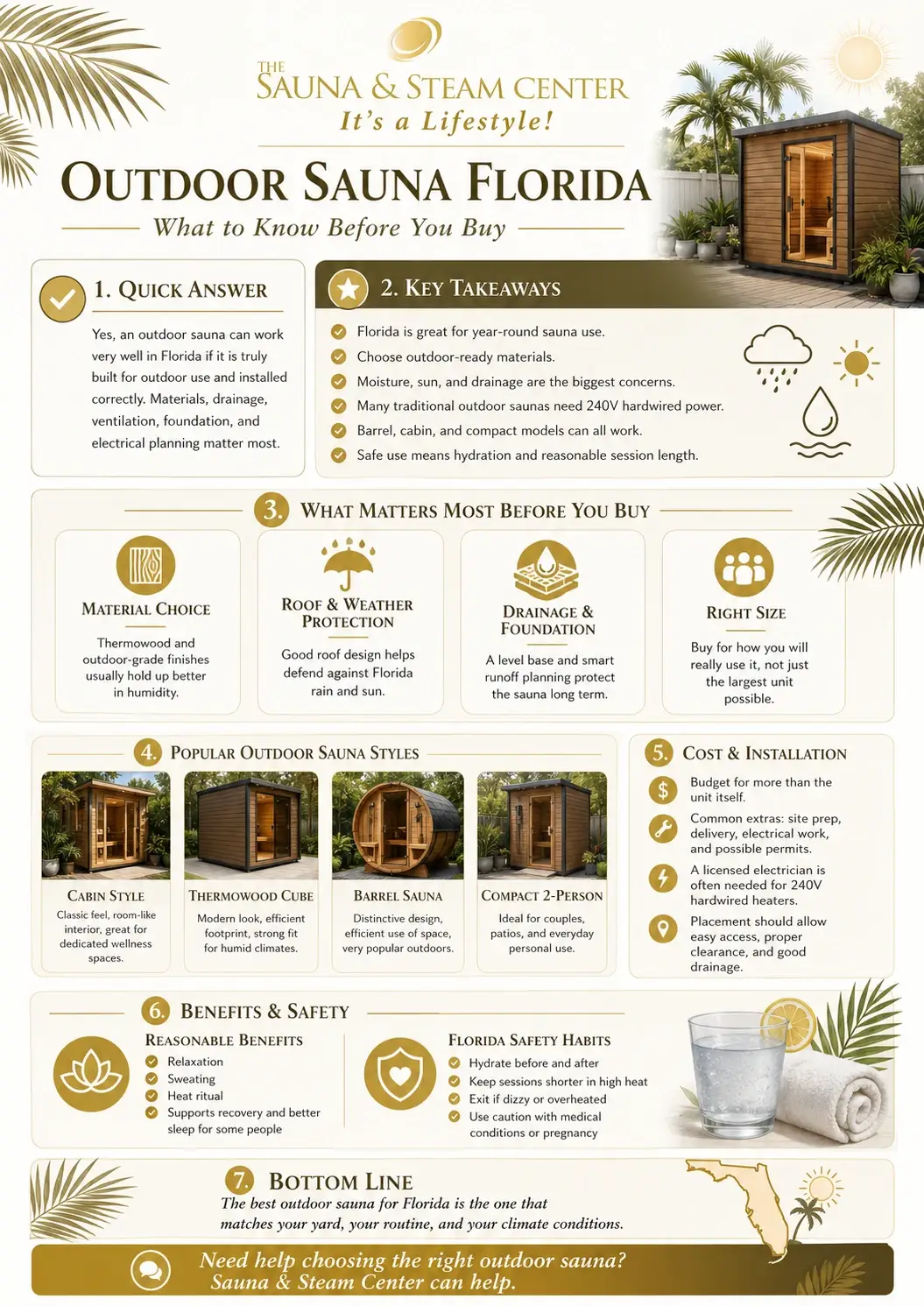
- Florida supports year-round outdoor sauna use when the structure is genuinely rated and prepared for exterior conditions.
- Humidity, ultraviolet exposure, rainfall, drainage, salt air, and wind matter more than marketing descriptions.
- Thermowood, thermo pine, cedar, and other properly finished outdoor-grade materials are common options.
- A two-person sauna suits private use, a four-person sauna fits many households, and a six-person sauna works better for families or entertaining.
- Many traditional electric heaters require dedicated 240V hardwired service and professional electrical work.
- The complete budget should include the sauna, delivery, foundation, electrical work, permits, accessories, and assembly.
- The best value comes from correct fit, dependable performance, climate durability, and accessible support.
Can an Outdoor Sauna Work Well in Florida?
Yes. Florida’s warm climate does not prevent effective sauna use because sauna heat is controlled, intentional, and much hotter than normal outdoor conditions. Many homeowners prefer early morning or evening sessions when the outdoor cool-down experience feels more comfortable. The real challenge is not the heat. It is long-term exterior exposure. High humidity, strong sunlight, wind-driven rain, tropical storms, insects, drainage, and coastal salt can shorten the life of a poorly selected or poorly installed structure.What Is the Best Outdoor Sauna for Florida?
The best outdoor sauna for Florida is the sauna that matches the property, climate exposure, intended capacity, maintenance expectations, and available electrical or wood-burning infrastructure. No single barrel, cabin, cube, or panoramic design is automatically best for every Florida home.
| Florida Buyer Priority | What to Look For | Good Direction to Consider |
|---|---|---|
| Lowest climate risk | Outdoor-rated shell, strong roof system, drainage plan, corrosion-resistant hardware, accessible service | Weather-ready cabin or cube with documented exterior use |
| Compact backyard | Efficient footprint, comfortable bench geometry, manageable delivery path | Two-person cabin, compact cube, or barrel sauna |
| Modern pool area | Exterior-rated glazing, privacy planning, sun exposure review, drainage | Cube or panoramic outdoor sauna |
| Traditional look | Roof protection, headroom, bench comfort, exterior finish, stable base | Barrel or cabin sauna |
| Coastal property | Salt-resistant hardware, protected electrical components, finish maintenance, drainage | Outdoor-rated system selected for the exact exposure |
Sauna in Florida Humidity: What Changes?
Florida humidity does not stop a sauna from working, but it changes how the structure should be selected, installed, dried, and maintained. The biggest concern is not whether the sauna can become hot enough. It is how repeated moisture exposure affects wood movement, finishes, seals, fasteners, doors, electrical components, and the base over time.
For a sauna in Florida humidity, prioritize:
- Exterior-rated construction: an indoor sauna cabin should not simply be placed outdoors.
- Drainage: rainwater and wash water should move away from the sauna rather than collect beneath it.
- Ventilation and drying: the room should be able to dry after use.
- Roof protection: roof details, overhangs, flashing, and seals matter during repeated heavy rain.
- Exterior finish: follow the sauna manufacturer’s maintenance recommendations for exposed wood.
- Corrosion resistance: coastal salt and humidity can accelerate corrosion of unsuitable hardware.
- Door and glazing inspection: swelling, seal wear, and alignment should be addressed early.
Best Home Saunas for Humid Florida Climates
For buyers searching for the best home saunas for humid Florida climates, the most useful comparison is not simply cedar vs. thermowood or barrel vs. cabin. Instead, compare how the complete system handles exterior exposure.
| Feature | Why It Matters in a Humid Florida Climate |
|---|---|
| Documented outdoor rating | Confirms that the manufacturer intends the structure for exterior exposure. |
| Weather-ready roof | Reduces direct water exposure to vulnerable joints and wall assemblies. |
| Suitable exterior wood and finish | Helps the structure tolerate repeated moisture and drying cycles when maintained correctly. |
| Protected, well-drained base | Helps prevent standing water and prolonged moisture contact underneath the sauna. |
| Corrosion-resistant hardware | Important where humidity and salt air are persistent. |
| Accessible exterior maintenance | Makes inspection, refinishing, sealing, and hardware service easier. |
| Local parts and service support | Helps resolve heater, control, glass, hardware, and weather-related issues after installation. |
UV Sauna Florida: How Sun Exposure Affects an Outdoor Sauna
People searching UV sauna Florida are usually concerned about ultraviolet exposure from Florida’s strong sun, not a special type of “UV sauna.” Outdoor sauna exteriors can fade, dry, weather, or age faster when they receive intense direct sunlight every day.
To reduce unnecessary UV and weather wear:
- Confirm the exterior finish recommended by the manufacturer.
- Inspect sun-facing walls and doors more frequently.
- Use permitted shading, roof overhangs, or thoughtful placement when practical.
- Avoid trapping moisture with an improvised cover that blocks drying or ventilation.
- Check seals, glazing, handles, fasteners, and finish as part of routine maintenance.
Barrel Sauna Installation in Florida: What to Plan Before Delivery
Barrel sauna installation in Florida requires the same climate and site planning as other outdoor saunas, plus attention to the barrel’s curved construction, supports, roof or weather-protection system, door alignment, bench geometry, and foundation.
Florida barrel sauna installation checklist
- Confirm the exact barrel is rated for outdoor use.
- Prepare a level, stable, well-drained base.
- Verify support locations required by the manufacturer.
- Plan the roof or weather-protection system.
- Review sun, sprinkler, pool-splash, and irrigation exposure.
- Confirm heater output and electrical requirements before delivery.
- Measure gates, side yards, slopes, turns, and assembly space.
- Check local setbacks, permits, and HOA requirements.
- Plan exterior inspection and maintenance after installation.
For a deeper look at the barrel shape itself, read our barrel sauna guide. This page keeps the focus on Florida installation conditions.
Where to Buy a Sauna in Florida
If you are searching where to buy a sauna in Florida, compare more than the product price. A sauna seller should be able to explain whether the exact model is appropriate for the intended location, what site preparation is required, what is included in delivery and assembly, what electrical work is needed, and who supports the equipment after installation.
Questions to ask a Florida sauna dealer
- Is this exact sauna rated for permanent outdoor use?
- Will the warranty remain valid in Florida exterior conditions?
- What foundation or base does the manufacturer require?
- Who checks delivery access before the sauna ships?
- What heater, controls, voltage, amperage, and circuit are required?
- Who coordinates assembly and electrical work?
- Are replacement heaters, controls, sensors, glass, and hardware available?
- Who performs local troubleshooting and service?
Sauna & Steam Center is based in Hollywood, Florida and helps buyers compare sauna systems, site requirements, delivery, installation planning, and service throughout South Florida. If you are still comparing all sauna types rather than specifically outdoor models, visit our sauna for sale near me guide.

What Florida Buyers Really Need to Know
Buyers searching for an outdoor sauna in Florida usually need more than a product grid. They want to know whether the unit can remain outside year-round, which materials last, how much the entire project costs, and what must be completed before delivery.The main questions behind the search
- Is the sauna truly rated for outdoor use in a humid climate?
- Which style fits the yard, architecture, and intended use?
- How many people should the sauna seat comfortably?
- Should the heater be electric, wood-burning, traditional, or infrared?
- What foundation, electrical work, permits, and delivery planning are required?
- How will the sauna handle rain, sun, wind, insects, and tropical weather?
- What is included in the advertised price?
- Who will provide warranty and service support after installation?
The Most Important Factors Before You Buy
1. Outdoor-rated materials
Thermowood, thermo pine, cedar, and other outdoor-ready materials can perform well when the complete structure is properly designed, finished, and maintained. Do not assume two wood saunas have the same durability simply because their photographs look similar.2. Roof and weather protection
The roof, overhangs, exterior cladding, door details, seals, flashing, fasteners, and finish must make sense for repeated sun and rainfall. A decorative cabin without a complete weather strategy can deteriorate quickly.3. Drainage and foundation
The sauna should sit level on a stable base that supports the complete load and directs water away from the structure. Poor drainage can affect the base, door alignment, exterior finish, and surrounding ground.4. Capacity and interior comfort
Compare actual bench length, depth, height, headroom, door location, and heater clearances instead of relying only on a two-person or four-person label.5. Heater and electrical requirements
Heater output, circuit voltage, amperage, panel capacity, disconnect location, controls, ventilation, and installation clearances should be confirmed before the sauna is ordered.6. Delivery and service access
Measure gates, side yards, turns, slopes, stairs, low branches, roof clearances, and the distance from the delivery point. The delivery format can determine whether the project requires hand assembly, special equipment, or a crane.Outdoor Sauna Styles Compared
Florida homeowners commonly compare cabin, cube, barrel, compact, and panoramic outdoor saunas. Each format can work when the construction and site are appropriate.| Style | Best Fit | Main Advantage | Important Tradeoff |
|---|---|---|---|
| Cabin-style sauna | Families and traditional backyard wellness areas | Room-like interior and familiar bench layouts | Requires adequate footprint, base preparation, and weather protection |
| Thermowood cube sauna | Modern homes and compact luxury spaces | Architectural appearance and efficient footprint | Modern styling and glass packages may increase cost |
| Barrel sauna | Buyers who want a recognizable backyard sauna | Distinctive appearance and efficient curved volume | Headroom and bench geometry differ from a rectangular room |
| Compact two-person sauna | Couples, solo users, and smaller yards | Easier placement and a lower total project footprint | Limited flexibility for guests or lying down |
| Glass-front or panoramic sauna | Pool areas, scenic properties, and premium outdoor spaces | Open feeling and strong visual impact | More glass affects privacy, cleaning, heat load, and price |
Barrel sauna
A barrel sauna has a classic outdoor appearance and reduces unused interior volume through its curved shape. It can be a good fit for compact yards, but taller users should review headroom and bench placement carefully. Read our guide to barrel sauna benefits, limitations, and safety for a deeper comparison.Cabin sauna
Cabin-style saunas provide straighter walls, familiar bench layouts, and an appearance that integrates naturally with patios, landscaping, pools, and outdoor living areas.Cube or modern sauna
Cube designs suit contemporary homes and hardscape-heavy yards. They often use more glass and visual design features, which should be considered when evaluating privacy, heat load, cleaning, and cost.How to Choose the Right Outdoor Sauna Size
Two-person outdoor sauna
A two-person sauna is practical for solo sessions, couples, smaller patios, townhomes, and households that want regular private use without dedicating a large part of the yard.Four-person outdoor sauna
A four-person model is a flexible middle ground. It offers more bench room for a couple, supports small-family use, and allows occasional guests without the size and heating demands of a larger structure.Six-person outdoor sauna
A six-person sauna works better for larger families, entertaining, rental properties, and complete backyard wellness areas with a shower, cold plunge, seating, or lounge space.Electric, Wood-Burning, Traditional, and Infrared Options
Electric outdoor sauna heater
Electric heaters are convenient, clean, repeatable, and suitable for frequent residential use. Many traditional electric heaters require dedicated 240V service, controls, a disconnect, and installation by a qualified electrician.Wood-burning outdoor sauna heater
Wood-burning heaters provide a traditional ritual and may work in sites where the owner values firewood, flame, and a rustic experience. They require chimney planning, fire clearances, ventilation, ash removal, wood storage, and local code review.Traditional outdoor sauna
A traditional sauna heats the room with an electric or wood-burning heater and sauna stones. It provides the high-temperature experience many buyers expect and may allow water on the stones when the equipment is designed for it.Outdoor infrared sauna
Infrared panels operate at lower air temperatures and warm the user more directly. Not every infrared cabin is designed for exterior placement, so confirm the outdoor rating, enclosure protection, electrical requirements, warranty, and environmental limits. Review our sauna heater guide before finalizing the room volume, power, and equipment.Materials, Weather Resistance, and Durability
Cedar
Cedar is common in outdoor saunas because of its appearance, aroma, and moisture resistance. The grade, construction quality, exterior finish, roof, and maintenance still affect long-term performance.Hemlock and spruce
Hemlock and spruce are common sauna woods, but outdoor suitability depends on the complete product and its exterior rating. Do not assume an indoor hemlock or spruce cabin is safe to expose directly to Florida weather.Thermowood and thermo pine
Thermally modified wood is heat-treated to improve dimensional stability and reduce moisture absorption. It is popular for outdoor sauna construction but still requires correct detailing and maintenance.Roof, doors, fasteners, and seals
Exterior performance depends on more than the wall wood. Roof design, door protection, glazing seals, flashing, corrosion-resistant fasteners, hardware, drainage, and exterior finish all contribute to durability.Florida and coastal exposure
Coastal salt, strong ultraviolet exposure, high humidity, heavy rain, wind, and insects can increase maintenance. Select materials and hardware for the actual location rather than relying on a generic outdoor description.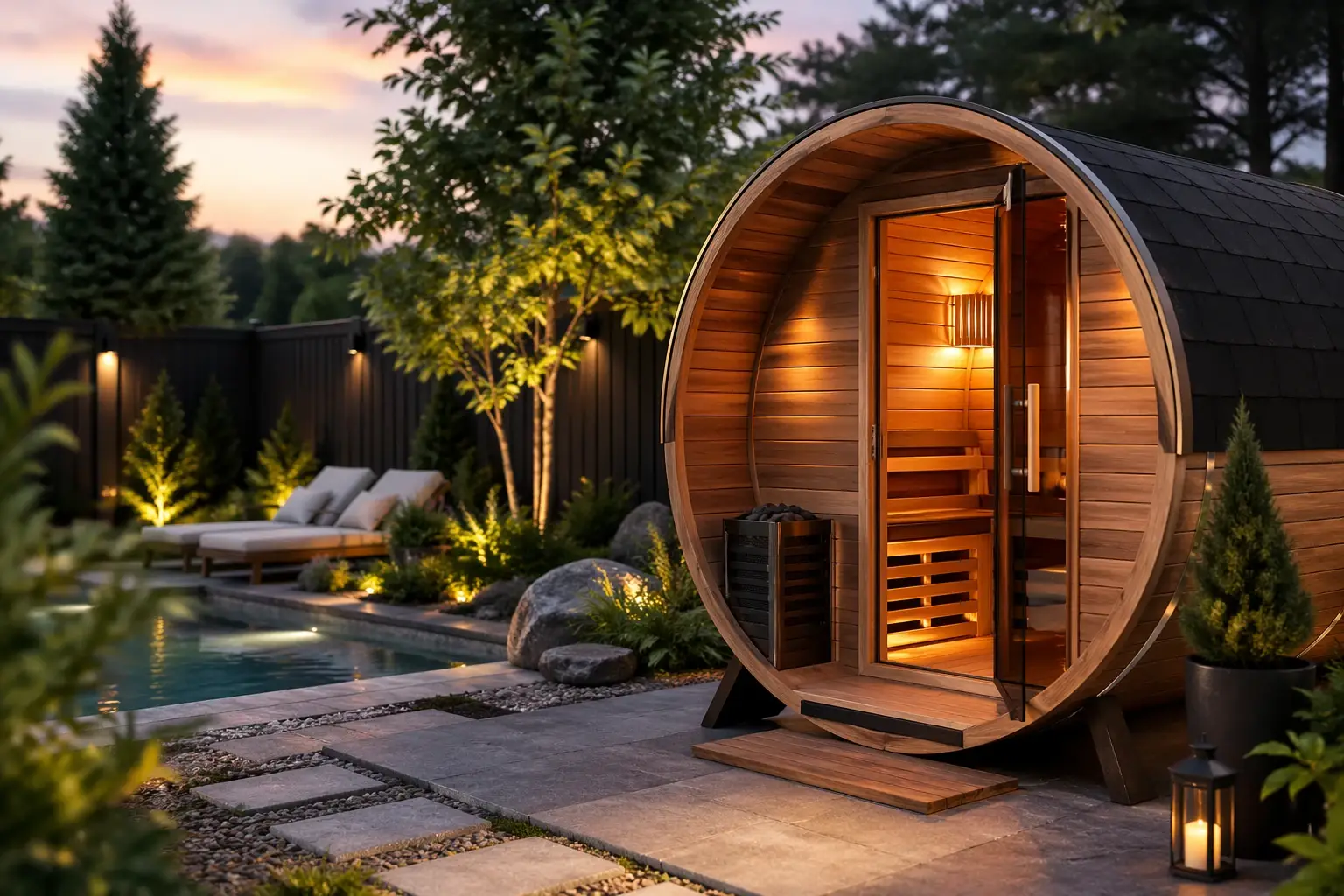
Outdoor Sauna Cost and Installation Expectations
Outdoor sauna pricing is not limited to the product. The complete project may include delivery, site preparation, a concrete pad or other base, electrical work, permits, assembly, landscaping adjustments, accessories, and safe access.Main cost drivers
- Size: larger saunas generally cost more to purchase, deliver, heat, and install.
- Heater: electric and wood-burning systems have different equipment, installation, and maintenance costs.
- Materials: premium wood, exterior protection, glass, hardware, and roof systems affect price.
- Foundation: concrete, pavers, gravel, deck reinforcement, or custom site work adds cost.
- Electrical work: panel capacity, circuit length, trenching, disconnects, controls, and permits influence the total.
- Delivery access: gates, slopes, stairs, low branches, cranes, and long transport paths affect logistics.
- Assembly: a kit may reduce labor, while a complex structure may benefit from professional installation.
How to Shop for Outdoor Saunas for Sale in Florida
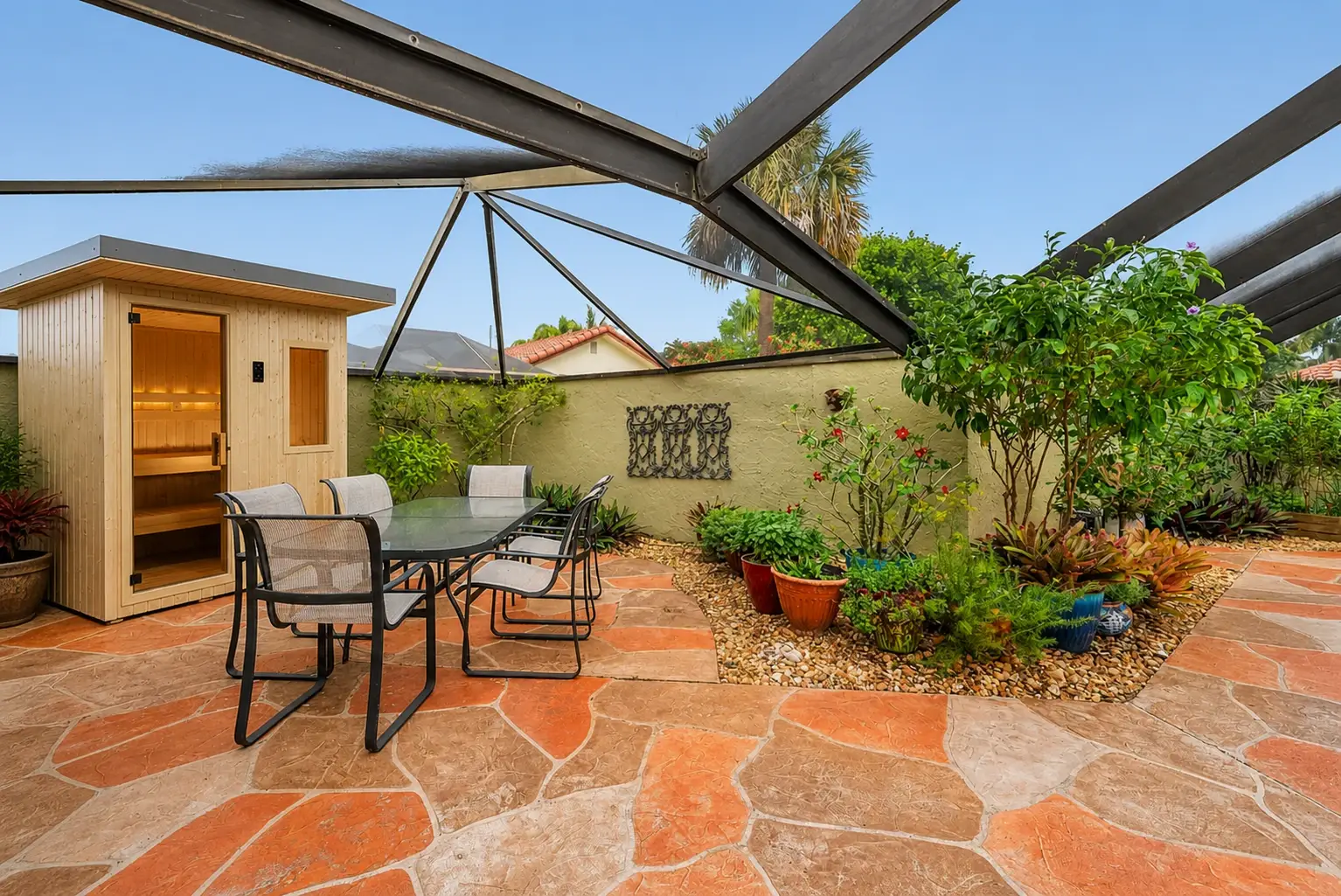
Broad searches such as sauna Florida, Florida sauna, and sauna in Florida can include indoor, outdoor, infrared, traditional, custom, and prebuilt options. This page is specifically for buyers whose sauna will live outdoors. If you are still deciding whether the sauna should be inside or outside, use our indoor vs. outdoor sauna comparison before choosing a model.
Understand what the listed price includes
A package may include the structure, benches, heater, controls, stones, roof, and hardware, but delivery, foundation, electrical work, permits, assembly, accessories, and final testing may be excluded.Compare online and local purchasing carefully
Online prices may appear lower, but freight delivery is often curbside. The buyer may be responsible for unloading, moving components through the property, coordinating trades, solving missing-part issues, and obtaining support remotely. A local dealer can review the site, explain the delivery route, coordinate electrical planning, discuss local permit considerations, and remain accessible after installation.Questions to ask every seller
- Is the exact model rated for permanent outdoor use in a humid climate?
- What wood, exterior finish, roof, and weather protection are included?
- What is the heater brand, output, voltage, amperage, and circuit requirement?
- Does the price include freight, unloading, backyard delivery, assembly, and testing?
- What foundation does the manufacturer require?
- Which permits or inspections may be needed?
- What does the warranty cover, and who performs service in Florida?
- Are replacement heaters, controls, sensors, glass, and hardware available?
Outdoor Sauna Placement, Foundations, and Permits
Choose a stable and well-drained base
Common bases include reinforced concrete, properly installed pavers, compacted gravel systems, and engineered decks. The surface must be level, stable, capable of supporting the full load, and consistent with the manufacturer’s requirements.Evaluate deck capacity
A deck must support the sauna, heater, stones, users, furniture, and applicable weather loads. Ask a qualified contractor or engineer to verify the structure when capacity is uncertain.Plan the electrical route before delivery
Confirm panel capacity, circuit length, trenching, conduit, disconnect location, controls, outdoor-rated components, and permit requirements before the sauna arrives.Check setbacks and homeowner association rules
Local rules may address the distance from property lines, the house, easements, pools, fences, and other structures. Wood-burning systems can introduce additional chimney and fire-clearance requirements.Measure the delivery path
Measure the width and height of gates, side yards, turns, stairs, roof overhangs, low branches, pool equipment, and the distance from the street or driveway to the final location. Miami-Dade homeowners can also review our sauna installation in Miami page for local service information.What Outdoor Sauna Ownership Is Really Like
Warm-up time
Many traditional saunas warm in approximately 30 to 60 minutes, but heater output, room volume, insulation, glass, outdoor temperature, wind, and target temperature affect the result.Interior maintenance
Keep benches and floors clean, allow the room to dry after use, inspect vents, follow heater and stone maintenance instructions, and avoid unsuitable coatings or harsh cleaners.Exterior maintenance
Inspect the roof, finish, seals, door, glazing, fasteners, hardware, base, drainage, and electrical components. Follow the manufacturer’s maintenance schedule and address water intrusion early.Comfort and layout
Bench depth, back support, ventilation, lighting, door placement, privacy, hooks, steps, and the cooling area all influence whether the sauna feels enjoyable after the novelty wears off.The surrounding area matters
A bench, towel storage, covered transition, shower, cold plunge, privacy screen, lighting, and a slip-resistant path can make the routine more comfortable and safer.Common Outdoor Sauna Buying Mistakes
Buying only by price
A low-cost sauna can become expensive when it requires unexpected electrical work, weak weather protection, difficult delivery, replacement components, or corrective installation.Choosing the largest model that fits
Oversizing can raise equipment, foundation, delivery, electrical, heating, and maintenance costs. Choose for normal weekly use rather than the largest possible gathering.Assuming every sauna is outdoor-rated
Many attractive cabin saunas are intended only for indoor or protected placement. Confirm the exact exterior rating, roof system, environmental limitations, warranty, and maintenance requirements.Ignoring the base and drainage
A rushed foundation can lead to movement, water accumulation, door problems, structural stress, and premature deterioration.Leaving electrical work until the end
The heater, circuit, panel, controls, conduit route, disconnect, permits, and site access should be reviewed before delivery.Choosing excessive glass without reviewing the tradeoffs
Large glass areas can improve the view but affect privacy, cleaning, sun exposure, heater sizing, heat retention, delivery risk, and cost.Benefits and Safety Without Hype
What is reasonable to expect
Sauna bathing creates heat exposure, sweating, a higher heart rate, and a relaxation ritual that many people enjoy. Research has explored cardiovascular and other outcomes, but individual results and study limitations matter.What should be framed carefully
Claims involving detoxification, large amounts of fat loss, exercise replacement, immunity, hormones, or treatment of medical conditions are often overstated.Florida-specific safety habits
- Hydrate appropriately before and after the session.
- Begin with shorter sessions when new to sauna bathing.
- Consider shorter sessions when outdoor heat and humidity are already high.
- Leave immediately when you feel dizzy, weak, nauseated, faint, confused, or overheated.
- Avoid alcohol before, during, and immediately after sauna use.
- Use a stable, illuminated, slip-resistant route between the house and sauna.
- Ask a healthcare professional about sauna use when pregnant or managing heart, kidney, blood-pressure, respiratory, medication, or heat-tolerance concerns.
What Our Experience Since 2004 Has Taught Us
The best outdoor sauna projects begin with the property rather than the product. A model can be well built and still be the wrong choice when the delivery route, base, electrical distance, drainage, exposure, privacy, or household routine is not compatible.The foundation and roof deserve as much attention as the interior
Buyers naturally focus on benches, glass, and wood appearance. Long-term outdoor performance depends heavily on how the structure sheds water, stays level, dries, and protects vulnerable components.Electrical distance can change the project budget
A heater that looks affordable can require substantial trenching, conduit, wiring, controls, disconnects, panel work, and permits when the sauna is far from the electrical service.South Florida conditions require site-specific decisions
Hollywood, Fort Lauderdale, Miami, Boca Raton, Naples, and the Florida Keys can present different combinations of salt air, drainage, wind, sun, access, zoning, and homeowner association requirements. The installation plan should reflect the actual property.How to Choose the Right Outdoor Sauna for Your Florida Home
- Choose the intended capacity. Decide how many people will use the sauna during normal weekly sessions.
- Select the preferred heat experience. Compare electric traditional, wood-burning, and outdoor-rated infrared options.
- Evaluate the site. Review setbacks, drainage, wind, sun, privacy, access, and the distance from the house and electrical panel.
- Confirm the foundation. Follow the manufacturer’s base requirements and verify deck capacity when applicable.
- Plan delivery and assembly. Determine the shipping format, unloading method, access route, labor, and equipment.
- Confirm the complete price. Include the sauna, heater, freight, base, electrical work, permits, assembly, and accessories.
- Review warranty and service. Identify who will provide parts, troubleshooting, maintenance, and repairs after installation.
| Your Main Goal | What to Prioritize | Likely Best Direction |
|---|---|---|
| Compact private use | Small footprint, efficient heater, easy access, and simple maintenance | Two-person outdoor sauna |
| Flexible household use | Comfortable benches, moderate footprint, and room for occasional guests | Four-person cabin, cube, or barrel sauna |
| Entertaining and complete wellness area | Large benches, privacy, cooling space, lighting, shower or cold plunge access, and site design | Six-person or custom outdoor sauna |
| Lowest project risk | Site review, outdoor-rated equipment, coordinated delivery, electrical planning, installation, and service | Local dealer and professional installation |
Planning an Outdoor Sauna in Florida?
Compare Models, Site Requirements, and Installation Before You Buy
Sauna & Steam Center can help you choose the size and style, review the yard, plan the base and electrical requirements, coordinate delivery, and understand the complete installed cost for an outdoor sauna in South Florida.Frequently Asked Questions About Outdoor Saunas in Florida
Can an outdoor sauna stay outside in Florida all year?
Yes, as long as it is genuinely designed for outdoor use and installed correctly. The climate is manageable when the sauna can handle humidity, ultraviolet exposure, heavy rainfall, heat, and normal exterior wear.Is an outdoor sauna harder to maintain in Florida?
It can require more attention than an indoor sauna because of sun, moisture, wind, rain, insects, and coastal exposure. Outdoor-rated materials, a sound roof, proper drainage, and a consistent maintenance plan make a major difference.What should I look for when buying an outdoor sauna in Florida?
Look for outdoor-rated materials, a properly matched heater, the right capacity, comfortable benches, a weather-ready roof and exterior, clear electrical requirements, dependable warranty support, and a realistic total installed cost.Where can I find outdoor saunas for sale in Florida?
Sauna & Steam Center in Hollywood, Florida helps homeowners compare outdoor saunas for sale, plan installation, and select models for their yard and budget. Service is available in Hollywood, Fort Lauderdale, Miami, Boca Raton, Naples, and surrounding Florida communities.What is included when I buy an outdoor sauna for sale?
Inclusions vary by seller and model. Many outdoor sauna packages include the structure, benches, heater, and basic hardware. Foundation work, electrical installation, permits, delivery beyond the curb, assembly, and accessories may be separate.Can I buy an outdoor sauna online and have it installed in Florida?
Yes, but confirm the delivery format, freight access, outdoor rating, foundation requirements, electrical specifications, assembly scope, warranty support, and availability of replacement parts before ordering. A local Florida dealer can help coordinate those details.What is the best outdoor sauna for home use in Florida?
The best option depends on the available site, capacity, preferred heat experience, maintenance expectations, and budget. A two-person sauna suits compact private use, a four-person sauna is a flexible middle ground, and a six-person sauna is better for families or entertaining.Is a barrel sauna a good choice in Florida?
For many homeowners, yes. Barrel saunas have a distinctive outdoor appearance and can use backyard space efficiently. They are not automatically better than cabin or cube saunas, so compare bench comfort, headroom, roof protection, exterior materials, and maintenance.How much does an outdoor sauna cost in Florida?
The total depends on size, materials, heater, glass, delivery, foundation, electrical work, permits, assembly, and site conditions. Budget for the complete installed project instead of relying only on the advertised sauna price.Do I need a permit for an outdoor sauna in Florida?
Possibly. Requirements vary by municipality, heater type, electrical scope, foundation, structure size, setbacks, easements, and project details. Confirm local requirements before ordering or beginning site work.Do outdoor saunas need electricity?
Electric saunas normally require a dedicated electrical connection, and many traditional heaters need 240V hardwired service. A wood-burning sauna may not need electricity for heat but may still use power for lighting, controls, or nearby outdoor features.Do outdoor saunas need plumbing?
Most dry outdoor saunas do not require plumbing. Plumbing becomes relevant when the project includes a shower, floor drain, cold plunge, sink, or another water feature.Can I install an outdoor sauna myself?
Some outdoor sauna kits are designed for homeowner assembly, but difficulty varies by model and site. Electrical work, structural questions, foundations, permits, and heater clearances should be handled according to code and manufacturer instructions by qualified professionals when required.Can I put an outdoor sauna on pavers?
Many outdoor saunas can be installed on properly prepared pavers when the surface is level, stable, well drained, and capable of supporting the full load. Follow the sauna manufacturer’s base requirements.Can I put an outdoor sauna on a deck?
Possibly, but the deck must support the sauna, heater, users, and applicable weather loads. A qualified contractor or engineer should verify the structure when load capacity is uncertain.When is the best time of day to use an outdoor sauna in Florida?
Many people prefer early morning or evening because the surrounding air is often more comfortable. The best time is the one that fits your routine, hydration, heat tolerance, and local weather conditions.Does an outdoor sauna add value to a Florida home?
It can add lifestyle value and make an outdoor space more appealing, but resale impact depends on the property, neighborhood, installation quality, condition, permits, and how well the sauna integrates with the yard.How long does an outdoor sauna take to heat up?
Warm-up time depends on heater output, sauna volume, insulation, glass area, weather, wind, and the target temperature. Many traditional saunas take about 30 to 60 minutes, but the exact time depends on the model and conditions.What should I avoid when buying an outdoor sauna?
Avoid shopping only by price, ignoring delivery access, overlooking electrical requirements, choosing the wrong size, skipping foundation and drainage planning, assuming every sauna is outdoor-rated, or buying without understanding warranty and service support.How does Florida humidity affect an outdoor sauna?
Florida humidity increases the importance of exterior-rated construction, ventilation, drainage, roof protection, corrosion-resistant hardware, drying after use, and routine inspection. The sauna can still work very well, but it should be designed and maintained as an exterior structure.
What is the best outdoor sauna for Florida?
The best outdoor sauna for Florida is one that is genuinely rated for exterior use and fits the site’s humidity, UV exposure, rainfall, drainage, salt-air exposure, capacity, heater requirements, maintenance expectations, and budget. Barrel, cabin, and cube saunas can all work when those conditions are handled correctly.
What are the best home saunas for humid Florida climates?
Look for outdoor-rated construction, a weather-ready roof, suitable exterior wood and finishes, a well-drained base, corrosion-resistant hardware, documented maintenance requirements, and accessible local parts and service.
Does Florida UV exposure damage outdoor saunas?
Strong sun can fade and weather exposed exterior materials over time. Follow the manufacturer’s finish and maintenance guidance, inspect sun-facing surfaces regularly, and plan placement or permitted shade where practical.
What should I know about barrel sauna installation in Florida?
Confirm outdoor rating, foundation requirements, support locations, drainage, weather protection, electrical service, delivery access, permits, setbacks, and maintenance needs before installation. The barrel should sit level and be installed according to the exact manufacturer’s instructions.
Where should I buy a sauna in Florida?
Buy from a seller that can verify outdoor suitability, explain site preparation and electrical requirements, plan delivery and assembly, and provide warranty, parts, and service support after installation. Sauna & Steam Center in Hollywood serves buyers throughout South Florida.
Where can I buy an outdoor sauna in South Florida?
Sauna & Steam Center in Hollywood, Florida helps buyers in Hollywood, Fort Lauderdale, Miami, Aventura, Hallandale Beach, Sunny Isles Beach, Dania Beach, Pembroke Pines, Miramar, Davie, Weston, Boca Raton, Delray Beach, Coral Gables, Pinecrest, Naples, Key Largo, and nearby areas compare outdoor sauna options and installation requirements.Conclusion: Choose an Outdoor Sauna for Florida Conditions, Not Just Appearance
An outdoor sauna can be an excellent addition to a Florida home when the structure, site, heater, electrical plan, foundation, drainage, and exterior materials are selected for the climate and property. Begin with the normal number of users, available space, preferred heat experience, and complete installed budget. Then compare durability, comfort, delivery, warranty, service, and maintenance instead of relying only on the advertised unit price. Sauna & Steam Center serves Hollywood, Fort Lauderdale, Miami, Boca Raton, Naples, the Florida Keys, and nearby communities. Call 954-744-5395 for help comparing outdoor sauna options and installation requirements.References
- Cleveland Clinic: Get Your Sweat On, The Benefits of a Sauna
- Harvard Health Publishing: Saunas and Your Health
- CDC NIOSH: Heat-Related Illnesses and Warning Signs
- CDC: About Heat and Your Health
- Laukkanen T, et al. Association Between Sauna Bathing and Fatal Cardiovascular and All-Cause Mortality Events
- Hussain JN, et al. A Hot Topic for Health: Results of the Global Sauna Survey
- National Fire Protection Association: Electrical Safety and GFCI Protection