How to Relax After Work at Home: Sauna, Hot Tub & Wellness Ideas
Editorial and wellness disclosure:
Sauna & Steam Center sells, designs, installs and services sauna and wellness systems. This article discusses everyday relaxation habits and heat-based wellness experiences. A sauna, hot tub or relaxation routine should not be presented as treatment for an anxiety disorder, depression, chronic stress or another medical or mental-health condition. If stress, anxiety, sadness or sleep problems are interfering with daily life, consider speaking with a qualified healthcare or mental-health professional.
If you are searching for how to relax after work, the solution does not have to begin with buying anything. A better evening often starts by creating a clear transition between work and home, reducing stimulation, moving your body, putting away work notifications and choosing an activity that gives you permission to stop solving problems. For some people that means a walk, music or reading. For others, a home sauna, hot tub, steam room or dedicated wellness space becomes the ritual that tells the body and mind that the workday is over.
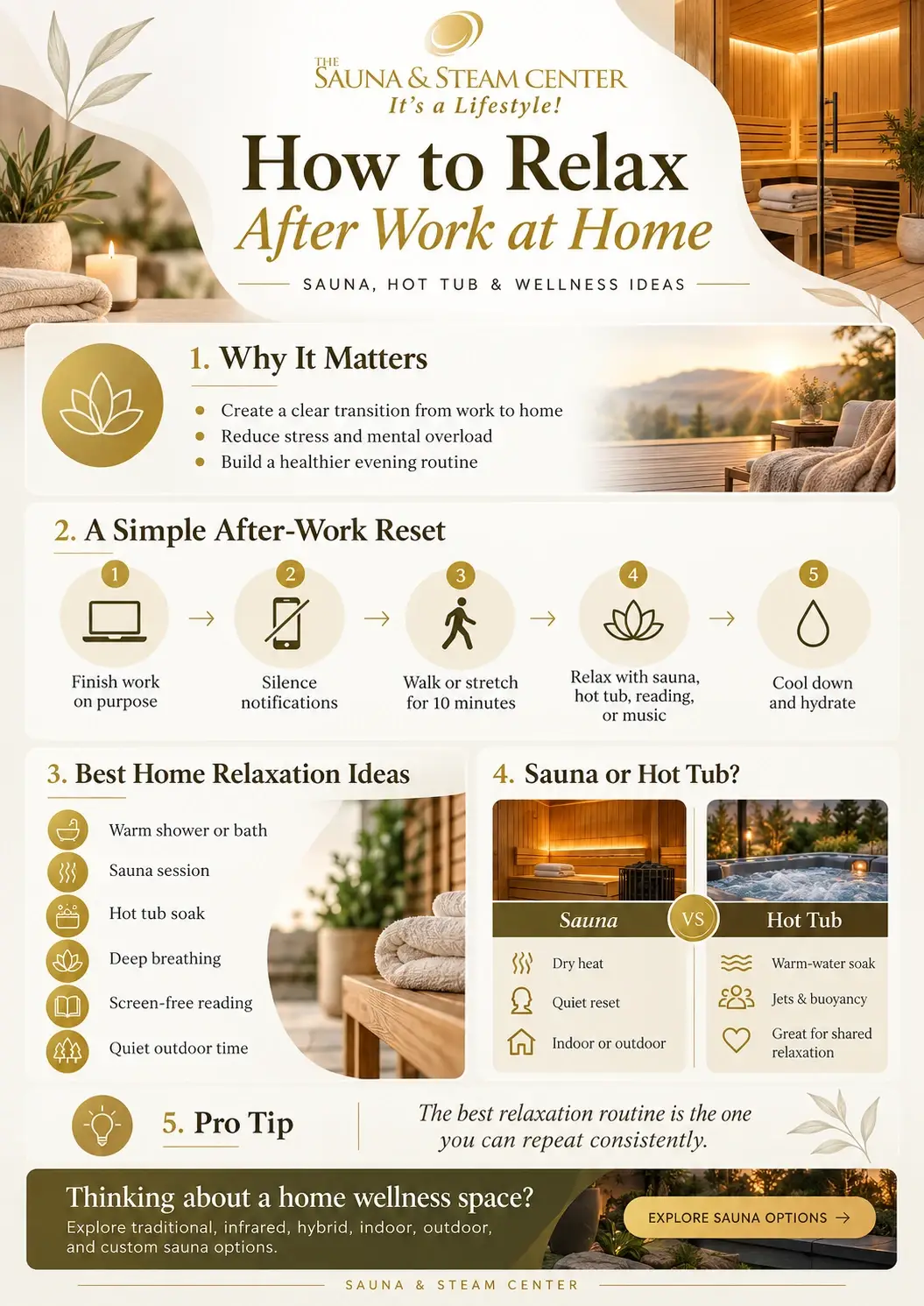
Quick answer: How can you relax after work?
Create a repeatable transition from work mode to home mode. Close work apps, silence unnecessary notifications, move for a few minutes, change clothes, hydrate and choose a low-stimulation activity you genuinely enjoy. Deep breathing, reading, stretching, music, a warm shower, sauna bathing or soaking in a hot tub can all become part of that transition. The most useful routine is usually one that is simple enough to repeat consistently rather than something complicated you only do occasionally.
You do not need a sauna to learn how to relax.
This guide starts with simple habits available to almost anyone. We then compare sauna, infrared sauna and hot tubs for people who want to build a more intentional relaxation ritual at home.
How to Relax at Home: Quick Answers
| What People Search | Quick Answer |
|---|---|
| How to relax after work | Create a clear end-of-work ritual, step away from notifications, move briefly and transition into a calming activity instead of continuing work mentally all evening. |
| Ways to unwind after work | Walk, stretch, shower, read, listen to music, practice slow breathing, spend time outside, use a sauna or soak in warm water. |
| How to reduce stress at home | Reduce unnecessary stimulation, protect personal time, use relaxation techniques and create predictable spaces or rituals associated with rest. |
| Home relaxation ideas | Create a screen-free chair, reading corner, warm shower routine, sauna space, outdoor retreat, meditation area or simple evening stretching zone. |
| Evening relaxation routine | Finish work, change environment, move briefly, use heat or another calming activity, cool down, hydrate and transition to low-stimulation evening activities. |
| Does sauna help with stress? | Many sauna users report relaxation and stress reduction, but sauna should be considered a wellness practice rather than a medical treatment for stress or mental-health conditions. |
| Sauna for relaxation | A sauna can create a warm, quiet, screen-free environment that some people find especially useful as an evening transition ritual. |
| Infrared sauna for stress | Infrared provides dry radiant heat at generally lower air temperatures than traditional sauna, which some users find more comfortable for quiet relaxation. |
| Traditional sauna for relaxation | Traditional sauna provides hotter air, wood interiors and the familiar stone-heater sauna experience. People who enjoy stronger heat may prefer it. |
| Sauna vs hot tub for relaxation | Choose sauna if you prefer dry heat, quiet heat sessions and less water maintenance. Choose a hot tub if you prefer warm-water immersion, buoyancy, jets and a more social soaking experience. |
| Home wellness ideas | Start with routines first. If you want a dedicated space, combine comfortable seating, warm lighting, sauna or steam, showering, hydration and a quiet cool-down area. |
The central idea:
Relaxation becomes easier when your environment gives you a clear signal that work has stopped. A home sauna can become one of those signals, but the ritual surrounding it matters too.
Key Takeaways
- Relaxing after work is easier when you deliberately mark the transition between work time and personal time.
- You do not need expensive wellness equipment to create an effective evening routine.
- Walking, stretching, breathing exercises, reading, music and warm bathing can all be used as relaxation rituals.
- Sauna users commonly report relaxation and stress reduction as reasons for sauna bathing.
- Research on sauna and specific mental-health outcomes remains much more limited than many wellness claims suggest.
- Heat exposure itself is a physiological stressor, so sauna should not be described as simply switching the body into a relaxed state while you are inside.
- Many people describe the sauna session and subsequent cool-down as subjectively calming.
- A traditional sauna provides hotter air, while infrared saunas usually operate at lower air temperatures.
- A hot tub provides warm-water immersion and buoyancy rather than hot-air exposure.
- The best relaxation product is the one whose heat style, maintenance and routine you actually enjoy enough to use consistently.
- A dedicated wellness room can improve convenience, but a consistent relaxation routine matters more than luxury finishes.
Why Is It So Hard to Relax After Work?
The end of working hours does not necessarily mean the end of work-related attention.
Your body may be home while your mind is still:
- Replaying a conversation
- Thinking about unfinished tasks
- Checking email
- Watching Slack or Teams notifications
- Planning tomorrow
- Responding to customers or coworkers
- Scrolling through another stream of information
This can be especially noticeable for people who work from home because the physical boundary between workplace and personal space may disappear.
Your Evening Needs a Transition
One of the most useful concepts for people learning how to disconnect after work is creating a transition ritual.
The activity itself does not have to be complicated.
It could be:
- A ten-minute walk
- Changing clothes
- Taking a shower
- Playing a specific playlist
- Making tea
- Stretching
- Reading
- Sitting outside
- Using your sauna
- Taking a hot-tub soak
Think of the ritual as a boundary.
The purpose is to create a recognizable moment that separates the part of the day when you solve problems from the part of the day when you are allowed to stop solving them.
A Simple Evening Relaxation Routine After Work
You do not need a complicated wellness schedule.
Start with a sequence you can realistically repeat.
Step 1: Finish the Workday on Purpose
Before leaving your desk, write down the most important tasks for tomorrow.
This can make it easier to stop mentally rehearsing everything you are afraid you will forget.
Step 2: Silence Work Notifications
If your job allows it, disable unnecessary work notifications after the workday.
The goal is to stop repeatedly re-entering work mode because of one email or message.
Step 3: Change Your Physical State
Walk, stretch, shower or change clothes.
You are creating a physical signal that the previous part of your day has ended.
Step 4: Choose One Restorative Activity
Examples include:
- Reading
- Deep breathing
- Listening to music
- Sauna bathing
- Warm-water soaking
- Gentle stretching
- Spending time outdoors
- Cooking without screens
Step 5: Reduce Stimulation
Relaxation can be difficult when one screen is simply replaced with another.
Consider giving yourself at least part of the evening without work email, news feeds or constant notifications.
Step 6: Cool Down and Hydrate
If your relaxation routine involves a sauna, steam room, hot tub or other heat exposure, give yourself time afterward to cool comfortably and replace fluids.
Step 7: Repeat the Routine
Consistency is what turns an activity into an evening cue.
A practical sequence:
Close work → walk or stretch → shower or sauna → cool down → hydrate → dinner → reading, music or conversation → bedtime routine.
12 Relaxing Things to Do at Home After Work
If you need home relaxation ideas or simple stress relief ideas, start with activities that reduce demands rather than adding another list of goals.
| Relaxation Idea | Why People Like It | What You Need |
|---|---|---|
| Take a short walk | Provides movement and a change of environment | Nothing |
| Practice slow breathing | Creates a deliberate pause and focuses attention | A quiet place |
| Read | Moves attention away from work-related tasks | Book or e-reader |
| Listen to music | Creates a different emotional atmosphere | Music |
| Stretch | Can feel comfortable after long periods of sitting | Floor space or mat |
| Take a warm shower | Simple physical transition between work and evening | Shower |
| Use a sauna | Warm, quiet environment with a defined beginning and end | Sauna |
| Soak in a hot tub | Combines warm-water immersion with buoyancy and optional jets | Hot tub |
| Sit outside | Creates separation from indoor workspaces and screens | Outdoor chair or patio |
| Journal | Provides a place to put unfinished thoughts | Notebook |
| Cook slowly | Provides a hands-on activity with a clear result | Kitchen |
| Talk with someone | Social connection can become part of the transition away from work | Friend, partner or family |
The National Center for Complementary and Integrative Health identifies practices such as deep breathing, progressive muscle relaxation and guided imagery among established relaxation techniques.
How to Disconnect After Work When Your Mind Keeps Running
When your brain keeps returning to work, telling yourself to “just relax” is rarely useful.
Instead, reduce the number of cues that pull you back into work mode.
Create a Work-Free Zone
If possible, avoid doing evening relaxation activities in the same chair where you spent eight hours working.
Put the Laptop Away
A visible laptop can become a visual reminder of unfinished tasks.
Use a Different Lighting Environment
Switching from bright work lighting to softer evening lighting can help make the transition feel more intentional.
Give Yourself Something Else to Do
An empty evening can easily become a return to email or scrolling.
A predictable activity such as walking, sauna bathing, cooking or reading gives the evening a different structure.
Create a Phone-Free Window
You do not need to eliminate your phone all evening.
Even a short period without constant notifications can create a more deliberate break from work.
Can a Sauna Help You Relax After Work?
For many users, yes, but the reason should be described realistically.
A sauna creates several characteristics that can make it useful as a relaxation ritual:
- A warm environment
- A defined session
- Few distractions
- A natural reason to leave the phone outside
- Time away from work
- A quiet setting
- A period of cooling and rest afterward
The Sauna Is Also a Physical Stressor
It is important not to oversimplify sauna physiology.
During heat exposure:
- Body temperature rises.
- Sweating increases.
- Heart rate usually increases.
- Blood flow to the skin increases.
Those are responses to heat stress.
The subjective feeling of relaxation can exist alongside that physiological workload, and many users particularly enjoy the quiet period during and after the session.
Does sauna help with stress?
Sauna bathing is commonly used for relaxation and stress reduction, and survey and qualitative research supports that many regular users perceive those benefits. Evidence is not strong enough, however, to claim that sauna treats chronic stress, anxiety or another mental-health condition.
For a broader review of evidence across many health outcomes, see our
Sauna Benefits Guide
.
What Does Research Say About Sauna and Stress?
The research is interesting, but stronger claims should be avoided.
Relaxation Is One of the Main Reasons People Use Saunas
A global survey of sauna users found that relaxation and stress reduction were among the most commonly reported reasons for sauna bathing.
That study is useful for understanding why people use saunas, but because it was observational and relied on self-reporting, it cannot establish that sauna caused specific mental-health improvements.
Regular Users Describe Psychological Benefits
A recent qualitative study of regular Finnish-style sauna users found recurring descriptions of stress relief, emotional regulation and social connection.
The study involved only a small group and explored people’s experiences rather than testing sauna as a clinical treatment.
What About Cortisol?
You may see online claims that sauna “lowers cortisol.”
The research is more complicated.
Different sauna protocols have reported different hormonal responses, and earlier reviews have described cortisol findings as inconsistent.
Be cautious with hormone marketing.
The strength of a home sauna is that it can become a repeatable relaxation ritual. It does not need exaggerated “cortisol detox” claims to be valuable.
How Do Home Saunas Compare With Hot Tubs for Relaxation?
A home sauna and hot tub can both create a clear transition from daily responsibilities to personal time, but they feel very different.
| Feature | Home Sauna | Hot Tub |
|---|---|---|
| Primary experience | Heated air or radiant heat | Warm-water immersion |
| Body sensation | Warmth and sweating | Warm water, buoyancy and optional jets |
| Atmosphere | Often quiet and inward-focused | Can be quiet or highly social |
| Traditional sauna option | Yes | No |
| Infrared option | Yes | No |
| Water chemistry | No standing body of water to maintain | Requires ongoing water care and filtration |
| Jets | No | Common |
| Social use | Possible, depending on size | Often a major part of the experience |
| Indoor placement | Many residential options | Possible but significantly more site planning is usually required |
| Outdoor placement | Available | Very common |
| Best fit | People who prefer dry heat and a defined heat ritual | People who prefer soaking, buoyancy and water-based relaxation |
Choose a Sauna for Relaxation If:
- You enjoy dry heat.
- You want a quiet heat-based ritual.
- You like wood interiors.
- You want traditional, infrared or hybrid options.
- You would rather not maintain a body of water.
- You want indoor or outdoor placement flexibility.
Choose a Hot Tub for Relaxation If:
- You prefer soaking in warm water.
- You enjoy hydrotherapy-style jets.
- You like buoyancy.
- You expect to relax socially with other people.
- You do not mind routine water chemistry and filter maintenance.
Which is more relaxing?
That is personal. Someone who dislikes intense heat may strongly prefer a hot tub. Someone who dislikes sitting in water or wants a quiet screen-free heat ritual may strongly prefer a sauna.
For a deeper discussion of warm-water use, see our
Hot Tub Therapy Guide
.
Infrared Sauna vs. Traditional Sauna for Relaxation
If relaxation is your main goal, neither sauna type is medically superior.
The better choice is usually the heat experience you enjoy more.
| Feature | Traditional Sauna | Infrared Sauna |
|---|---|---|
| Heat style | Heats the room and sauna stones | Uses radiant infrared emitters |
| Air temperature | Generally higher | Generally lower |
| Humidity | Usually low, with temporary increases when water is used on approved stones | Usually low |
| Experience | Classic high-heat sauna | Gentler-feeling radiant warmth for many users |
| Best relaxation fit | People who enjoy stronger traditional heat | People who prefer lower air temperatures |
Infrared Sauna for Stress and Relaxation
An infrared sauna can appeal to someone who wants warmth without the higher air temperatures associated with traditional sauna.
That comfort preference can make it easier for some people to build sauna use into a regular evening routine.
Traditional Sauna for Relaxation
Traditional sauna appeals to users who enjoy stronger heat, wood interiors, hot stones and the ritual associated with Finnish-style sauna bathing.
For the technical differences, see our
Infrared vs. Traditional Sauna Guide
.
How to Create an Evening Sauna Relaxation Routine
A sauna does not need to become another productivity challenge.
You do not need to chase the highest temperature, longest session or largest amount of sweat.
Before the Sauna
- Finish work.
- Put away the laptop.
- Silence unnecessary notifications.
- Hydrate.
- Give yourself time so the session does not feel rushed.
During the Sauna
- Use a comfortable temperature.
- Keep the phone outside when practical.
- Sit quietly, breathe normally or talk with someone you enjoy.
- Leave when you have had enough.
- Do not turn heat tolerance into a competition.
After the Sauna
- Cool down comfortably.
- Hydrate.
- Shower if desired.
- Choose a lower-stimulation activity.
- Give yourself time before immediately returning to email or social media.
A useful mindset:
Think of your sauna as a boundary between the workday and the evening rather than another task to optimize.
New to sauna bathing? See
How to Use a Sauna
and our guide to
Sauna Session Length
.
Benefits of Having a Sauna at Home for Your Relaxation Routine
This section is intentionally about convenience and routine, not the broader medical benefits of sauna bathing.
No Travel Required
A home sauna removes the drive to a gym, spa or wellness center.
Privacy
You control who is in the room, what you wear, the lighting and whether the session is silent.
Consistency
Having the sauna nearby can make it easier to use as part of an established routine.
Your Preferred Environment
Lighting, wood, music, temperature and surrounding décor can all be selected around your preferences.
Indoor or Outdoor Options
A sauna can become part of a bathroom, home gym, wellness room, patio or backyard retreat depending on the system and site.
Looking for general home sauna benefits?
We intentionally keep the broader health-benefit discussion on our
dedicated Sauna Benefits page
so this article stays focused on after-work relaxation rather than competing with it in search results.
Home Relaxation Room and Wellness Room Ideas
A dedicated room can make relaxation more convenient, but it does not need to look like a hotel spa.
Useful Elements Include:
- Comfortable seating
- Warm adjustable lighting
- Low visual clutter
- Sauna or infrared cabin
- Steam shower if appropriate
- Shower or cool-down area
- Water and towels
- Plants
- Storage
- Quiet music
- Reading chair
- Access to an outdoor patio or garden
Keep the room focused.
A relaxation room does not need ten wellness technologies. A sauna, comfortable chair, good lighting and somewhere to cool down may be far more useful than filling the room with equipment you rarely use.
For a complete design-focused discussion, continue to our
Home Wellness Room Ideas
guide.
How to Make Your Home Feel More Like a Spa
If you search for how to make home feel like a spa, expensive remodeling is not the first step.
Start With the Senses
Think about:
- Lighting
- Sound
- Temperature
- Texture
- Visual clutter
- Privacy
Use Warm, Adjustable Lighting
A harsh overhead work light creates a very different environment from warm indirect lighting.
Store Everyday Clutter
A calm space is easier to create when work papers, laundry and unrelated equipment are not competing for attention.
Add a Heat Experience
Depending on your space and preference, this might be:
- Traditional sauna
- Infrared sauna
- Hybrid sauna
- Steam room
- Steam shower
- Hot tub
Include Somewhere to Rest
The five or ten minutes after heat exposure can be just as important to the experience as the room itself.
What Is the Best Sauna for Home Relaxation?
There is no single best sauna for every person.
| Your Preference | Option to Consider |
|---|---|
| Classic high heat | Traditional sauna |
| Lower air temperature | Infrared sauna |
| Two heat experiences | Hybrid sauna |
| Indoor convenience | Indoor sauna |
| Backyard retreat | Outdoor sauna |
| Architectural integration | Custom sauna |
| Small household | Compact one- or two-person sauna |
This article is not our buying guide.
If you have moved from “I need to relax” to “I think I want a sauna,” continue to our
Home Sauna Guide
.
That page covers the purchasing decision in much more detail.
You can also compare
Indoor vs. Outdoor Saunas
before deciding where the sauna should go.
Using Sauna and Hot-Tub Heat Safely
Relaxation should never depend on tolerating discomfort.
General Heat-Safety Principles
- Hydrate appropriately.
- Start conservatively if you are new to heat exposure.
- Leave if you feel dizzy, faint, nauseated, confused or unusually weak.
- Avoid alcohol before or during sauna use.
- Do not use extreme temperature or session length as a competition.
- Follow the manufacturer instructions for your sauna or hot tub.
Ask a Healthcare Professional First If Appropriate
Individualized guidance may be appropriate if you:
- Are pregnant
- Have cardiovascular disease
- Have unstable blood pressure
- Have difficulty regulating body temperature
- Take medication that affects blood pressure, sweating or hydration
- Have another condition that may affect heat tolerance
Persistent stress deserves attention.
A sauna can be part of a pleasant wellness routine, but it should not delay appropriate medical or mental-health care when stress, anxiety, depression or sleep problems are significantly affecting your daily life.
Turn the End of the Workday Into Something You Look Forward To
Create a Home Sauna Routine Built Around How You Relax
Sauna & Steam Center helps homeowners compare traditional, infrared, hybrid, indoor, outdoor and custom sauna options based on the heat experience they prefer, available space and how they actually want to use the room.
Frequently Asked Questions About Relaxing After Work and Sauna Use
How can I relax after work?
Create a deliberate transition between work and personal time. Close work applications, put away the laptop, silence unnecessary notifications, move for a few minutes and choose one relaxing activity such as reading, walking, stretching, slow breathing, sauna bathing or warm-water soaking.
What are good ways to unwind after work?
Common options include walking, listening to music, reading, journaling, stretching, deep breathing, taking a warm shower, sitting outside, using a sauna or soaking in a hot tub.
How can I reduce stress at home?
Reduce unnecessary stimulation, separate work space from relaxation space when possible, protect some work-free time and practice repeatable relaxation habits such as breathing, movement, reading, music or quiet heat-based wellness routines.
How do I disconnect from work when working from home?
Create a clear closing ritual. Write down tomorrow’s tasks, shut down work applications, leave the work area, change clothes or go for a short walk and begin an activity that belongs only to your personal time.
Does sauna help with stress?
Many sauna users report relaxation and stress reduction as reasons they use sauna. Research supports these perceptions, but current evidence does not establish sauna as a treatment for chronic stress, anxiety or other mental-health conditions.
Is sauna good for relaxation?
It can be. A sauna provides warmth, quiet, a defined period away from work and a natural opportunity to reduce phone and screen use. Whether you personally find the heat relaxing depends on your comfort and preferences.
What are sauna stress benefits?
The most defensible benefit is subjective relaxation. Sauna also produces normal physiological responses to heat such as sweating and increased heart rate. Claims that sauna universally lowers stress hormones or treats anxiety should be approached cautiously.
Does sauna lower cortisol?
Research on cortisol responses to sauna is mixed and depends on the temperature, session duration, repeated exposure, cooling method and population studied. It is more accurate to describe sauna as a relaxation practice than as a guaranteed cortisol-lowering treatment.
Does sauna have mental health benefits?
Some observational and qualitative research suggests that regular sauna users perceive benefits related to relaxation, emotional well-being and social connection. Evidence is not strong enough to use sauna as a substitute for professional mental-health treatment.
Is infrared sauna good for stress?
An infrared sauna may work well as a relaxation environment for people who prefer radiant heat and lower air temperatures. There is not strong evidence showing that infrared sauna is uniquely superior to traditional sauna for stress reduction.
Is traditional sauna good for relaxation?
Many people enjoy traditional sauna because of the high heat, wood environment, heated stones and quiet ritual. Whether it feels more relaxing than infrared heat depends on personal preference.
Is a sauna or hot tub better for relaxation?
Neither is universally better. Sauna provides dry heat and a structured heat session. Hot tubs provide warm-water immersion, buoyancy and often massage jets. Choose the experience you personally find more comfortable and convenient.
What are the benefits of having a sauna at home?
From a lifestyle perspective, a home sauna provides privacy, convenience, control over the environment and easier integration into a consistent wellness routine. Broader health benefits are covered separately in our Sauna Benefits Guide.
What is a good evening relaxation routine?
A simple routine might include shutting down work, walking or stretching, showering or using a sauna, cooling down, hydrating, eating dinner and finishing the evening with reading, music or conversation rather than returning immediately to work.
How can I make my home feel like a spa?
Start with warm adjustable lighting, comfortable seating, less clutter, towels, plants, calming music and a quiet place to rest. A sauna, steam room, hot tub or shower can become the main heat or water experience if you want a dedicated home wellness space.
What is the best sauna for home relaxation?
Traditional sauna is a strong fit for people who prefer high dry heat, while infrared can suit people who prefer lower air temperatures. Hybrid systems provide both heat styles. The best choice is the one you enjoy and can realistically use as part of your normal routine.
Conclusion: Make Relaxation a Transition, Not Another Task
Learning how to relax after work does not require turning your evening into another performance goal.
The most useful first step is creating separation between your workday and personal time.
That might begin with shutting down notifications, going for a short walk, changing clothes, reading or practicing slow breathing.
For people who enjoy heat, a sauna can become a powerful environmental cue because the session has a clear beginning and end, takes you away from your normal workspace and creates time when very little is expected from you.
A hot tub can serve a similar role for someone who prefers water, buoyancy and jets.
You do not have to decide which wellness product is objectively “best.”
You need an evening routine that feels good enough and convenient enough that you actually want to repeat it.
Bottom line:
Build the habit first. Then, if sauna bathing becomes the part of your evening you look forward to most, design the home sauna around your preferred heat style, location and routine rather than around exaggerated wellness claims.
References
National Center for Complementary and Integrative Health
5 Things To Know About Relaxation Techniques for Stress.
Overview of the stress response, relaxation response and practices including breathing exercises, progressive relaxation and guided imagery.
National Center for Complementary and Integrative Health
Relaxation Techniques: What You Need To Know.
Evidence overview covering relaxation response techniques, stress and anxiety research.
Hussain J, Cohen M.
Clinical Effects of Regular Dry Sauna Bathing: A Systematic Review.
A review of clinical sauna research and the limitations of the available evidence.
Hussain J, Cohen M.
A Hot Topic for Health: Results of the Global Sauna Survey.
Survey research documenting relaxation and stress reduction among the major reasons respondents reported using saunas.
Mental Well-Being and Regular Sauna Bathing
A Phenomenological Study of Psychological Experiences and Perceived Impact.
Qualitative research examining regular sauna users’ experiences related to emotional regulation, relaxation and social connection.
Kukkonen-Harjula K, et al.
How the Sauna Affects the Endocrine System.
Review noting that hormonal responses to sauna, including cortisol, can vary by bathing conditions and protocol.
Toda M, et al.
Change in Salivary Physiological Stress Markers by Spa Bathing.
Small study examining physiological stress markers following warm spa bathing.
Centers for Disease Control and Prevention
Improve Your Emotional Well-Being.
General guidance covering healthy approaches to stress, physical activity, journaling, relaxation techniques and seeking support when needed.