Himalayan Salt Sauna: Design, Salt Walls, Cost & What to Know Before Building
Editorial disclosure: Sauna & Steam Center designs, sells, installs and services sauna systems. This guide focuses on Himalayan salt sauna design, materials, construction and ownership considerations. Wellness information is educational only. A passive Himalayan salt wall should not be presented as equivalent to active halotherapy or as a treatment for respiratory, skin or other medical conditions.
A Himalayan salt sauna combines a sauna with Himalayan salt bricks, tiles or panels used as an architectural feature. The salt can create a dramatic backlit wall, add texture and change the visual atmosphere of the room, but the most important decisions are practical: where the salt goes, how it is supported, how it is protected from moisture, how close it is to the heater, how the wall can dry between sessions and whether the project is traditional or infrared.
Himalayan Salt Sauna: Quick Buying Guide
| Question | Short Answer |
|---|---|
| Can you put Himalayan salt in a sauna? | Yes, when sauna-rated salt materials are installed with proper heat clearances, backing, support, ventilation and moisture control. |
| Is infrared or traditional better for salt? | Infrared is generally easier because the environment is drier. Traditional sauna can work, but moisture management matters more. |
| Does a salt wall create halotherapy? | No. A passive salt wall is not the same as a halogenerator that disperses fine dry salt aerosol. |
| What is the biggest installation concern? | Moisture, heater clearance, structural support and corrosion-resistant detailing. |
| Is backlighting worth it? | For many buyers, yes. Lighting is one of the biggest reasons Himalayan salt walls are chosen because it creates a distinctive warm visual effect. |
| How much does it cost? | There is no universal price. Cost depends on wall size, salt material, support system, lighting, electrical work, sauna type and installation labor. |
What Is a Himalayan Salt Sauna?
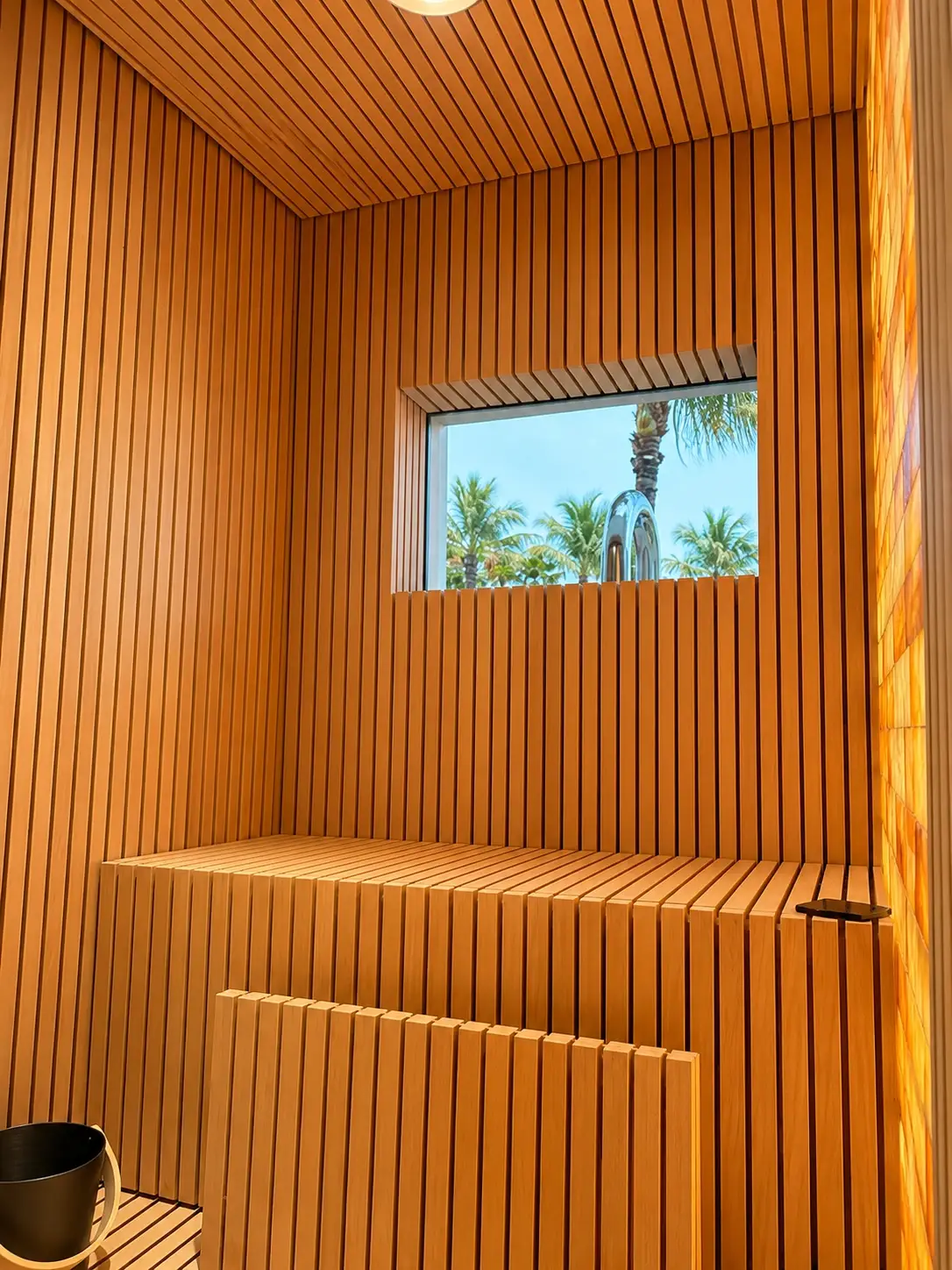
A Himalayan salt sauna is a traditional or infrared sauna that incorporates Himalayan salt blocks, bricks, tiles or panels into the interior. Most projects use the salt as an accent wall, backlit feature or architectural panel rather than replacing the entire sauna interior.
The sauna still depends on a proper heater, ventilation, insulation, vapor management and safe interior materials. The salt feature is an addition to the sauna design, not a substitute for the core sauna construction.

Why Add Himalayan Salt to a Sauna?
The strongest reasons are design and experience.
1. Visual impact
Himalayan salt ranges from pale peach to deeper pink and amber tones. When backlit, the wall can become the visual focal point of the sauna.
2. A warmer atmosphere
The color and texture can soften the appearance of a wood sauna and create a more spa-like environment.
3. Architectural contrast
Salt can pair well with cedar, hemlock, aspen, glass and dark stone details.
4. Premium positioning
In residential wellness rooms, hotels, spas and amenity spaces, a salt wall can make a sauna feel more distinctive than a standard wood-only interior.
4 Ways to Add Himalayan Salt to a Sauna
1. Full salt feature wall
A full wall creates the strongest visual effect and works especially well behind a bench or on a wall opposite the glass entry.
2. Backlit accent panel
A smaller panel can create much of the visual impact while reducing material, structural and installation cost.
3. Salt brick column or architectural insert
Vertical columns, niches and framed sections can integrate salt without dedicating an entire wall.
4. Prefabricated salt panel system
Some projects use modular panels or framed assemblies that simplify installation and make service access easier.
Infrared vs. Traditional Himalayan Salt Sauna
| Factor | Infrared Sauna | Traditional Sauna |
|---|---|---|
| Heat style | Radiant heat from emitters or panels | Hotter air heated by sauna heater and stones |
| Typical humidity | Lower | Can rise temporarily when water is used on approved stones |
| Salt installation difficulty | Usually simpler | Requires more moisture planning |
| Main salt concern | Emitter clearance and heat-rated materials | Moisture cycles, heater clearance and corrosion |
| Backlit salt wall | Works well | Works well when detailed correctly |
| Best for | Lower-temperature, dry salt-feature projects | Buyers who want classic sauna heat plus a salt feature |
For a broader comparison of the two heat systems, see our infrared vs. traditional sauna guide.
How Is a Himalayan Salt Sauna Wall Built?
The exact assembly depends on the salt system, sauna type, wall dimensions and whether lighting is integrated. A professional project normally considers several layers rather than simply gluing salt bricks to a finished sauna wall.
Structural backing
The wall must support the weight of the salt material. Larger installations may require a dedicated frame or channel system.
Heat-rated materials
Backing, adhesives, fasteners, lighting components and wiring must be appropriate for the sauna environment.
Mechanical support
Salt bricks are heavy. Large walls should not rely solely on a decorative adhesive system when mechanical support is needed.
Heater and emitter clearances
Maintain every clearance specified by the heater or infrared-emitter manufacturer. A decorative wall should never compromise equipment safety.
Ventilation and drying
The design should allow the sauna and salt feature to dry after use rather than trapping moisture behind or around the salt.
Service access
Lighting drivers, wiring connections and nearby equipment should be planned so future service does not require destroying the salt wall.
Why Is Backlighting So Popular in Himalayan Salt Saunas?
Backlighting is one of the main reasons homeowners and commercial properties choose salt walls. The translucent blocks can glow in orange, amber and pink tones, creating a dramatically different atmosphere from ordinary sauna lighting.
A good lighting plan considers:
- Heat-rated fixtures and components
- Appropriate LED placement
- Even light distribution behind the salt
- Access to power supplies and drivers
- Dimming when compatible
- Electrical separation from the heater
- Future service access
Lighting should be designed around the salt wall instead of added as an afterthought.
Moisture, Humidity and Himalayan Salt Durability
Salt is hygroscopic, meaning it attracts moisture from the surrounding environment. That is why moisture management is one of the most important design considerations.
In an infrared sauna
Humidity is usually lower, making the environment easier on salt installations.
In a traditional sauna
Humidity can rise when water is poured on approved sauna stones. The salt wall should be positioned away from direct splashing and allowed to dry between sessions.
In a steam room
A true steam room is a much wetter environment than a sauna. Salt and steam-room design should not be treated as interchangeable. Persistent high humidity can shorten the life of exposed salt features.
Can Himalayan Salt Cause Corrosion in a Sauna?
Salt and moisture can accelerate corrosion when they remain in contact with unprotected metal. That makes detailing around heaters, fasteners, frames and electrical components important.
Good design practices include:
- Keeping salt away from heater components unless the manufacturer specifically approves the arrangement
- Using appropriate corrosion-resistant hardware
- Preventing condensation from collecting around metal channels
- Avoiding direct water splash onto the salt feature
- Inspecting nearby metal periodically
Himalayan Salt Wall vs. Halogenerator: What Is the Difference?
This is the most important distinction in the entire topic.
| Feature | Passive Himalayan Salt Wall | Halogenerator |
|---|---|---|
| Primary purpose | Design, ambience and visual effect | Creates fine dry salt aerosol |
| Salt particles intentionally dispersed? | No | Yes |
| Equivalent to active halotherapy? | No | Designed to create an active dry-salt environment |
| Main installation concern | Weight, heat, moisture, lighting and corrosion | Equipment sizing, aerosol delivery, maintenance and room design |
Cleveland Clinic describes active salt rooms as spaces where a machine breaks salt into microscopic particles and circulates them through the room. Passive rooms simply contain salt surfaces. Those are different exposures.
For the deeper health-evidence discussion, read our salt sauna benefits guide.
What Benefits Can You Realistically Expect From a Himalayan Salt Sauna?
The sauna and the salt wall should be evaluated separately.
What comes primarily from the sauna
- Heat exposure
- Sweating
- Relaxation
- Temporary cardiovascular responses to heat
- A repeatable wellness or wind-down routine
What the passive salt wall clearly adds
- Visual interest
- Warm ambient lighting
- Texture
- A premium spa-like environment
Passive salt walls should not automatically inherit respiratory, detox, anti-inflammatory or other clinical claims associated with active halotherapy research.
How Much Does a Himalayan Salt Sauna Cost?
There is no useful universal price because a small salt accent panel and a full custom backlit wall are very different projects.
The biggest cost drivers are:
- Square footage of the salt feature
- Salt bricks vs. tiles vs. prefabricated panels
- Custom framing or structural support
- Backlighting system
- Heat-rated electrical work
- Sauna type
- Access complexity
- Corrosion-resistant hardware
- Custom woodwork around the feature
- Installation labor
- Halogenerator, if active salt aerosol is part of the design
If the sauna itself has not been selected yet, start with our in-home sauna cost guide and sauna cost calculator.
How Do You Maintain a Himalayan Salt Sauna Wall?
Salt walls do not need the same maintenance as wood benches, but they should still be inspected.
Basic maintenance includes:
- Keep direct water spray away from the salt
- Allow the room to dry after use
- Do not wash salt bricks with ordinary cleaning products
- Dust gently when needed
- Inspect for moisture accumulation
- Inspect metal channels and fasteners for corrosion
- Check backlighting operation
- Address leaks or ventilation problems quickly
If salt begins dissolving, shedding heavily or staying wet, correct the moisture source before replacing materials.
Residential vs. Commercial Himalayan Salt Saunas
Residential applications
- Primary bathroom wellness rooms
- Home gyms
- Indoor custom saunas
- Garage wellness conversions
- Dedicated recovery rooms
Commercial applications
- Hotels
- Resorts
- Spas
- Gyms
- Condominium amenities
- Wellness centers
Commercial projects require additional attention to durability, cleaning, operating hours, ventilation, code requirements, service access and the number of users. See our commercial sauna installation guide for the larger commercial planning process.

Himalayan Salt Sauna Installation in South Florida
South Florida creates an additional design challenge because ambient humidity is high for much of the year. A Himalayan salt feature should be planned around that reality.
Local design priorities include:
- Installing the sauna in a properly conditioned environment when required
- Managing ventilation and drying after sessions
- Keeping salt away from direct water sources
- Using corrosion-resistant hardware
- Planning electrical access behind backlit walls
- Avoiding poorly protected exterior salt features
- Maintaining service access to heaters, controls and lighting
For local planning, see our South Florida sauna installation guide.
7 Common Himalayan Salt Sauna Design Mistakes
- Treating the salt wall as a medical device. Passive salt décor is not active halotherapy.
- Installing salt too close to the heater. Heater clearances always take priority.
- Ignoring moisture. Salt should not stay wet between sessions.
- Using ordinary wall materials behind the salt. The sauna environment requires heat-appropriate construction.
- Failing to support the weight. Salt bricks are heavy.
- Using vulnerable metal hardware. Salt plus moisture can accelerate corrosion.
- Making the lighting impossible to service. Drivers and connections should remain accessible.
Is a Himalayan Salt Sauna Worth It?
It can be worth it if you value design, atmosphere and a distinctive sauna experience. It is less compelling if you are buying it only because of aggressive detox, respiratory or anti-aging claims.
| It May Be Worth It If… | Think Twice If… |
|---|---|
| You want a premium visual centerpiece | You expect the wall itself to deliver clinical halotherapy |
| You are building a custom wellness room | Your sauna has unresolved moisture problems |
| You appreciate warm backlit ambience | You cannot maintain heater clearances |
| You want a distinctive commercial amenity | Your budget would be better spent first on heater, ventilation or construction quality |
Planning a Himalayan Salt Sauna?
Design the Salt Feature Around the Sauna, Not the Other Way Around
Sauna & Steam Center can help you plan a traditional, infrared or custom sauna with Himalayan salt elements while accounting for wall dimensions, heater clearances, ventilation, lighting, moisture, materials and long-term service access.
Send us photographs and approximate measurements of your available space. We can help you determine whether a full salt wall, accent panel or another sauna layout makes the most sense for your project.
Frequently Asked Questions About Himalayan Salt Saunas
Can you put Himalayan salt in a sauna?
Yes. Himalayan salt bricks, tiles and panels can be incorporated into a sauna when they are installed with appropriate structural support, heat-rated materials, heater clearances, ventilation and moisture control.
Can you put a Himalayan salt wall in an infrared sauna?
Yes. Infrared cabins are often easier environments for salt features because they generally operate with lower humidity than traditional saunas.
Can you put a Himalayan salt wall in a traditional sauna?
Yes, but moisture exposure becomes more important. Keep the salt away from direct splashing, use appropriate hardware and allow the wall to dry between sessions.
Does a Himalayan salt wall create halotherapy?
No. A passive salt wall does not intentionally disperse fine dry salt aerosol. Active halotherapy uses a halogenerator to create and circulate microscopic salt particles.
Does a Himalayan salt sauna need a halogenerator?
No, not if your goal is design and atmosphere. A halogenerator is only relevant when the project is specifically intended to create an active dry-salt aerosol environment.
Does Himalayan salt release negative ions in a sauna?
Claims that a passive salt wall produces meaningful health effects through negative ions are not well established. The strongest reason to install a salt wall is its design and atmospheric impact.
Can Himalayan salt damage a sauna heater?
Salt and moisture can accelerate corrosion, so salt should be kept away from heater components unless the heater manufacturer specifically approves the arrangement. Do not put loose salt on sauna stones unless approved.
How do you clean a Himalayan salt sauna wall?
Avoid washing the salt with ordinary cleaners or saturating it with water. Keep it dry, dust gently when needed and correct any moisture source that causes the salt to remain damp.
How much does a Himalayan salt sauna cost?
Cost depends on the size of the salt feature, material type, framing, lighting, electrical work, sauna construction and installation labor. A small accent panel costs far less than a full custom backlit wall.
Is a Himalayan salt sauna worth it?
It can be worthwhile for buyers who value design, ambience and a distinctive premium sauna. It is less compelling if the purchase is based mainly on unsupported medical or detox claims.
Conclusion: A Himalayan Salt Sauna Is Primarily a Design and Experience Upgrade
A well-designed Himalayan salt sauna can become one of the most visually distinctive rooms in a home, hotel, spa or wellness facility. The salt wall can add warm color, texture and dramatic backlighting while preserving the traditional or infrared sauna experience.
The key is treating the salt as a real building material with weight, moisture and corrosion considerations. Heater clearances, ventilation, drying, heat-rated backing, lighting access and structural support should all be planned before installation.
Most importantly, separate the design value of a passive Himalayan salt wall from the evidence around active halotherapy. If you want a beautiful salt feature, build it well. If you want active dry-salt aerosol, evaluate a halogenerator separately.
References
- Cleveland Clinic: What Is Salt Therapy?
- Bar-Yoseph R, et al. Halotherapy as asthma treatment in children: randomized controlled pilot study.
- The Sauna Place: Is Himalayan Salt Worth Adding to Your Sauna?
- SaltBricks.us: Himalayan Salt for Saunas, Safety and Installation
- Select Salt: How to Build a Himalayan Salt Sauna
- Sauna & Steam Center: Salt Sauna Benefits, Evidence-Based Guide