
Dry Sauna: What It Is, Benefits, Temperature & How to Use One
Editorial and medical disclosure:
Sauna & Steam Center sells, designs, installs, services, and repairs sauna systems. Product and installation guidance reflects our industry experience. Health information is educational and is not a substitute for individualized medical advice. Sauna heat can affect hydration, heart rate, blood pressure, and heat tolerance. Follow the manufacturer instructions for the exact sauna and heater you are using.
A dry sauna is a hot, low-humidity sauna environment that warms the body primarily through heated air and radiant heat from the heater and surrounding surfaces. In everyday U.S. usage, the term usually refers to a traditional sauna heated by an electric heater or wood-burning stove, although the wording can be confusing because a traditional sauna may still allow small amounts of water to be poured over approved hot stones to create temporary humidity. A dry sauna is different from a steam room, which uses much lower air temperatures and near-saturated humidity, and it is also different from an infrared sauna, which heats the body mainly with radiant infrared emitters.
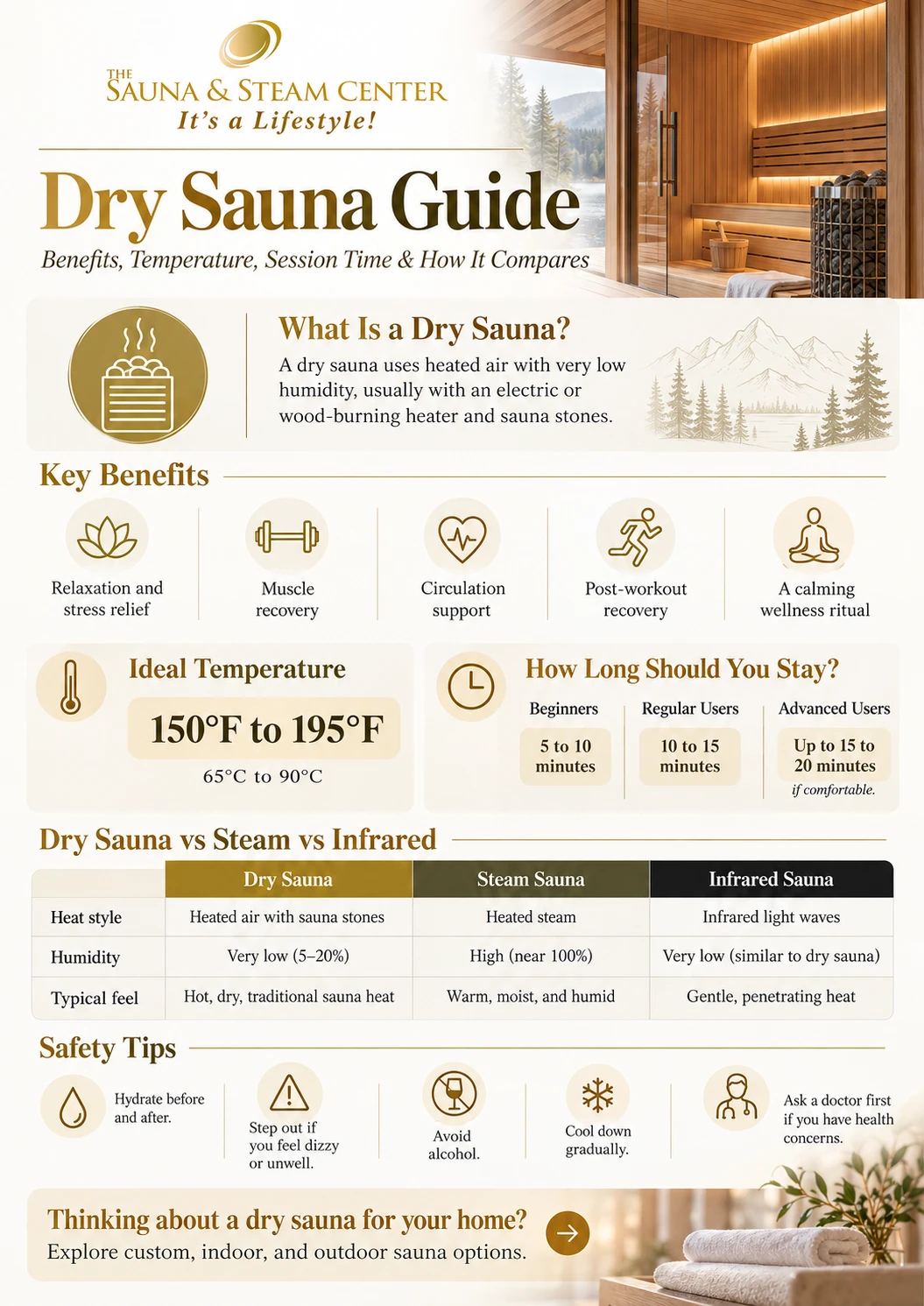
A dry sauna is a high-heat, low-humidity sauna. Traditional Finnish-style dry sauna research commonly involves temperatures around 80–100°C (176–212°F) with relative humidity around 10–20%, although a comfortable home sauna may be operated lower depending on the heater, room design, user preference, and manufacturer guidance.
The word dry describes the overall environment, not a rule that the room can never contain moisture. If the heater is designed for it, a small amount of water may be added to hot sauna stones to create a short burst of humidity known as löyly.
A dry sauna is not the same thing as a steam room, and an infrared sauna should not automatically be treated as identical to a traditional dry sauna. All three can make you sweat, but they create heat in different ways.
Dry Sauna: Quick Answers
| Question | Direct Answer |
|---|---|
| What is a dry sauna? | A hot, low-humidity sauna, usually heated by an electric heater or wood-burning stove that warms the room and sauna stones. |
| Is a dry sauna the same as a traditional sauna? | Usually, yes in everyday U.S. search language. Traditional Finnish saunas are low-humidity most of the time but may include brief humidity increases when water is added to approved stones. |
| What temperature is a dry sauna? | Traditional Finnish sauna studies commonly use roughly 176–212°F (80–100°C). Many users prefer a lower setting, especially when new to sauna bathing. |
| What humidity is a dry sauna? | Traditional Finnish sauna research commonly reports relative humidity around 10–20%, with temporary increases when water is added to stones. |
| What are dry sauna benefits? | The strongest evidence relates to heat-induced cardiovascular responses and observational associations with cardiovascular health. Relaxation and temporary muscle comfort are common practical reasons people use saunas. |
| How long should you stay in a dry sauna? | Beginners can start around 5–10 minutes. General consumer guidance commonly recommends keeping sessions around 15–20 minutes rather than pushing through discomfort. |
| Dry sauna vs. steam room? | A dry sauna uses hotter air with low humidity. A steam room uses lower air temperatures with very high humidity. |
| Dry sauna vs. infrared sauna? | A traditional dry sauna heats the room and the body through hot air and radiant heat. Infrared panels heat the body more directly at lower air temperatures. |
| Can you pour water on rocks in a dry sauna? | Yes, but only when the traditional heater is specifically designed for water. Never pour water on infrared emitters, controls, or an unapproved heater. |
| Does a dry sauna burn fat? | No meaningful fat loss should be expected from sweating. Any immediate drop on the scale is mainly temporary water loss. |
| Can you use a dry sauna every day? | Some experienced healthy users sauna frequently, but there is no universal schedule. Frequency should match your health, hydration, heat tolerance, and medical guidance when appropriate. |
| Is a dry sauna good for a home? | It can be. Home planning depends on room size, heater sizing, electrical or stove requirements, ventilation, clearances, bench layout, and where the sauna will be installed. |
Key Takeaways About Dry Saunas
- A dry sauna is a high-heat, low-humidity sauna environment.
- In everyday search language, “dry sauna” usually means a traditional sauna heated by an electric heater or wood stove.
- The term can be misleading because traditional saunas may still use water on approved stones to create temporary humidity.
- Traditional Finnish sauna research commonly involves 80–100°C (176–212°F) and approximately 10–20% relative humidity.
- Beginners do not need to start at the highest temperature. Comfort matters more than matching someone else’s setting.
- Dry saunas and steam rooms are different heat environments.
- Infrared saunas are also different because infrared emitters heat the body at lower air temperatures.
- The best-established sauna research involves cardiovascular and physiological heat responses, but much of the long-term outcome evidence is observational.
- Sauna sweating does not equal fat loss or proof of “detoxification.”
- Dehydration, overheating, dizziness, and low blood pressure are practical risks.
- Alcohol and sauna use are a poor combination.
- For a home sauna, heater sizing, electrical requirements, ventilation, clearances, bench layout, and service access matter as much as aesthetics.
What Is a Dry Sauna?
A dry sauna is an enclosed heated room designed to create intense warmth with relatively low humidity.
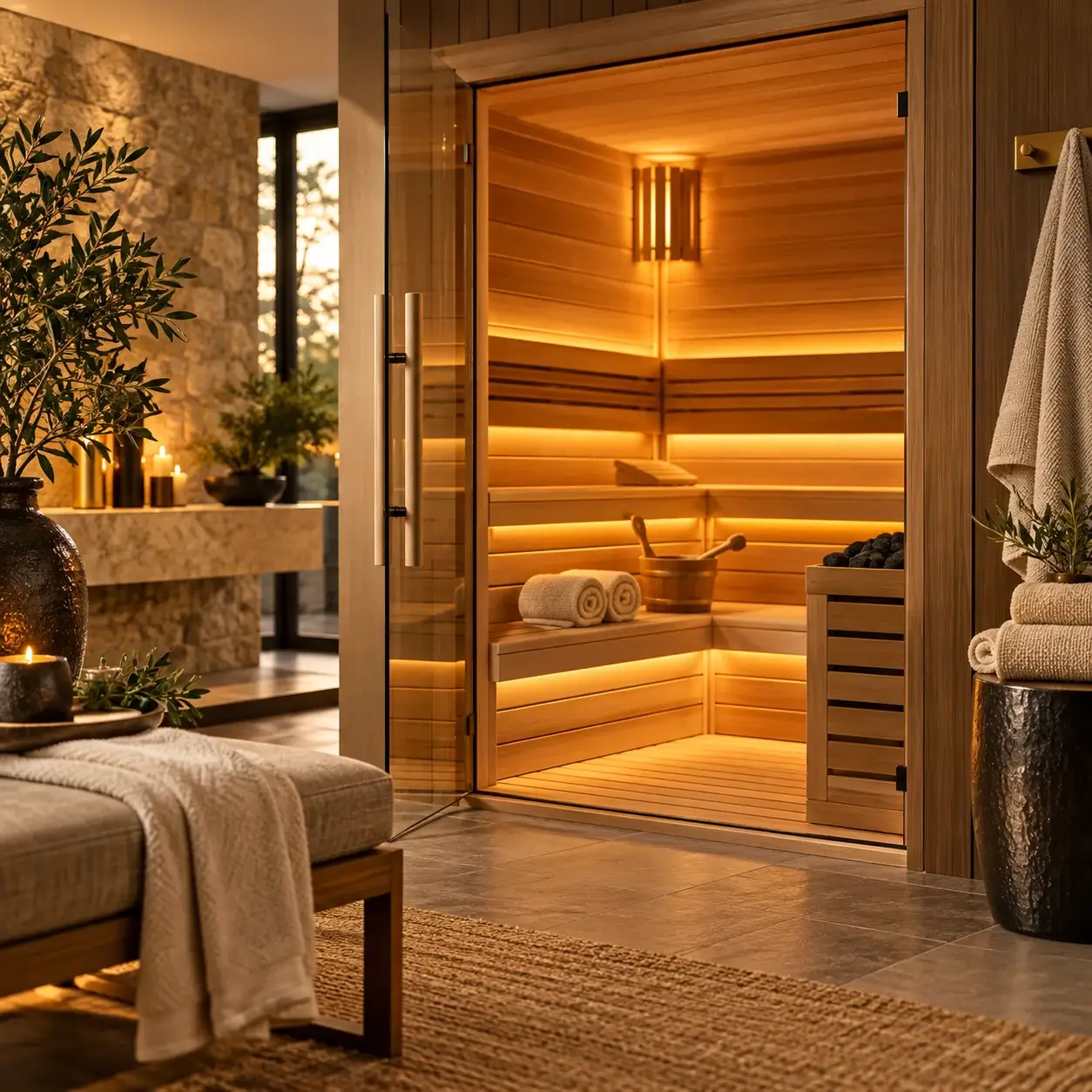
The most familiar version is a wood-lined room with an electric sauna heater or wood-burning stove, sauna stones that store and radiate heat, wood benches at one or more heights, and ventilation designed for the heater and room.
The heater warms the room, the surrounding surfaces, and the stones. Your body then gains heat through a combination of hot-air convection and radiant heat.
Is a Dry Sauna the Same as a Traditional Sauna?
In most U.S. searches, dry sauna and traditional sauna are used to describe the same general category.
However, the wording is not perfect.
A traditional Finnish sauna is usually low in humidity compared with a steam room, but sauna bathers may pour water over approved heated stones. That creates a temporary wave of heat and humidity called löyly.
| Term | What It Usually Means |
|---|---|
| Dry sauna | A high-temperature, low-humidity sauna, typically the traditional heater-and-stone style. |
| Traditional sauna | A sauna heated by an electric heater or wood stove, typically with stones and the option for controlled water use. |
| Finnish sauna | A traditional sauna experience where high heat and controlled löyly are both part of normal sauna bathing. |
| Steam room | A separate high-humidity system created by a steam generator in a sealed wet-room enclosure. |
| Infrared sauna | A lower-air-temperature sauna using infrared emitters to heat the body more directly. |
How Does a Dry Sauna Work?
A traditional dry sauna creates heat through three main processes.
1. The Heater Warms the Air
An electric heater or wood-burning stove raises the air temperature in the room.
2. The Stones and Surfaces Radiate Heat
Sauna stones, wood surfaces, and the heater itself absorb energy and radiate heat back into the room.
3. Your Body Responds to Heat
As body temperature rises, blood flow to the skin increases, heart rate can increase, and sweating becomes an important cooling mechanism.
| What Changes | Typical Heat Response |
|---|---|
| Skin temperature | Rises as the body absorbs heat. |
| Skin blood flow | Increases to help move heat toward the body’s surface. |
| Heart rate | Can rise during heat exposure. |
| Sweating | Increases to help cool the body through evaporation. |
| Fluid loss | Increases as sweating continues. |
This is why hydration and session length matter. The sauna is not just a warm room. It creates a real thermoregulatory challenge for the body.
What Temperature and Humidity Does a Dry Sauna Use?
Traditional Finnish sauna research commonly describes short exposures at approximately 80–100°C (176–212°F) with relative humidity around 10–20%. In the intervention studies reviewed in a major systematic review, Finnish-style sauna sessions were commonly conducted around 80–90°C with 10–20% relative humidity.
That does not mean every user should set a sauna to 212°F.
Harvia’s guidance emphasizes that there is no single correct sauna temperature. The right setting is one where the user can sit comfortably and sweat without feeling forced to endure the heat.
| Setting | Practical Meaning |
|---|---|
| Lower heat | Often more comfortable for beginners and can allow softer humidity when using an approved heater with stones. |
| Moderate traditional heat | A common everyday home-sauna range for users who want strong heat without chasing maximum temperature. |
| High traditional heat | Can feel very dry and intense, especially on an upper bench. Small additions of water can feel much sharper. |
For a deeper temperature discussion, read our Sauna Temperature Guide.
What Does a Dry Sauna Feel Like?
A dry sauna generally feels hotter than a steam room on the thermometer but lighter in humidity.
Because the air is dry, sweat can evaporate from the skin more easily than it can in a saturated steam room. That evaporation is part of the body’s cooling process.
What a Beginner May Notice
- The upper body may feel hotter than the feet.
- An upper bench usually feels hotter than a lower bench.
- The air can feel dry in the nose or throat.
- Sweating may begin gradually rather than instantly.
- Adding water to approved stones can make the heat feel dramatically stronger for a short period.
Dry Sauna Benefits: What Does the Evidence Actually Support?
Dry sauna bathing has been studied for decades, but it is important to separate physiological effects, observational associations, and proven medical treatments.
A 2018 systematic review included 40 clinical studies involving 3,855 participants. Most reported beneficial outcomes, but only 13 were randomized controlled trials and many studies were small. The authors concluded that regular dry sauna bathing has potential health benefits while also calling for better research.
| Potential Benefit | What We Can Reasonably Say |
|---|---|
| Relaxation and stress relief | One of the most common practical reasons people use a sauna. Heat and quiet time can support a relaxation routine. |
| Cardiovascular response | Sauna heat increases heart rate and skin blood flow. Finnish observational studies have linked frequent sauna bathing with lower cardiovascular risk, but association does not prove that sauna alone caused the outcome. |
| Blood-vessel function | Heat exposure can affect vascular tone, arterial stiffness, and blood pressure. Individual blood-pressure responses can vary. |
| Temporary muscle comfort | Heat may help muscles feel warm and relaxed, which is one reason sauna is popular after exercise. |
| Exercise recovery routine | Some research suggests useful physiological adaptations with repeated post-exercise sauna use, but sauna does not replace training, sleep, hydration, or nutrition. |
| General wellness | Many users value the routine for quiet time, relaxation, and consistency. Those benefits can be meaningful even when they are not treatment claims. |
For a broader evidence review, see our Sauna Benefits Guide.
What Does a Dry Sauna Not Reliably Do?
Dry sauna marketing sometimes goes beyond what the evidence can support.
| Claim | Better Interpretation |
|---|---|
| “Dry sauna melts body fat.” | Immediate weight loss is mainly water lost through sweat. That weight generally returns after rehydration. |
| “More sweat means more calories burned.” | Sweating is primarily a cooling mechanism. Sweat volume is not a reliable measure of fat loss or calorie expenditure. |
| “Sauna detoxes the body.” | Sweat contains water and electrolytes. Sweating should not be treated as proof that the sauna is removing harmful substances or replacing the body’s liver and kidney functions. |
| “Hotter is always better.” | Higher temperature increases heat stress. Comfort and safe repeatability matter more than chasing a maximum number. |
| “Longer sessions give more benefit.” | Longer heat exposure can increase dehydration, dizziness, and overheating risk. More time is not automatically more useful. |
How Do You Use a Dry Sauna?
The best dry-sauna routine is simple and conservative.
| Step | What to Do |
|---|---|
| 1. Hydrate | Enter normally hydrated rather than thirsty or already depleted from exercise or outdoor heat. |
| 2. Check the heater area | Make sure towels, clothing, and other objects are not touching the heater or inside required safety clearances. |
| 3. Preheat correctly | Use the approved controller and follow the heater manufacturer’s preheat instructions. |
| 4. Start lower and milder | Beginners can choose a lower bench and a moderate temperature. |
| 5. Sit on a towel | Keep a clean towel between your body and the wood bench. |
| 6. Relax | Sit or lie down, breathe normally, and let the sauna provide the heat. Hard exercise inside is unnecessary. |
| 7. Add water only if approved | Use a small amount on the stones only when the heater and facility allow it. |
| 8. Leave before discomfort | Do not wait for dizziness, nausea, weakness, or excessive heat. |
| 9. Cool down | Rest in a cooler environment and let your heart rate and body temperature settle. |
| 10. Rehydrate | Replace fluids lost through sweating. |
For the full beginner routine, see our How to Use a Sauna Guide.
How Long Should You Stay in a Dry Sauna?
There is no mandatory session length that every user should reach.
Cleveland Clinic recommends keeping sauna sessions around 15 to 20 minutes, with new users starting around 5 minutes and building gradually. Harvard Health also advises limiting typical sauna exposure to about 15 to 20 minutes.
| Experience | Practical Starting Point |
|---|---|
| First-time user | About 5–10 minutes at a comfortable heat level. |
| New regular user | Increase gradually only if previous sessions felt comfortable during and afterward. |
| Experienced user | Follow manufacturer guidance and personal tolerance rather than assuming a longer session is better. |
For a detailed discussion of session length, see our How Long Should You Stay in a Sauna?
How Often Should You Use a Dry Sauna?
There is no universal frequency that every healthy adult needs to follow.
Finnish observational research has studied people who sauna from once per week to several times per week, and more frequent use has been associated with some favorable long-term outcomes. But that does not mean everyone should immediately copy a 4-to-7-times-per-week routine.
A Better Way to Build Frequency
- Start with occasional sessions.
- Notice how you feel during and after.
- Make sure hydration remains normal.
- Increase frequency only if the routine feels comfortable and sustainable.
- Do not use frequent sauna sessions to compensate for poor sleep, inadequate hydration, or overtraining.

Can You Pour Water on the Rocks in a Dry Sauna?
This is one of the most confusing parts of the phrase dry sauna.
When Water Is Appropriate
- The heater has sauna stones intended for water use.
- The manufacturer’s instructions allow water on the stones.
- The facility permits it.
- You use clean water and an appropriate ladle.
When Water Is Not Appropriate
- Infrared emitters
- Control panels
- Unapproved electric components
- Heaters without water-approved stones or instructions
For more detail on heater rocks, see our Sauna Stones Guide.
Dry Sauna vs. Steam Room: What Is the Difference?
A dry sauna and a steam room are not two versions of the same machine.
| Feature | Dry Sauna | Steam Room |
|---|---|---|
| Heat | High-temperature air and radiant heat | Lower-temperature saturated steam |
| Humidity | Low most of the time | Very high, often near saturation |
| Typical interior | Wood walls and benches | Tile, stone, glass, or another waterproof finish |
| Heat source | Electric heater or wood stove, usually with stones | Steam generator |
| How sweat behaves | Evaporates more readily in the dry air | Evaporates less readily because humidity is high |
| Home construction | Requires sauna-appropriate heat design, ventilation, electrical or stove planning | Requires a vapor-tight wet-room enclosure, waterproofing, drainage, and steam equipment |
For the full comparison, read our Sauna vs. Steam Room Guide.
Dry Sauna vs. Infrared Sauna: Are They the Same?
Not exactly.
Infrared cabins are also low-humidity environments, so some people casually call them “dry saunas.” But the heating mechanism is different enough that buyers should treat them as separate sauna types.
| Feature | Traditional Dry Sauna | Infrared Sauna |
|---|---|---|
| Primary heat method | Heater warms air, stones, and room surfaces | Infrared emitters deliver radiant energy toward the body |
| Air temperature | Higher | Lower |
| Water on stones | Possible with an approved traditional heater | No |
| Humidity | Low, with optional temporary increases | Low |
| Experience | Classic hot-room sauna | Lower-air-temperature radiant heat |
| Research base | Strongest long-term observational sauna literature is based largely on Finnish sauna bathing | Has clinical research, but long-term outcome evidence is not identical to the Finnish sauna literature |
For the detailed decision guide, see Infrared vs. Traditional Sauna.
Dry Sauna vs. Wet Sauna: What Does “Wet Sauna” Mean?
The phrase wet sauna is inconsistent, which is why buyers should ask what equipment someone actually means.
It can refer to a traditional sauna where water is regularly added to stones, a steam room, even though a true steam room uses a different system, or a humid sauna style such as a banya.
Should You Use a Dry Sauna Before or After a Workout?
Many people prefer a dry sauna after exercise because it fits naturally into a cooldown and relaxation routine.
But exercise can already raise body temperature and increase fluid loss.
If You Sauna After Exercise
- Let your heart rate begin to settle.
- Replace some fluid if the workout was demanding.
- Use a shorter or milder sauna if you are already hot.
- Do not use the sauna as an excuse to avoid normal recovery nutrition, sleep, or hydration.
Before Exercise
Intense heat before demanding exercise may increase dehydration and reduce comfort. If you enjoy brief warmth before activity, keep it conservative and do not treat a sauna as a substitute for a proper warm-up.
For more detail, see our Sauna After the Gym Guide.
What Should You Wear or Bring to a Dry Sauna?
| Item | Recommendation |
|---|---|
| Clean towel | Recommended. Sit or lie on it to keep the wood cleaner. |
| Water | Useful before or after the session and during cool-down periods. |
| Swimsuit or towel wrap | Depends on the facility. Follow posted rules. |
| Jewelry | Best removed because metal can become uncomfortably hot. |
| Phone or smartwatch | Better left outside because sauna temperatures may exceed the device’s operating limits. |
| Sauna hat | Optional. Some users find it makes upper-bench heat more comfortable. |
Dry Sauna Risks, Safety and Who Should Be Careful
Dry sauna use is generally well tolerated by many healthy adults when used sensibly, but the heat creates real physiological stress.
Common Practical Risks
- Dehydration
- Dizziness or lightheadedness
- Overheating
- Blood-pressure changes
- Weakness or fainting
Avoid Alcohol Around Sauna Use
Alcohol can increase dehydration and impair judgment, making it harder to recognize when heat exposure is becoming unsafe.
Ask a Healthcare Professional Before Starting a Sauna Routine If Appropriate
Individual guidance may be important if you have cardiovascular disease, unusual blood-pressure problems, a history of fainting, neurologic conditions affected by heat, pregnancy, fluid restrictions, or medications that affect hydration, blood pressure, alertness, or sweating.
Do Not Sauna When You Are Acutely Ill
A fever, vomiting, diarrhea, significant dehydration, or serious respiratory illness is not the time to add extra heat stress.
Dry Sauna for Home: What Should You Plan Before Buying?
If your search for dry sauna is really the beginning of a home purchase, the room itself is only one part of the project.
A home traditional sauna should be planned around available indoor or outdoor space, number of users, heater type and kW sizing, electrical service or wood-stove requirements, required heater clearances, ventilation, bench height and depth, door placement, wood species and interior materials, floor and moisture management, lighting and controls, and service access.

For the full buying and installation discussion, continue with our Dry Sauna for Home Guide.
If you are planning a custom project in South Florida, see our Sauna Installation in South Florida or contact our team for site-specific planning.
Is a Dry Sauna Worth It?
A dry sauna can be worth it when you genuinely enjoy high-temperature, low-humidity heat and will use the room consistently.
A Dry Sauna May Be a Good Fit If You Want:
- The classic traditional sauna experience
- High heat with low continuous humidity
- The option for brief löyly when the heater allows it
- A dedicated home relaxation routine
- A sauna type with a large traditional and research history
- Indoor or outdoor design flexibility
You May Prefer Something Else If:
- You strongly dislike high air temperatures
- You prefer constant humidity
- You want a lower-temperature infrared experience
- Your space cannot support the heater, electrical, ventilation, or clearance requirements
Planning a Dry Sauna for Your Home?
Choose the Room, Heater and Bench Layout as One System
Sauna & Steam Center has designed, installed, and serviced sauna systems since 2004. We help homeowners compare traditional electric heaters, custom room sizes, bench layouts, ventilation, controls, wood choices, indoor and outdoor placement, and service access.
Tell us your available space, how many people will use the sauna, whether it will be indoors or outdoors, and the type of heat experience you want. We can help you plan the system around how you will actually use it.
Frequently Asked Questions About Dry Saunas
What is a dry sauna?
A dry sauna is a high-temperature, low-humidity sauna, usually heated by a traditional electric sauna heater or wood-burning stove with sauna stones.
Is a dry sauna the same as a traditional sauna?
Usually, yes in everyday U.S. language. Traditional Finnish saunas are low-humidity environments but may include temporary humidity when water is poured on approved hot stones.
What temperature should a dry sauna be?
Traditional Finnish sauna research commonly uses temperatures around 80 to 100 degrees Celsius, or 176 to 212 degrees Fahrenheit. Beginners can use a lower temperature and should follow the manufacturer’s instructions and personal heat tolerance.
What humidity is a dry sauna?
Research on traditional Finnish sauna commonly reports relative humidity around 10 to 20 percent, although humidity can rise temporarily when water is added to approved sauna stones.
What are the benefits of a dry sauna?
Dry sauna bathing creates cardiovascular and thermoregulatory responses, and long-term observational research has associated frequent Finnish sauna use with favorable cardiovascular outcomes. Relaxation and temporary muscle comfort are also common practical reasons for sauna use.
How long should you stay in a dry sauna?
Beginners can start around 5 to 10 minutes. General consumer medical guidance commonly recommends limiting typical sessions to about 15 to 20 minutes and leaving earlier whenever the heat becomes uncomfortable.
Can you put water on the rocks in a dry sauna?
Yes, but only when the traditional sauna heater is designed for water. A small amount of water creates temporary humidity and löyly. Never pour water on infrared panels, controls, or unapproved electrical components.
What is the difference between a dry sauna and a steam room?
A dry sauna uses high-temperature air with low humidity. A steam room uses a steam generator to create lower-temperature heat with very high humidity inside a waterproof enclosure.
What is the difference between a dry sauna and an infrared sauna?
A traditional dry sauna heats the room and your body using a heater, stones, hot air, and radiant heat. An infrared sauna uses infrared emitters to heat the body more directly while the room air remains cooler.
Does a dry sauna help you lose weight?
A sauna can cause temporary water-weight loss through sweating, but this is not the same as losing body fat. The weight generally returns after rehydration.
Does sweating in a sauna detox your body?
Sweating is primarily a cooling mechanism. Sauna sweating should not be treated as proof that harmful substances are being removed or as a substitute for the normal functions of the liver and kidneys.
Should you use a dry sauna before or after a workout?
Many people prefer sauna use after exercise for relaxation. If you sauna after a demanding workout, allow your heart rate to settle, replace some fluids, and use a conservative session because exercise has already increased body temperature and fluid loss.
Can you use a dry sauna every day?
Some experienced healthy users sauna frequently, but there is no universal daily requirement. Build frequency gradually according to hydration, comfort, health status, and professional guidance when appropriate.
Is a dry sauna good for your skin?
Heat and sweating change skin blood flow and moisture temporarily, but dry sauna should not be treated as a medical skin treatment. People with sensitive skin or specific skin conditions may need individualized guidance.
Can a dry sauna help sinus congestion?
Dry heat may feel relaxing, but it can irritate a dry or inflamed nose. If congestion and nasal dryness are the main symptoms, humid heat may feel more comfortable. Sauna does not cure a sinus infection.
What should you wear in a dry sauna?
Follow the rules of the home, gym, spa, or hotel. Use a clean towel on the bench, avoid metal jewelry, and leave heat-sensitive electronics outside.
Who should be careful with dry sauna use?
People with certain cardiovascular conditions, unusual blood-pressure problems, a history of fainting, pregnancy, heat-sensitive neurologic conditions, fluid restrictions, or medications that affect hydration, blood pressure, alertness, or sweating may need individualized medical guidance.
Is a dry sauna worth buying for home?
It can be if you enjoy high-temperature, low-humidity heat and will use it consistently. The best home sauna is planned around room volume, heater sizing, electrical requirements, ventilation, bench layout, clearances, and user comfort.
Research and Safety References
Hussain J, Cohen M.
Clinical Effects of Regular Dry Sauna Bathing: A Systematic Review.
Systematic review of 40 dry-sauna studies involving 3,855 participants, including Finnish and infrared sauna interventions.
Laukkanen JA, Laukkanen T, Kunutsor SK.
Cardiovascular and Other Health Benefits of Sauna Bathing: A Review of the Evidence.
Mayo Clinic Proceedings review of cardiovascular, physiological, and observational sauna research.
Cleveland Clinic
Sauna Benefits.
Consumer medical guidance on sauna benefits, dehydration, session length, safety, alcohol, and weight-loss claims.
Harvard Health Publishing
Saunas and Your Health.
Overview of physiological responses to dry sauna heat and practical safety guidance.
Harvard Health Publishing
Can Regular Sauna Sessions Support a Healthy Heart?
Explanation of Finnish sauna heat, löyly, infrared differences, and the role of sauna as an adjunct rather than a replacement for exercise.
Harvia
What Is the Correct Sauna Temperature?
Manufacturer guidance emphasizing comfort and the interaction between sauna temperature and water added to stones.
Conclusion: A Dry Sauna Is the Classic High-Heat, Low-Humidity Sauna Experience
A dry sauna is best understood as a traditional high-temperature sauna operated with low continuous humidity. It typically uses an electric heater or wood-burning stove, sauna stones, and wood benches to create the classic sauna environment.
The word dry can be confusing because a traditional sauna may still allow small amounts of water on approved stones. That temporary increase in humidity does not turn the room into a steam room.
For beginners, the most important factors are not maximum heat or maximum sweat. Start conservatively, use a comfortable bench and temperature, stay hydrated, follow the heater instructions, and leave before the heat becomes unpleasant.
For buyers, the right dry sauna depends on more than the cabin size. Heater sizing, ventilation, bench layout, electrical service, clearances, materials, and how many people will use the room all affect the final experience.
If you are moving from research to purchase, continue with our Dry Sauna for Home Guide or contact Sauna & Steam Center for help planning a custom system.