Steam Room Maintenance: Cleaning, Mold Prevention and Generator Care
Editorial disclosure: Sauna & Steam Center designs, installs and services residential and commercial steam rooms. This guide brings together general enclosure-care practices, manufacturer resources and moisture-control recommendations. It is not a substitute for the instructions supplied with your generator, waterproofing system, tile or stone, nor for professional electrical, plumbing or mold assessment. The example schedules below are planning tools, not universal manufacturer maintenance intervals.
A steam room can look spotless while moisture collects around door seals, behind damaged finishes or inside a poorly maintained generator. Conversely, white marks on glass may be ordinary hard-water deposits rather than evidence that the generator is failing. This guide explains what to clean yourself, how to reduce the conditions that support mold, what mineral scale means for steam equipment, and when to stop using the system and request service.
What Does Steam Room Maintenance Actually Include?
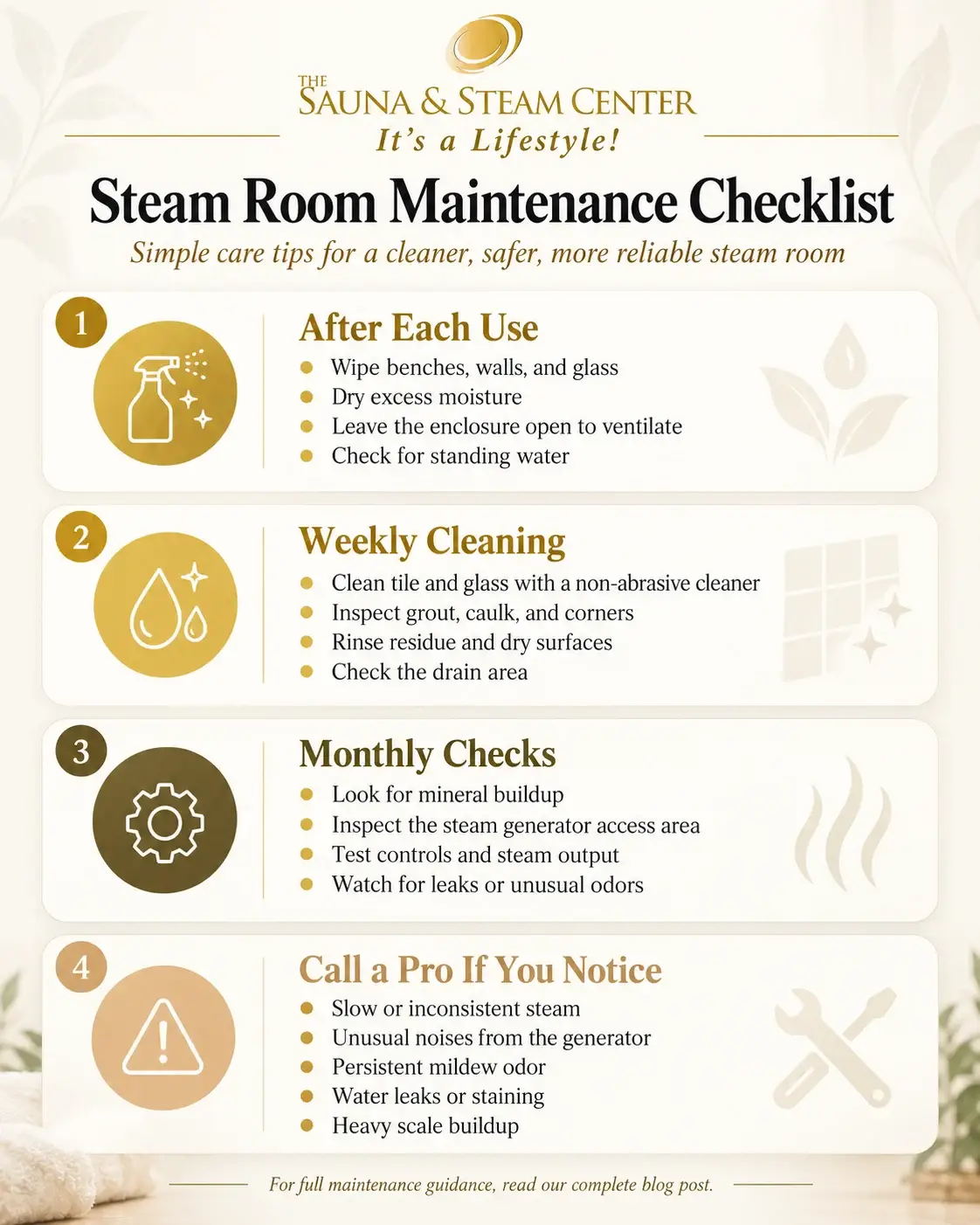
A steam room has two areas that need different kinds of care. The enclosure includes tile or stone, grout, glass, door, bench, drain, seals and other exposed surfaces. The steam-generation system includes the generator, water supply, drains, controls, sensors, steam delivery components and service connections. One part is largely routine cleaning; the other may require trained personnel and access to technical documentation.
| Area | What to check | Suggested planning point | Who handles it? |
|---|---|---|---|
| Enclosure surfaces | Soap residue, visible dirt, water spots and approved surface cleaning | After use, with a more thorough clean as needed | Owner or trained cleaner |
| Moisture and drainage | Standing water, musty odors, pooling and slow drains | After use and during routine cleaning | Owner or facilities staff; tradesperson for faults |
| Grout, seals and door | Cracks, gaps, loose components and recurring wet areas | Periodic visual inspection | Owner or staff; qualified enclosure professional for repairs |
| Controls and steam outlet | Display errors, unusual performance, damage or leaks | Observe during normal operation | Owner or staff observes; technician repairs |
| Generator and scale control | Manual or automatic drain operation, water conditions, service history | Manufacturer schedule and usage profile | Qualified steam-system technician when required |
For an occasional-use home steam shower, a brief post-session routine may be most of the ongoing work. A busy hotel or gym needs documented checks between operating periods, trained staff and scheduled preventive service. These are different operating environments, not merely different-sized rooms.
How to Clean a Steam Room Enclosure Without Damaging It
Start by allowing the room to cool. Check the cleaning directions for the exact finish: glazed ceramic or porcelain, natural stone, glass, metal trim, grout and sealants may require different cleaners. When in doubt, use a product specifically approved by the surface manufacturer and test it on an inconspicuous area first.
A practical enclosure-cleaning sequence
- Let the space cool: Keep clear of the steam outlet and hot components. Do not clean around a running generator.
- Remove loose residue: Use a soft cloth or nonabrasive tool appropriate for the surface. Avoid scraping finishes or damaging sealant joints.
- Clean compatible surfaces: Follow the product label and material manufacturer’s instructions for cleaner selection, dilution and contact time. Do not assume that an acidic limescale remover is safe for natural stone.
- Rinse when instructed: Remove cleaner residue from surfaces where the product requires rinsing. Keep cleaning liquids away from electrical controls and openings.
- Help the enclosure dry: Squeegee glass and nonporous walls if suitable, clear obvious standing water, and use the approved post-session drying method.
- Inspect while cleaning: Record loose grout, failed sealant, a slow drain or staining that returns in the same place.
What about glass, grout and natural stone?
Glass: Routine wiping can limit water spotting and soap film. Follow guidance for any coating or treated glass. Grout and sealant: Look for cracks, missing joints and recurring dark staining; a cleaning product cannot repair failed waterproofing. Natural stone: Use a stone-compatible cleaning method. Acidic products that remove mineral deposits from some surfaces can damage acid-sensitive materials.
Do not pressure-wash an enclosure, drive water into penetrations, or apply sealers over deteriorated material without first understanding the manufacturer’s assembly requirements.

Steam Room Mold Prevention Starts With Moisture Control
A steam room is intended to be humid while it runs. The goal is not to prevent steam during a session; it is to avoid leaving moisture trapped in the wrong places afterward. The EPA advises drying wet surfaces or materials within 24 to 48 hours and repairing leaks that keep them wet. That is a general mold-prevention principle, not a guarantee that a particular steam room is free of mold.
Five ways to reduce persistent moisture
- Use the designed post-session drying routine. After use and once safe, allow the room to drain and dry. Use any manufacturer-approved drying cycle or adjacent bathroom exhaust system as designed.
- Check floor slope and drainage. Recurring puddles suggest an issue to investigate rather than simply a cleaning problem.
- Watch grout, sealants and penetrations. Surface staining that rapidly returns, separating sealant or wet areas outside the enclosure merit closer inspection.
- Do not store absorbent items inside. Remove wet towels and other moisture-holding items instead of leaving them in the enclosure.
- Address leaks promptly. Find and correct the source of water intrusion rather than repeatedly masking odor or stains.
A standard bathroom exhaust fan is not automatically designed for installation inside a steam enclosure. Do not add or relocate ventilation equipment without checking the steam-room assembly, electrical requirements and manufacturer specifications.
Hard Water, Mineral Buildup and Steam Generator Scale
Steam generators heat water and produce steam. Dissolved minerals can remain behind and accumulate as scale or sediment, especially when incoming water is mineral-rich or the unit operates frequently. MrSteam notes that routine draining or its optional AutoFlush system is intended to help remove water and sediment from supported generators. The appropriate treatment depends on the equipment model and water conditions.
| What you notice | Possible explanation | Appropriate next step |
|---|---|---|
| White spots on glass | Evaporated water leaving surface minerals | Use a glass-safe method approved for the finish |
| Chalky marks on tile or stone | Surface scale or mineral migration; causes vary | Identify finish and moisture source before treatment |
| Increasingly inconsistent steam | Possible generator, control, water-supply or steam-line issue | Document symptoms and request diagnostics if persistent |
| Sediment at an equipment drain | Mineral discharge may occur during an approved drain cycle | Compare behavior with the specific generator manual |
Should you descale a steam generator yourself?
Not unless the manufacturer explicitly provides a procedure for your exact model and you are qualified to follow it safely. Do not pour vinegar, acid, bleach or commercial descaler into a generator based on general internet advice. Some systems use automatic drains, others require model-specific manual maintenance, and commercial systems may use dedicated blowdown or water-treatment equipment. Chemicals, hot water and electrical components create risks that are different from cleaning shower glass.
Ask the installer or service provider whether the system uses an automatic drain, whether incoming water conditions warrant evaluation, and which preventive tasks the documentation assigns to an owner versus a trained technician.
Steam Generator Maintenance: What Owners Should Know
A steam generator may be located in a closet, accessible ceiling space or other service area rather than inside the enclosure. Do not remove covers or reach into electrical or hot-water equipment to perform a casual inspection. Safe owner-level tasks usually involve knowing the model, keeping access unobstructed, observing normal system behavior and reporting changes.
Automatic drain and AutoFlush systems
MrSteam describes its optional AutoFlush system as draining water and sediment automatically after a steam bath, typically after a cooling delay of approximately two hours. That timing applies to the specified MrSteam product, not to every generator. For example, Steamist’s published Auto Drain instructions describe a different cool-down and drain sequence for supported equipment.
Automatic draining reduces one maintenance task; it does not repair a leak, failed heating component, loose control wire or waterproofing defect. It also does not make the enclosure self-cleaning.
Why service access matters
Generators require model-specific clearances and safe access for inspection and repair. A unit boxed behind permanent finishes can turn a straightforward diagnostic visit into a much larger project. If you are planning a new installation, include service access, drain routing and water-quality considerations in the design. See our steam room design and installation service for project planning.
What to have ready when calling a technician
- Generator brand, model and serial number, if accessible without opening equipment
- Approximate installation date and last professional service date, if known
- Any displayed error code and when it appears
- Whether steam output changed gradually or failed suddenly
- Details of visible leaks, drainage issues, noises or intermittent operation
- Photos of the equipment label and affected area, taken only from a safe position
Steam Room Warning Signs: When to Clean and When to Call a Technician
Not every stain requires professional service, but safety-related changes should never be treated as routine cosmetic maintenance.
| Symptom | First response | Next step |
|---|---|---|
| Light water spots or soap film | Clean approved finishes after cooling | Adjust routine if deposits quickly return |
| Musty odor or recurring mold | Investigate trapped moisture; keep people out if unsafe | Address leaks, drying or contamination with appropriate professional help |
| Water pooling or leaking outside the enclosure | Stop use if slipping, electrical or water-damage risk exists | Inspect drainage or waterproofing with a qualified professional |
| No steam, weak steam or unusual startup | Note control settings, symptoms and error messages | Request generator and control diagnostics |
| Breaker trips, burning smell, sparking or exposed wiring | Stop use immediately; do not repeatedly reset a breaker | Contact a qualified electrical or steam-system technician |
| Unusual steamhead behavior, scalding leak or loud mechanical noises | Stop use and keep clear of hot components | Arrange professional inspection before returning to service |
For faulty controls, leaks or inconsistent steam, visit our steam room repair page. If the problem appears to be at the equipment itself, our steam generator repair and replacement service outlines the information needed for an evaluation.
Guided Steam Room Maintenance Checklist: Home vs. Commercial
How to use this guide: Choose the checklist that matches your steam room. Open each step, check off observations as you complete them, and record anything that needs follow-up. The boxes work locally in your browser and do not save, submit or replace a facility’s maintenance records. For commercial sites, transfer findings to your approved inspection log or work-order system.
Residential Steam Room Checklist | Homeowners and occasional-use steam showers
Step 1: After every session
Step 2: During routine cleaning
Step 3: At model-specific service intervals
Commercial Steam Room Checklist | Hotels, gyms, spas, clubs and multifamily amenities
Step 1: Before opening or at staff shift checks
Step 2: At scheduled cleaning and closing checks
Step 3: At the preventive-maintenance interval
About frequency: These tracks organize tasks by use, cleaning and service cycles. Exact daily, weekly, monthly or quarterly obligations should come from your product manuals, facility risk assessment, sanitation requirements, water conditions and local regulations, not from a generic blog calendar.

A Simple Steam Room Maintenance Log to Keep
Most problems become easier to diagnose when you can describe a change over time. Record the same basic information after a fault, recurring damp area or scheduled professional visit.
| Field | Example of what to record |
|---|---|
| Date and location | Inspection date; room or unit identifier |
| Generator identity | Brand, model and serial number if safely accessible |
| Observation | Slow drainage, stain near doorway, fault code or unusual sound |
| Action | Cleaned compatible surfaces, submitted work order or stopped use |
| Follow-up | Responsible person, service appointment and completion date |
Commercial teams may also need operating hours, water-test results and technician sign-off as required by their equipment and operating procedures. Keep photos and repair invoices with the log to help compare recurring symptoms.
When Does a Steam Generator Need Repair or Replacement?
Not producing steam does not automatically mean the generator is beyond repair. Problems can involve power, controls, sensors, water supply, drains or heating components. A qualified assessment compares the equipment’s age and condition, parts availability, compatibility with existing controls, access, and the cost and practicality of repair.
- Maintenance or cleaning: Suitable when the equipment is operating normally and the issue is routine surface care or an approved maintenance task.
- Professional repair: Consider when a serviceable component or installation fault can be identified and corrected safely.
- Replacement evaluation: More relevant for extensively corroded equipment, unsupported parts, repeated major failures or an installation that needs broader correction.
Steam Room or Generator Acting Up?
Know What Needs Attention Before Replacing Equipment
Sauna & Steam Center helps South Florida homeowners and commercial operators evaluate steam rooms, controls, generators and drainage issues. Share the model, symptoms and any available error codes so the team can identify the next practical step.
Steam Room Maintenance Frequently Asked Questions
How often should a steam room be cleaned?
Attend to moisture and obvious residue after use, with deeper cleaning based on usage and manufacturer-approved procedures. A heavily used commercial room generally needs more frequent staff attention than an occasional-use home steam shower. Facility sanitation rules may also apply.
How do I prevent mold in a steam room?
Correct leaks, remove standing water, dry the enclosure after use using its designed system, and investigate musty odors or repeated staining. Surface cleaning alone will not correct trapped moisture behind damaged materials.
Can I use vinegar to clean a steam room generator?
Do not add vinegar or other chemicals to the generator unless the manufacturer specifies that method for your exact model and you can follow it safely. Enclosure-surface cleaning and generator descaling are separate tasks.
Do all steam generators need manual flushing?
No. Maintenance and drain arrangements vary. Some supported MrSteam generators can use optional AutoFlush, while other brands and models have different automatic or manual drain instructions. Confirm the installed equipment before taking action.
What causes white residue in a steam room?
Hard-water minerals, soap residue or material-related deposits are possible. Surface marks do not by themselves prove internal generator scale. Check the surface type and investigate whether moisture or water conditions have changed.
Why does my steam room smell musty even after cleaning?
Persistent odor can suggest moisture in a drain, joint, concealed area or another part of the building. Investigate the source rather than relying on fragrance or repeated surface treatments.
Can I maintain a commercial steam room with a residential checklist?
No. Commercial rooms typically require documented staff inspections, sanitation procedures, incident escalation and planned equipment service suitable for their operating hours and applicable requirements. Use the commercial track above.
When should I call a steam room technician?
Request service for recurring failures to generate steam, unexplained shutdowns, error codes, visible equipment leaks, unusual sounds, suspected drain faults or control problems. Stop use promptly for electrical hazards, steam leaks or scalding risks.
References and Additional Resources
Conclusion: Keep the Room Clean, Dry Between Uses and Service the Right Equipment
Steam room maintenance works best as a consistent routine, not a reaction after the room smells musty or stops making steam. Clean compatible surfaces, make sure the enclosure can dry, record recurring issues and follow the manufacturer instructions for your specific generator. For commercial operations, pair daily staff observations with a documented preventive-maintenance plan.
If problems continue or the equipment needs technical work, a proper diagnosis helps distinguish routine maintenance from repairs or replacement. You can also explore our steam room use guide for general operating advice.