
Sauna Temperature Guide: How Hot Is a Sauna?
How Hot Is a Sauna? Quick Answer
Sauna temperature varies by type. A traditional sauna is usually about 150°F to 195°F (66°C to 90°C), an infrared sauna is usually 110°F to 140°F (43°C to 60°C), and a steam room is usually 105°F to 120°F (41°C to 49°C). For many home users, a comfortable starting range is 150°F to 175°F in a traditional sauna or 115°F to 130°F in infrared. Beginners should start near the lower end, keep the first session short and increase only when the heat feels comfortable.
When people ask how hot is a sauna, the most accurate answer depends on the heating method, humidity and the location of the temperature sensor. A higher setting is not automatically safer, more effective or more beneficial.
There is no single ideal number for every sauna or every person. The best setting depends on the heating method, humidity, room design, bench height, thermometer location, session length and individual heat tolerance. A control showing 180°F may not mean that the air at shoulder level is exactly 180°F because heat stratifies and the control sensor may be installed near the ceiling or heater.
This guide explains the normal ranges for traditional, infrared, steam and outdoor systems, then shows how to choose a comfortable setting without confusing equipment limits with personal safety limits. For more detail on exposure time, see our guide to how long you should stay in a sauna.
Key Takeaways
- Traditional sauna: commonly 150°F to 195°F, with 150°F to 175°F comfortable for many home users.
- Infrared sauna: commonly 110°F to 140°F, with many systems used around 115°F to 125°F.
- Steam room: commonly 105°F to 120°F, but near-saturated humidity makes the lower air temperature feel intense.
- Beginner approach: start low, try five to ten minutes, and increase heat or time gradually, not both at once.
- Safety: the equipment’s maximum setting is not a personal target. Stop at the first sign of heat intolerance.
- Performance: uneven or disappointing heat may be caused by heater sizing, ventilation, sensor placement, room construction or insufficient preheating, not a thermostat that is set too low.
Average Sauna Temperature by Type
The average traditional sauna is generally used between 150°F and 195°F, although many residential users settle between 150°F and 175°F. A current Finnleo control manual states that typical traditional bathing temperatures are 150°F to 165°F, while the same system lists 115°F to 125°F as a typical infrared range.[1] The word average can be misleading because traditional, infrared and steam systems create heat differently. Traditional heaters warm the room and sauna stones. Infrared emitters transfer radiant energy to the body while operating at a lower air temperature. Steam rooms use a lower temperature with very high humidity. Those numbers should not be compared as though they create the same thermal experience. Bottom line: for a typical home traditional sauna, 160°F to 170°F is a reasonable middle range to test. For infrared, begin around 110°F to 120°F. For steam, begin around 105°F to 110°F and judge comfort carefully because evaporation is limited.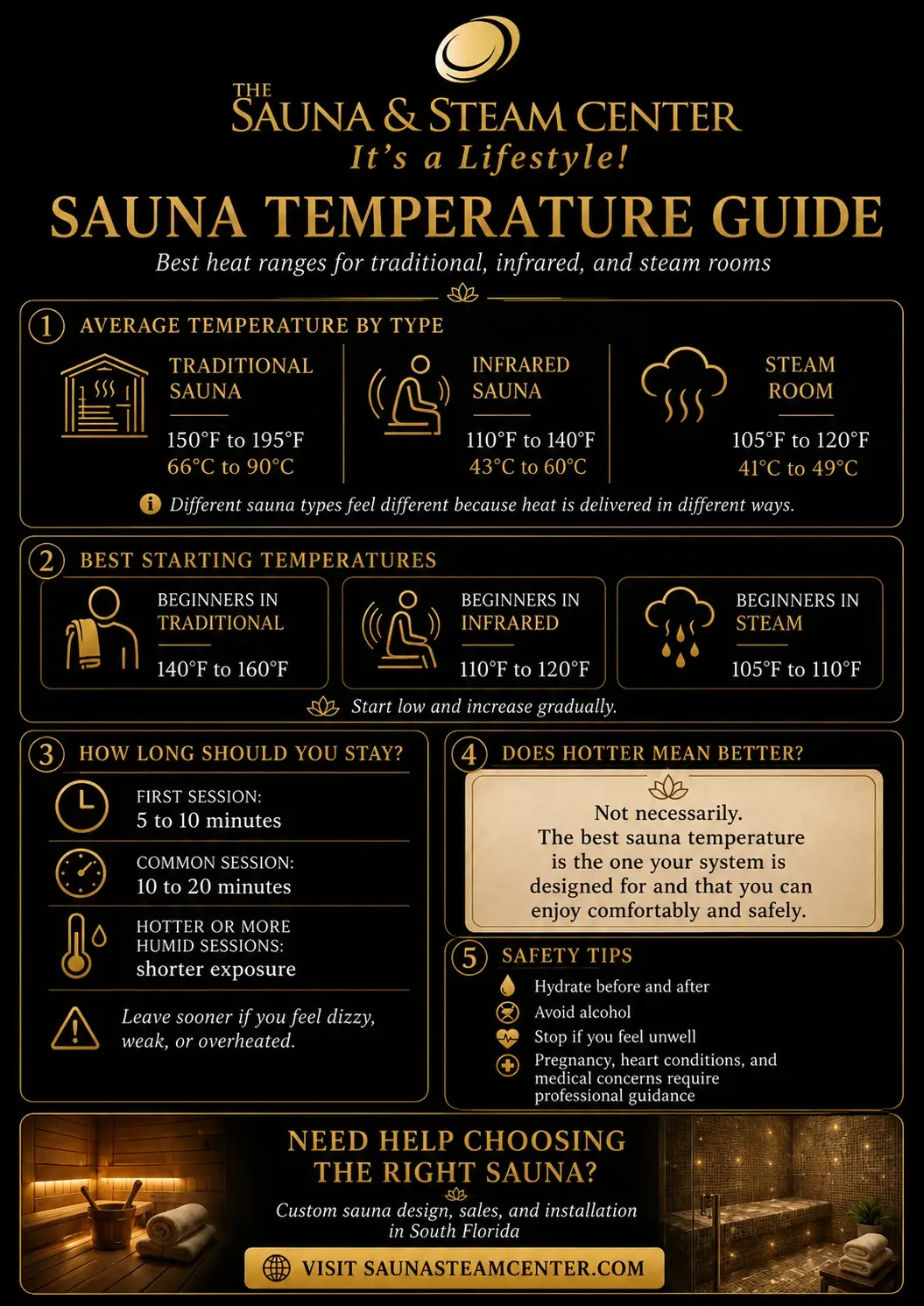
Sauna Temperature Chart: Fahrenheit and Celsius
| System type | Typical range | Common starting point | Humidity and heat feel | Best fit |
|---|---|---|---|---|
| Traditional electric sauna | 150°F to 195°F 66°C to 90°C | 150°F to 160°F 66°C to 71°C | Usually dry between water pours, with short humidity spikes from water on the stones | Classic high-air-temperature sauna experience |
| Wood-burning sauna | About 160°F to 200°F 71°C to 93°C | About 160°F 71°C | Varies with the fire, stone mass, ventilation and water use | Users who value traditional fire-heated bathing and accept more temperature variation |
| Infrared sauna | 110°F to 140°F 43°C to 60°C | 110°F to 120°F 43°C to 49°C | Lower room temperature with direct radiant heating from emitters | Users who prefer gentler air temperature and faster warmup |
| Steam room or steam shower | 105°F to 120°F 41°C to 49°C | 105°F to 110°F 41°C to 43°C | Near-saturated humidity reduces evaporative cooling | Users who prefer enveloping moist heat |
| Hybrid or combination system | Manufacturer-specific | Use the lower recommended mode setting | Depends on which heaters operate together | Households that want more than one heat experience |
What Is the Average Temperature of a Traditional Sauna?
A traditional sauna usually operates from about 150°F to 195°F in the United States. Harvia controls sold for the U.S. market commonly allow adjustment up to 194°F, or 90°C, while Finnleo documentation identifies 150°F to 165°F as a typical bathing range rather than treating the maximum as the normal target.[1][2] Finnish sauna practice can include a broader range. Harvia notes that 80°C to 100°C produces a hotter, sharper steam sensation, while 50°C to 60°C can feel softer and more humid when a large stone mass supports generous water use.[3] The setting alone does not define the experience. Stone quantity, bench elevation, water use and airflow can make two rooms at the same displayed temperature feel very different.Is 150°F Hot Enough for a Sauna?
Yes. A traditional sauna at 150°F, or about 66°C, is hot enough for a mild sauna session, especially for a beginner, a longer relaxed session or a user who prefers more humidity and less aggressive air heat. It is also within the typical bathing range identified in Finnleo control documentation.[1]Is 180°F a Good Sauna Temperature?
For a healthy, heat-acclimated adult, 180°F, or about 82°C, can be a normal traditional sauna setting. It is not necessary for every session and it is not appropriate for infrared or steam systems. At 180°F, use a shorter session, enter well hydrated, avoid alcohol and leave as soon as the heat becomes uncomfortable.What Is the Average Infrared Sauna Temperature?
Most infrared saunas are used between 110°F and 140°F, or about 43°C to 60°C. A 2025 Finnleo control manual lists a typical infrared bathing temperature of 115°F to 125°F and an adjustable maximum of 149°F for that specific system.[1] Other brands and models may use different controls, emitter layouts and maximum settings. Infrared does not need to match a traditional sauna’s air temperature. The emitters transfer radiant energy directly toward the body, so the room can feel thermally demanding even when the thermometer reads much lower. Cleveland Clinic recommends that new infrared users start around 110°F for five to ten minutes, then build gradually according to tolerance.[5] Do not choose between infrared and traditional heat by temperature alone. Compare warmup time, air feel, radiant intensity, electrical requirements, room size and personal preference. Evaluate each system by its intended heat method rather than by the highest temperature on the control.What Is the Average Steam Sauna or Steam Room Temperature?
A steam room is generally maintained around 105°F to 120°F, or 41°C to 49°C. Harvia identifies 45°C to 50°C, about 113°F to 122°F, as an ideal steam-room range, while MrSteam commonly describes residential steam environments around 105°F to 115°F with roughly 100 percent humidity.[6][7] The lower number does not mean steam is automatically easier to tolerate. When humidity is near saturation, sweat cannot evaporate efficiently, so the body loses one of its main cooling mechanisms. A 110°F steam room can therefore feel more oppressive than a much hotter dry sauna. Steam-room temperature also depends on generator sizing, enclosure sealing, wall materials, ceiling shape, sensor location and ventilation. For operating steps and practical precautions, use our steam room guide.Why Can Two Thermometers Show Different Sauna Temperatures?
Sauna temperature changes sharply with height and distance from the heater. Hot air rises, so the upper bench and head area can be much warmer than the floor. Finnleo heater documentation notes that room temperatures vary by height and heater distance, and that ventilation reduces but does not eliminate those differences.[8] The heater’s control sensor and a decorative wall thermometer may also serve different purposes. The control sensor protects and regulates the equipment. A user-level thermometer tries to represent the bathing zone. Harvia warns that installing a sensor near a supply-air vent, door, glass surface or warm corner can distort readings and heater behavior.[9]Factors That Change the Reading
- Bench height: the upper bench is warmer because it sits in the rising hot-air layer.
- Distance from the heater: the area above and near the heater is often hottest.
- Sensor placement: a sensor cooled by fresh air may cause the heater to run longer than intended.
- Glass and masonry: large non-insulated surfaces increase heat demand and can slow warmup.
- Ventilation: correct airflow supports comfort, but poorly placed or excessive airflow can create cold zones.
- Preheating: the air may reach the set point before benches, walls and stones feel evenly heated.
- Instrument accuracy: inexpensive analog thermometers can disagree, especially after prolonged heat exposure.
What Is the Best Sauna Temperature for Beginners?
A healthy adult who is new to sauna use can begin around 140°F to 160°F in a traditional sauna, 110°F to 120°F in infrared, or 105°F to 110°F in a steam room. Start with five to ten minutes. Cleveland Clinic advises new sauna users to begin around five minutes and increase gradually, while general sessions are often kept around 15 to 20 minutes.[4]| Experience | Traditional sauna | Infrared sauna | Steam room | Adjustment strategy |
|---|---|---|---|---|
| First session | 140°F to 150°F | 110°F | 105°F | Try five minutes, cool down and evaluate how you feel |
| Beginner | 150°F to 160°F | 110°F to 120°F | 105°F to 110°F | Increase time before raising temperature |
| Regular user | 160°F to 175°F | 115°F to 130°F | 110°F to 115°F | Adjust one variable at a time |
| Experienced heat-tolerant user | 175°F to listed equipment limit | Model-specific upper range | Model-specific upper range | Use shorter exposure and never treat discomfort as a goal |
How Does Humidity Affect Sauna Temperature?
Higher humidity usually makes a given air temperature feel hotter because sweat evaporates less efficiently. In a traditional sauna, throwing water on heated stones creates a temporary burst of steam, often called löyly. The room thermometer may change little, yet the heat on the skin can intensify quickly. At higher traditional-sauna temperatures, steam can feel sharp. At lower temperatures with a large stone mass, more water can create a softer, more humid experience.[3] In a steam room, humidity remains near saturation, which is why normal operating temperatures are much lower than in a dry sauna.Is the “Rule of 200” a Safety Standard?
No. The popular “Rule of 200,” which adds Fahrenheit temperature and relative humidity to reach a total near 200, is a comfort heuristic used by some sauna enthusiasts. It is not a medical limit, building code, product certification or substitute for manufacturer instructions. Relative-humidity sensors can also be inaccurate in sauna conditions, especially during rapid steam spikes.How Long Should You Stay in a Sauna at Different Temperatures?
There is no validated formula that assigns one universally safe duration to every temperature. A conservative principle is simple: hotter and more humid conditions generally call for shorter exposure. Cleveland Clinic suggests about 15 to 20 minutes for many sauna users, with beginners starting around five minutes. Its infrared guidance advises staying below 30 minutes even for experienced users.[4][5]| Condition | Suggested first exposure | Common session range | Important qualification |
|---|---|---|---|
| Traditional, 140°F to 160°F | 5 to 10 minutes | 10 to 20 minutes | Lower bench and less water can reduce intensity |
| Traditional, 160°F to 175°F | 5 to 10 minutes | 10 to 15 minutes | Shorten the session if humidity rises |
| Traditional, 175°F to 194°F | About 5 minutes | Often 5 to 10 minutes | Experienced users only, within equipment instructions |
| Infrared, 110°F to 125°F | 5 to 10 minutes | 10 to 20 minutes | Radiant intensity and emitter distance matter |
| Infrared, 125°F to 140°F | 5 to 10 minutes | 10 to 20 minutes | Do not exceed the model’s listed limit |
| Steam, 105°F to 115°F | 5 minutes | 10 to 15 minutes | Near-saturated humidity can accelerate heat strain |
How Hot Should a Home Sauna Be?
A home sauna should be hot enough to create the experience you enjoy while remaining within the listed operating range of the heater and control. For many households, 150°F to 170°F works well in a traditional room, while 115°F to 130°F works well in infrared. The right choice is the setting that household members can use consistently without turning each session into an endurance test. Homes with children, older adults or users with different heat preferences benefit from tiered benches and accurate user-level temperature monitoring. A lower bench provides a cooler zone without changing the thermostat. For mixed-use households, comfort flexibility can be more valuable than maximum heat.What Temperature Should an Outdoor Sauna Reach?
An outdoor traditional sauna should generally reach the same bathing range as an indoor traditional sauna. The difference is the time and energy required to get there. Wind, cool starting temperatures, moisture, glazing, insulation and door openings can slow warmup. In South Florida, the major installation concerns are not winter cold alone. Humidity, heavy rain, UV exposure, salt air, drainage, corrosion and storm-resistant placement all affect long-term performance. Do not oversize a heater without checking the room and heater instructions. Exposed glass, masonry and uninsulated surfaces can increase the effective heating load. Homeowners planning an outdoor sauna in Florida should evaluate the full enclosure, electrical route, drainage, foundation and weather exposure before focusing on the thermostat number.Does a Hotter Sauna Provide Better Results?
No strong evidence shows that simply choosing the highest possible setting provides better health results for everyone. The frequently cited Finnish cohort study found associations between sauna habits and lower cardiovascular and all-cause mortality, but it was observational, focused initially on middle-aged Finnish men and used traditional Finnish sauna bathing at a mean temperature of about 79°C, or 174°F. It did not prove that raising a sauna from 170°F to 194°F causes additional benefit.[10] A systematic review found promising effects across several sauna studies but also identified substantial variation in sauna type, temperature, session protocol, population and outcome measurement.[11] Evidence from one modality should not be automatically transferred to infrared cabins, steam rooms or every medical condition.| Claim | What the evidence supports | Practical conclusion |
|---|---|---|
| “Hotter always produces more benefit” | No established universal dose-response based only on room temperature | Use a tolerable, repeatable setting rather than chasing the maximum |
| “Traditional sauna research proves every heat modality works the same” | Traditional Finnish studies cannot be directly generalized to steam, hot tubs or all infrared protocols | Match expectations to the specific system and evidence |
| “More sweat means more fat loss” | Immediate scale changes are mainly fluid loss | Rehydrate and do not use temperature to chase temporary weight change |
| “The maximum control setting is the safest target” | A control limit protects the system and defines its listed range | It is not a personalized recommendation |
How Hot Is Too Hot for a Sauna?
A sauna is too hot when it exceeds the listed limit for the equipment, when safety controls are altered, or when the user develops symptoms. Some U.S. electric controls allow settings up to 194°F, but that number should not be interpreted as a guarantee that every person can safely remain at that temperature. The safest response to dizziness, headache, nausea, weakness, unusual breathlessness, faintness or confusion is to exit and cool down. OSHA identifies headache, nausea, dizziness, weakness, thirst and heavy sweating as signs of heat exhaustion, while confusion, loss of consciousness and seizures can indicate heat stroke and require emergency help.[12]What Is the Safest Sauna Temperature?
There is no single safest setting for every person. For a healthy beginner, a moderate starting range is about 140°F to 160°F in a traditional sauna, 110°F to 120°F in infrared, or 105°F to 110°F in steam. Personal safety depends on temperature, humidity, time, hydration, health status, medication and the ability to leave immediately.Who Should Seek Professional Guidance?
- Pregnant people: ACOG notes that core body temperature rises in saunas and hot tubs and advises avoiding these exposures early in pregnancy. Discuss any heat exposure with an obstetric professional rather than using a generic chart.[13] Individualized obstetric guidance should take priority over a general temperature recommendation.
- Children and teens: children regulate heat differently and need direct adult supervision. The Finnish Sauna Society describes the high heat and rapid thermal changes as demanding on a child’s temperature-regulation system.[14]
- Older adults: ask a clinician when age-related conditions, mobility, blood-pressure changes or medications could increase risk.
- People with cardiovascular, neurologic or blood-pressure conditions: obtain individualized advice, especially after a recent event, new diagnosis or medication change.
- Anyone who is sick, feverish, dehydrated or recently vomiting: postpone heat exposure until recovered.
Safety Checklist Before Every Session
- Drink water before and after the session.
- Avoid alcohol and recreational drugs. Research reviews associate alcohol plus sauna use with increased risk of hypotension, arrhythmia and serious events.[15]
- Do not use a sauna alone when a health or mobility issue could make exiting difficult.
- Never block ventilation or defeat a high-limit switch, door safety device or temperature sensor.
- Keep the door easy to open and never install a locking mechanism that could trap a user.
- Do not use sauna heat as a test of toughness.
- Cool down gradually and stop the session before symptoms become severe.
What Our Experience Since 2004 Has Taught Us
Installer insight: customers often ask for one universal average, but temperature complaints are frequently system-design complaints in disguise. A sauna that warms slowly, feels cold at the feet or cycles off before the upper bench is comfortable may have an undersized heater, incorrect sensor placement, restricted airflow, unsuitable stone placement, excessive uninsulated surface area or an electrical issue. Another common mistake is comparing an infrared control reading directly with a traditional-sauna reading. A 120°F infrared cabin and a 170°F traditional sauna are not underperforming versions of the same system. They deliver heat differently and should be evaluated according to their design. Sauna & Steam Center has designed, installed and serviced residential and commercial systems in South Florida since 2004 and operates a physical showroom in Hollywood. Our project experience includes homes, hotels, gyms, spas and luxury residential properties. The Better Business Bureau currently lists Florida Hot Tub & Sauna Center, Inc. with an A+ rating and also states that the company is not BBB accredited.[16]Common Temperature Problems We Evaluate
- A heater selected only by floor area instead of the manufacturer’s effective room-volume method
- A sensor installed near a door, corner, window or supply-air stream
- Bench heights that leave users below the best heat zone
- Large glass areas that were not included in heat-load planning
- Loose, deteriorated or incorrectly stacked stones that affect airflow and steam quality
- Insufficient preheating before judging performance
- Outdoor moisture, salt air or corrosion affecting equipment over time
- Commercial controls that allow inconsistent guest settings or excessive operating cycles
How to Choose the Right Sauna Temperature and System
Choose the heat experience first, then confirm the equipment and room can deliver it consistently. A traditional sauna is best for users who want high air temperature, stones and adjustable steam. Infrared is best for users who prefer lower ambient heat and direct radiant warmth. A steam room is best for people who prefer moist heat and already have, or are planning, a properly waterproofed enclosure.Choose a Traditional Sauna When
- You enjoy 150°F to 195°F air temperatures and water on heated stones.
- You want upper and lower benches that create different heat zones.
- You are comfortable with longer preheating than most infrared cabins.
Choose an Infrared Sauna When
- You prefer 110°F to 140°F room temperatures.
- You want fast warmup and direct radiant heating.
- You understand that lower air temperature does not make every session automatically suitable for every health condition.
Choose a Steam Room When
- You prefer moist heat around 105°F to 120°F.
- You can build or use a sealed, waterproof, drain-equipped enclosure.
- You are prepared for generator maintenance, water-quality management and moisture control.
Plan the complete system, not just the thermostat
Get a Sauna That Reaches and Holds the Right Temperature
Compare traditional, infrared, indoor and outdoor options based on your space, preferred heat, electrical requirements and installation conditions. Start with an estimate, then speak with a South Florida sauna specialist when the room or project needs professional review.Frequently Asked Questions About Sauna Temperature
How hot is a sauna?
A traditional sauna is usually 150°F to 195°F, an infrared sauna is usually 110°F to 140°F, and a steam room is usually 105°F to 120°F. The exact heat depends on the sauna type, humidity, bench height, sensor location and the manufacturer’s operating range.What is the average sauna temperature?
For many home users, the average comfortable setting is about 160°F to 170°F in a traditional sauna, 115°F to 125°F in an infrared sauna, and 105°F to 115°F in a steam room. Beginners should start lower and increase gradually.Is 150°F hot enough for a sauna?
Yes. A traditional sauna at 150°F is hot enough for a mild session and is a practical starting point for beginners. Many users later increase the setting gradually, but a hotter temperature is not required for the room to function as a sauna.Is 180°F a good sauna temperature?
Yes, 180°F can be a normal traditional sauna temperature for a healthy, experienced user. It is not appropriate for infrared or steam systems, and the session should be shortened if the heat feels intense.What sauna temperature is best for beginners?
A beginner can start around 140°F to 160°F in a traditional sauna, 110°F to 120°F in infrared, or 105°F to 110°F in a steam room. Begin with five to ten minutes and increase gradually.What temperature should an infrared sauna be?
Most infrared saunas are used between 110°F and 140°F. Many users begin near 110°F, while some manufacturer documentation identifies 115°F to 125°F as a typical bathing range.What temperature should a steam room be?
A steam room is commonly set between 105°F and 120°F. Because humidity is near saturation, the heat can feel intense even though the air temperature is lower than in a traditional sauna.How hot is too hot for a sauna?
A sauna is too hot when it exceeds the equipment’s listed limit or causes dizziness, headache, nausea, weakness, faintness, confusion or unusual breathing difficulty. Exit immediately when symptoms appear.How long can you stay in a sauna at 180°F?
There is no universal safe time, but many experienced users keep a 180°F traditional sauna session around five to ten minutes. Personal health, humidity and heat tolerance matter, so leave earlier if discomfort or symptoms develop.What temperature should an outdoor sauna reach?
An outdoor traditional sauna should generally reach the same bathing range as an indoor sauna, often 150°F to 195°F. Weather, insulation, glass, wind and starting temperature mainly affect warmup time and heat retention.What is the safest sauna temperature?
There is no single safest setting for everyone. A healthy beginner can start at a moderate temperature, such as 140°F to 160°F traditional or 110°F to 120°F infrared, use a short session and stop immediately if symptoms appear.Choose the Right Sauna Temperature, Not the Maximum Heat
The right sauna temperature is not the highest number the control can display. It is the range your system is designed to produce and that you can tolerate comfortably for an appropriate length of time. Start moderate, change one variable at a time, and pay attention to humidity, bench height and how your body responds. How hot is a sauna supposed to feel? It should feel intense enough to create the intended traditional, infrared or steam experience without causing dizziness, nausea, weakness, confusion or unusual breathing difficulty. When a sauna heats unevenly or cannot hold its normal range, investigate the installation before raising the thermostat. Heater sizing, sensor placement, ventilation, insulation and room materials often explain the problem. A properly planned sauna should make your preferred setting easy to reach, repeat and enjoy.References
- Finnleo, SaunaLogic 2 IS Control Manual, revised August 21, 2025. Typical traditional and infrared bathing ranges and control limits.
- Harvia, Xenio CX45 U.S. control specifications. Temperature adjustment range of 104°F to 194°F.
- Harvia Support, What Is the Correct Sauna Temperature?. Temperature and humidity experience in traditional saunas.
- Cleveland Clinic, Sauna Benefits and Safety Tips. Beginner duration, hydration, symptoms and groups advised to seek medical guidance.
- Cleveland Clinic, Infrared Saunas: Benefits and Safety. Start-low guidance and session-duration precautions.
- Harvia, How to Build a Steam Room. Steam-room temperature and sensor guidance.
- MrSteam, What Is a Steam Shower?. Typical residential steam temperature and humidity.
- Finnleo, Designer B Heater Installation and Operating Instructions. Temperature variation by room height, heater distance and ventilation.
- Harvia Support, Temperature Sensor Installation. Sensor-placement errors and their effect on readings and heater operation.
- Laukkanen et al., JAMA Internal Medicine, 2015. Observational association between Finnish sauna habits and cardiovascular and all-cause mortality.
- Hussain and Cohen, Clinical Effects of Regular Dry Sauna Bathing: A Systematic Review, 2018. Evidence quality, protocol variation and reported clinical effects.
- Occupational Safety and Health Administration, Heat-Related Illnesses and First Aid. Heat exhaustion and heat stroke symptoms.
- American College of Obstetricians and Gynecologists, Can I Use a Sauna or Hot Tub Early in Pregnancy?. Pregnancy and overheating guidance.
- Finnish Sauna Society, A Child in the Sauna. Children’s thermoregulation and supervision considerations.
- Hannuksela and Ellahham, Benefits and Risks of Sauna Bathing, 2001. Review of sauna safety and alcohol-related risk.
- Better Business Bureau, Florida Hot Tub & Sauna Center, Inc. Business Profile. Current rating and accreditation status.