Infrared Sauna Dangers: Side Effects, Warning Signs and Safety Risks
Infrared sauna dangers are real and worth understanding before you buy or use one at home. The most common infrared sauna dangers are connected to heat exposure, dehydration, temporary blood pressure changes, medication effects, personal health conditions, and unsafe equipment use. Infrared saunas operate at lower air temperatures than many traditional saunas, but the body can still absorb substantial heat, sweat heavily, and become unwell when a session is too intense. This guide explains the realistic risks without relying on fear-based claims. It covers common side effects, serious warning signs, factors that make problems more likely, practical prevention steps, and the difference between supported safety concerns and exaggerated online claims.Medical notice: This article provides general education and buyer guidance. It is not medical advice and does not diagnose, treat, cure, or prevent any condition. Ask a qualified healthcare professional before using a sauna if you are pregnant, take medications that may affect heat tolerance, or have concerns involving your heart, blood pressure, kidneys, circulation, nerves, sweating, or temperature regulation.
Quick Answer
Infrared saunas are not considered inherently dangerous for most healthy adults when the equipment works properly and sessions are used conservatively. The main infrared sauna dangers are dehydration, dizziness, overheating, headaches, nausea, fainting, skin irritation, and temporary blood pressure changes. Risk increases when users stay too long, enter while dehydrated, combine sauna use with alcohol, ignore warning symptoms, or have medical or medication-related heat sensitivity.Key Takeaways
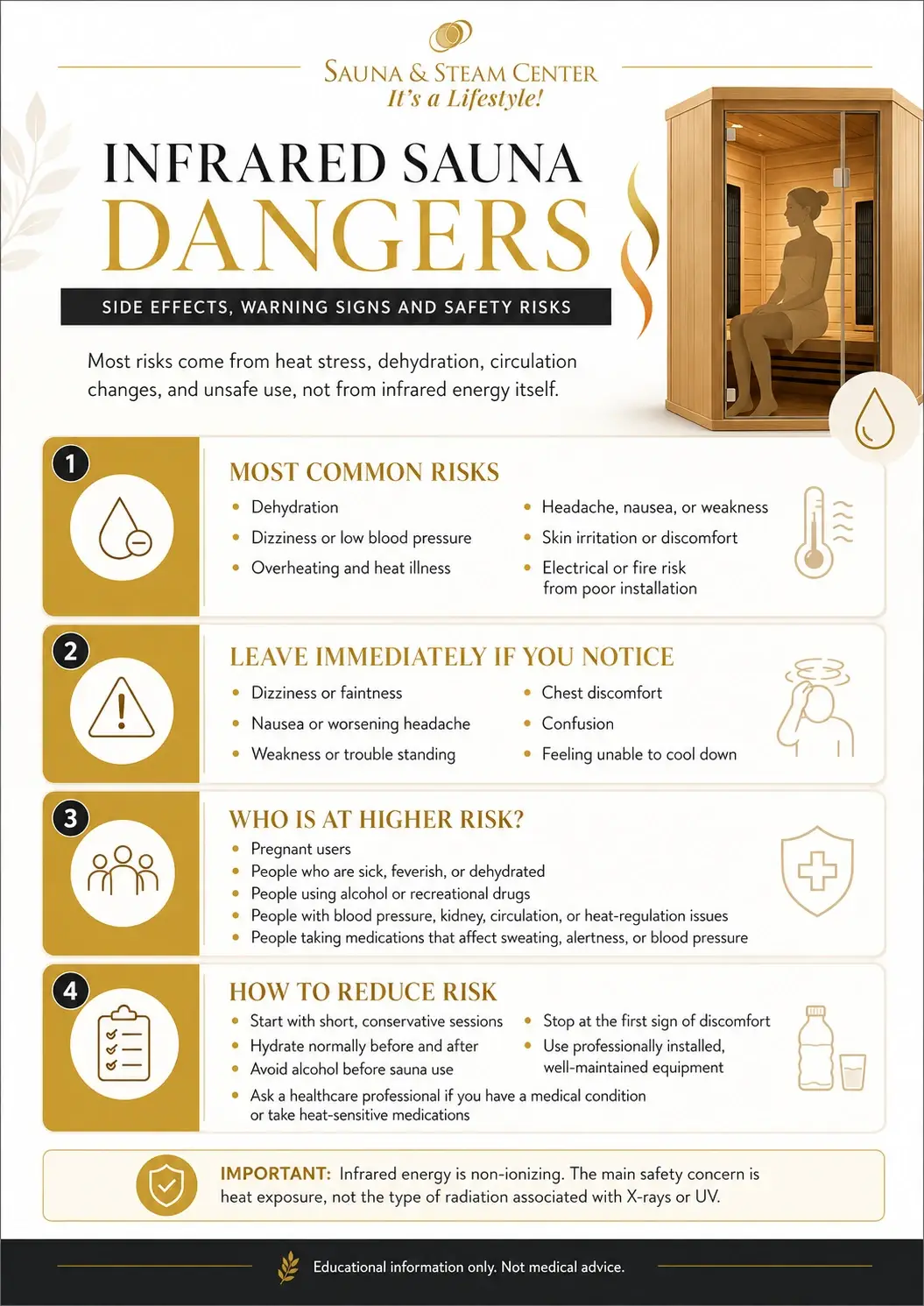
- The most realistic infrared sauna dangers come from heat stress, fluid loss, circulation changes, and unsafe use — not from infrared energy itself.
- Dizziness, nausea, weakness, worsening headache, chest discomfort, confusion, or feeling unable to cool down are reasons to leave immediately.
- Pregnancy, acute illness, certain medications, low blood pressure, kidney disease, impaired sweating, and reduced heat sensation may increase risk.
- Infrared energy is non-ionizing and is not the same as ultraviolet radiation, X-rays, or gamma rays.
- Safe equipment, conservative sessions, normal hydration, and attention to symptoms are more important than trying to tolerate a specific temperature or duration.
Are Infrared Saunas Dangerous?
Infrared saunas can be used without serious problems by many healthy adults, but they are not risk-free. An infrared unit still warms the body, raises skin temperature, increases sweating, changes circulation, and can increase heart rate. A lower air temperature may feel more comfortable, but comfort does not guarantee that a long session is safe. Published sauna research generally reports few serious adverse events under controlled conditions. A systematic review that included traditional and infrared sauna studies found that reported adverse effects were usually mild to moderate, such as heat discomfort, low blood pressure, lightheadedness, airway irritation, and claustrophobia. However, controlled research conditions do not represent every home sauna, every session length, or every user’s medical situation.When infrared sauna dangers become more likely
Infrared sauna dangers are more likely when a user:- Starts the session while dehydrated, sick, feverish, or exhausted
- Uses alcohol or recreational drugs before entering
- Stays inside after developing dizziness, nausea, weakness, or headache
- Uses a temperature or duration beyond personal tolerance
- Falls asleep inside the sauna
- Has a condition that affects blood pressure, sweating, circulation, heat sensation, or fluid balance
- Takes medication that changes temperature regulation, alertness, thirst, sweating, or blood pressure
- Uses damaged, poorly installed, or malfunctioning equipment
Infrared radiation is not the same as ionizing radiation
Infrared energy is part of the non-ionizing portion of the electromagnetic spectrum and is experienced primarily as heat. It is not the same type of radiation as X-rays or gamma rays, and it is not ultraviolet light. This distinction matters because some alarming claims incorrectly group every form of radiation together. That does not mean unlimited infrared exposure is harmless. Excessive heat can still cause dehydration, skin injury, overheating, or worsening symptoms in a heat-sensitive person. Readers who want a balanced review of potential positive outcomes can visit the separate guide to infrared sauna benefits.Main Infrared Sauna Dangers and Side Effects
Most infrared sauna dangers are related to the body’s attempt to regulate temperature. Mild discomfort can sometimes progress into a serious heat-related problem when the user remains inside or ignores symptoms.Dehydration
Sweating causes fluid loss. The amount varies by session temperature, duration, body size, recent exercise, heat tolerance, and hydration status. Possible signs include thirst, dry mouth, darker urine, headache, fatigue, dizziness, reduced concentration, and muscle cramps. Dehydration is more likely after strenuous exercise, prolonged outdoor heat, alcohol use, vomiting, diarrhea, fasting, or inadequate fluid intake. People with kidney disease, heart failure, electrolyte disorders, or prescribed fluid limits should not follow generic hydration advice without professional guidance.Dizziness, low blood pressure and fainting
Heat causes blood vessels near the skin to widen. This helps release heat but can temporarily lower blood pressure. A person may feel lightheaded while seated, when standing, or shortly after leaving the sauna. The risk may be higher for people who already have low blood pressure, use diuretics or blood pressure medication, are dehydrated, stand suddenly, or have a history of fainting. Dizziness should not be interpreted as detoxification. It is a reason to end the session, move carefully, and cool down.Overheating and heat illness
An infrared sauna can cause overheating even when its air temperature is lower than that of a traditional sauna. Early symptoms may include heavy sweating, headache, nausea, weakness, rapid heartbeat, excessive thirst, irritability, dizziness, and muscle cramps. Confusion, collapse, loss of consciousness, seizure, severe breathing difficulty, or an inability to cool down can indicate a medical emergency. Call emergency services rather than trying to complete the session or manage severe symptoms alone.Headache, nausea and unusual fatigue
Headaches and nausea may be associated with dehydration, heat sensitivity, blood pressure changes, strong odors, inadequate ventilation, recent exercise, or excessive exposure. These symptoms are not proof that unspecified toxins are leaving the body. Temporary relaxation is expected for some users. Feeling sick, unstable, mentally foggy, or severely exhausted is not a desirable response. Recurring symptoms are a reason to stop sauna use and discuss the pattern with a healthcare professional.Heart strain, palpitations and chest symptoms
Heart rate may increase as the body moves more blood toward the skin. For many healthy users this response is temporary, but heat may create additional strain for someone with an unstable cardiovascular condition. Leave immediately if you experience chest pressure, chest pain, an unusually rapid or irregular heartbeat, severe shortness of breath, or weakness that feels different from normal heat fatigue. Seek urgent care for severe or persistent cardiovascular symptoms.Skin irritation, hot spots and burns
Temporary skin redness can occur as circulation near the skin increases. Excessive exposure may cause itching, heat rash, worsening irritation, skin pain, or burns. Risk may be higher for people with neuropathy, reduced heat sensation, poor circulation, open wounds, recent cosmetic treatments, active skin inflammation, or direct contact with a hot component. Stop using a sauna that produces isolated hot spots, burning odors, visible scorching, unstable temperatures, cracked panels, exposed wiring, or controls that do not respond normally.Falls and injuries after the session
Some injuries occur while leaving rather than while sitting inside. Dizziness, wet floors, fatigue, poor balance, and standing too quickly can contribute to falls. Remain seated briefly after the session, stand slowly, keep the floor dry, and do not walk unassisted if you feel unsteady.Infrared sauna danger signs that require immediate action
Leave the sauna immediately if you notice:- Dizziness or feeling close to fainting
- Worsening headache
- Nausea or vomiting
- Unusual weakness or difficulty standing
- Chest discomfort or severe shortness of breath
- A racing or irregular heartbeat
- Confusion, blurred vision, or slurred speech
- Skin pain, burning, or a painfully hot surface
- Feeling unable to cool down normally

What Happens If You Stay in an Infrared Sauna Too Long?
Most people who have had a truly comfortable sauna session know the feeling — you relax, the warmth settles in, and leaving feels like the last thing you want to do. That feeling is part of what makes infrared saunas enjoyable. It is also part of why staying too long is one of the most common and preventable infrared sauna dangers. Your body does not always announce problems loudly. The early signs are easy to miss or dismiss, especially when the overall experience feels good. Here is how things tend to progress when a session runs beyond what the body is ready for.Stage one: early warning signs you might brush off
In the early minutes past your comfortable limit, the signals are subtle. You may notice heavier than usual sweating, a slight rise in your heart rate, a growing sense of thirst, or the first trace of a dull headache. These are your body’s way of saying it is working hard. Many people at this stage feel fine and push on — which is exactly when the situation can shift.Stage two: symptoms that should make you leave now
As heat stress builds, symptoms become harder to ignore. Dizziness or lightheadedness often arrives around this stage, along with nausea, a stronger headache, and a kind of fatigue that feels different from normal tiredness. Your concentration may start to slip. If this is where you are, the right move is to end the session immediately — not after one more minute, right now.Stage three: a medical emergency
If symptoms are allowed to progress — confusion, an inability to stand without support, severe weakness, or a feeling that you cannot cool down even after leaving — this is a heat-related medical emergency. Move the person to a cool area, apply cool damp cloths to the neck and wrists, and call emergency services. Do not wait to see if it passes.The honest truth about time limits
There is no single time limit that is safe for everyone. The right duration depends on your health, hydration, fitness level, the session temperature, recent activity, and how your body responds that specific day. A time that is perfectly fine on one occasion can be too long on another. Our separate guide on how long to stay in a sauna covers this in more depth, but the principle is simple: leave when your body signals discomfort, not when a timer or goal says you should.What Should You Do If You Feel Sick After an Infrared Sauna?
First, if you feel unwell after a session, please know that this does not automatically mean something is permanently wrong with you or that you can never use a sauna again. What it does mean is that this particular session was more than your body was ready for that day — and your body is doing exactly what it should by telling you so. Here is a calm, step-by-step guide to what to do.Step 1: Get out and sit down somewhere safe
If you are still inside the sauna, leave immediately. Do not try to gather your belongings first. Move to a cooler area and sit down. If you feel dizzy, do not rush to stand — sit or lie down on the floor rather than risk a fall.Step 2: Cool your body gently
A cool, damp cloth on the back of your neck, your forehead, or your wrists helps bring body temperature down gradually. A cool shower is fine once you feel stable enough to stand safely. Avoid ice-cold water applied suddenly to large areas of the body, as this can cause its own circulatory shock response.Step 3: Sip water slowly
Small, steady sips of water are better than gulping large amounts all at once. If you have a medical condition that prescribes fluid limits, follow that guidance rather than generic hydration advice. A sports drink with electrolytes can help after a heavily sweating session, but plain water is fine for most people.Step 4: Rest and observe how you feel over the next 30 to 60 minutes
Mild nausea, a dull headache, or general fatigue that gradually improves with rest, cool air, and fluids is usually a sign of mild heat stress or dehydration — uncomfortable, but manageable at home. If symptoms are improving, keep resting.Step 5: Know the signs that need emergency attention
Call emergency services if you or someone with you experiences confusion or disorientation, loss of consciousness, seizure, severe chest pain, extreme vomiting, difficulty breathing, or symptoms that are worsening rather than improving after 20 to 30 minutes of cooling and rest. Do not give fluids to someone who is unconscious or severely confused.Step 6: Reflect before your next session
Before going back into the sauna, it is worth asking what was different. Were you dehydrated going in? Had you skipped a meal? Was the session longer than usual? Did you exercise hard beforehand? Had you taken a new medication recently? The answer to one of those questions is usually the culprit, and identifying it is more useful than simply vowing to be tougher next time. If you feel sick after every sauna session, or the pattern is getting worse rather than better, stop using the sauna and discuss it with a healthcare professional before resuming.Who Is at Higher Risk from Infrared Sauna Dangers?
Heat tolerance varies significantly. Having a risk factor does not always mean that all sauna use is forbidden, but it may require medical guidance, shorter exposure, closer monitoring, or avoiding sauna use completely.People with cardiovascular or blood pressure concerns
People with unstable heart disease, unexplained chest pain, recurring abnormal heart rhythms, recent cardiovascular events, low blood pressure, fainting episodes, or poorly controlled blood pressure should ask a qualified healthcare professional before using an infrared sauna. Heat may temporarily change heart rate and blood pressure. Research performed in supervised clinical settings should not be treated as permission to begin unsupervised heat therapy at home.People with kidney disease or fluid restrictions
Sweating changes fluid and electrolyte balance. People with kidney disease, dialysis requirements, heart failure, electrolyte disorders, or medically prescribed fluid limits may face risk from both dehydration and inappropriate fluid replacement.People with impaired sweating, circulation or heat sensation
Some neurological, metabolic, autoimmune, and skin conditions can affect sweating, circulation, temperature regulation, or the ability to feel excessive heat. Neuropathy or reduced mobility may also make it difficult to recognize a hot surface or move away from it. A person who does not sweat normally should not remain inside longer in an attempt to force sweating.People taking medications that affect heat tolerance
The Centers for Disease Control and Prevention notes that some medications can interfere with sweating, thirst, fluid balance, blood pressure, alertness, kidney function, or central temperature regulation. Examples may include certain diuretics, antihistamines, antidepressants, stimulants, antipsychotic medications, blood pressure drugs, and medicines with anticholinergic effects. Do not stop or change a medication to use a sauna. Ask the prescribing clinician or pharmacist whether your specific medication and health history create a heat-related concern.Pregnant people
Pregnancy changes circulation, hydration needs, and temperature regulation. Because excessive maternal heat exposure may create avoidable risk, pregnant people should obtain individual advice from their obstetric clinician before using a sauna. This article keeps pregnancy coverage brief to avoid duplicating the dedicated guide to sauna use during pregnancy.People who are sick, feverish or already dehydrated
Do not use an infrared sauna to sweat out a fever, respiratory infection, stomach illness, or other acute condition. Fever already raises body temperature, while vomiting and diarrhea can significantly increase dehydration risk. This is one of the most commonly underestimated infrared sauna dangers for people who assume sweating accelerates recovery.People who recently used alcohol or recreational drugs
Alcohol may worsen dehydration, reduce judgment, affect blood pressure, and make warning symptoms harder to recognize. Recreational drugs may also alter heart rate, alertness, temperature regulation, or decision-making. Never use an infrared sauna while intoxicated.People using a sauna after intense exercise
Exercise already raises body temperature and increases fluid loss. Entering a sauna immediately after a demanding workout can add to heat strain and dehydration. The complete timing and recovery discussion belongs in the guide to using a sauna after the gym, but the key point here is that post-exercise sauna use is a specific infrared sauna danger that deserves extra caution.People with fertility concerns
Repeated high-heat exposure has been associated in limited research with temporary changes in sperm production and quality. The evidence does not establish that occasional infrared sauna use causes permanent infertility, and much of the research involves traditional sauna heat. Men actively trying to conceive or receiving fertility treatment may wish to discuss repeated heat exposure with a fertility specialist.Can Infrared Saunas Interact With Medications?
This is one of the most important infrared sauna danger questions that does not get enough attention, and it deserves a straight answer: yes, some medications genuinely change how your body handles heat — and that can make a sauna session riskier than it would otherwise be. The tricky part is that these interactions are not always obvious in the moment. You might feel fine sitting inside the sauna, not realizing that a medication has quietly reduced your ability to sweat properly, lowered your blood pressure further than usual, or dulled your awareness of how hot you actually are. These are exactly the kinds of subtle changes that can turn a session from relaxing into dangerous.
Medication categories that may increase infrared sauna dangers
The Centers for Disease Control and Prevention and other health authorities have identified several medication categories that can interfere with the body’s ability to handle heat safely:- Diuretics (water pills): These increase fluid and electrolyte loss through urine, which adds to the fluid you are already losing through sweat. The combination can lead to dehydration faster than most people expect.
- Blood pressure medications: Some of these lower blood pressure further when heat causes blood vessels to relax. The result can be significant dizziness, lightheadedness, or fainting — especially when standing up after a session.
- Antihistamines: Older antihistamines in particular can reduce sweating, which means your body loses one of its main ways of cooling itself. Feeling comfortable while your body overheats internally is a genuine risk.
- Antidepressants and antipsychotics: Certain types in these categories affect temperature regulation, sweating response, alertness, or blood pressure — sometimes in ways that are hard to predict without knowing the specific drug and dose.
- Stimulants: These can raise heart rate and blood pressure even at rest, adding to the cardiovascular load that heat already creates.
- Medications with anticholinergic effects: This is a broad category that includes some allergy medications, bladder medications, and others. Anticholinergic effects can significantly reduce the ability to sweat, which is a serious overheating risk.
- Sedatives or sleep aids: These can reduce alertness enough that warning symptoms — dizziness, confusion, increasing weakness — are harder to notice and respond to.
This is not a complete list — your situation is specific
The categories above are a starting point, not a definitive inventory. Your own combination of medications, health conditions, and heat tolerance matters far more than a general list. Two people taking the same medication may respond very differently in a sauna depending on their dose, their other medications, and their overall health.What to actually do
Before starting a regular sauna routine, ask the pharmacist or clinician who manages your prescriptions one simple question: could any of my current medications affect how my body handles heat? You do not need to stop anything to ask. A five-minute conversation can give you a much clearer picture of whether regular sauna use is something to approach carefully, modify, or avoid altogether until your situation changes.How to Reduce Infrared Sauna Dangers and Risks
Many preventable infrared sauna dangers involve excessive exposure, poor preparation, ignored warning signs, or unsafe equipment. A conservative routine is safer than trying to match another person’s temperature, sweating level, or session length.Before the session
- Read and follow the manufacturer’s operating instructions.
- Use the sauna only when you feel healthy, alert, and normally hydrated.
- Avoid use after alcohol, recreational drugs, fever, vomiting, diarrhea, or prolonged outdoor heat.
- Consider recent exercise and fluid loss before entering.
- Ask a pharmacist or clinician about medication-related heat sensitivity when appropriate.
- Set a timer before the session begins.
- Confirm that the door opens easily and the exit is unobstructed.
- Check for damaged wiring, cracked heaters, burning odors, unstable controls, or unusual hot spots.
During the session
- Remain seated when possible.
- Do not touch exposed heating components.
- Do not block ventilation openings.
- Do not fall asleep.
- Do not raise the temperature simply because sweating has not started.
- Stop at the first sign of dizziness, nausea, weakness, chest discomfort, or skin pain.
- Never try to outperform another person’s sauna session.
After the session
- Sit briefly before standing.
- Stand slowly and use a stable handhold when needed.
- Move to a comfortable, cooler area.
- Replace fluids gradually according to your normal health needs.
- Do not drive until dizziness has completely resolved.
- Do not repeat the session if you developed concerning symptoms.
- Seek care when symptoms are severe, persistent, or worsening.
Safety features to examine before buying
A safer infrared sauna should have understandable temperature controls, an automatic timer, overheat protection, protected heating components, clear electrical requirements, reliable door operation, ventilation instructions, and accessible technical support. Some models also include chromotherapy color light therapy as a built-in wellness feature — confirm that any add-on components are covered by the manufacturer’s safety testing. Look for recognized electrical safety testing appropriate for the market where the sauna will be installed. Confirm voltage, amperage, circuit requirements, grounding, indoor or outdoor placement limits, required clearances, and whether a licensed electrician is needed. Electromagnetic field measurements can be a buying consideration, but EMF is a separate topic from the most common heat-related side effects. Readers who need measurement and shopping guidance should use the dedicated low-EMF sauna guide.When to get medical help
Contact a healthcare professional if symptoms repeatedly occur, headaches follow most sessions, heat triggers fainting or migraines, blood pressure becomes difficult to manage, palpitations recur, or you are uncertain about a medication or chronic condition. Call emergency services when someone loses consciousness, becomes confused, has a seizure, develops severe chest pain or breathing difficulty, collapses, cannot cool down, or continues worsening after leaving the heat. Do not give fluids to a person who is unconscious or severely confused.Are Home Infrared Saunas Dangerous If Installed Incorrectly?
The honest answer is yes — and this is one of the most preventable categories of infrared sauna danger because it happens before anyone even steps inside. When people buy an infrared sauna online, it can be tempting to treat it like any other piece of furniture. You find a spot, you plug it in, and you assume it will work safely because it came in a box. But a sauna draws significant electrical power, generates sustained heat, and needs to be placed in a location where it can operate reliably every single time you use it. Incorrect installation does not always announce itself immediately. A sauna that seems to work fine might have wiring that is quietly overloaded, ventilation that is partially blocked, or placement that traps heat in ways the manufacturer never intended. Some of these problems take weeks or months to surface — and by the time they do, the consequences can be far more serious than a bad session.The most common installation mistakes that create real risk
- Wrong circuit type: Running a 240V sauna on a 120V outlet, or using a circuit not rated for the draw, is a fire and equipment hazard.
- No dedicated circuit: Sharing a breaker with other high-draw appliances can cause overloads, tripped breakers, or wiring damage over time.
- Insufficient clearances: Placing the sauna too close to walls, stored items, or low ceilings traps heat and increases fire risk.
- Blocked ventilation: It can seem counterintuitive, but blocking vents to “keep the heat in” actually creates dangerous heat buildup in components that need airflow to operate safely.
- Skipping the electrician: For hardwired or high-draw models, a licensed electrician is not optional — it is the difference between a safe installation and a liability.
- Wrong environment: Installing an indoor-rated sauna outdoors, or placing an outdoor unit somewhere it will be exposed to water intrusion, creates both electrical and structural hazards.
- Extension cords: These are not rated for sustained high electrical loads and should never be used as a permanent sauna connection.
What safe home installation actually looks like
Before you choose a location, confirm the voltage and amperage requirements for your specific model. Most traditional infrared saunas require 240V with a dedicated circuit. Some compact infrared units run on 120V. These are not interchangeable without proper electrical work, and guessing is not worth the risk. A licensed electrician should review the requirements before installation for any hardwired model or any situation where a new circuit needs to be added. Beyond electrical safety, the sauna needs level and stable flooring, appropriate clearances on all sides, nearby access to water for cooling down, and a delivery path that does not require forcing panels through tight spaces. Our team handles professional sauna installation in South Florida for homeowners who want the process done correctly from the beginning — not fixed after something goes wrong. Getting installation right the first time is one of the most effective ways to protect both the people using the sauna and the home it is installed in.How Can You Tell If an Infrared Sauna Is Unsafe?
Knowing what to look for before and during a session can make a real difference. An infrared sauna that looks fine from the outside can have equipment problems that only become apparent when you know what warning signs actually mean. This is not about being paranoid — it is about being informed enough to trust your own judgment.Warning signs in the equipment itself
- Burning or electrical smell: A normal sauna has a warm wood smell. An electrical or burning plastic smell when heating is a sign of a component problem that needs immediate attention — do not use the sauna until it has been inspected.
- Visible damage: Cracked panels, scorched wood, exposed or frayed wiring, discolored heater components, or broken door seals are all reasons to stop using the sauna until the problem is resolved.
- Hot spots: If specific areas of the wall or floor feel significantly hotter than the surrounding surfaces, that is a sign of uneven or malfunctioning heating that deserves investigation.
- Erratic or unresponsive controls: A sauna whose temperature climbs past the set point, whose controls do not respond consistently, or that fails to shut off when it should is not safe to use until it has been serviced.
- Door problems: The door of any sauna should open easily from the inside. If it sticks, does not close properly, or requires force to open, this needs to be fixed before use.
Warning signs in how the sauna is set up
- Tripped circuit breakers associated with sauna use: A breaker that trips repeatedly when the sauna runs is telling you something about the electrical load — do not simply reset and continue.
- Flickering lights on the same circuit: This suggests the sauna is drawing more power than the circuit was designed for.
- The sauna is running on an extension cord: This is not a safe long-term setup regardless of how well it seems to work.
- No recognizable safety certification: Look for UL, ETL, CE, or equivalent markings appropriate for the country where the sauna is being used. A sauna with no traceable safety testing history is a risk that is hard to assess.
- Blocked or sealed ventilation: Ventilation exists for a reason. If someone has taped, blocked, or sealed the vents to increase heat, the sauna is not operating within its designed safety parameters.
The rule that makes this simple
If something about the sauna feels wrong — a smell, a sound, a surface temperature, an electrical behavior, or a control that is not responding — trust that instinct and do not use it until the issue is identified. A good sauna session is not worth starting on equipment you are not certain about. If the concern involves wiring, heating components, or anything electrical, have it inspected by a qualified professional before returning to use.Understanding the Evidence on Infrared Sauna Dangers
What is well supported
It is well established that heat exposure can increase sweating, raise heart rate, widen blood vessels near the skin, and contribute to fluid loss. These responses help explain realistic infrared sauna dangers such as thirst, dizziness, low blood pressure, heat discomfort, weakness, and headache. Medical guidance also supports additional caution when medications interfere with sweating, thirst, circulation, alertness, fluid balance, or temperature regulation. Alcohol should not be combined with sauna use because it can worsen dehydration, impaired judgment, hypotension, and cardiovascular risk.
What is mixed or conditional
Infrared saunas have been studied for cardiovascular, pain, exercise-recovery, and other uses, but the overall evidence is limited by small studies, varied protocols, and differences between traditional, far-infrared, and other heat exposures. Findings from supervised clinical research may not apply to every consumer sauna or every person with a medical condition. Claims about fertility, skin effects, cardiovascular safety, and long-term outcomes depend on exposure level, individual health, equipment type, and study design. These topics should be presented with appropriate uncertainty rather than as universal conclusions.What is overstated or unproven
Claims that dizziness or headaches prove detoxification are unsupported. Sweating primarily helps regulate temperature. A headache, nausea, weakness, or confusion should be treated as a possible sign of dehydration or heat stress, not as evidence that a session is working correctly. Some buyers also ask whether infrared sauna dangers include weight loss or gain. A sauna causes temporary water-weight loss through sweating that must be replaced by rehydration. It should not be treated as a fat-loss tool. For a research-based breakdown, read do saunas help you lose weight. Infrared saunas should not be presented as replacements for medical treatment, cancer care, blood pressure management, rehabilitation, or prescribed medication. Bottom line: The most credible infrared sauna dangers involve heat, dehydration, circulation, medication interactions, individual health risks, and unsafe equipment use — not sensational claims about all infrared energy being toxic.Can Infrared Saunas Cause Long-Term Health Problems?
If you use an infrared sauna regularly and you have started wondering whether it could be quietly doing harm over time, that is a completely reasonable question — and it deserves a genuinely honest answer rather than reassurance designed to make you keep buying sessions. Here is what the evidence actually shows, what it does not show, and where real caution is warranted.What we have reasonable confidence about
For most healthy adults who use infrared saunas conservatively, there is no strong evidence of long-term harm from responsible use. The existing population research on regular sauna use — most of which comes from studies on traditional Finnish sauna — has not found associations between moderate sauna use and long-term health decline in healthy populations. Some studies have found associations in the opposite direction. However, it is worth being clear that long-term infrared sauna research specifically is still limited. Most of the robust data we have comes from Finnish sauna studies involving different temperatures, different heat dynamics, and different cultural patterns of use. Extending those findings to home infrared sauna use requires a degree of assumption that responsible communication should acknowledge.Where genuine long-term concern exists
The people most at risk of long-term harm are not the ones using infrared saunas thoughtfully — they are the ones using them to extremes, repeatedly, without respecting what the body is signaling.- Repeated dehydration without adequate rehydration can strain the kidneys and cardiovascular system over time, particularly in people who are already managing those organ systems carefully.
- Consistent ignoring of symptoms — pushing through dizziness, nausea, or headaches session after session — is not a form of conditioning. It is repeated stress on systems that are already being challenged.
- Regular heat exposure without medical oversight for people with underlying cardiovascular, kidney, or neurological conditions may create compounding risk that is hard to monitor at home.
- Fertility-related concerns remain relevant for men who use heat-intensive saunas frequently while actively trying to conceive. The evidence on this is not conclusive, but the precautionary principle applies.
The practical takeaway
Long-term infrared sauna use is likely to be safe for most healthy adults when each session is moderate, hydration is maintained, and the body’s warning signals are taken seriously. The people most at risk of long-term problems are not those who use it regularly and carefully — they are those who use it to excess and ignore the feedback their body provides every session. If you are using the sauna and feeling genuinely better over time, that is a meaningful signal. If you are using it and feeling progressively more tired, more unwell, or noticing recurring symptoms, that is equally meaningful and worth discussing with a healthcare professional.Can Infrared Saunas Cause Cancer or Damage DNA?
Let us be direct about this one, because the fear circulating online around infrared saunas and cancer is causing real anxiety for people who simply want to know whether their sauna is safe. The short answer is: there is no credible scientific evidence that responsible infrared sauna use causes cancer or damages DNA. But the longer answer matters too, because understanding why helps you evaluate the claims you might come across.Why the confusion happens — and why it is understandable
The word “radiation” is applied to things that are vastly different from each other. When most people hear radiation and cancer in the same sentence, they think of X-rays, gamma rays, or nuclear exposure — and reasonably so, because those forms of ionizing radiation do carry enough energy to break chemical bonds and damage DNA directly. Infrared radiation is not in that category. It is non-ionizing, which means it does not carry enough energy to break chemical bonds or damage DNA in the way that ionizing radiation does. The primary biological effect of infrared energy — at the levels produced by a consumer sauna — is heat. That is not a minimization; it is a scientifically accurate description of what infrared energy actually does to human tissue.What infrared heat can and cannot do
What infrared sauna exposure can do is cause heat-related problems: dehydration, overheating, skin burns from direct contact with heating components, and cardiovascular strain in vulnerable individuals. These are the real infrared sauna dangers that this guide addresses throughout, and they deserve to be taken seriously. What infrared sauna exposure at consumer levels cannot do, based on current scientific understanding, is ionize cells, directly break DNA strands, or cause the type of cellular mutation that initiates cancer through radiation exposure the way X-rays or UV light can.The honest caveat every responsible guide should include
Science is always evolving, and long-term studies specifically on consumer infrared sauna use remain limited. Acknowledging that uncertainty is part of honest communication. But the current body of evidence — which includes decades of research on heat exposure, infrared therapy, and sauna use in various populations — does not support classifying residential infrared sauna use as a cancer risk. Infrared saunas should also not be marketed in the opposite direction, as cancer treatments or therapies that destroy cancer cells. Neither claim is supported, and both cause harm — one through unnecessary fear, the other through false hope.What to do if you have seen alarming content online
If you have encountered online articles or videos claiming that infrared saunas cause cancer, check the source carefully. Ask whether the claim distinguishes between ionizing and non-ionizing radiation, cites peer-reviewed research, and separates heat-related risks from radiation-related risks. Content that conflates infrared with X-ray or nuclear exposure is not using those terms accurately, and the fear it generates is not based on the scientific consensus as it currently stands. The real infrared sauna dangers — heat stress, dehydration, medication interactions, improper installation, poor equipment — are worth your attention and preparation. They are also, importantly, within your ability to manage with the right information and a sensible approach.Frequently Asked Questions About Infrared Sauna Dangers
What is the biggest danger of an infrared sauna?
The biggest practical danger is excessive heat exposure, especially when combined with dehydration, alcohol, medication effects, illness, or a condition that reduces heat tolerance. Early symptoms can include headache, dizziness, nausea, weakness, and heavy sweating. Confusion, collapse, seizure, or inability to cool down requires emergency attention.
What happens if you stay in an infrared sauna too long?
Staying too long can progress from mild discomfort — heavy sweating, thirst, elevated heart rate — into dizziness, nausea, weakness, confusion, and in severe cases, heat illness requiring emergency care. Leave at the first sign of discomfort rather than pushing toward a time goal.
What should you do if you feel sick after an infrared sauna?
Leave immediately, sit down safely, cool down gently with a damp towel or cool air, and sip water slowly. Rest and monitor symptoms. Call emergency services if you experience confusion, loss of consciousness, severe chest pain, seizure, or worsening symptoms that do not improve with rest and cooling.
Can infrared saunas interact with medications?
Yes. Some medications can reduce sweating, lower blood pressure further in heat, impair thirst recognition, affect fluid balance, or reduce alertness — all of which increase infrared sauna dangers. Ask your pharmacist or prescribing clinician whether your specific medications create a heat-related concern before using a sauna regularly.
Are home infrared saunas dangerous if installed incorrectly?
Yes. Incorrect installation can create electrical hazards, overloaded circuits, fire risk, and unsafe heat buildup. Common mistakes include using the wrong circuit, blocking ventilation, insufficient clearances, and skipping electrician review. Professional installation significantly reduces these risks.
How can you tell if an infrared sauna is unsafe?
Warning signs include a burning or electrical smell during heating, visible damage to panels or wiring, hot spots on interior surfaces, erratic or unresponsive controls, a door that does not open easily from inside, tripped breakers during use, and no visible safety certification markings. Do not use a sauna showing any of these signs until the issue has been inspected.
Can infrared saunas cause long-term health problems?
For most healthy adults using infrared saunas conservatively, there is no strong evidence of long-term harm. Long-term risk is most relevant for people who repeatedly push past warning symptoms, do not rehydrate adequately, or have underlying conditions that make regular heat exposure a compounding stress. If you experience recurring symptoms, stop and consult a healthcare professional.
Can infrared saunas cause cancer or damage DNA?
There is no strong evidence that responsible infrared sauna use causes cancer or DNA damage. Infrared energy is non-ionizing — it is experienced as heat, not the kind of radiation that breaks chemical bonds or damages DNA the way X-rays or UV radiation can. Infrared saunas should also not be marketed as cancer treatments.
Can an infrared sauna make you sick?
Yes. A session that is too long or intense can cause dehydration, headache, nausea, weakness, dizziness, cramping, low blood pressure, or overheating. Repeated symptoms suggest that sauna use should stop until the contributing factors have been evaluated.
Who should avoid an infrared sauna?
People who are pregnant, intoxicated, feverish, acutely ill, severely dehydrated, unable to sense heat normally, or managing certain heart, blood pressure, kidney, neurological, circulation, or sweating-related conditions should obtain medical guidance before sauna use. Certain medications can also increase heat sensitivity.
Is an infrared sauna safer than a traditional sauna?
Infrared saunas generally operate at lower air temperatures, which some people find easier to tolerate. That does not automatically make them safer for every user. The direct comparison belongs in the guide to infrared versus traditional sauna, while the main point here is that either system can cause heat-related problems when used irresponsibly.
Is a steam room safer than an infrared sauna?
Steam rooms and infrared saunas carry similar heat-related risks including dehydration, dizziness, overheating, and blood pressure changes. The right choice depends on personal tolerance, health history, and what your home can support. For safe steam room use, read our steam room guide.
Conclusion: Putting Infrared Sauna Dangers in Perspective
Infrared sauna dangers are often misunderstood in two directions at once — some online content exaggerates the risks of infrared energy itself, while some marketing minimizes the real and manageable risks that come with heat exposure. Neither extreme is helpful to someone who genuinely wants to use a sauna safely. The most useful thing you can take from this guide is a clear sense of what the actual risks are: dehydration, dizziness, overheating, temporary blood pressure changes, medication interactions, individual medical vulnerabilities, electrical and installation hazards, and equipment problems. These are real. They are also largely within your control when you are informed and attentive. Use a properly installed sauna, follow the manufacturer’s instructions, begin conservatively, avoid alcohol, pay attention to warning symptoms, and leave immediately when you feel unwell. People with medical concerns, pregnancy, medication-related heat sensitivity, or recurring side effects after sessions should obtain individual guidance from a qualified healthcare professional before continuing. If you are also weighing the positive side of the picture, our guide to hot tub therapy benefits covers another popular home heat option that some buyers compare with infrared sauna for recovery and relaxation.Planning a safe infrared sauna for your South Florida home
Understanding infrared sauna dangers is especially important before purchasing and installing a unit at home, where there is no staff monitoring sessions or stepping in if something goes wrong. Sauna Steam Center helps homeowners across South Florida choose, plan, and install saunas that are correctly sized, properly wired, and set up for safe daily use from day one. We offer professional sauna installation in South Florida and serve customers across the region, including sauna installation in Miami, infrared sauna in Fort Lauderdale, steam room installation in Fort Lauderdale, sauna installation in Boca Raton, and outdoor sauna installations across Florida. We also handle commercial sauna installation for hotels, gyms, and wellness facilities throughout the area. Before comparing models, use our sauna cost calculator to get an instant price estimate for your space, or read the full home sauna cost breakdown to understand what total installed cost looks like before your first conversation with our team.Planning an infrared sauna for your South Florida home or wellness space? Contact Sauna Steam Center for help comparing models, electrical requirements, installation conditions, controls, warranties, and safety features.Back to top
References
- Centers for Disease Control and Prevention: Heat and Medications, Guidance for Clinicians
- Centers for Disease Control and Prevention: Clinical Overview of Heat
- Centers for Disease Control and Prevention: Heat and Cardiovascular Disease
- American College of Obstetricians and Gynecologists: Can I Use a Sauna or Hot Tub Early in Pregnancy?
- Mayo Clinic: Do Infrared Saunas Have Any Health Benefits?
- Clinical Effects of Regular Dry Sauna Bathing: A Systematic Review
- Benefits and Risks of Sauna Bathing
- Infrared Radiation in the Management of Musculoskeletal Conditions and Chronic Pain: A Systematic Review
- Injuries Related to Sauna Bathing