
Sauna for Runners: Recovery, Endurance, VO2 Max, and Heat Training
Sauna for runners means using controlled heat exposure as part of a running recovery or heat acclimation routine. It is not a shortcut to better fitness, and it does not replace mileage, strength training, hydration, sleep, or smart programming. But when used after running and built gradually, sauna sessions may help some runners support heat tolerance, recovery habits, cardiovascular adaptation, and endurance performance.
If you are a runner, the real question is not simply whether saunas are “good.” The better question is how to use a sauna without adding too much stress to your body. In this guide, we explain what research says about sauna use for endurance athletes, how runners can use it safely, how traditional and infrared saunas compare, and what to consider if you want a home sauna for consistent recovery.
Quick Answer
Using a sauna after running may help support heat acclimation, recovery routines, and endurance-related performance markers when combined with proper training. One study on post-exercise sauna bathing found improvements in VO2 max, running speed, and time to exhaustion compared with endurance training alone. The benefit depends on consistency, hydration, gradual heat exposure, and avoiding excessive session lengths.
Key Takeaways
- Sauna use after running may help runners adapt to heat, especially before warm-weather races.
- Research on post-exercise sauna bathing suggests possible improvements in VO2 max, running speed, and time to exhaustion.
- Traditional saunas are often better for stronger heat acclimation, while infrared saunas may feel easier for frequent recovery use.
- Hydration, electrolytes, and gradual progression matter more than pushing extreme heat.
- Sauna sessions should support training, not replace recovery days, sleep, nutrition, or smart programming.
- For serious runners, the best sauna is the one that fits the routine consistently and safely.
Why Runners Use Saunas
Runners put repeated stress on the body through mileage, long runs, intervals, hills, tempo work, and race preparation. That stress is necessary for improvement, but the body also needs recovery and adaptation time. Sauna use has become popular because it gives runners a controlled way to add heat exposure without needing to run every workout in extreme outdoor conditions.
Many runners use saunas for practical reasons:
- To feel more relaxed after long runs
- To support a structured post-run recovery routine
- To prepare for races in hot or humid climates
- To improve comfort during summer training blocks
- To add heat exposure without adding more impact on the joints
- To build a wellness routine around training, sleep, and recovery
For South Florida runners, this matters even more. Heat, humidity, sweat loss, and pacing challenges are part of regular training. A sauna will not make hot-weather running easy, but consistent exposure may help some runners feel more prepared for heat stress over time.
What the Research Says About Sauna for Runners
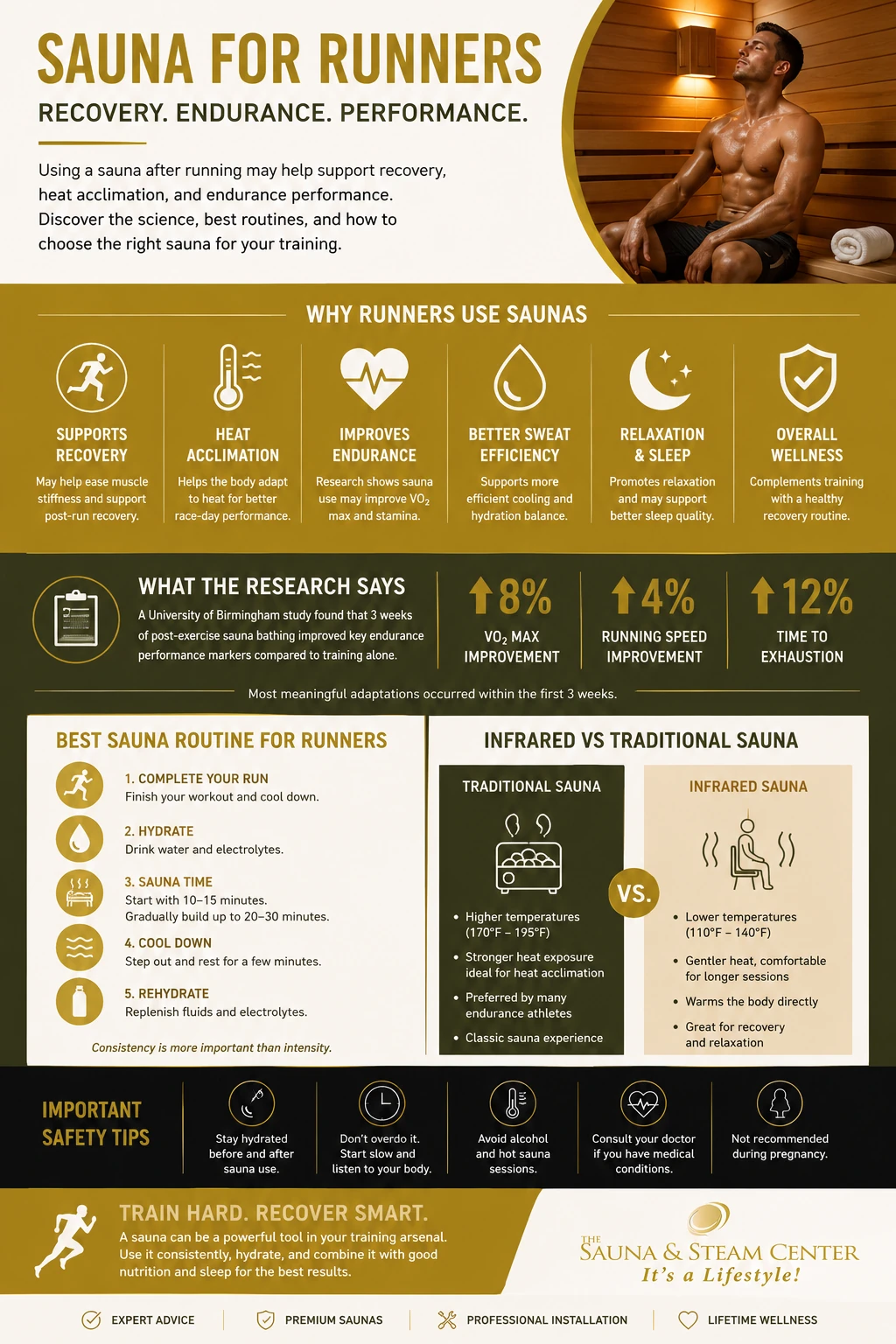
One of the most relevant studies for runners examined whether intermittent post-exercise sauna bathing could improve heat tolerance and endurance performance more than endurance training alone. The study found that three weeks of post-exercise sauna bathing produced heat acclimation adaptations and improved several performance markers.
The reported improvements included:
- VO2 max improved by about 8%
- Running speed at a set blood lactate level improved by about 4%
- Time to exhaustion improved by about 12%
The study also found that most of the meaningful adaptation occurred within the first three weeks. Extending the protocol to seven weeks did not appear to create major additional physiological improvement.
Bottom line: the strongest article angle is not “sauna magically improves running.” The more accurate takeaway is that post-run sauna use may be a practical heat acclimation tool for trained runners when added carefully to an endurance program.
This is why this article should be treated as a runner-specific performance and heat training guide, not a duplicate of our broader guide on using a sauna after the gym. That article is better for general post-workout use, while this one focuses on runners, endurance, VO2 max, heat tolerance, and race preparation.
Can Sauna Improve VO2 Max?
Possibly, but it is important to understand what that means. VO2 max is the maximum amount of oxygen your body can use during intense exercise. It is one of the most common measurements of aerobic fitness, but it is not the only factor that determines running performance.
Sauna sessions do not replace running workouts. You still need mileage, intensity, strength, recovery, and race-specific training. However, post-exercise heat exposure may support adaptations that can help endurance athletes perform better in certain conditions.
How Sauna May Support Endurance Adaptation
Researchers often discuss several possible mechanisms:
- Increased plasma volume, which may help cardiovascular efficiency
- Improved thermoregulation during heat stress
- Greater sweat response over time
- Improved tolerance to exercising in warm environments
- Reduced relative strain during hot-weather exercise
For a runner, this may translate into better comfort when holding pace in heat, especially during summer training or races in warm climates. It does not guarantee faster race times, but it may support the conditions that make better performance possible.
How Sauna Helps With Heat Acclimation
Heat acclimation is the process of adapting to hot conditions. Runners who are not adapted to heat often see heart rate rise faster, perceived effort increase, and performance drop earlier than expected.
This matters for:
- Marathon runners
- Half-marathon runners
- Triathletes
- Trail runners
- Track athletes training through summer
- Florida runners preparing for humid races
Post-run sauna use may help create a controlled heat exposure stimulus after the workout is complete. That makes it attractive because the runner can complete the training session first, then add heat exposure without compromising workout quality as much as running hard in extreme heat might.
Why Post-Run Timing Matters
For most runners, sauna use makes more sense after a workout than before one. Using a sauna before running may increase fluid loss, raise body temperature, and make the run feel harder. After running, the sauna becomes part of the recovery and adaptation window.
If you are building a dedicated recovery area, a well-planned home sauna setup can make this type of routine easier to maintain without depending on a gym or spa schedule.
Sauna and Running Recovery
Many runners first consider sauna use because they want to recover better. Heat may temporarily increase circulation, help muscles feel looser, and create a calming recovery ritual after demanding sessions. That can be valuable, especially when the routine encourages the runner to slow down, hydrate, and rest.
Still, sauna use should be framed realistically. A sauna will not erase poor recovery habits. It cannot make up for too little sleep, under-fueling, excessive mileage, or dehydration.
What Sauna May Help With
- Relaxation after intense workouts
- Temporary relief from stiffness
- A consistent post-run recovery habit
- Heat tolerance for warm-weather training
- Better routine structure around hydration and rest
What Sauna Does Not Replace
- Sleep
- Easy days
- Strength training
- Proper nutrition
- Electrolyte replacement
- Medical care for injuries
Some athletes also like pairing sauna sessions with cold exposure. If you are comparing recovery methods, our guide to sauna and cold plunge benefits explains where contrast therapy may fit and why the evidence depends on timing, goals, and training intensity.
Best Sauna Routine for Runners
The best sauna routine for runners is gradual, repeatable, and safe. The goal is adaptation, not punishment.
Beginner Sauna Routine After Running
- Finish your run and cool down first.
- Drink water and allow your heart rate to settle.
- Start with 10 to 15 minutes in the sauna.
- Keep the first few sessions moderate rather than extreme.
- Stop if you feel dizzy, nauseous, weak, or unusually lightheaded.
- Rehydrate with fluids and electrolytes afterward, especially after long runs.
Intermediate Routine for Heat Adaptation
Once you know you tolerate sauna sessions well, many runners move toward 15 to 30 minutes after easier runs or moderate training days. Some athletes use this approach 2 to 4 times per week during a heat acclimation block.
Avoid stacking your hardest run, longest sauna session, poor hydration, and low sleep on the same day. That is where a helpful tool can become too much total stress.
Race Week Considerations
During race week, avoid trying a new aggressive sauna routine. If you have not practiced sauna use during training, race week is not the time to experiment. Keep sessions shorter, familiar, and hydration-focused.
Traditional vs Infrared Sauna for Runners
Both traditional and infrared saunas can be useful, but they feel different and may serve different goals.
Traditional Sauna for Heat Training
Traditional saunas usually operate at higher air temperatures. For runners focused on heat acclimation, race preparation, and a stronger heat stimulus, this is often the preferred option.
Traditional saunas may be a strong fit if you want:
- A hotter sauna environment
- A classic Finnish-style sauna experience
- More intense heat exposure
- Outdoor or custom build flexibility
- A recovery space that can serve multiple people
For runners comparing heat styles, our guide to infrared vs traditional sauna is the best next read because it explains the differences in heat, comfort, installation, and everyday use.
Infrared Sauna for Frequent Recovery Use
Infrared saunas typically operate at lower ambient temperatures. Many people find them easier to tolerate, especially for longer or more frequent sessions.
Infrared may be a good fit if you want:
- A gentler-feeling heat experience
- Simple daily wellness use
- A compact home recovery option
- Faster warm-up times in many models
- A lower-temperature environment
For runners who are newer to sauna use, infrared can feel more approachable. For runners specifically chasing heat acclimation, traditional heat may be more relevant.
Common Sauna Mistakes Runners Make
Using the Sauna While Already Dehydrated
Running causes fluid loss. Sauna use causes more sweating. Combining both without hydration can increase the risk of dizziness, headaches, cramping, or overheating.
Going Too Hot Too Quickly
A runner does not need to prove toughness in the sauna. Gradual exposure is safer and more sustainable than jumping straight into long, high-heat sessions.
Using Sauna Before Hard Runs
Most runners should avoid sauna use before demanding workouts. Pre-run heat exposure may increase fatigue and fluid loss before the workout even begins.
Ignoring Electrolytes
Water matters, but electrolytes also matter after heavy sweat loss. This is especially true for long-distance runners and anyone training in South Florida heat.
Assuming More Is Always Better
More heat does not always mean more benefit. A sauna session should support your training, not leave you drained for the next workout.

Choosing a Home Sauna for Running Recovery
For runners who train year-round, a home sauna can make recovery more consistent. Instead of relying on a gym sauna, you can build heat exposure into your normal training rhythm.
When helping runners choose a sauna, we usually look at:
- Indoor vs outdoor placement
- Traditional vs infrared heat style
- Electrical requirements
- Available space
- How many people will use it
- Ventilation and comfort
- Long-term durability
- Whether the sauna is for recovery, heat training, relaxation, or all three
Indoor Sauna Considerations
Indoor saunas can work well in home gyms, spare rooms, wellness rooms, garages, and primary suite areas. They are convenient, private, and easy to use after treadmill runs or strength sessions.
Outdoor Sauna Considerations
Outdoor saunas are popular for backyard wellness spaces, pool areas, and properties where indoor space is limited. In Florida, outdoor sauna planning should consider weather exposure, proper materials, electrical planning, and long-term durability.
If you are comparing layouts and long-term value, our home sauna buying guide can help you understand the difference between custom, prebuilt, portable, indoor, and outdoor sauna options.
The best sauna for runners is not always the biggest or most expensive. It is the one that fits your routine, supports safe use, and gets used consistently.
Safety Notes for Runners
Sauna use is generally well tolerated by many healthy adults, but runners should take safety seriously because training already creates heat, sweat, and cardiovascular stress.
Use extra caution if you:
- Have blood pressure concerns
- Have a heart condition
- Are pregnant
- Take medications that affect sweating, hydration, or blood pressure
- Have a history of fainting, heat illness, or dehydration
- Are recovering from illness or injury
Do not use sauna sessions as medical treatment or as a replacement for professional care. When in doubt, ask a qualified healthcare professional before starting a regular sauna routine.
Frequently Asked Questions
Is sauna good for runners?
Sauna use may be helpful for runners when used safely after workouts. It may support heat acclimation, relaxation, and endurance-related adaptation, but it should be combined with proper training, hydration, nutrition, and recovery.
Should runners use a sauna before or after running?
Most runners should use a sauna after running, not before. Sauna use before a workout may increase fatigue, dehydration risk, and heat stress.
How long should runners stay in a sauna?
Many runners start with 10 to 15 minutes. More experienced users may build toward 15 to 30 minutes depending on heat tolerance, hydration, and training load.
Can sauna improve VO2 max?
Some research suggests post-exercise sauna bathing may improve VO2 max and endurance markers in trained athletes. The sauna should be viewed as a support tool, not a replacement for aerobic training.
Is a traditional sauna or infrared sauna better for runners?
Traditional saunas are often better for stronger heat acclimation because they usually operate at higher air temperatures. Infrared saunas may be better for comfort, gentler heat, and frequent recovery use.
Can sauna help with marathon training?
Sauna use may help runners prepare for warm-weather races by supporting heat acclimation. It should be introduced during training, not suddenly during race week.
Can sauna replace recovery days?
No. Sauna sessions should not replace easy days, rest days, sleep, nutrition, or injury management. They work best as part of a complete recovery routine.

Conclusion
Sauna for runners is most valuable when it is used as a smart support tool. It may help with heat acclimation, post-run relaxation, and endurance-related adaptation, especially when used consistently after training. The key is to use it gradually, hydrate well, and avoid turning recovery into another source of excessive stress.
At Sauna & Steam Center, we help runners, athletes, and wellness-focused homeowners choose sauna systems that fit real routines. Whether you are building a compact recovery space, comparing infrared and traditional heat, or planning a custom indoor or outdoor sauna, the right setup can make recovery easier to maintain year-round.
References
- PubMed: Post-exercise sauna bathing and endurance training adaptations
- Harvard Health Publishing: Sauna health benefits and risks
- Cleveland Clinic: Infrared sauna benefits and safety considerations
- American Heart Association: Heart health information and wellness guidance
- CDC NIOSH: Heat stress and heat illness basics