Swim Spa Hot Tub Guide: How to Choose, Plan, and Install the Right Model
Editorial disclosure: Sauna & Steam Center sells, plans, installs, and services residential and commercial wellness systems. We work with our sister company, Florida Hot Tub & Sauna, to present available TidalFit swim spa models. Product and installation guidance reflects industry experience and current public manufacturer information. Specifications, prices, warranties, codes, and availability can change, so the current model documents and local requirements always control.
Quick answer:
A swim spa hot tub is a self-contained aquatic system that combines a swim or exercise area with heating, filtration, and spa-style features. A single-zone model uses one body of water at one temperature, while a dual-zone model separates the exercise pool from the hot tub so each side can operate at a different temperature. The best choice depends on how the household will use it, the available space, delivery access, structural support, electrical capacity, and long-term service plan.
A swim spa hot tub can provide resistance swimming, low-impact exercise, family recreation, and hydrotherapy in a footprint that is smaller than many traditional pools. For South Florida homeowners, the difficult part is rarely understanding the concept. The real challenge is selecting the correct configuration and planning the foundation, electrical service, delivery route, drainage, permits, and future service access before the unit arrives.
This guide explains single-zone and dual-zone systems, compares swim spas with hot tubs and pools, presents the available TidalFit models, and outlines the practical installation questions that affect the total project. Buyers creating a broader home-wellness space can also review our guide to hydrotherapy at home for realistic context about relaxation and warm-water use.
Important note:
Never engineer a slab, size an electrical circuit, schedule a crane, or begin excavation from a general article. Use the exact model’s current data plate, pre-delivery guide, owner’s manual, written warranty, approved plans, and requirements from the authority having jurisdiction. Structural, electrical, and permit work should be handled by appropriately licensed professionals.
Key Takeaways
- Choose the configuration around how the household will use it most: swimming, aquatic exercise, family recreation, hot-water relaxation, or a combination.
- A single-zone swim spa uses less space and is generally simpler, but swimming and soaking must share one water temperature.
- A dual-zone model is more practical when the household wants a cooler exercise area and a hotter spa area available at the same time.
- The equipment price is only one part of the project. Foundation work, electrical service, permits, delivery, crane access, drainage, decking, and service access can materially change the total.
- The safest buying sequence is to define the use case, shortlist models, complete a site review, verify structure and power, and approve delivery logistics before ordering.
Is a Swim Spa Hot Tub Right for Your Home?
A swim spa hot tub is most useful for households that want more than seated soaking but do not need the open area of a conventional swimming pool. It can support swimming in place, water walking, resistance exercise, stretching, recreation, and spa-style relaxation. It is less suitable for buyers who mainly want a compact social hot tub or who expect the long, uninterrupted lap distance of a full-size pool. The decision becomes easier when you rank four priorities: swimming performance, aquatic exercise, family use, and hot-water hydrotherapy. When exercise is the main goal and hot soaking is occasional, a single-zone model may be enough. When exercise and true hot-tub use must happen at the same time, a dual-zone FitSpa is usually the better match, provided the property can support the longer footprint and greater project complexity.
Simple summary:
A swim spa is a good fit when exercise space is important. A dual-zone model is the stronger choice when separate swimming and hot-soaking temperatures are essential.
What Is a Swim Spa Hot Tub?
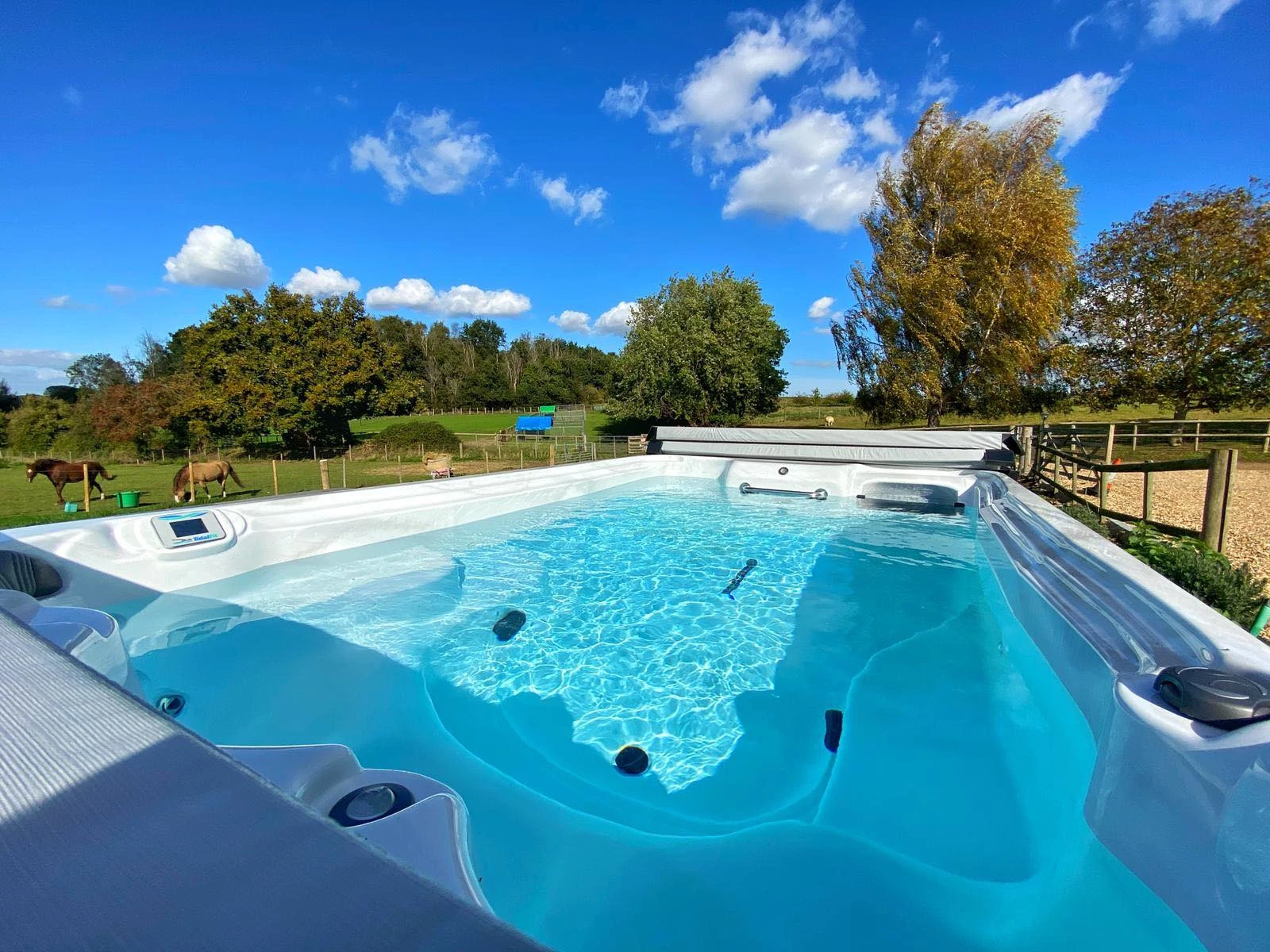
A swim spa hot tub combines elements of a compact pool and a portable spa. The shell, pumps, controls, filtration, heater, and cabinet arrive as an integrated system. Instead of swimming laps from one end of a large pool to the other, the user swims in place against an adjustable current or jet system. The phrase can describe two product types. A single-zone swim spa places the swim area, exercise space, spa seating, and hydromassage jets in one shared body of water. A dual-zone swim spa hot tub uses a physical divider and separate controls so the exercise side and hot-tub side can operate independently. For buyers focused mainly on warm soaking, a conventional hot tub may be more practical. Read our hot tub pricing guide to understand the cost categories that apply to a smaller, dedicated spa.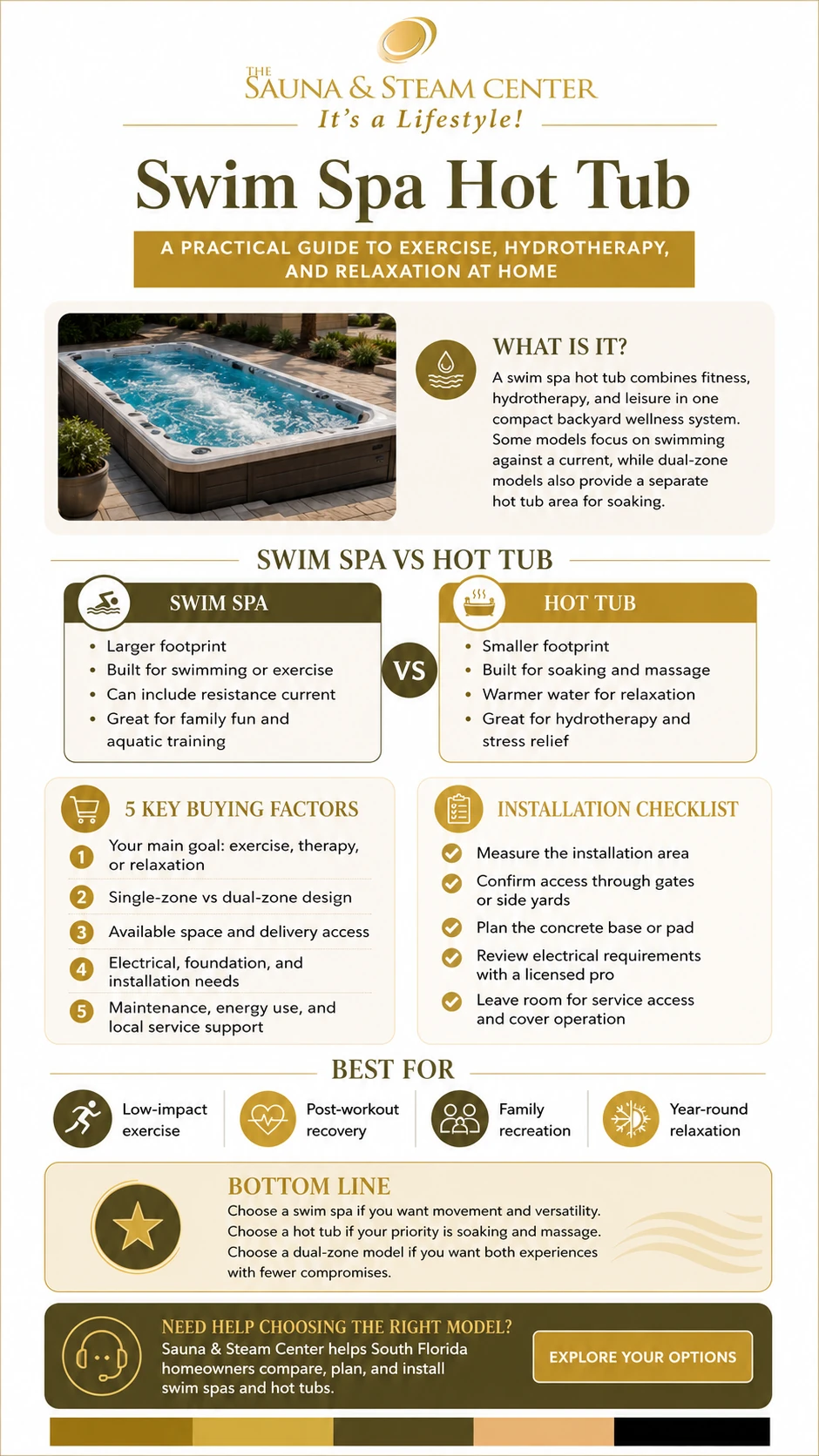
How Does a Swim Spa Hot Tub Work?
A swim spa circulates, filters, and heats a large volume of water through an integrated equipment system. A swim-current or resistance system moves water toward the swimmer, allowing the person to remain in one place. Separate therapy pumps may power hydromassage seats, while controls manage temperature, filtration cycles, lighting, and optional accessories.The swimming and exercise area
Current quality matters as much as advertised pump power. The best system for a household depends on swimmer ability, body position, desired resistance, and whether the primary activities are swimming, walking, rowing, aquatic conditioning, or recreation. Strong swimmers should test a comparable current system when possible.The hydrotherapy and soaking area
Spa-style seating can include directional jets, lounge positions, and separate pump controls. In a single-zone model, the same water must serve both exercise and soaking. In a dual-zone model, the hot-tub side can remain warmer while the exercise side stays more comfortable for movement.- The heater maintains the selected water temperature within the model’s operating limits.
- Filtration and sanitation manage debris and water quality.
- An insulated cover reduces heat loss and helps keep contamination out.
- Steps, rails, cover lifters, exercise equipment, and lighting affect daily usability.
What Do Manufacturer and Safety Guidelines Say?
The most important installation facts come from the current manufacturer documents for the exact model. The posted TidalFit owner’s manual instructs installers to use a structurally sound, level foundation that supports the entire unit. It identifies reinforced concrete as the preferred foundation for the models covered by that manual and states that improper foundation work can affect warranty coverage. The same posted manual describes dedicated 240 VAC hardwired electrical configurations with GFCI protection for covered products. CDC guidance states that hot tub water should not exceed 104°F. The U.S. Department of Energy treats portable electric spas as energy-regulated products, but actual operating cost still depends on water volume, temperature, insulation, cover condition, pump schedules, local weather, and electricity rates.How We Evaluated the Information
We gave the most weight to manufacturer manuals and specifications for product-specific requirements, government sources for safety and permit context, and local authority information for South Florida planning. Dealer pages were used to identify models currently displayed for sale. General cost averages and promotional claims were treated more cautiously because they may not reflect a specific model, property, utility rate, or jurisdiction.
Evidence note:
A general guide cannot replace the exact product documents or local approvals. Manuals, model configurations, warranty language, codes, and dealer availability can change after publication.
Seven Project Factors to Plan Before Buying a Swim Spa Hot Tub
1. Complete equipment and project cost
There is no single honest installed price because a swim spa project contains several cost categories. The model, swim-current technology, hydrotherapy package, dual-zone construction, freight, foundation, electrical work, crane access, permits, decking, drainage, and long-term ownership costs all affect the total. TidalFit pricing on the local dealer site is quote-based, so a current model-specific quote is more reliable than an old national average.2. Foundation and structural support
A filled swim spa is a major structural load. Water weighs about 8.34 pounds per gallon before adding the dry unit, accessories, and occupants. Do not assume that an existing patio, paver area, deck, rooftop, or elevated floor can support the system. Confirm the exact filled weight, cabinet footprint, equipment-access sides, soil conditions, and drainage plan before construction.3. Electrical capacity and disconnect location
Swim spas are generally not plug-and-play products. A licensed electrician should verify the home’s available service capacity, the exact voltage and amperage shown on the model documents, GFCI protection, bonding, grounding, conductor route, disconnect location, trenching, and inspection timing. Plan this work before pouring concrete or closing trenches.4. Delivery route and crane logistics
Measure the complete route from the street to the final pad. Document driveway width, gates, side yards, roof overhangs, power lines, trees, screen enclosures, soft ground, drainage structures, neighboring property, and intended equipment-panel orientation. A crane may be the safest solution when direct access is limited, but the crane company may need unit weight, lift radius, setup area, ground-bearing information, traffic control, or additional permits.5. Permits, setbacks, barriers, and HOA review
Requirements vary by city, county, property type, and project scope. The local authority may request surveys, zoning review, setbacks, electrical permits, structural plans, barriers, alarms, approved covers, or engineering. Waterfront restrictions, easements, septic areas, flood-zone requirements, and HOA architectural rules may also affect placement.6. Drainage and South Florida weather
Heavy rain, strong sun, humidity, wind, and salt air affect the installation. Grade the site so roof water, sprinklers, and yard drainage do not repeatedly soak the cabinet or equipment bay. A recessed installation needs a deliberate way to remove rainwater. Near coastal areas, inspect exposed metal, fasteners, cover hardware, electrical enclosures, and nearby structures more frequently.7. Service access and future removal
Decks, walls, planters, and landscaping should not permanently block removable panels, ventilation, pumps, controls, heaters, plumbing, or electrical components. Plan how technicians will work around the unit and how the swim spa could eventually be removed or replaced without destroying the surrounding project.Explore Available TidalFit Swim Spa Hot Tub Models
Sauna & Steam Center works with our sister company, Florida Hot Tub & Sauna, to help South Florida homeowners compare TidalFit exercise pools and dual-temperature FitSpas. The currently displayed collection includes five single-zone exercise-pool models and four dual-temperature models. Product options, dimensions, specifications, and availability can change, so confirm the current specification sheet before engineering the pad or electrical service.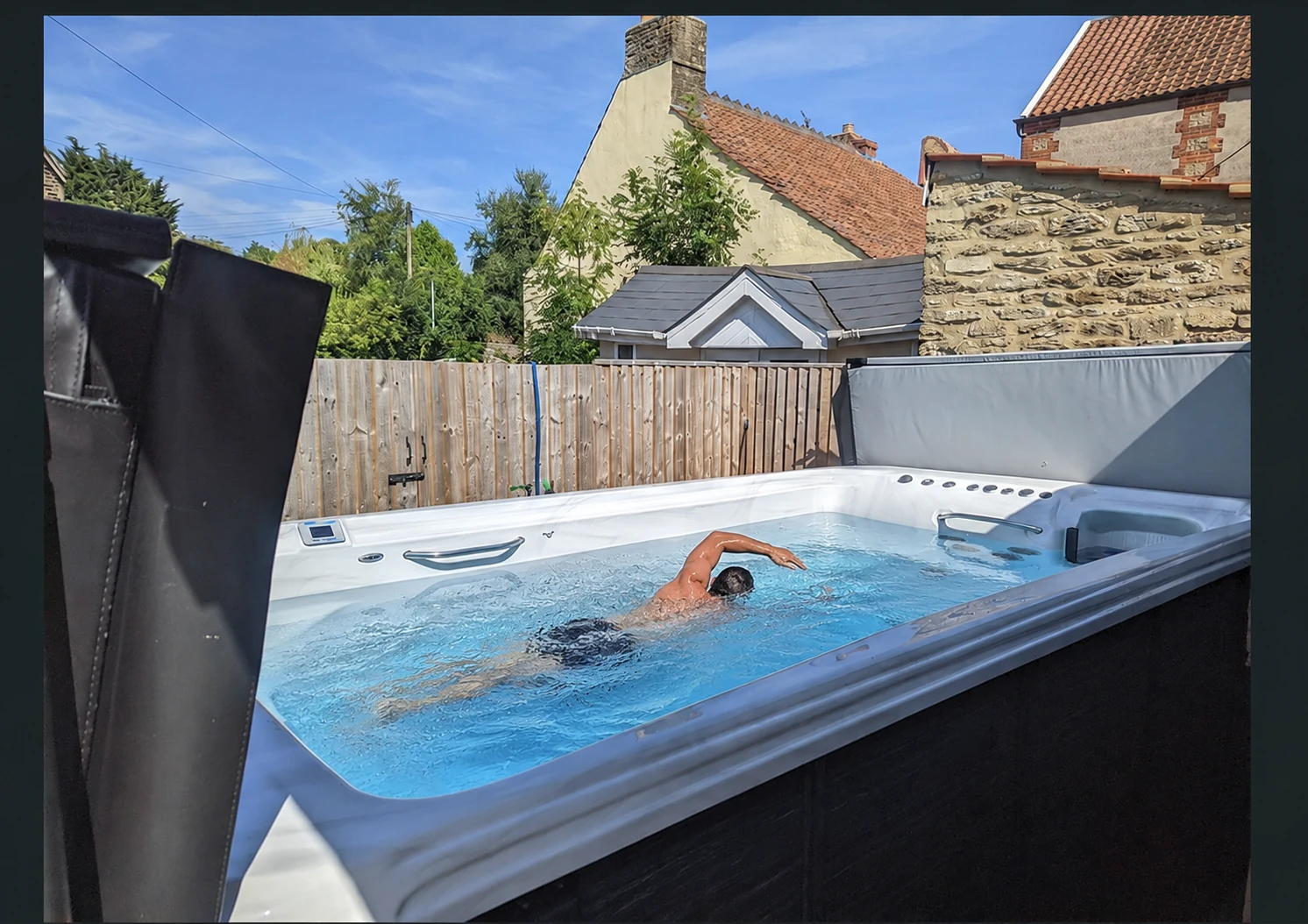
Single-zone TidalFit exercise pools
| Model | General Positioning | Who Should Explore It |
|---|---|---|
| TidalFit Active EP-12 | Compact 12-foot exercise-pool format with spa-style features. | Buyers balancing limited space with swimming, exercise, and warm-water use. |
| TidalFit ActivePlus EP-12 | Another 12-foot format with expanded swim-system and hydrotherapy possibilities. | Buyers who want compact dimensions with more configuration flexibility. |
| TidalFit Premium EP-14 | Longer 14-foot exercise pool with manufacturer-listed swim and seating options. | Households wanting more interior length without moving to the largest format. |
| TidalFit Pro EP-15 | Performance-oriented 15-foot exercise-pool layout. | More serious swimmers and fitness-focused buyers seeking additional length. |
| TidalFit Core Swimmer | Exercise-focused model that prioritizes swimming and aquatic conditioning. | Customers placing swim use ahead of built-in lounge seating. |
Dual-temperature TidalFit FitSpas
| Model | General Positioning | Who Should Explore It |
|---|---|---|
| TidalFit Dual Temp FITSPA DTL-6 | Dual-temperature configuration paired with a dedicated hot-tub section. | Households wanting separate exercise and soaking water in a more compact dual-zone format. |
| TidalFit Dual Temp FITSPA DTL-8 | Dual-temperature layout with additional spa-seating emphasis. | Families prioritizing both aquatic exercise and social hot-tub use. |
| TidalFit Dual Temp FITSPA DT-19 | Larger dual-zone model that separates exercise water from hot soaking water. | Properties with enough space for a longer, more complex installation. |
| TidalFit Dual Temp FITSPA DT-21 | Large two-zone format with independently controlled exercise-pool and hot-tub areas. | Buyers wanting substantial swim space and a dedicated hot tub in one system. |
Model availability:
Use the full product URLs above to review each model, then confirm current dimensions, equipment, warranty terms, availability, and pricing directly with the dealer before beginning site work.
Swim Spa vs Hot Tub vs Swimming Pool
The main difference is intended use. A hot tub prioritizes seated soaking, a swim spa adds exercise and recreation, and a traditional pool provides the largest open-water area but usually requires more construction and property modification.| Option | How It Works or Feels | Best For | Important Consideration |
|---|---|---|---|
| Traditional hot tub | Compact vessel with warm water, seating, and hydromassage jets. | Relaxation, conversation, and dedicated hot soaking. | Not designed for meaningful swimming or aquatic conditioning. |
| Single-zone swim spa | One body of water supports swimming, exercise, recreation, and spa-style seating. | Fitness-focused households comfortable sharing one temperature. | Exercise and maximum-temperature soaking cannot be optimized simultaneously. |
| Dual-zone swim spa hot tub | Separate exercise and hot-tub areas use independent temperature controls. | Households wanting swimming and hot soaking at the same time. | Larger footprint, more water, and greater installation complexity. |
| Traditional in-ground pool | Large open-water area with broad design flexibility. | Lap distance, large gatherings, and extensive recreation. | More construction, yard disruption, and property-specific maintenance. |
When a single-zone swim spa is better
Choose a single-zone model when swimming, water walking, low-impact exercise, or family recreation are the primary goals; when the household can adjust temperature between activities; and when reducing footprint and maintenance complexity matters.When a dual-zone model is better
Choose a dual-zone model when different users want different experiences at the same time, when hydrotherapy seating is a major priority, and when the property can support the additional length, electrical demand, water volume, and service access.How to Plan a Swim Spa Hot Tub Installation in South Florida
The safest project sequence resolves property constraints before the purchase becomes difficult to change. Complete the site and utility review using the exact shortlisted models, not generic dimensions.- Define the use case. Rank swimming, fitness, family use, and hot-water hydrotherapy in order of importance.
- Shortlist models. Compare actual dimensions, water capacity, seating, current systems, electrical requirements, and warranty terms.
- Complete a site review. Measure the final location, service access, delivery path, drainage, setbacks, and overhead hazards.
- Verify structure and power. Coordinate the foundation professional, electrician, and permit requirements using the current model documents.
- Approve delivery logistics. Confirm unit orientation, crane or cart access, setup area, and responsibility for temporary obstacle removal.
- Build for serviceability. Preserve removable panels, equipment ventilation, GFCI access, safe circulation, and drainage.
- Complete startup and owner training. Review controls, filtration, chemistry, cover use, emergency shutoff, and maintenance records.
Important:
Do not permanently surround a swim spa with decking or walls until the service-panel locations, ventilation needs, equipment-removal clearances, drainage, and warranty access requirements have been verified.
Evidence at a Glance
The table below separates essential model-specific requirements from factors that depend on user preference or property conditions.| Claim, Feature, or Factor | Strength or Importance | Best Way to Understand It |
|---|---|---|
| Foundation design | Essential | Use the exact filled weight, current manual, soil conditions, and structural guidance. Do not rely on an existing patio without verification. |
| Electrical service | Essential | Use the model data plate and pre-delivery documents. A licensed electrician must verify capacity, GFCI protection, bonding, grounding, and disconnect placement. |
| Single-zone versus dual-zone | High decision importance | Base the choice on whether swimming and hot soaking must happen at different temperatures at the same time. |
| Swim-current performance | User-specific | Strong swimmers should test a comparable system because current feel and body position matter more than a simple pump-power claim. |
| Monthly operating cost | Variable | Estimate model-specific monthly kWh and multiply by the all-in electricity rate shown on the utility bill. |
| Local permits and barriers | Property-specific | Confirm with the city or county and HOA before ordering or beginning site work. |
Monthly Operating Cost, Water Care, and Maintenance
Monthly cost varies too much for one universal number. A 12-foot single-zone exercise pool, a large dual-zone FitSpa, and a conventional hot tub do not have the same water volume, heating load, or pump schedule. South Florida weather may reduce winter heating demand compared with colder climates, but high target temperatures, frequent cover removal, powerful swim pumps, and two independently heated zones can increase consumption.Use a model-specific electricity estimate
Estimate monthly electricity cost by multiplying the unit’s measured or estimated monthly kilowatt-hours by the all-in electricity rate shown on the utility bill. Ask for model-specific energy information and avoid applying a small-hot-tub estimate to a much larger swim spa.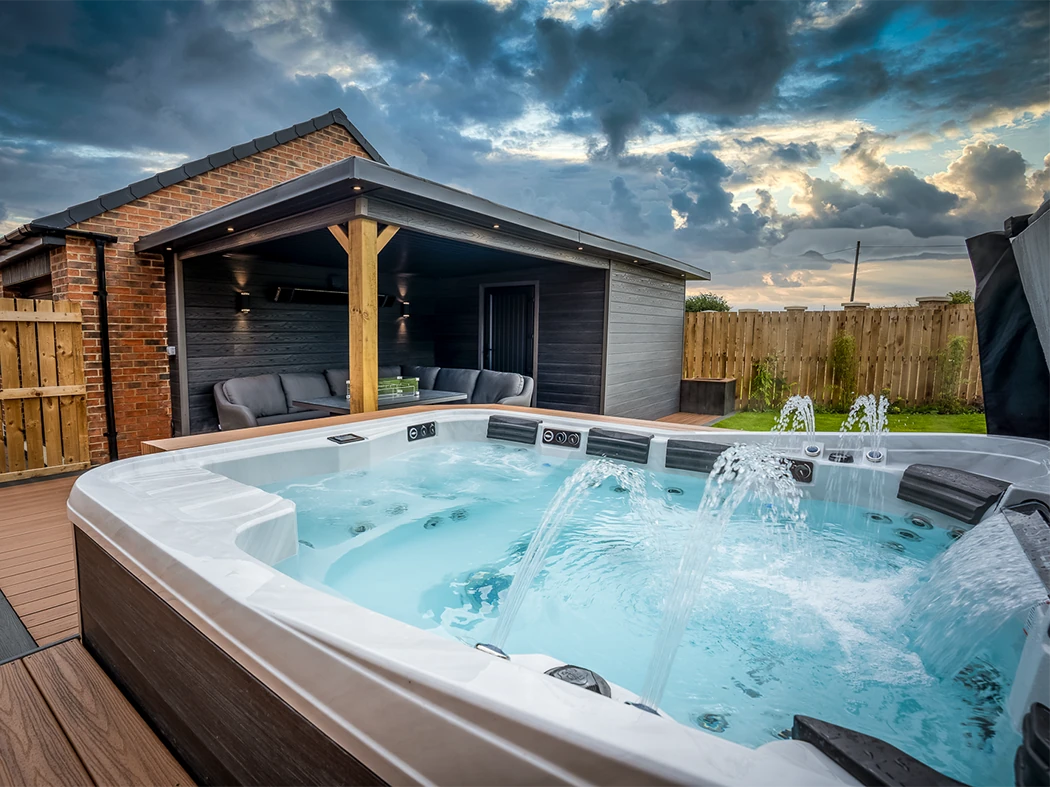
Factors that change operating cost
- Water volume and selected temperature.
- Single-zone versus two separately controlled bodies of water.
- Insulation quality, cabinet design, and cover condition.
- Hours of swim-pump, circulation-pump, and filtration operation.
- Frequency of use and how long the cover stays open.
- Shade, wind exposure, rainwater on the cover, and water-chemistry problems.
Practical maintenance routine
- Test and adjust sanitizer and pH according to the system and bather load.
- Clean filters regularly and replace them with approved components when needed.
- Inspect the cover, locks, seams, and water absorption.
- Limit leaves, sand, sunscreen, and body oils entering the water.
- Check the equipment bay for leaks, unusual sounds, corrosion, and pest activity.
- Drain, clean, and refill according to the current manual and actual water condition.
Limitations, Risks, and Common Buying Mistakes
What is well supported
Swim spas can provide a contained area for resistance swimming, water exercise, recreation, and warm-water use. Dual-zone designs solve the practical temperature conflict between exercise and hot soaking. Manufacturer manuals clearly establish the need for model-specific structural, electrical, drainage, and service-access planning.What is conditional
Whether a swim spa replaces a pool depends on the buyer. Serious lap swimmers may prefer a longer open-water environment. Some households use the swim system frequently, while others primarily use the spa seats after the novelty of swimming fades. Energy cost, maintenance time, and comfort also vary by model and use pattern.What is commonly overstated
A swim spa is not maintenance-free, a salt system does not eliminate water care, a high jet count does not guarantee better hydrotherapy, and a clean-looking site does not prove that a slab or electrical panel is adequate. The largest avoidable mistake is ordering a model before confirming the full site, delivery route, utility requirements, approvals, and service access.
Bottom line:
The right swim spa is selected as part of a complete property project, not as an isolated online product purchase.
When Should You Ask a Professional?
Professional guidance is needed whenever the project involves structural loading, hardwired electrical equipment, excavation, permits, barriers, elevated or indoor placement, crane delivery, or health conditions that affect heat tolerance. The appropriate professionals may include a licensed electrician, structural engineer, concrete contractor, pool or spa contractor, crane company, designer, building official, or healthcare professional.- The unit will sit on a deck, rooftop, elevated floor, questionable slab, or poorly compacted soil.
- The electrical panel may require a service upgrade or a long underground conductor route.
- The design is partially recessed, fully integrated into decking, indoors, or inside a screen enclosure.
- The property is waterfront, in a flood zone, affected by easements, or subject to strict HOA review.
- A user is pregnant, has cardiovascular concerns, takes medications affecting heat tolerance, or has another condition requiring individualized medical advice.
What Our Experience Since 2004 Has Taught Us
The most successful wellness projects begin with the property and the owner’s real habits, not with the largest model or longest feature list. Buyers are more satisfied when delivery, foundation, power, drainage, maintenance, and service expectations are discussed before the purchase.Access problems are often discovered too late
A model may fit the final space but still be impossible to move through the side yard, under power lines, past a screen enclosure, or around landscaping. Documenting the full route and crane setup area before ordering prevents expensive surprises.Service access matters more than decorative enclosure
Owners often want to surround the cabinet with decking, walls, planters, or stone. Those details can create a polished look, but they must remain removable where technicians need access. A beautiful installation becomes a service problem when pumps, heaters, controls, plumbing, or electrical components cannot be reached.South Florida drainage and exposure need deliberate planning
Heavy rain, direct sun, humidity, salt air, and storm preparation should affect placement and finish decisions. Water must drain away from the equipment bay, exposed materials should be appropriate for the environment, and the cover and surrounding structures should have a documented severe-weather plan.
Local support:
Sauna & Steam Center has served South Florida since 2004 and operates a physical showroom at 2801 Greene Street, Suite 1, Hollywood, Florida. Our goal is to help buyers think through selection, access, placement, installation coordination, maintenance, and service as one complete project.
How to Choose the Right Swim Spa Hot Tub
Begin with the activities that will happen every week, not the features that sound impressive in a showroom. Then eliminate models that do not fit the property, utility capacity, delivery route, or budget for the complete installation.- Will the household primarily swim, walk, exercise, entertain, soak, or combine several uses?
- Can one shared temperature satisfy everyone, or are separate zones necessary?
- Has the strongest swimmer tested a comparable current system?
- Is there enough room for the cabinet, stairs, cover movement, safe circulation, and every service panel?
- Has the filled weight, foundation, electrical capacity, drainage, delivery route, and permit path been verified?
- Who will perform warranty and post-warranty service, and how quickly are common parts available?
| Your Main Goal | What to Prioritize | Recommended Next Step |
|---|---|---|
| Swimming and aquatic fitness | Current quality, usable swim area, interior depth, exercise accessories, and temperature preferences. | Test a comparable swim system and compare the single-zone exercise-pool models. |
| Exercise plus true hot-tub soaking | Separate temperature zones, spa seating, equipment access, and the longer project footprint. | Compare the DTL and DT FitSpa models and complete a detailed site review. |
| Relaxation in a smaller space | Seat comfort, jet placement, ease of entry, operating cost, and service support. | Compare a conventional hot tub before paying for swim features that may be rarely used. |
| Complete outdoor wellness area | Site circulation, drainage, electrical capacity, privacy, complementary features, and total project budget. | Plan the property as one system and consider an outdoor sauna in Florida only where it fits the space and ownership goals. |
Plan Before You Purchase
Compare TidalFit Models With a South Florida Planning Team
Sauna & Steam Center can help you compare single-zone and dual-zone TidalFit models, evaluate the proposed location, and identify the foundation, electrical, delivery, drainage, permitting, and service questions that should be resolved before delivery.Frequently Asked Questions
Is a swim spa the same as a hot tub?
No. A hot tub is primarily designed for seated soaking and hydromassage. A swim spa provides a longer exercise area with a swim current or resistance system. Some swim spas include spa seats, while dual-zone models add a physically separate hot tub.Can a swim spa be used as a hot tub?
Yes, when the model includes hydrotherapy seating and the water is set to a comfortable soaking temperature. In a single-zone unit, raising the temperature for soaking may make vigorous swimming uncomfortable until the water cools again.Is a dual-zone swim spa worth it?
A dual-zone swim spa can be worth the extra footprint and project cost when the household genuinely wants swimming and hot-tub soaking at different temperatures at the same time. It may be unnecessary when exercise is the main use and warm soaking is occasional.What temperature should a swim spa be?
The right setting depends on the activity and user. Moderate swimming is generally more comfortable in cooler water than hot-tub soaking. CDC guidance says hot tub water should not exceed 104°F. Follow the manufacturer limits and seek individualized medical guidance when health conditions, pregnancy, or medications affect heat tolerance.Does a swim spa need a concrete pad?
Many installations use reinforced concrete because it provides stable, continuous support. The posted TidalFit manual specifies a structurally sound, level foundation and identifies a minimum six-inch reinforced concrete slab as the preferred solution for the models covered by that manual. Use the current model instructions and local engineering requirements.What electrical service does a swim spa need?
The posted TidalFit manual states that covered models require a dedicated 240 VAC hardwired system with GFCI protection, with 50-amp or 60-amp configurations shown depending on equipment. The final requirement comes from the exact model data plate and current pre-delivery documents.Do I need a permit for a swim spa in South Florida?
Often, yes, particularly when the project includes a slab, deck, electrical connection, plumbing, barriers, excavation, or permanent placement. Requirements differ by city and county. Confirm with the authority having jurisdiction before ordering or beginning site work.Can a swim spa be installed indoors?
Yes, but indoor installations require structural engineering, waterproof surfaces, floor drainage, humidity control, ventilation, and complete service access. The posted TidalFit manual warns that elevated humidity can contribute to mold, mildew, rot, and material deterioration when the room is not properly designed.Can a swim spa be installed partially in the ground?
Some models offer semi-inground configurations. The design must prevent water accumulation, maintain equipment ventilation, and preserve access to controls, pumps, heaters, and plumbing. Confirm the model’s approved installation options before excavation.Are saltwater swim spas maintenance-free?
No. Compatible salt systems can automate part of sanitizer production, but owners still need to test water, manage balance, clean filters, and inspect equipment. Salt can also accelerate corrosion when water chemistry, splash-out, or nearby materials are not managed properly.Conclusion: Choose the Model and the Installation Plan Together
A swim spa hot tub can combine exercise, family use, and hydrotherapy in a compact aquatic system. A single-zone model is usually the simpler choice for exercise-focused households, while a dual-zone FitSpa is better when swimming and hot-tub soaking must happen at different temperatures at the same time. The model should never be separated from the property plan. Foundation capacity, electrical service, delivery access, drainage, permits, climate exposure, maintenance, and serviceability can determine whether the project works as intended. Start by ranking your uses, comparing the available model specifications, and completing a professional site review before placing the order.References
- Artesian Spas: TidalFit Collection
- Artesian Spas: TidalFit Owner’s Manual
- Artesian Spas: Premium EP-14 Specifications
- Artesian Spas: DT-21 Specifications
- Miami-Dade County: Swimming Pool and Spa Permits
- Florida Building Code Online
- CDC: Staying Healthy in Hot Tubs
- CDC: Home Pool and Hot Tub Water Treatment and Testing
- U.S. Department of Energy: Portable Electric Spas
- Florida Power & Light: Rates and Billing