Sweat Bathing Guide: Saunas, Steam Rooms, Global Traditions & Home Wellness
Editorial and medical disclosure: Sauna & Steam Center sells, designs, installs and services sauna and steam systems. Product and installation guidance reflects our industry experience. Health information is educational and should not replace medical advice. The traditions discussed in this article also have important cultural, social and, in some cases, spiritual meanings that extend beyond modern wellness use.
Sweat bathing is the intentional use of a heated environment to warm the body, encourage sweating and create a structured period of rest, bathing or relaxation. Finnish saunas, Russian banyas, steam baths, Turkish hammams, Indigenous Mesoamerican temazcales and modern infrared cabins all connect to the broader history of heat-based bathing. Modern wellness spaces may also combine sauna or steam with cold plunges, showers, relaxation rooms and warm-water bathing to create a larger hydrothermal experience.
Sweat Bathing: Quick Answers
| What People Ask | Direct Answer |
|---|---|
| What is sweat bathing? | Intentional exposure to a heated environment for sweating, bathing, relaxation, ritual or social use. |
| Is sweat bathing the same as a sauna? | No. Sauna is one form of sweat bathing. Steam baths, banyas, hammams, temazcales and some infrared systems are other examples. |
| What are the main types of sweat baths? | Common examples include Finnish sauna, smoke sauna, Russian banya, steam bath, hammam, temazcal, infrared sauna and hybrid sauna systems. |
| What is hydrothermal bathing? | A broader category that combines heat, water, steam, cooling and rest. It can include saunas, steam rooms, warm pools, hot tubs, cold plunges and relaxation areas. |
| What is the difference between a sweat bath and a sauna? | Sauna describes a specific heat-bathing environment. Sweat bath is a broader term that can include several heat and steam traditions. |
| Does a steam room count as sweat bathing? | Yes. Steam rooms encourage sweating using moist heat and very high humidity. |
| Is infrared sauna sweat bathing? | Yes. Infrared cabins use radiant energy and generally lower air temperatures to create heat exposure and sweating. |
| Are hot tubs sweat baths? | Not strictly. Hot tubs are warm-water hydrotherapy, but they commonly appear alongside sweat-bathing facilities in modern wellness environments. |
| What are sweat bathing benefits? | The clearest immediate effects include warming, sweating and relaxation. Research has also explored cardiovascular and other outcomes, but evidence varies by sauna type, population and study design. |
| Does sweat bathing detox the body? | Sweating is primarily a temperature-regulation process. Avoid treating sauna or steam as a medical detoxification treatment. |
| Can I create sweat bathing at home? | Yes. Traditional sauna, infrared sauna, hybrid sauna and properly constructed steam rooms are the most practical residential options. |
| What is contrast bathing? | A routine that alternates warm or hot exposure with cooler air, showers or water. Cold exposure is optional and is not required to benefit from sauna or steam bathing. |
Key Takeaways
- Sweat bathing is much broader than sauna alone.
- Traditional sweat bathing has hygiene, social, cultural, ritual and relaxation roles.
- Finnish sauna, Russian banya, steam baths, hammams and temazcales all create different heat and humidity experiences.
- Infrared sauna is a modern form of passive heat exposure rather than a traditional cultural bathing system.
- Hot tubs and onsen belong more accurately to hydrothermal or warm-water bathing than to sweat bathing itself.
- Traditional sauna usually provides hotter, drier air than a steam room.
- Steam rooms use lower temperatures but much higher humidity.
- Laconiums and tepidariums function as gentler warm or relaxation spaces rather than intense sweat rooms.
- Cold plunges and contrast routines are optional additions, not requirements for sauna use.
- Research supports clear acute effects such as warming, sweating and changes in cardiovascular workload, while long-term medical claims require more caution.
- Homeowners can recreate many elements of thermal bathing with a sauna, steam room, shower, cold plunge and dedicated rest area.
- Commercial wellness design should consider circulation between hot, cool and rest spaces rather than treating every amenity as an isolated room.
What Is Sweat Bathing?
Sweat bathing refers to intentionally spending time in a heated environment that warms the body and generally produces perspiration.
Historically, these spaces were not created only for modern ideas of fitness or recovery. Depending on the culture, they have served purposes connected to:
- Bathing and cleanliness
- Rest and relaxation
- Family and community gatherings
- Hospitality
- Spiritual or ceremonial traditions
- Recovery after physical work
- Social connection
- Warmth in cold climates
Sweat Bathing Is Defined by More Than Temperature
Two rooms can both make you sweat while feeling completely different.
The experience is shaped by:
- Air temperature
- Humidity
- Radiant heat
- Air movement
- Room materials
- Heater design
- Water and steam
- Length of exposure
- Cooling between rounds
- Rest and hydration
- The cultural ritual surrounding the bath
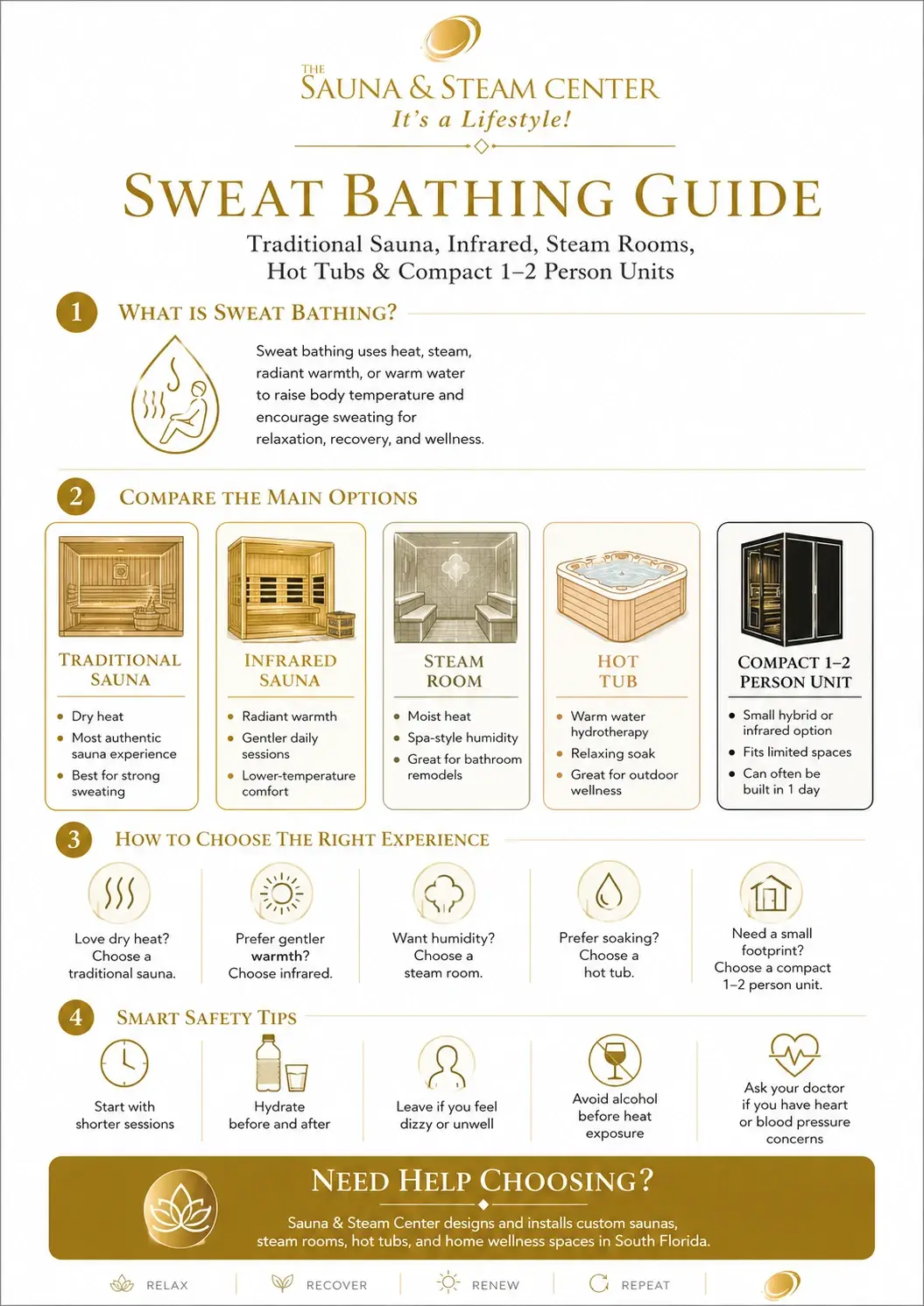
Sweat Bathing vs. Hydrothermal Bathing: What Is the Difference?
These terms overlap, but they are not identical.
| Term | Meaning | Examples |
|---|---|---|
| Sweat bathing | Heat exposure designed to warm the body and usually produce perspiration | Sauna, banya, steam bath, hammam, temazcal |
| Passive heat therapy | Modern research term for heat exposure without physical exercise | Sauna, hot-water immersion, other controlled heating |
| Hydrothermal bathing | Broader combination of heat, water, steam, cooling and rest | Sauna, steam room, hot pool, hot tub, cold plunge, shower |
| Contrast bathing | Alternating warmer and cooler thermal experiences | Sauna plus cool shower, steam plus cold plunge |
| Balneotherapy | Bathing in mineral or thermal water, often studied separately from sauna | Thermal springs and mineral baths |
Sweat Bathing Traditions Around the World
Human societies developed heat and bathing practices long before the modern wellness industry.
Climate, religion, architecture, available fuel, access to water and social customs all influenced how each tradition developed.
That history is important because terms such as sauna, banya, hammam and temazcal are not simply interchangeable marketing names.
Finnish Sauna: The Best-Known Sweat Bathing Tradition
Finnish sauna culture is one of the world’s most recognizable forms of sweat bathing and was added to UNESCO’s Representative List of the Intangible Cultural Heritage of Humanity in 2020.
A traditional sauna typically uses a wood-burning or electric heater with sauna stones to warm the room.
What Is Löyly?
A central feature of Finnish sauna culture is löyly, the heat and steam sensation created when water is poured onto heated sauna stones.
This temporarily raises humidity and changes how the heat feels against the skin.
What Defines the Experience?
- Wood-lined room
- Elevated benches
- Sauna heater and stones
- High-temperature environment
- Relatively low background humidity
- Optional water on appropriate sauna stones
- Periods of cooling and rest
Smoke Sauna: An Older Sauna Tradition
A smoke sauna represents one of the older sauna-heating methods.
Instead of continuously venting smoke through a chimney while the fire burns, the room and large mass of stones are heated before bathing begins. The bathing environment is prepared after the heating phase.
The smoke-sauna tradition of Võromaa in Estonia is also recognized by UNESCO as intangible cultural heritage.
Russian Banya: Heat, Humidity and Social Bathing
The Russian banya shares several characteristics with northern European sauna traditions but often incorporates greater humidity and a more explicitly social bathing routine.
Traditional banya culture may also include leafy branch bundles known as veniki, cooling periods, washing and extended periods of rest and conversation.
Banya vs. Finnish Sauna
| Feature | Finnish Sauna | Russian Banya |
|---|---|---|
| Main heat style | Hot sauna room with relatively low background humidity | Hot environment that may be operated with greater humidity |
| Water on stones | Common where heater permits | Common |
| Traditional branch use | Birch whisks may be used in some Finnish traditions | Veniki are strongly associated with banya culture |
| Social component | Important | Often especially prominent |
| Cooling and rest | Common | Common |
Turkish Hammam: Heat, Steam, Washing and Social Ritual
The hammam developed from a long Mediterranean and Middle Eastern public-bathing tradition influenced in part by earlier Roman and Byzantine bath architecture.
Historically, hammams were not simply steam rooms. They were complete bathing environments that combined warm rooms, washing, heated surfaces, humidity, social interaction and rest.
Hammam vs. Modern Steam Room
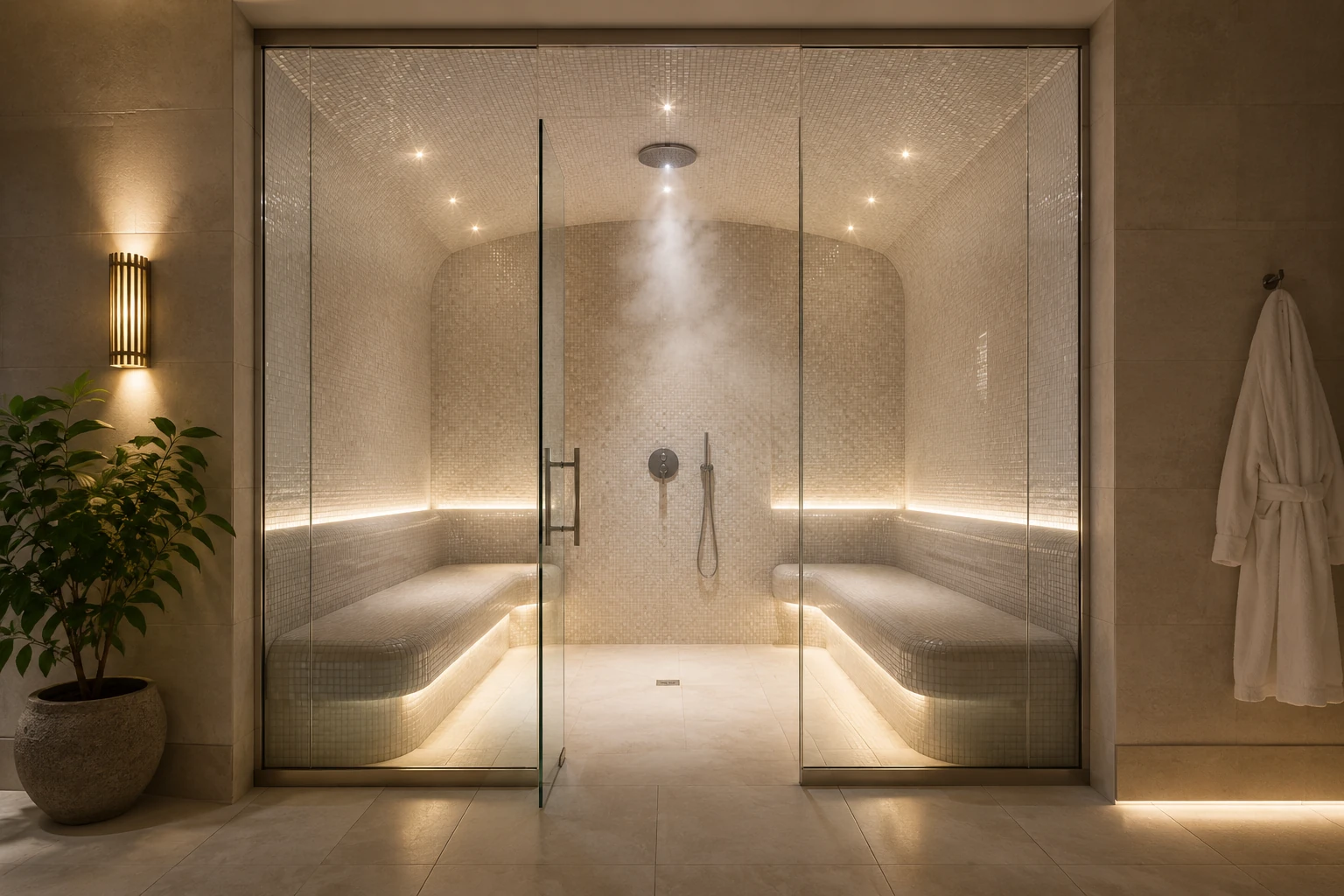
A modern residential steam room recreates one important element of the hammam experience: a warm environment with very high humidity.
It does not automatically recreate the full architectural or cultural bathing ritual.
Modern Home Translation
For a homeowner seeking a hammam-inspired environment, the practical equivalent may include:
- Steam generator
- Fully waterproofed room
- Tile or stone surfaces
- Built-in seating
- Warm lighting
- Hand shower or rinse station
- Approved aromatherapy system
- Separate cool-down or rest space
For construction details, see our Home Steam Room Guide .
Temazcal and Traditional Sweat Lodges
The temazcal is a traditional Mesoamerican heat and steam-bathing structure with Indigenous cultural roots.
Historic and living temazcal practices can include hygiene, childbirth, medicine, community and ceremony depending on the people and tradition involved.
Is a Temazcal the Same as a Sauna?
No.
Both can expose the body to substantial heat, but the construction, heating method, humidity, cultural meaning and bathing practices can be very different.
Should You Build One as a Home Sauna?
If your goal is simply residential heat bathing, a traditional sauna or steam room is generally easier to engineer, control, ventilate, service and operate predictably.
Laconium, Tepidarium and Other Warm Rooms
Not every room in historic thermal bathing was designed to produce maximum sweating.
Roman and later European bathing systems used sequences of rooms at different temperatures.
| Room | General Role | Modern Equivalent |
|---|---|---|
| Caldarium | Hot bathing room | Closest in concept to a hot steam or thermal room |
| Laconium | Warm or hot dry relaxation room | Gentler heated relaxation room |
| Tepidarium | Warm transitional and relaxation room | Heated lounge or recovery space |
| Frigidarium | Cooler bathing or recovery space | Cool shower, plunge or cooling room |
Why This Matters for Modern Wellness Design
A luxury thermal space does not need every room to be extremely hot.
A quieter warm bench, lounge or recovery zone can improve the experience by giving users somewhere comfortable to rest between hotter sessions.
Japanese Onsen and Korean Bathhouse Culture
Japanese Onsen
An onsen is a Japanese hot-spring bathing tradition centered primarily on natural geothermal water.
It is therefore better classified as thermal-water bathing than sweat bathing.
Cleanliness, pre-bathing washing, quiet behavior and respect for shared water are central to traditional public onsen etiquette.
Korean Jjimjilbang
A Korean jjimjilbang is better understood as an entire bathhouse and wellness environment rather than one specific sauna room.
Depending on the facility, it may combine:
- Heated rooms
- Hot baths
- Cold baths
- Showers
- Heated floors
- Relaxation spaces
- Food
- Social gathering areas
Modern Infrared and Hybrid Sweat Bathing
Infrared sauna is a much newer category than Finnish sauna, banya or hammam culture.
Instead of relying primarily on very hot room air, infrared cabins use radiant emitters to transfer energy toward the user and surrounding surfaces.
Infrared Sauna
Infrared systems generally operate at lower air temperatures than traditional saunas.
They can be attractive to homeowners who prefer:
- Gentler-feeling heat
- Compact cabin sizes
- Indoor installation
- Simple controls
- Private one- or two-person use
Hybrid Sauna
A hybrid sauna combines more than one heat format, commonly infrared emitters plus a conventional sauna heater.
This can allow one household to choose between lower-temperature radiant heat and traditional higher-temperature sauna bathing.
Compare the two main heat formats in our Infrared vs. Traditional Sauna Guide .
Types of Sweat Bathing Compared
| Experience | Heat Style | Humidity | Primary Experience | Practical Home Equivalent |
|---|---|---|---|---|
| Finnish sauna | Hot room and heated stones | Usually lower, with temporary increases from löyly | Traditional high-heat sauna bathing | Traditional electric or wood sauna |
| Smoke sauna | Stored heat from a smoke-heated room | Variable | Historic northern sauna tradition | Specialty project, not typical residential installation |
| Russian banya | Hot room with steam and water use | Often higher than a typical dry sauna | Heat, humidity, washing and social ritual | Traditional sauna operated with compatible water-on-stones use |
| Steam bath | Steam generator | Very high | Moist enveloping heat | Steam room or steam shower |
| Hammam | Warm rooms, heated surfaces and humidity | High | Bathing, cleansing and social use | Custom tiled steam room with relaxation space |
| Temazcal | Traditional heated structure | Variable | Cultural, ceremonial and sweat-bathing practice | No direct commercial equivalent |
| Infrared sauna | Radiant infrared emitters | Low | Lower-air-temperature radiant warmth | Infrared cabin |
| Hybrid sauna | Infrared plus conventional sauna heat | Mode dependent | Two heat experiences in one cabin | Hybrid home sauna |
| Laconium | Gentler heated surfaces or room | Low to moderate | Longer warm relaxation | Heated relaxation room |
| Tepidarium | Mild warmth | Variable | Rest and transition | Warm lounge or recovery zone |
| Onsen / hot spring | Hot-water immersion | Not applicable | Thermal-water bathing | Hot tub or warm soaking pool, though not culturally equivalent |
Sweat Bathing Benefits: What Is Reasonable to Expect?
The most defensible benefits of sweat bathing begin with the immediate effects of controlled heat exposure.
Well-Established Immediate Effects
- Skin temperature rises.
- Sweating increases.
- Heart rate can increase during heat exposure.
- Blood vessels respond to the thermal environment.
- Many users experience relaxation.
- Warmth can temporarily feel comfortable for tight or tired muscles.
Why People Commonly Use Sweat Bathing
- Relaxation
- Stress reduction
- Quiet time
- Social connection
- Post-exercise comfort
- Warmth during colder weather
- Personal wellness routines
- Bathing tradition and ritual
What About Cardiovascular Health?
Long-term observational research, particularly from Finland, has reported associations between more frequent sauna bathing and several favorable cardiovascular outcomes.
However, observational associations do not prove that sauna alone caused those outcomes.
Controlled intervention studies remain smaller and more mixed.
For a deeper review of the evidence, see: Sauna Benefits .
What Does Sweat Bathing Research Actually Show?
One of the challenges with heat research is that the term sauna may describe very different environments.
Studies can involve:
- Traditional Finnish sauna
- Dry sauna
- Infrared sauna
- Hot-water immersion
- Whole-body passive heating
- Different temperatures
- Different session durations
- Healthy people
- People with specific medical conditions
Older Systematic Review
A systematic review of regular dry sauna bathing included 40 clinical studies and reported potential health benefits, but the researchers also emphasized that many studies were small and that better evidence was needed regarding optimal sauna type, duration, frequency and safety.
Newer Randomized-Trial Evidence
A more recent systematic review and meta-analysis examining randomized trials of passive heating found no statistically significant pooled improvement for many of the cardiometabolic and vascular outcomes that were studied.
What Should Not Be Overstated?
- Detoxification claims
- Permanent fat loss from sweating
- Disease cures
- Guaranteed immune enhancement
- Guaranteed hormone changes
- Claims that one heat tradition is medically superior to all others
- Claims that more heat is always better
What Is Hot and Cold Contrast Bathing?
Contrast bathing alternates a warm or hot experience with a cooler one.
Examples include:
- Sauna followed by cool outdoor air
- Sauna followed by a shower
- Sauna followed by a cold plunge
- Steam room followed by a cool shower
- Warm pool followed by cooler water
Is Cold Exposure Required?
No.
You can enjoy sauna or steam bathing without a cold plunge.
A Modern Home Thermal Circuit
A practical home wellness sequence might be:
- Heat in the sauna or steam room.
- Exit when you have had enough.
- Cool naturally or rinse with comfortable water.
- Hydrate.
- Rest.
- Repeat only if you feel comfortable.
Best Sweat Bathing Options for Home Use
For most homeowners, the practical question is not which culture invented the best sweat bath.
The useful question is which modern system fits your home and routine.
| Home Option | Best For | Main Strength | Main Planning Requirement |
|---|---|---|---|
| Traditional sauna | Classic sauna enthusiasts | High heat and authentic sauna ritual | Heater sizing, power, ventilation and wood |
| Infrared sauna | Compact or lower-temperature use | Radiant warmth and smaller cabin options | Electrical requirements, panel coverage and placement |
| Hybrid sauna | Households wanting flexibility | Traditional and infrared heat in one cabin | Electrical load and system design |
| Steam room | Bathroom and spa-style projects | High humidity and tiled luxury design | Waterproofing, vapor control, generator sizing and drainage |
| Outdoor sauna | Backyard wellness | Preserves indoor floor space | Base, roofing, drainage and weather exposure |
| Thermal wellness suite | Luxury or commercial projects | Combines multiple experiences | Layout, circulation, mechanical systems and budget |
Homeowners comparing sauna formats can continue with our Home Sauna Guide .
Compact 1 to 2 Person Sweat Bathing Options
Not every home needs a large custom room.
Compact one- and two-person infrared, traditional and hybrid saunas can work well in:
- Home gyms
- Wellness rooms
- Large bathrooms
- Guest suites
- Spare rooms
- Appropriate garage spaces
What to Verify Before Buying
- Exterior dimensions
- Interior bench dimensions
- Door swing
- Ceiling height
- Electrical requirements
- Dedicated circuit requirements
- Ventilation
- Delivery route
- Assembly requirements
- Warranty
- Local service support
Commercial Sweat Bathing and Modern Social Wellness
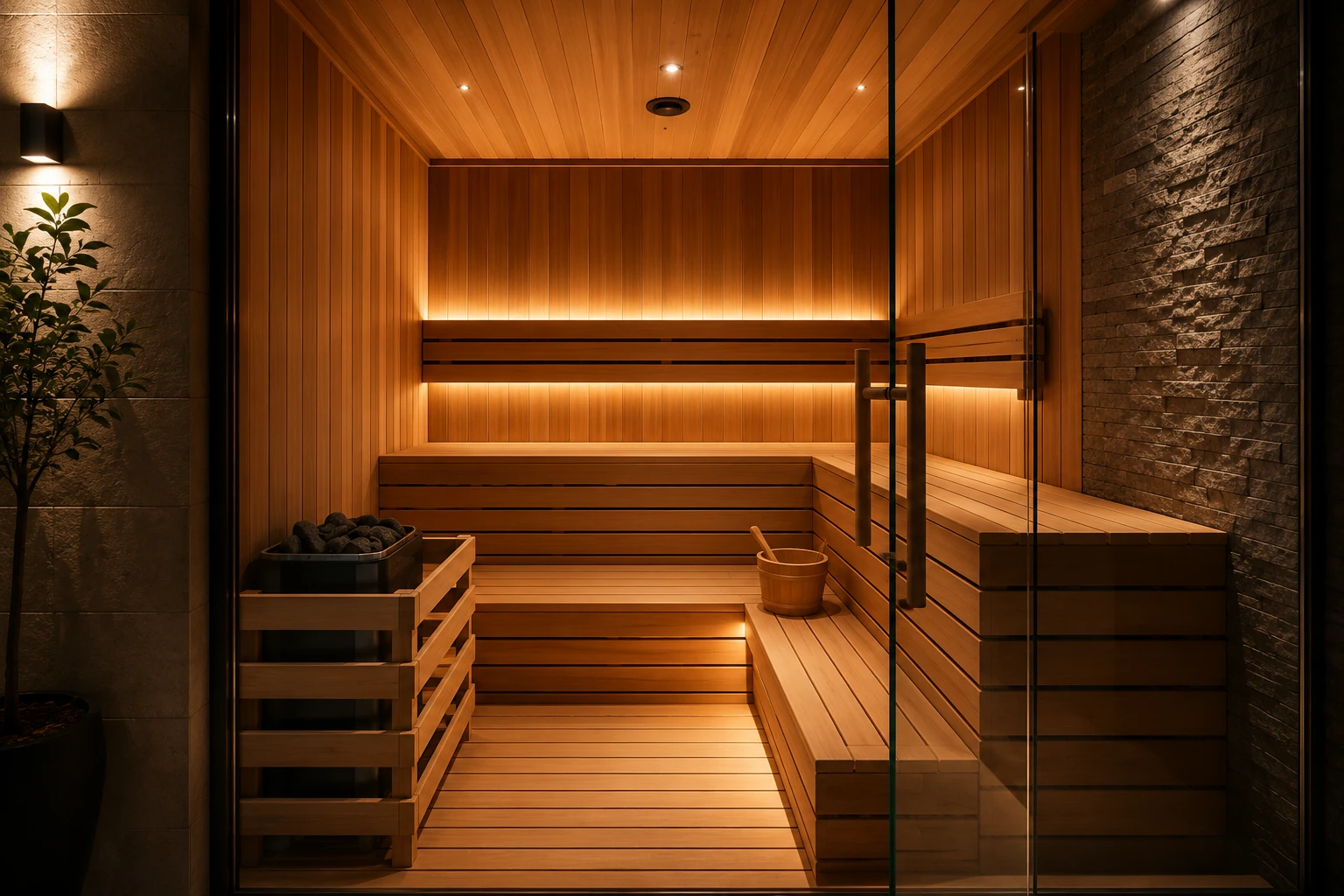
Commercial wellness facilities are increasingly designed as experiences rather than collections of unrelated equipment.
A hotel, spa, gym or wellness club might combine:
- Traditional sauna
- Steam room
- Infrared room
- Hot pool
- Cold plunge
- Experience shower
- Warm relaxation area
- Quiet lounge
- Hydration area
Why Rest Space Matters
A successful thermal experience needs somewhere for users to recover between intense heat exposures.
That idea is visible across many historical bathing traditions, including Roman thermal sequences, Finnish cooling periods, hammam rest spaces and modern bathhouses.
Social Wellness
Sweat bathing has often been communal rather than solitary.
Commercial wellness spaces can support social connection by providing:
- Comfortable shared benches
- Clear circulation paths
- Quiet conversation areas
- Changing facilities
- Hydration stations
- Rest areas outside hot rooms
For larger facilities, see our Commercial Sauna Installation Guide and Commercial Steam Room Design Guide .
Sweat Bathing Design and Installation Requirements
The most beautiful thermal room will disappoint if the underlying system is poorly planned.
Traditional Sauna
Plan for:
- Correct heater output for room volume
- Electrical capacity
- Manufacturer clearances
- Ventilation
- Appropriate sauna wood
- Bench height and depth
- Safe lighting
- Service access
Infrared Sauna
Plan for:
- Correct voltage and amperage
- Emitter coverage
- Distance from heaters
- Cabin dimensions
- Indoor or approved outdoor location
- Control access
- Warranty and service
Steam Room
Plan for:
- Complete waterproofing
- Vapor control
- Steam generator sizing
- Steam generator service access
- Drainage
- Appropriate nonporous materials
- Ceiling design
- Door and glass design
- Post-use ventilation
Outdoor Sauna
Plan for:
- Structural base
- Site drainage
- Roof protection
- Weather exposure
- Electrical routing
- Sun exposure
- Safe pathways
- Exterior maintenance
For project planning, see our Sauna Installation in South Florida Guide .
Sweat Bathing Maintenance: What Changes by System?
| System | Main Maintenance |
|---|---|
| Traditional sauna | Benches, floors, ventilation, heater, stones and wood condition |
| Infrared sauna | Interior cleaning, emitters, electronics, controls and cabin condition |
| Steam room | Tile and grout, drain, generator maintenance, steam head and ventilation |
| Outdoor sauna | Interior sauna care plus roofing, cladding, seals, drainage and exterior finish |
| Hot tub | Water chemistry, filters, plumbing, pumps, jets and cover care |
| Cold plunge | Water treatment, filtration, sanitation and chiller maintenance depending on system |
How to Choose the Right Sweat Bathing Experience
Choose Traditional Sauna If:
- You enjoy hotter room temperatures.
- You want the classic sauna ritual.
- You want sauna stones and optional löyly.
- You value traditional wood interiors.
Choose Infrared If:
- You prefer lower air temperatures.
- You need a compact indoor solution.
- You enjoy direct radiant warmth.
- You prefer straightforward daily operation.
Choose a Steam Room If:
- You strongly prefer humidity.
- You are remodeling a shower or bathroom.
- You like tile and glass spa design.
- You are willing to invest in correct waterproofing and vapor control.
Choose a Hybrid Sauna If:
- Different household members prefer different heat styles.
- You want infrared and traditional heat in one cabin.
- You have the required electrical capacity.
Choose an Outdoor Sauna If:
- You want to preserve indoor space.
- You are creating a backyard wellness area.
- You want the sauna near a pool or cold plunge.
- Your property has an appropriate exterior site.
| Your Priority | Strong Starting Point |
|---|---|
| Authentic high-heat sauna | Traditional sauna |
| Lower-temperature radiant warmth | Infrared sauna |
| Two heat styles | Hybrid sauna |
| Maximum humidity | Steam room |
| Compact one-person setup | Infrared or compact traditional sauna |
| Luxury bathroom integration | Custom sauna or steam room |
| Backyard retreat | Outdoor sauna |
| Complete thermal circuit | Sauna or steam + cooling + rest area |
Sweat Bathing Safety
Saunas, steam rooms and other heated environments intentionally place thermal stress on the body.
Use Heat Conservatively
- Begin with shorter sessions when you are inexperienced.
- Hydrate appropriately.
- Do not use alcohol before or during a heat session.
- Do not force yourself to remain in the room to reach a target time.
- Leave immediately if you feel faint, dizzy, nauseated, confused or unusually weak.
- Allow time to cool down.
When to Seek Medical Guidance
Ask a qualified healthcare professional about heat exposure if you:
- Are pregnant
- Have cardiovascular disease
- Have unstable blood pressure
- Have difficulty regulating body temperature
- Have a condition affected by dehydration
- Take medication that changes sweating, fluid balance or blood pressure
- Have another medical concern about heat exposure
Bring the World’s Heat-Bathing Traditions Into a Modern Home
Plan a Sauna, Steam Room or Complete Home Wellness Space
Sauna & Steam Center helps homeowners, hotels, gyms, spas and wellness properties compare traditional sauna, infrared, hybrid, steam and outdoor options based on space, heat preference, electrical requirements, construction and long-term ownership.
Frequently Asked Questions About Sweat Bathing
What is sweat bathing?
Sweat bathing is intentional exposure to a heated environment that warms the body and usually encourages perspiration. Examples include sauna, banya, steam baths, hammams, temazcales and modern infrared cabins.
Is sweat bathing the same as sauna bathing?
No. Sauna bathing is one form of sweat bathing. Sweat bathing is a broader category that also includes steam-based and culturally distinct heat-bathing traditions.
What are the different types of sweat baths?
Examples include Finnish sauna, smoke sauna, Russian banya, steam bath, Turkish hammam, temazcal, infrared sauna and hybrid sauna. Laconiums and tepidariums are gentler thermal rooms used for warmth and relaxation.
What is the difference between a sweat bath and a sauna?
A sauna is a specific type of heated bathing room. Sweat bath is a wider term that can describe several traditions that use heat or steam to encourage sweating.
What is hydrothermal bathing?
Hydrothermal bathing is a broader wellness category that can combine heat, steam, warm water, cold water and rest. Sauna and steam can form part of a hydrothermal circuit.
What is a Finnish sauna?
A Finnish sauna is a heated room traditionally using a stove and stones. Water may be thrown on appropriate heated stones to create löyly, a temporary increase in heat and humidity sensation.
What is löyly?
Löyly refers to the steam and heat sensation produced when water is cast onto hot sauna stones and is a central concept in Finnish sauna culture.
What is a Russian banya?
A Russian banya is a heat-bathing tradition that shares characteristics with sauna but often emphasizes greater humidity, washing, cooling, socializing and the traditional use of leafy branch bundles called veniki.
What is a Turkish hammam?
A hammam is a Middle Eastern bathing tradition combining warm or hot rooms, humidity, washing, heated surfaces, cleansing and social interaction. A modern steam room recreates only part of the traditional hammam experience.
What is a temazcal?
A temazcal is an Indigenous Mesoamerican heat and steam-bathing tradition with cultural, ceremonial, medicinal and community uses depending on the specific tradition.
What is a laconium?
A laconium is a gentler warm or dry thermal room intended for extended relaxation rather than the intense heat typically associated with traditional sauna bathing.
What is a tepidarium?
A tepidarium is a mildly heated room historically used as a transitional and relaxation space within a larger bathing circuit.
Is a steam room sweat bathing?
Yes. A steam room uses warm, highly humid air to heat the body and encourage sweating.
Is infrared sauna sweat bathing?
Yes. Infrared sauna is a modern form of passive heat exposure that uses radiant emitters and typically operates at lower air temperatures than traditional sauna.
Do hot tubs count as sweat bathing?
Hot tubs are more accurately described as warm-water hydrotherapy or hydrothermal bathing. They can raise body temperature but use immersion rather than a heated room as the primary thermal environment.
Is a Japanese onsen a sweat bath?
Not technically. Onsen culture centers on bathing in naturally heated spring water and is therefore better classified as thermal-water bathing.
What are the health benefits of sweat bathing?
Heat exposure clearly raises skin temperature, increases sweating and changes cardiovascular workload during a session. Research has explored additional long-term effects, but results and evidence quality vary considerably by heat method and study design.
Does sweat bathing detox your body?
Sweating is primarily a mechanism for regulating body temperature. Sweat bathing should not be presented as a medical detoxification treatment.
Does sweat bathing help you lose fat?
Sweating can cause temporary water-weight loss, but this is not the same as losing body fat.
What is hot and cold contrast bathing?
Contrast bathing alternates warmer experiences such as sauna or steam with cooler air, showers or cold water. Cold exposure is optional and introduces additional physiological stress.
Can I create a sweat bathing experience at home?
Yes. Traditional sauna, infrared sauna, hybrid sauna and custom steam rooms are the most practical home options. Cold plunges, showers and relaxation areas can be added to create a larger thermal wellness circuit.
What is the best sweat bathing option for a small home?
A compact one- or two-person infrared, traditional or hybrid sauna can work well when space is limited. The best choice depends on heat preference, available space and electrical requirements.
Which is better, a sauna or steam room?
Neither is universally better. Traditional sauna is generally better for people who enjoy hotter and drier conditions, while steam rooms suit people who prefer lower-temperature heat with very high humidity.
How long should a sweat bathing session last?
There is no universal time that is appropriate for everyone or every heat environment. Beginners should start conservatively, follow equipment guidance and leave whenever the heat becomes uncomfortable.
Conclusion: Sweat Bathing Is a Global Tradition With Many Modern Forms
Sweat bathing is not a single product or one universal ritual.
It includes centuries of heat-bathing practices shaped by geography, culture, climate, architecture and community.
Finnish sauna, Russian banya, hammam and temazcal traditions each developed their own relationships with heat, humidity, washing, cooling and rest.
Modern infrared and hybrid sauna systems add new ways to create controlled heat at home, while steam rooms translate part of the historic humid-bathing experience into contemporary bathrooms and wellness spaces.
Hot tubs, thermal pools and onsen sit beside these traditions within the larger world of hydrothermal bathing rather than fitting neatly into the definition of a sweat bath.

References
-
UNESCO Intangible Cultural Heritage
Sauna Culture in Finland. Finnish sauna culture was inscribed on UNESCO’s Representative List of the Intangible Cultural Heritage of Humanity in 2020.
-
UNESCO Intangible Cultural Heritage
Smoke Sauna Tradition in Võromaa. Documentation of the cultural traditions surrounding Estonian smoke sauna bathing.
-
The Metropolitan Museum of Art
Baths and Bathing Culture in the Middle East: The Hammam. Historical overview of hammam architecture, bathing culture and its connections with earlier Mediterranean bath traditions.
-
Hussain J, Cohen M.
Clinical Effects of Regular Dry Sauna Bathing: A Systematic Review.
-
Passive Heating Systematic Review and Meta-Analysis
Review of randomized controlled trials examining longer-term effects of passive heating interventions on cardiometabolic and vascular outcomes.
-
Cleveland Clinic
Sauna Benefits. Medical overview discussing sauna types, heat exposure, potential benefits, weight-loss misconceptions and safety considerations.
-
Harvard Health Publishing
Overview of sauna, hot bathing and cardiovascular considerations.
-
Laukkanen JA, Laukkanen T, Kunutsor SK.
Cardiovascular and Other Health Benefits of Sauna Bathing: A Review of the Evidence.
-
Centers for Disease Control and Prevention
Heat-health guidance covering hydration, heat illness risk and people who may be more vulnerable to heat exposure.