
Sauna While Fasting: Is It Safe and Does It Help?
Editorial disclosure: Sauna & Steam Center sells, designs, installs, and services sauna and steam systems. Product and installation guidance reflects our first-hand industry experience. This educational article is not medical advice and has not been medically reviewed.
Quick Answer
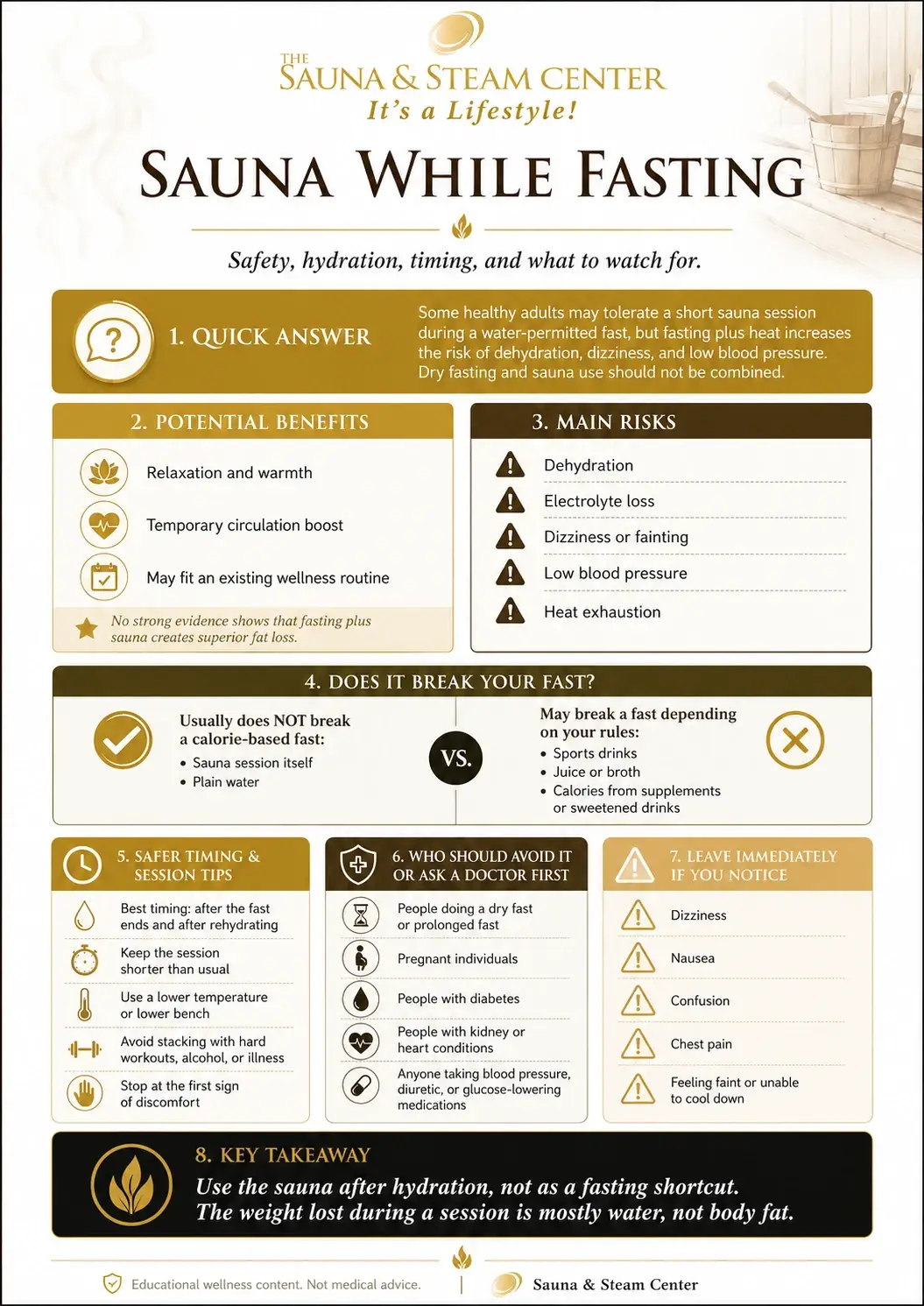
Sauna while fasting may be tolerable for some healthy adults during a short, water-permitted fast, but it adds heat stress, sweating, fluid loss, and a possible drop in blood pressure to the demands of fasting. It is not a reliable shortcut for fat loss, and the immediate change on the scale is mostly water. Avoid combining a sauna with dry fasting, prolonged fasting without medical supervision, illness, alcohol, or hard exercise. Start with a shorter and cooler session than usual, hydrate beforehand when your fast allows it, leave immediately if you feel dizzy or weak, and ask a qualified clinician first if you take diabetes, blood pressure, heart, kidney, or diuretic medications.
The key question is not simply whether a sauna “breaks” a fast. The more important question is whether your hydration, medications, blood pressure, health conditions, fasting method, and total heat exposure make the combination reasonable for you. Evidence directly testing fasted sauna sessions is sparse. Most practical recommendations must therefore be based on what is known separately about fasting, sweating, dehydration, blood pressure, and acute heat illness.
Important: Do not use a sauna during a dry fast. Dry fasting restricts both food and fluids, while sauna bathing increases fluid loss through sweating. Mayo Clinic guidance describes dry fasting as dangerous because it can cause severe dehydration and serious health concerns [1].
Key Takeaways
- A short fast does not automatically make sauna use unsafe, but fasting may reduce your margin for tolerating heat, especially when fluids are restricted.
- The largest immediate risk is dehydration combined with salt loss, low blood pressure, dizziness, fainting, or heat illness.
- A sauna does not meaningfully “melt fat.” Rapid post-sauna weight loss primarily reflects sweat and should return after rehydration.
- Water normally does not break a calorie-based intermittent fast, but electrolyte drinks, supplements, religious rules, and medical fasts require separate consideration.
- Dry fasting and sauna use should not be combined.
- People with diabetes, cardiovascular disease, kidney disease, low blood pressure, pregnancy, an eating disorder history, or medications that affect fluids, glucose, or blood pressure should obtain individualized guidance.
Can You Use a Sauna While Fasting?
Some healthy, experienced sauna users may be able to complete a brief, moderate session during a short fast that permits water. That is not the same as saying the combination is beneficial, necessary, or suitable for everyone. Sauna heat raises skin temperature, increases circulation to the skin, elevates heart rate, and triggers sweating. Fasting may also affect energy, glucose management, hydration habits, and blood pressure. Combining the two can make symptoms appear sooner than they would during a normal fed and hydrated session.
The safest default is to use the sauna after you have eaten and hydrated, especially if you are new to either fasting or sauna bathing. Never make your first fasting day the same day as your first sauna session. Do not stack fasting with a hard workout, a long sauna, cold immersion, alcohol, or outdoor heat simply because each practice may be tolerable on its own.
For general session guidance outside the fasting context, see how long you should stay in a sauna. A person who normally tolerates 15 to 20 minutes should still reduce the session when fasting rather than treating the usual maximum as a target.
How the Type of Fast Changes the Safety Decision
“Fasting” is not one single practice. An international consensus distinguishes forms such as time-restricted eating, fluid-only fasting, short-term fasting, prolonged fasting, modified fasting, and religious fasting [2]. The practical sauna answer changes according to whether you can drink and how long the fast lasts.
| Fasting method | Sauna concern | Practical guidance |
|---|---|---|
| Time-restricted eating with water allowed | Usually the lowest-risk fasting scenario, but dehydration and dizziness are still possible. | Hydrate first, use a shorter session, and stop early if symptoms develop. |
| Water-only fasting lasting a full day or longer | Longer fasting may increase weakness, low blood pressure, electrolyte imbalance, and poor heat tolerance. | Skip the sauna unless a qualified clinician overseeing the fast specifically approves it. |
| Dry fasting | No fluid replacement is allowed while sauna use increases sweat loss. | Do not combine the two. |
| Religious daytime fasting | Food and fluids may be prohibited for many hours, sometimes during hot weather. | Use the sauna only during nonfasting hours after rehydration, if permitted by your tradition and appropriate for your health. |
| Medical or pre-procedure fasting | Instructions may restrict food, fluids, medications, or physical activities for safety and test accuracy. | Follow the medical facility’s instructions. Do not add sauna heat unless the care team approves it. |
| Modified fast with low-calorie drinks | Hydration may be possible, but low energy intake and medication interactions still matter. | Treat it conservatively and confirm what the fasting plan permits. |
Religious fasting deserves particular respect and precision. A workplace study of Ramadan fasting under high-heat conditions found progressive hypohydration among workers and concluded that robust heat controls were needed [3]. A controlled sauna is not identical to industrial heat exposure, but the study supports a conservative principle: avoid voluntary heat exposure while you are unable to replace fluids.
What Happens to Your Body When You Combine Sauna Use and Fasting?
Heat increases the demand for cooling
A sauna transfers heat to the body. Blood flow shifts toward the skin, heart rate generally rises, and sweating helps remove heat. Reviews of sauna bathing describe these as normal acute thermoregulatory responses, but individual tolerance varies according to temperature, humidity, session duration, health, acclimatization, and hydration [4].
Sweating removes water and electrolytes
Sweat contains water and electrolytes, especially sodium and chloride. The amount lost differs greatly among people. The CDC describes heat exhaustion as the body’s response to excessive loss of water and salt, usually through sweating [5]. A 2025 controlled protocol also showed that infrared sauna exposure can deliberately produce more than 2 percent body-mass loss in healthy young adults, demonstrating how quickly a sauna can create measurable dehydration under aggressive conditions [6]. That study was a dehydration protocol, not a recommendation for wellness use.
Blood pressure may fall during or after heat exposure
Heat causes blood vessels near the skin to widen. When combined with sweating and reduced circulating fluid, this can contribute to light-headedness or fainting, particularly when standing up quickly. A 2026 emergency-medicine review of acute heat exposure in saunas, hot baths, and hot springs identified syncope, hypotension, arrhythmia-related complications in vulnerable people, dehydration, kidney stress, and electrolyte disturbances among the clinically important risks [7].
Fasting changes fuel availability, but the heat still needs to be managed
During fasting, insulin levels generally fall and the body gradually relies more on stored fuels, including fat. The timing and degree of this shift depend on the individual, the length of the fast, recent meals, activity, and metabolic health. This does not remove the need for water, normal blood pressure, or safe heat dissipation. It also does not prove that adding sauna heat produces more long-term fat loss than fasting alone.
Bottom line: fasting and sauna bathing are both physiological stressors. The combination may be manageable for some people at a low dose, but there is no reason to assume that two stressors always create twice the benefit.
Potential Benefits of Using a Sauna While Fasting
The most defensible potential benefits are the same benefits a person might seek from a normal sauna session, such as relaxation, warmth, a temporary increase in circulation, or maintaining an established wellness routine. Evidence about regular sauna bathing may be promising in selected populations, but it should not be presented as evidence that a fasted session is superior.
Claims that the combination dramatically accelerates fat loss, “deepens detox,” multiplies autophagy, or creates a unique metabolic state are not supported by direct clinical trials. Research on intermittent fasting itself remains dependent on the protocol and population, and the National Institute on Aging notes that more needs to be learned about effectiveness and safety across age groups [8].
| Claim | What the evidence supports | Confidence for fasted sauna use |
|---|---|---|
| Immediate scale weight drops | Yes, sweating can reduce body mass quickly through fluid loss. | High, but this is not equivalent to fat loss. |
| The body uses more fat during fasting | Fasting can increase reliance on stored fat as a fuel source. | Moderate for fasting generally, but not proof of extra long-term fat loss from adding sauna. |
| Sauna adds meaningful fat loss | Direct evidence is insufficient. Long-term fat loss requires a sustained energy deficit. | Low. |
| Sauna increases autophagy during a fast | Mechanistic interest exists, but there is no practical human threshold showing that a sauna session meaningfully increases fasting-related autophagy. | Very low. |
| The combination improves cardiovascular health | Regular sauna use has been studied separately, including observational associations and small interventions. | Insufficient for the specific fasted-sauna combination. |
| Sauna “detoxes” the body during fasting | Sweat removes water and small amounts of dissolved substances, but liver and kidney function remain the body’s primary waste-processing systems. | Insufficient for broad detox claims. |
Risks and Side Effects of Sauna Use During a Fast
The practical risks deserve more attention than speculative benefits. The combination can produce a narrow safety margin when the person begins dehydrated, takes certain medications, has been exercising, drinks alcohol, is ill, or stays in too long.
Dehydration
Dehydration occurs when fluid losses exceed intake. Symptoms may include thirst, dry mouth, dark urine, reduced urination, headache, fatigue, dizziness, and difficulty concentrating. The American Heart Association notes that fluid needs vary with climate, clothing, activity, health conditions, medications, and how much a person sweats [9].
Low blood pressure and fainting
Fasting, heat-related vasodilation, sweat loss, and standing quickly can combine to cause dizziness or a fainting episode. A fall inside or immediately outside a sauna can cause a serious injury even when the underlying episode is brief.
Electrolyte disturbance
Repeated heavy sweating without appropriate replacement can disturb sodium and other electrolyte levels. More electrolyte is not always better, however. People with kidney, heart, or blood pressure conditions may have restrictions, and indiscriminate salt or potassium supplementation can be harmful. Avoid copying generic online recipes that prescribe a fixed amount of salt for everyone.

Low or unstable blood glucose
Healthy adults usually regulate blood glucose during an ordinary short fast, but diabetes changes the risk. In a randomized trial involving adults with type 2 diabetes taking glucose-lowering medication, fasting increased the rate of hypoglycemia despite education and medication adjustment [10]. A later review concluded that fasting may offer modest glycemic benefits in some people with diabetes, but careful glucose monitoring and medication management are needed to reduce hypoglycemia risk [11].
Heat exhaustion or heat stroke
Heat exhaustion can involve headache, nausea, dizziness, weakness, thirst, heavy sweating, elevated temperature, irritability, and decreased urine output. Heat stroke is a medical emergency that may involve confusion, loss of consciousness, seizures, very high temperature, or hot skin with either absent or profuse sweating. The CDC advises immediate emergency care for suspected heat stroke [5].
Compounded stress from exercise and contrast therapy
A fasted workout followed by a sauna creates more heat, fluid loss, and fatigue than either practice alone. Review the separate guidance on sauna after the gym before combining them. Adding an ice bath can also create rapid cardiovascular changes. A sauna and cold plunge protocol should be approached independently before considering it during a fast.
Does Using a Sauna Break Your Fast?
A sauna session itself does not contain calories, so it generally does not break a calorie-based intermittent fast. What you drink or take around the session may affect the answer.
- Plain water: Usually allowed during health-oriented intermittent fasting and water fasting.
- Unsweetened, zero-calorie electrolytes: Often compatible with a calorie-based fast, but ingredient labels and personal fasting rules differ.
- Sports drinks, coconut water, juice, broth, or sweetened electrolyte products: Contain calories and typically end a strict calorie-free fast.
- Religious fasting: Rules vary by faith and practice. Water or supplements may invalidate the fast even when they contain no calories.
- Medical fasting: Follow the exact instructions from the procedure or testing facility. “Zero calorie” does not automatically mean permitted.
Safety takes priority over preserving a fast. If you become dizzy, confused, faint, unusually weak, or unable to cool down, leave the sauna and treat the symptoms. Breaking a fast is preferable to allowing a heat-related illness to progress.
Does Sauna While Fasting Help You Burn More Fat?
There is no good evidence that a fasted sauna session produces meaningful extra fat loss compared with a sustainable nutrition plan and ordinary sauna use. Fasting may increase fat oxidation during the fasting window, and heat exposure increases the body’s work temporarily, but neither fact proves greater long-term fat loss from combining them.
The number on the scale may fall immediately after a session because sweat has left the body. That is acute water loss. A person who loses one pound during the session has not burned one pound of body fat. The weight should mostly return as fluids are replaced. Deliberately using saunas to dehydrate for a lower scale reading can impair performance and increase health risk.
For a deeper separation of calorie expenditure, water loss, and body-fat change, read our evidence-focused guide on whether saunas help you lose weight.
What Is the Best Time to Use a Sauna While Fasting?
The lowest-risk timing is usually after the fast ends, once you have had time to drink fluids and, when appropriate, eat a light meal. This lets you correct dehydration and makes it easier to stop the session without worrying about preserving the fast.
If water is allowed during the fast
Choose a time when you are not already thirsty, overheated, fatigued, or light-headed. Avoid the end of a long fasting window if you have gone many hours with little fluid. Do not use the sauna immediately after strenuous exercise, outdoor heat exposure, or alcohol.
If fluids are not allowed
Wait until the nonfasting period. Rehydrate first rather than entering immediately at sunset or at the first permitted minute. A normal meal followed by an immediate hot session can also feel uncomfortable, so allow time for digestion.
Morning versus evening
There is no universal best clock time. Morning may work for a well-hydrated person doing time-restricted eating, while evening after rehydration may be safer during a religious fast. The deciding factors are fluid access, symptoms, medication timing, exercise, sleep, and your usual sauna tolerance.
How Long Should You Stay in a Sauna While Fasting?
There is no validated “fasted sauna” duration. A cautious starting point for an experienced, healthy adult using a moderate sauna is about 5 to 10 minutes, followed by a full cool-down and symptom check. Do not treat this as a guaranteed safe dose. Temperature, humidity, sauna type, body size, health, acclimatization, and hydration all affect tolerance.
Use a lower bench or lower temperature than usual. Keep the door unobstructed, stand slowly, and do not continue merely to reach a timer goal. A comfortable 7-minute session is more appropriate than forcing 15 minutes while dizzy.
How to Stay Hydrated Without Breaking Your Fast
Hydration strategy depends on the fasting rules. For calorie-based intermittent fasting, plain water is normally the simplest option. For a fast that prohibits fluids, there is no reliable way to replace sauna sweat without ending the fast, which is why delaying the session is the safer decision.
Before the session
- Begin only when urine is reasonably pale and you are not unusually thirsty.
- Drink water in advance when the fasting method permits it.
- Avoid alcohol and do not rely on a large dose of caffeine before heat exposure.
- Do not start immediately after a workout, hot outdoor activity, vomiting, diarrhea, fever, or poor fluid intake.
During the session
- Keep water accessible when permitted.
- Use a timer and leave before symptoms become intense.
- Do not use heavy clothing, plastic garments, or other methods intended to force extra sweating.
- Never lock or block the sauna door.
After the session
- Cool down gradually in a safe seated area.
- Replace fluid according to thirst, sweat loss, health needs, and professional guidance.
- Include normal meals containing sodium, potassium, and other nutrients when the eating window opens.
- Seek care if symptoms persist, worsen, or include confusion, fainting, chest pain, or inability to keep fluids down.
Electrolyte products are not automatically necessary for every short session. Water and a normal balanced meal may be enough for many healthy people. Longer, hotter, or repeated sessions create greater replacement needs, but people with kidney disease, heart failure, hypertension, or medication-related restrictions should not self-prescribe concentrated electrolyte mixtures.

Who Should Avoid Using a Sauna While Fasting?
Skip the combination or seek individualized medical guidance if any of the following apply:
- Diabetes treated with insulin or medication that can cause low blood glucose
- History of fainting, low blood pressure, unstable blood pressure, heart rhythm problems, recent cardiovascular symptoms, or poorly controlled heart disease
- Kidney disease, reduced kidney function, dialysis, fluid restriction, or electrolyte disorders
- Pregnancy or trying a new fasting routine while pregnant
- Use of diuretics, blood pressure medications, glucose-lowering medication, or other drugs that affect heat tolerance, alertness, fluids, or electrolytes
- Current fever, infection, vomiting, diarrhea, hangover, dehydration, or acute illness
- History of an eating disorder or fasting used as compensation for eating
- Prolonged fasting, medically supervised fasting, or medical test preparation
- Older age with reduced heat tolerance, multiple health conditions, or limited mobility
- Being alone when you have previously become dizzy or faint in heat
This list is not exhaustive. A clinician who knows your diagnoses, medications, and fasting plan can provide more useful guidance than a universal internet rule.
Warning Signs That Mean You Should Leave the Sauna
Leave immediately if you notice:
- Dizziness, tunnel vision, unsteadiness, or feeling that you may faint
- New weakness, shaking, confusion, unusual irritability, or trouble concentrating
- Headache, nausea, vomiting, muscle cramps, or intense thirst
- Chest pain, pressure, severe shortness of breath, or a new irregular heartbeat sensation
- Skin that feels extremely hot, inability to cool down, or a rapidly worsening sense of illness
- Little or no urine, very dark urine, or symptoms that continue after cooling and drinking
Sit or lie down in a cooler place if you feel faint. Do not stand suddenly or walk unassisted. Call 911 for confusion, loss of consciousness, seizure, severe chest symptoms, very high body temperature, or suspected heat stroke. The CDC treats heat stroke as an emergency requiring immediate cooling and emergency medical care [5].
What Our Sauna Experience Since 2004 Has Taught Us
Our experience applies to sauna selection, installation, controls, and ownership patterns, not to diagnosing medical conditions. The clearest practical lesson is that a safer routine is easier when the sauna itself is easy to control.
Homeowners often focus on maximum temperature, but precise controls, a visible timer, comfortable lower seating, reliable ventilation, uncomplicated door operation, and a safe cool-down area matter just as much. A well-designed sauna should let the user choose a moderate session rather than forcing every session to feel intense.
We also see that consistent users tend to benefit from convenience and repeatability. They keep water nearby, avoid rushing, use familiar settings, and adjust the session when they have exercised, slept poorly, traveled, or spent time outdoors. In hot climates, total daily heat exposure matters. A person coming in from yard work, a beach day, or a non-air-conditioned job may already be carrying a heat and hydration burden before the sauna turns on.
For a future home sauna, start by comparing realistic ownership costs rather than choosing a system around health promises. You can use our sauna cost calculator, review the home sauna cost breakdown, or learn about professional sauna installation. A consultation should address room size, electrical requirements, heater capacity, controls, ventilation, materials, and how the space will actually be used.
Practical Decision Guide
| Your situation | Best decision | Why |
|---|---|---|
| Healthy, experienced sauna user doing a short fast with water allowed | Consider a shorter, cooler session only if fully hydrated and symptom-free. | This is the scenario with the most flexibility for fluid replacement. |
| New to fasting or new to sauna bathing | Practice them separately first. | You need to know how your body responds to each stressor independently. |
| Dry fast or religious fast that prohibits water | Wait until the fast ends and rehydrate first. | Sweat loss cannot be replaced during the fasting window. |
| Prolonged water-only fast | Skip the sauna unless the supervising clinician approves it. | Longer fasting can involve glucose, blood pressure, electrolyte, and hydration changes. |
| Diabetes, kidney disease, cardiovascular disease, low blood pressure, pregnancy, or relevant medication use | Get individualized medical guidance. | Generic session rules cannot account for medication and disease-specific risk. |
| Fasted workout plus sauna or cold plunge | Separate the stressors. | Exercise, heat, fluid loss, and rapid temperature changes can compound risk. |
Planning a Home Sauna?
Choose a Sauna That Makes Moderate, Consistent Use Easy
A home sauna should be sized and configured for your space, electrical service, preferred heat style, and realistic routine. Sauna & Steam Center can help you compare traditional, infrared, indoor, outdoor, prefab, and custom options without tying the purchase to unproven medical outcomes.
Frequently Asked Questions About Sauna While Fasting
Is it safe to use a sauna on an empty stomach?
It may be tolerable for some healthy adults, but an empty stomach does not guarantee safety. Hydration, medications, blood pressure, illness, fasting duration, temperature, and session length matter more. New users should sauna after eating and hydrating until they know their normal heat response.
Can I use a sauna during intermittent fasting?
A short session may be reasonable for an experienced, healthy user when water is allowed and the person is well hydrated. Use a shorter and cooler session than usual, avoid combining it with hard exercise, and stop immediately if dizziness, weakness, nausea, or unusual symptoms occur.
Can I use a sauna during a water fast?
Longer water-only fasts can affect hydration, blood pressure, glucose, electrolytes, and energy. Skip the sauna during a prolonged fast unless a qualified clinician supervising the fast specifically approves it.
Can I use a sauna during a dry fast?
No. Dry fasting prevents fluid replacement while sauna bathing increases sweat loss. Combining them can raise the risk of severe dehydration, fainting, heat illness, kidney stress, and electrolyte problems.
Does sweating in a sauna break a fast?
Sweating does not add calories, so it does not end a calorie-based fast. Water, electrolyte products, supplements, religious rules, and medical fasting instructions may change what is allowed.
Does a sauna make fasting burn more fat?
There is no strong evidence that adding a sauna to fasting creates meaningful extra long-term fat loss. The rapid change on the scale after a sauna is mainly fluid loss, not body-fat loss.
Should I take electrolytes before a fasted sauna?
Not automatically. A short session may require only water and a normal balanced meal afterward for many healthy adults. Electrolyte needs vary, and concentrated sodium or potassium products may be inappropriate for people with kidney, heart, or blood pressure conditions.
What temperature should I use while fasting?
No temperature has been proven safe for every fasted user. Choose a lower setting than you normally tolerate, sit on a lower bench when possible, limit the session, and leave at the first sign of discomfort rather than chasing a target temperature.
Is an infrared sauna safer while fasting?
Infrared saunas often operate at a lower air temperature than traditional saunas, but they can still cause substantial sweating, dehydration, dizziness, and heat stress. Lower air temperature does not remove the need for hydration and conservative session limits.
When should I sauna during Ramadan or another no-water fast?
Wait until the nonfasting period, then rehydrate before using the sauna. Avoid entering immediately while still thirsty or depleted. Follow your religious guidance and obtain medical advice if you have diabetes, kidney disease, cardiovascular disease, pregnancy, or medication-related concerns.
What should I do if I feel dizzy in the sauna?
Leave immediately, sit or lie down in a cool place, and avoid standing suddenly. Rehydrate if permitted and safe. Seek urgent help for fainting, confusion, chest pain, seizure, severe shortness of breath, very high temperature, or symptoms that worsen instead of improving.
Conclusion: Use the Sauna After Hydration, Not as a Fasting Shortcut
Using a sauna during a short fast is not automatically unsafe for every healthy adult, but it is less forgiving than a normal hydrated session. The combination increases concern about fluid loss, salt loss, dizziness, fainting, unstable glucose in susceptible people, and heat illness. Dry fasting and sauna use should not be combined.
The most practical approach is to schedule the sauna after the fasting window, rehydrate first, keep the session moderate, and avoid stacking it with strenuous exercise, alcohol, outdoor heat, or cold immersion. Treat any immediate scale change as water loss, not proof of extra fat loss. When a health condition or medication affects glucose, blood pressure, kidney function, fluid balance, or heat tolerance, obtain individualized guidance before entering the sauna.
References
- Mayo Clinic Q and A: Long-term benefits and risks of intermittent fasting are not yet known.
- International consensus on fasting terminology. PubMed.
- Effect of fasting during Ramadan on thermal stress parameters. Eastern Mediterranean Health Journal, World Health Organization.
- Clinical Effects of Regular Dry Sauna Bathing: A Systematic Review. Evidence-Based Complementary and Alternative Medicine.
- Heat-related Illnesses. CDC and National Institute for Occupational Safety and Health, updated March 3, 2026.
- Reliability of achieving target dehydration levels using a portable infrared sauna protocol in healthy young adults. PubMed.
- Acute Heat Exposure-Related Illness: A Unified Emergency Medicine Framework for Hot Baths, Hot Springs, and Saunas. PubMed.
- Calorie restriction and fasting diets: What do we know?. National Institute on Aging.
- Staying Hydrated, Staying Healthy. American Heart Association.
- Intermittent fasting in Type 2 diabetes mellitus and the risk of hypoglycaemia. Diabetic Medicine.
- Intermittent fasting in the management of diabetes: a review of glycemic control and safety. Nutrition Reviews.