Red Light Therapy Benefits: Skin, Recovery, Hair Growth, Pain Relief, and Safety
Red light therapy benefits may include smoother looking skin, calmer redness, mild wrinkle support, better recovery, and support for some types of hair thinning. These benefits are not magic. They depend on the device, the dose, the routine, and the person using it. Red light therapy uses red and near infrared light. The goal is to support normal cell function and repair. It is not the same as an infrared sauna. It is not a cure for disease. It is also not a replacement for sunscreen, medical care, or proven treatment when you need it. This guide explains what is realistic, what is mixed, and what buyers should know before spending money on a mask, wand, panel, full body device, or wellness setup.Quick Answer
Red light therapy may help with skin texture, mild fine lines, visible redness, muscle recovery, joint comfort, and some types of hair thinning. The strongest claims are usually about skin appearance and recovery support. The weakest claims are the ones that promise fast fat loss, instant anti aging, or a cure for serious skin problems. The best results usually come from steady use over several weeks or months. One session will not change much. More time under the light is not always better.Key Takeaways
- Red light therapy may help skin look smoother, calmer, and more even.
- It may support muscle recovery and joint comfort, but it should not replace medical care.
- Some devices may help mild to moderate hair thinning with regular use.
- Results are slow. Most people need weeks or months, not days.
- Device quality matters. Wavelength, power, distance, and treatment time all change the result.
- Red light therapy and infrared saunas are different. They can work together, but they do different jobs.
- The main risk is often disappointment from exaggerated claims.
What Are the Main Red Light Therapy Benefits?
The main red light therapy benefits are tied to skin, recovery, comfort, and hair support. Some benefits have stronger support than others. The honest answer is simple. Red light therapy may help, but it works best when the goal is realistic.- Skin texture: It may help skin look smoother over time.
- Fine lines: It may soften the look of mild lines and wrinkles.
- Redness: It may help calm visible irritation in some people.
- Acne support: It may help with inflammation, but it is not a stand alone cure.
- Hair growth: Some devices may support mild to moderate hair thinning.
- Muscle recovery: It may help some people feel less sore after training.
- Joint comfort: It may support comfort, but it should not be sold as a cure.
- Wound support: It is being studied for tissue repair, but medical wounds need medical care.
How Red Light Therapy Works
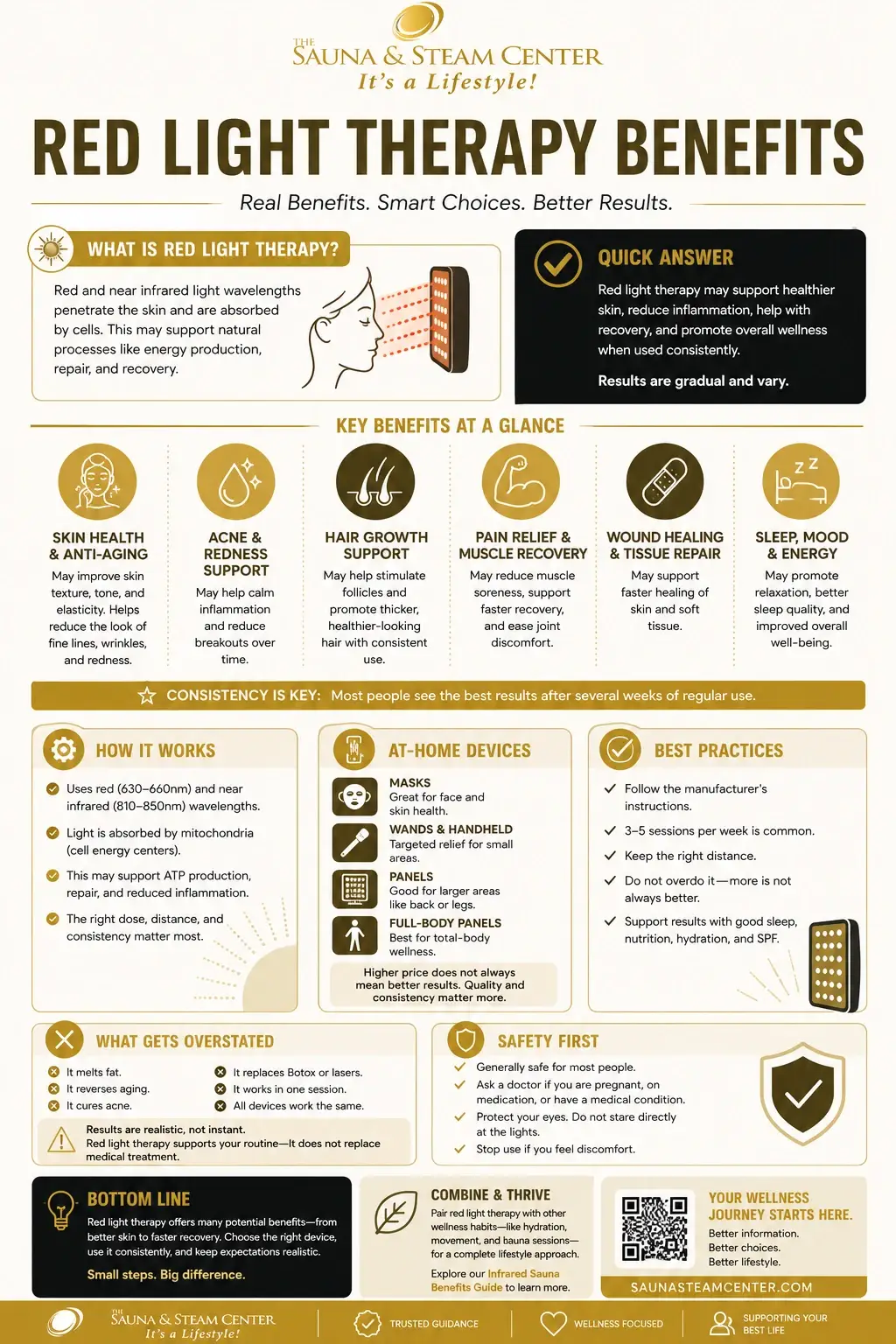
Red light therapy uses specific light wavelengths. Most devices use visible red light and near infrared light. Red light is often used for skin surface concerns. Near infrared light may reach deeper tissue. The idea is that the light may support the way cells make and use energy. This may help normal repair, circulation, and recovery processes. That does not mean every device works the same way. It also does not mean more light gives better results. The dose matters. Distance matters. Session length matters. Wavelength matters. A cheap device with weak output may not feel the same as a better built device.Red Light Therapy Benefits for Skin and Anti Aging
Skin is one of the biggest reasons people try red light therapy. The most realistic benefit is not dramatic transformation. It is gradual improvement.1. Smoother Texture and Mild Fine Line Support
Red light therapy may help skin look smoother. It may also help soften the look of mild fine lines. This is where the evidence is more promising. Do not expect deep wrinkles to vanish. Do not expect loose skin to tighten like surgery. A better expectation is fresher looking skin after a steady routine.2. Better Overall Skin Tone
Some users notice that their skin looks more even. The change is usually subtle. It may show as better tone, less dullness, or a cleaner looking surface. This is not the same as removing melasma, deep pigmentation, or years of sun damage. Those issues often need a dermatologist guided plan.3. Calmer Looking Skin and Less Visible Redness
Red light therapy may help some skin look less stressed. This is why people with reactive or flushed looking skin often become interested in it. Still, redness can have many causes. If redness is constant, painful, or getting worse, do not guess. Get it checked.Red Light Therapy for Acne, Redness, and Scars
Red light therapy may support acne care when inflammation is part of the problem. But acne is complex. Oil, bacteria, hormones, clogged pores, stress, and medication can all play a role. For mild breakouts, red light may be one useful tool. For painful acne, cystic acne, or acne that leaves scars, it should not be the first or only step.Can Red Light Therapy Help Acne Scars?
It may help the skin look healthier overall. It may also support normal repair. But deeper scars are hard to treat with a simple home device. Indented scars, raised scars, and dark marks often need a more specific plan. That may include professional treatment, prescription products, or time.When Acne Needs More Than Red Light
- Breakouts are painful.
- Acne is leaving scars.
- Acne is spreading fast.
- You have deep cysts or nodules.
- Over the counter products are not working.
Red Light Therapy for Hair Growth: Does It Help?
Red light therapy is also used for hair thinning. This is usually done with caps, helmets, combs, or panels designed for the scalp. The best fit is often mild to moderate hair thinning. It may help some users keep a steadier hair routine. It is less likely to help if hair loss is advanced, sudden, patchy, or caused by a medical problem.What to Know Before Buying a Hair Device
- Hair results take time.
- Consistency matters.
- Scalp coverage matters.
- Not every device has the same power or design.
- Hair loss should be diagnosed if it is sudden or severe.
Red Light Therapy for Pain, Inflammation, and Muscle Recovery
Many people search for red light therapy because they want help with soreness, stiffness, or recovery. This is a different goal than skin care. Red light and near infrared light may support comfort and recovery in some users. Athletes, active adults, and people with routine muscle soreness often use it for this reason.What It May Help With
- Post workout soreness
- General muscle recovery
- Mild joint comfort
- Relaxation after training
- A more consistent recovery habit
Red Light Therapy for Wound Healing and Tissue Repair
Red light therapy is studied for tissue repair and wound healing. This is one reason it appears in medical and recovery conversations. For a normal buyer, the key point is simple. It may support recovery, but it is not medical wound care. Do not use a home device as a substitute for a clinician.Use Extra Care With These Issues
- Open wounds
- Infections
- Burns
- Surgical sites
- Diabetic wounds
- Slow healing skin
Red Light Therapy Benefits for Sleep, Mood, and Energy: What Is Known?
Some users say red light therapy helps them feel calm. Others say it helps them build a better night routine. These reports are common, but the evidence is not as strong as the marketing makes it sound. Red light therapy should not be sold as a cure for insomnia, anxiety, depression, or low energy. It may support a wellness routine. That is different from treating a condition.A Realistic View
- It may help you slow down at night.
- It may fit well into a recovery routine.
- It may feel relaxing for some users.
- It should not replace sleep hygiene or medical care.
Red Light vs Near Infrared Light: What Is the Difference?
Red light and near infrared light are often grouped together. They are related, but they are not identical.Red Light
Red light is visible. It is often used for skin surface concerns. Many face masks and smaller beauty devices use red light.Near Infrared Light
Near infrared light is not always visible. It may reach deeper tissue than red light. It is often used in panels and recovery devices.Why This Matters
A buyer should not choose a device only because the label says “red light.” Check the wavelengths. Check the treatment area. Check how the device is meant to be used.At Home Red Light Therapy Devices vs Professional Treatments
At home devices are convenient. Professional treatments may offer stronger equipment, better guidance, and more controlled use. The right choice depends on your goal.Common At Home Devices
- Face masks
- Handheld wands
- Small panels
- Large panels
- Full body panels
- Hair caps and helmets
What Professional Treatments May Offer
- Better supervision
- More specific treatment plans
- Help with skin diagnosis
- Better fit for complex concerns
How Often Should You Use Red Light Therapy?
Follow the device instructions first. That matters more than advice from social media. Many routines use several short sessions per week. Some use more. Some use less. The right plan depends on the device, the body area, the distance, and the goal.Simple Usage Rules
- Start with the manufacturer’s instructions.
- Do not double the time to get faster results.
- Keep the distance consistent.
- Track your use for several weeks.
- Stop if your skin gets irritated.
Red Light Therapy Before and After: What Results Are Realistic?
Before and after photos can be helpful. They can also be misleading. Lighting, angles, makeup, filters, and skin care changes can all affect the photo.What You May Notice First
- Skin may look calmer.
- Skin may feel less dull.
- Post workout soreness may feel easier to manage.
- The routine may feel relaxing.
What Usually Takes Longer
- Fine line changes
- Texture changes
- Hair growth support
- Scar appearance
- Long term recovery benefits
Who Should Avoid Red Light Therapy or Ask a Doctor First?
Red light therapy is often described as low risk when used as directed. But low risk does not mean risk free. Ask a doctor first if you have a medical concern or a higher risk situation.- You are pregnant.
- You take light sensitive medication.
- You have an eye condition.
- You have a history of skin cancer.
- You have a changing mole or suspicious spot.
- You have severe acne or a skin infection.
- You have a diagnosed skin disease.
- You want to use it on a wound or surgical site.
Red Light Therapy Myths: Benefits That Are Often Exaggerated
Red light therapy has real potential. It also has a lot of hype. Be careful with claims that sound too easy.Common Myths
- “It reverses aging.” It may support skin appearance. It does not reverse aging.
- “It melts fat.” Do not buy a device for fat loss unless the evidence and product claim are clear.
- “It cures acne.” It may support acne care. It is not a cure for all acne.
- “It replaces Botox or lasers.” It does not give the same result as medical procedures.
- “It works in one session.” Most benefits need repeated use.
- “All red light devices are the same.” Device quality varies a lot.
Red Light Therapy vs Infrared Sauna
Red light therapy and infrared sauna are not the same thing. They both use light related technology, but the experience and goal are different. Red light therapy is a light based treatment. It is often targeted to skin, scalp, joints, or muscles. Infrared sauna is a heat based wellness experience. It warms the body and supports a sweat routine.When Red Light Therapy Makes More Sense
- You want a targeted skin routine.
- You want scalp or hair support.
- You want a short recovery session.
- You do not want a heat based experience.
When an Infrared Sauna Makes More Sense
- You want a full body heat routine.
- You enjoy sweating.
- You want a daily relaxation habit.
- You want a broader home wellness setup.
How to Choose the Right Red Light Therapy Device
The right device depends on the goal. A face mask may make sense for skin. A scalp cap may make sense for hair. A larger panel may make sense for recovery or larger treatment areas.What to Check Before You Buy
- Wavelengths: Look for clear red and near infrared wavelength details.
- Treatment area: Match the device size to the area you want to treat.
- Ease of use: A device you avoid will not help.
- Session time: Make sure the routine fits your life.
- Eye protection: Check the instructions.
- Claims: Avoid devices that promise overnight changes.
- Return policy: Results vary, so a fair return policy matters.
Safety, Limits, and What to Avoid
Red light therapy is generally low risk when used as directed. But the rules still matter.Common Safety Points
- Follow the device instructions.
- Use the correct distance.
- Do not overuse it.
- Protect your eyes when needed.
- Be careful with light sensitive medication.
- Stop if irritation gets worse.
- Ask a clinician before treating a medical condition.
What Happens If You Overdo It?
Overuse may cause irritation. It may also give no extra benefit. Longer sessions do not always mean better results.When Not to Guess
Do not use a device to avoid a doctor visit. Severe acne, changing moles, deep pigmentation, infection, wounds, or sudden hair loss need proper evaluation.What to Use Instead in Some Situations
Sometimes the best answer is not red light therapy. Sometimes the better answer is sunscreen, medical care, a simpler routine, or a different home wellness setup.- For sun damage: daily sunscreen and dermatologist guided care usually matter more.
- For severe acne: use a proven acne plan first.
- For sensitive skin: repair the skin barrier before adding a device.
- For deep scars: ask about professional treatment options.
- For chronic pain: get a diagnosis before relying on light therapy.
- For full body wellness: a sauna may fit the goal better than a small light device.
Custom Wellness Solutions
Want Red Light Therapy Plus a Sauna Built Around You?
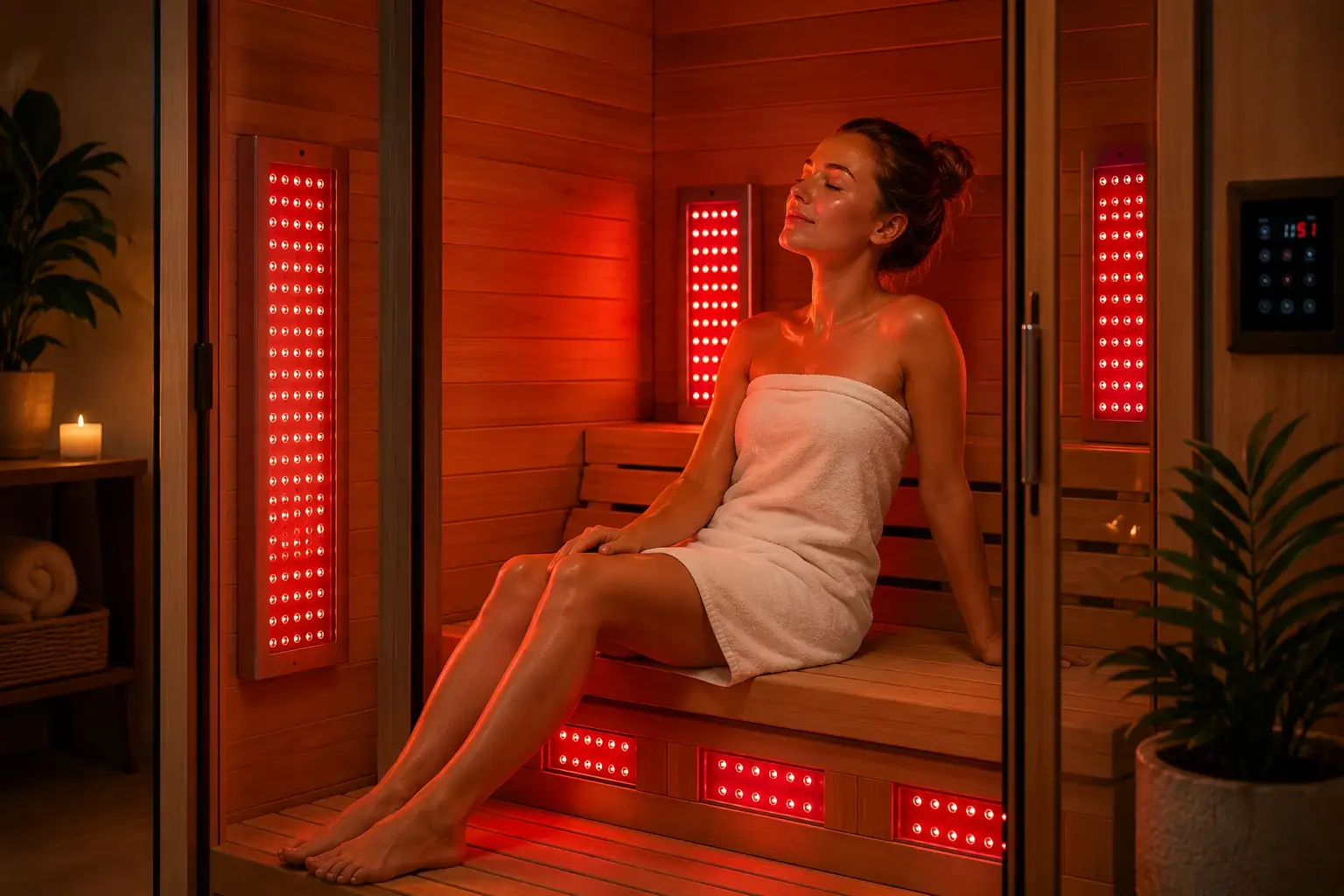
Sauna & Steam Center can help you plan a complete red light therapy and sauna solution for your home, spa, gym, or wellness space. Choose from a custom-built sauna, a prefab sauna kit, or a setup designed around your room, goals, and budget.
Custom saunas. Prefab sauna kits. Red light therapy panels. One wellness solution made for your lifestyle.
Frequently Asked Questions
What are the biggest red light therapy benefits?
The biggest possible benefits are smoother looking skin, calmer redness, mild fine line support, recovery support, joint comfort, and hair growth support for some users. Results vary by device and routine.Does red light therapy really work?
It may work for some goals. The best results are usually gradual and modest. It is not a cure all.How long does red light therapy take to show results?
Some people notice small changes within a few weeks. Bigger changes may take two to three months or longer. Hair support can take even more time.Can red light therapy help wrinkles?
It may help mild fine lines and skin texture. It will not erase deep wrinkles or replace professional procedures.Can red light therapy help acne?
It may help support acne care when inflammation is part of the problem. Severe, painful, hormonal, or scarring acne needs better treatment guidance.Can red light therapy help hair growth?
Some devices may support mild to moderate hair thinning. Sudden, patchy, or severe hair loss should be checked by a clinician.Can red light therapy help pain?
It may support comfort and recovery for some users. It should not replace diagnosis or treatment for injury, severe pain, or chronic disease.Is red light therapy safe?
It is generally considered low risk when used as directed. But people with light sensitivity, eye problems, pregnancy, cancer history, or diagnosed skin conditions should ask a clinician first.Is red light therapy the same as infrared sauna?
No. Red light therapy is a light based treatment. Infrared sauna is a heat based wellness routine. They can complement each other, but they are not the same.What should I look for before buying a red light device?
Look for clear wavelength information, practical instructions, safe design, a good return policy, and a device you will actually use.Conclusion
Red light therapy benefits are real enough to consider. But they are not as dramatic as many ads make them sound. The most realistic benefits are smoother looking skin, calmer redness, mild fine line support, recovery support, and possible help with some hair thinning. The best results take time. They also need the right device and a steady routine. Start with the goal. Then choose the tool. Red light therapy may be the right fit. An infrared sauna may be the better fit. Sometimes the answer is medical care, sunscreen, or a simpler routine. Good results start with clear expectations.References
- Wunsch A, Matuschka K. A Controlled Trial to Determine the Efficacy of Red and Near-Infrared Light Treatment in Patient Satisfaction, Reduction of Fine Lines, Wrinkles, Skin Roughness, and Intradermal Collagen Density Increase. Photomedicine and Laser Surgery.
- Jagdeo J, et al. Safety of light emitting diode-red light on human skin: Two randomized controlled trials. Journal of Biophotonics.
- Hernández-Bule ML, et al. Unlocking the Power of Light on the Skin: A Comprehensive Review on Photobiomodulation. International Journal of Molecular Sciences.
- Taha N, et al. The Effects of Low-Level Laser Therapy on Wound Healing and Pain Management in Skin Wounds: A Systematic Review and Meta-Analysis.
- Harvard Health Publishing. Red light therapy for skin care.
- American Academy of Dermatology. Is red light therapy right for your skin?.
- Cleveland Clinic. Red Light Therapy: Benefits, Side Effects & Uses.
- Stanford Medicine. What to know about red light therapy for skin and hair.