Letter of Medical Necessity for Sauna: HSA & FSA Eligibility Guide
Editorial disclosure: Sauna & Steam Center sells, designs, installs, and services sauna and steam systems. Product and installation guidance reflects our industry experience. This article is educational information and is not medical, tax, legal, or benefits advice. Sauna & Steam Center cannot diagnose a medical condition, determine whether an expense qualifies under federal tax law, write a Letter of Medical Necessity, or guarantee HSA or FSA reimbursement.
A letter of medical necessity for sauna use may help support an HSA or health care FSA claim when a licensed practitioner connects the sauna to treatment of a specific diagnosed medical condition. However, a sauna is not automatically HSA or FSA eligible, and an LMN does not by itself convert a general wellness purchase into a qualified medical expense. Whether a sauna qualifies depends on the medical purpose, supporting documentation, applicable federal rules, and, for an FSA, the terms and claims procedures of the specific plan.
Sauna HSA and FSA Eligibility: Quick Answers
| What People Ask | Direct Answer |
|---|---|
| Can you use an HSA to buy a sauna? | Possibly, if the sauna qualifies as a condition-specific medical expense rather than a general wellness purchase and you retain appropriate documentation. |
| Is a sauna HSA eligible? | Not automatically. The IRS does not provide a universal sauna eligibility category. Qualification depends primarily on the medical purpose of the expense. |
| Are saunas HSA eligible? | They may qualify in individual circumstances when used primarily for medical care, but a sauna purchased for general wellness, relaxation or fitness should not be assumed to qualify. |
| Are infrared saunas eligible for HSA reimbursement? | Infrared saunas do not receive automatic HSA eligibility because they use infrared heat. The same medical-purpose standard applies. |
| Is an infrared sauna HSA eligible? | Potentially in a condition-specific situation, but the word “infrared” does not make the sauna a qualified medical expense by itself. |
| Can I use my HSA to buy a sauna for health benefits? | General health benefits alone are generally not enough. IRS guidance distinguishes medical care for a specific condition from expenses that are merely beneficial to general health. |
| Is a sauna eligible for FSA reimbursement? | Possibly under some health care FSA plans when medically necessary and properly documented. Plan rules and administrator requirements vary. |
| Do I need an LMN for a sauna? | An LMN is commonly requested for products that can serve both medical and general-wellness purposes, but requirements depend on the account and plan. |
| Does an LMN guarantee sauna reimbursement? | No. It provides supporting medical documentation but does not override federal rules or an FSA plan’s terms. |
Key Takeaways
- A sauna is not universally HSA or FSA eligible.
- A Letter of Medical Necessity can support a condition-specific medical claim but does not guarantee eligibility.
- The IRS medical-expense standard focuses on diagnosis, cure, mitigation, treatment or prevention of disease, or affecting a body structure or function.
- Expenses that are merely beneficial to general health do not automatically qualify as medical care.
- Infrared saunas are not automatically more HSA-eligible than traditional saunas.
- For an HSA, the account owner is responsible for substantiating qualified tax-free distributions.
- For an FSA, reimbursement follows the employer plan and administrator’s documentation rules.
- A debit card approval is not the same as a final eligibility determination.
- Custom construction, electrical work, delivery and optional upgrades may be evaluated separately from the sauna itself.
- Get documentation and itemized pricing before committing to a nonrefundable project whenever possible.
- Sauna & Steam Center can document the product and project scope but cannot establish medical necessity.
Can You Use an HSA to Buy a Sauna?
You may be able to use HSA funds for a sauna if the expense qualifies as medical care under federal tax rules.
The IRS defines medical expenses as costs primarily for the diagnosis, cure, mitigation, treatment or prevention of disease, or for affecting a structure or function of the body.
That does not mean every product associated with health or wellness qualifies.
A sauna purchased because you enjoy relaxation, want a home wellness room, hope to recover after exercise, or simply believe sauna use is healthy should not automatically be treated as a qualified HSA expense.
When Might an HSA Sauna Purchase Have a Stronger Medical Basis?
The situation is stronger when:
- A licensed practitioner has diagnosed a specific medical condition.
- The practitioner determines that sauna use is medically appropriate as part of treatment.
- The recommendation explains how the sauna relates to the condition.
- The treatment frequency and duration are documented when required.
- The exact product can reasonably be connected to the medical recommendation.
- The expense is not being reimbursed elsewhere.
- You keep appropriate supporting records.
Is a Sauna HSA Eligible?
A sauna is not automatically HSA eligible as a product category.
The IRS does not provide a blanket rule stating that all saunas qualify.
Instead, the question is whether the specific expense meets the federal definition of medical care.
| Reason for Buying the Sauna | How to Think About HSA Eligibility |
|---|---|
| Relaxation | Generally a general-wellness purpose rather than condition-specific medical care. |
| Home spa or luxury amenity | Personal lifestyle use alone does not establish medical eligibility. |
| Post-workout comfort | Fitness or recovery goals alone should not be assumed to qualify. |
| General cardiovascular wellness | General health benefits alone are not enough to establish eligibility. |
| Treatment of a specific diagnosed condition | Potentially stronger medical-purpose case when supported by appropriate practitioner documentation. |
| Condition-specific treatment plan with LMN | May support qualification, but the LMN itself does not guarantee the tax treatment. |
Are Infrared Saunas Eligible for HSA Reimbursement?
An infrared sauna is not automatically HSA eligible simply because it uses infrared technology.
Federal medical-expense rules focus primarily on why the expense was incurred, not on whether the sauna is marketed as infrared, traditional, hybrid, full spectrum, low EMF or another category.
Does Infrared Make Medical Necessity Easier to Prove?
Not by itself.
If the practitioner’s clinical recommendation specifically requires an infrared format, that fact may help explain why a particular product was selected.
However, a retailer should not create that medical rationale for the provider.
For buyers comparing infrared systems outside the HSA/FSA context, see our Infrared Sauna Benefits Guide .
Can I Use My HSA to Buy a Sauna for Health Benefits?
General health benefits are usually not enough.
IRS guidance distinguishes medical care for a particular disease or condition from expenses that are merely beneficial to general health.
That distinction is extremely important for sauna purchases because sauna use is commonly promoted for:
- Relaxation
- General wellness
- Exercise recovery
- Stress reduction
- Sleep routines
- Lifestyle improvement
- Heat acclimation
These may be legitimate reasons to own a sauna, but they do not automatically make the purchase a qualified medical expense.
Is a Sauna Eligible for FSA Reimbursement?
A sauna may potentially be reimbursable under a health care FSA when it qualifies as medical care and the plan’s required documentation is provided.
However, FSA plans are administered under written plan rules, so the exact claims process matters.
Your FSA May Ask For:
- A Letter of Medical Necessity
- The plan’s own LMN form
- A specific diagnosed condition
- Description of the recommended treatment
- Treatment frequency
- Treatment duration
- Licensed-practitioner signature
- Detailed product receipt
- Itemized invoice
- Additional product documentation
FSAFEDS, for example, publishes an LMN form for items or services that may require medical-necessity documentation and asks the practitioner to identify the medical condition, recommended treatment and duration.
What Is a Letter of Medical Necessity for Sauna Use?
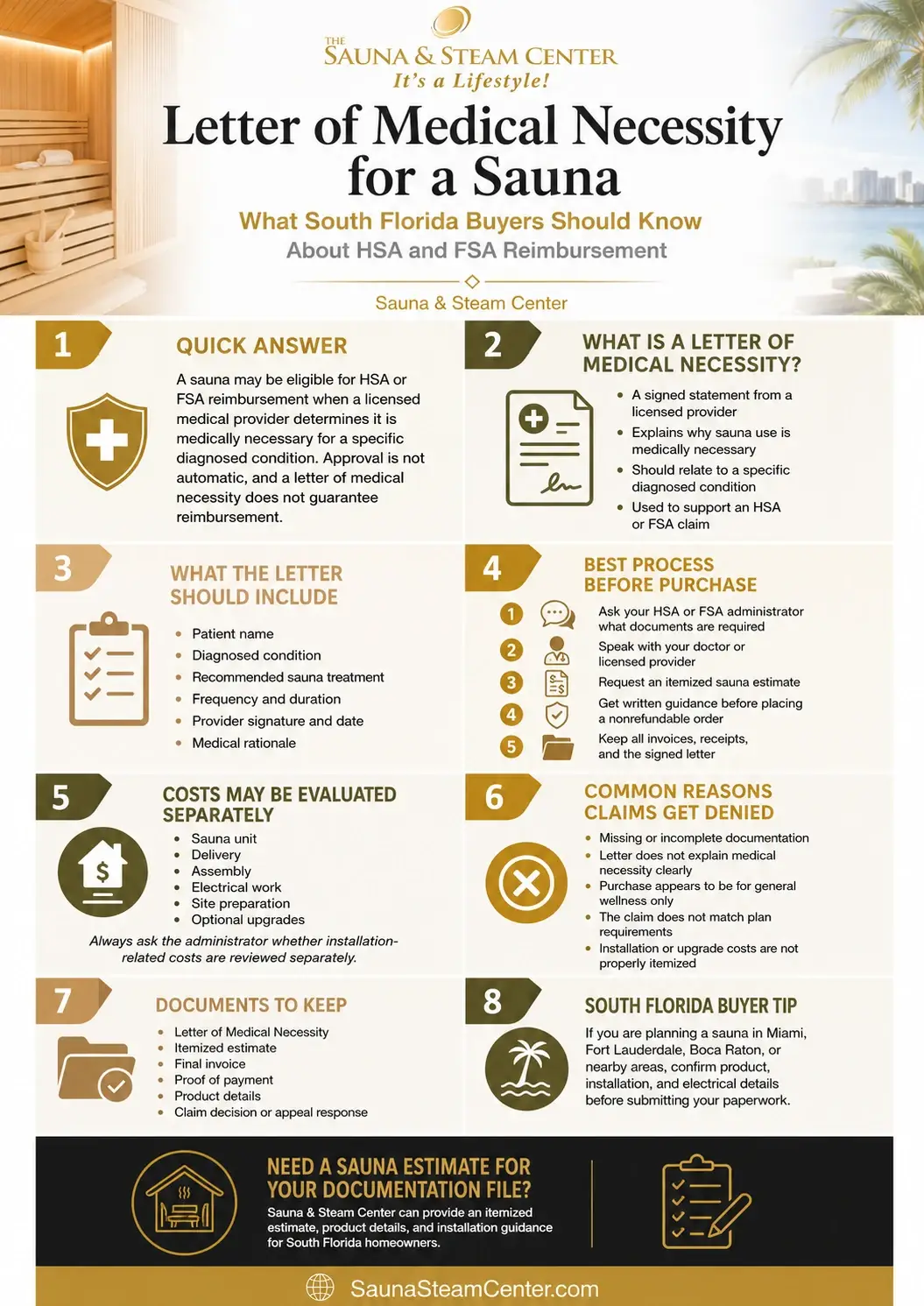
A Letter of Medical Necessity, commonly abbreviated LMN, is a statement from an accepted medical practitioner explaining why a product or service is medically necessary for a particular patient.
For a sauna, the letter may need to identify:
- The patient
- The diagnosed condition
- The recommended sauna-related treatment
- How the treatment relates to the medical condition
- Recommended frequency
- Expected treatment duration
- Practitioner name and credentials
- Signature
- Date
The purpose is to distinguish a condition-specific medical recommendation from a normal lifestyle or wellness purchase.
How Do HSA and FSA Rules Differ for a Sauna Purchase?
| Question | HSA | Health Care FSA |
|---|---|---|
| Who owns or controls the account? | The individual owns the HSA. | The FSA is an employer-established benefit plan. |
| Who substantiates eligibility? | The account holder is responsible for showing that tax-free HSA distributions were used for qualified medical expenses. | The plan administrator reviews claims according to plan rules and required substantiation. |
| Can an LMN help? | Yes. It may help document the medical purpose of the expense. | Yes. Many dual-purpose expenses require or may require an LMN. |
| Does the debit card transaction prove eligibility? | No. | No. The administrator may still require substantiation. |
| Can you reimburse yourself later? | Generally possible for a qualified expense incurred after the HSA was established, provided adequate records are retained and there is no duplicate reimbursement. | Claims must follow the plan year, submission deadlines and reimbursement procedures. |
| Who makes the final tax determination? | The taxpayer remains responsible for proper HSA tax treatment. | The administrator determines whether the FSA plan will reimburse the submitted claim. |
Who Can Write a Letter of Medical Necessity for Sauna Use?
The safest approach is to use a treating physician or another licensed practitioner accepted by the applicable plan or documentation process.
Requirements vary. One program may require a doctor, while another may accept a broader category of licensed health care practitioner.
Before requesting an LMN, determine:
- Which provider credentials are accepted
- Whether a specific form is required
- Whether the letter must predate the purchase
- How long the LMN remains valid
- Whether a diagnosis code is required
- Whether frequency and treatment duration must be included
What Should a Letter of Medical Necessity for Sauna Include?
Exact requirements depend on the program reviewing the documentation. As one current example, FSAFEDS asks for the medical condition, recommended treatment including frequency, treatment duration, practitioner information, signature and date.
| Element | Why It Matters | Who Supplies It |
|---|---|---|
| Patient identification | Connects the medical recommendation to the individual receiving treatment. | Medical provider or required plan form |
| Specific medical condition | Helps distinguish treatment from a general-wellness purchase. | Medical provider |
| Recommended treatment | Explains why the sauna is part of the treatment plan. | Medical provider |
| Frequency | Describes how the provider recommends the sauna be used. | Medical provider |
| Duration | Identifies the expected treatment period. | Medical provider |
| Provider credentials and signature | Authenticates the medical recommendation. | Medical provider |
| Sauna description and model | Connects the recommendation with the actual equipment being purchased. | Sauna & Steam Center |
| Itemized estimate | Separates equipment, delivery and project costs. | Sauna & Steam Center and contractors |
| Final invoice | Documents the actual purchase. | Seller and applicable contractors |
| Proof of payment | Documents amount and transaction date. | Customer and seller |
How Do You Ask Your Doctor for a Letter of Medical Necessity for Sauna?
Ask for a clinical evaluation rather than asking the doctor simply to sign a prewritten letter.
Explain that you are considering purchasing a sauna and want to know whether sauna use is medically appropriate for your diagnosed condition, medications and treatment plan.
“I am considering purchasing a home sauna and may use HSA funds or request health care FSA reimbursement if the expense qualifies. Would you evaluate whether sauna use is medically appropriate and necessary for my condition? If you recommend it, my documentation may need to identify the condition, treatment, frequency and duration.”
Bring any required administrator form along with a product description and preliminary itemized estimate.
Sample Letter of Medical Necessity for Sauna
This is a discussion template only. It is not a self-certification document and should not be copied and signed without an independent clinical evaluation.
If your FSA administrator provides its own form, use that form instead.
Date:
[Date]
Patient:
[Full name and other identifier required by the plan]
Medical condition:
[Specific diagnosed condition]
Recommended treatment or equipment:
[Home sauna type or specific model, if clinically appropriate]
Medical rationale:
In my clinical judgment, the requested sauna is medically necessary as part of the patient’s treatment plan for the condition identified above. The recommendation is not solely for general health, recreation, fitness or convenience.
Recommended frequency:
[Provider completes]
Treatment duration:
[Provider completes]
Provider:
[Name, credentials, license information if required, contact information and signature]
A strong LMN is not one that uses more dramatic language. It is one that accurately reflects the provider’s medical judgment and contains the information required by the applicable plan or recordkeeping process.

Should You Get HSA or FSA Guidance Before Buying a Sauna?
For an expensive or nonrefundable sauna project, confirm the documentation requirements before purchasing whenever possible.
For an HSA
- Determine whether the expense can reasonably qualify as medical care under federal rules.
- Ask your tax adviser when the situation is uncertain.
- Obtain the practitioner documentation supporting the medical purpose.
- Keep the LMN, product description, itemized invoice and proof of payment.
- Keep records showing that the expense was not reimbursed from another source.
- Do not rely solely on whether an HSA debit card processes successfully.
For a Health Care FSA
- Ask the administrator whether it will consider the sauna.
- Request the exact LMN form or documentation checklist.
- Ask whether the LMN must predate the purchase.
- Ask how long the LMN is valid.
- Confirm claim deadlines.
- Ask whether equipment, delivery, construction and electrical work will be reviewed separately.
- Submit the required documentation through the approved process.
Can Sauna Installation Costs Be Paid With HSA or FSA Funds?
Potentially in some circumstances, but installation does not automatically qualify simply because the sauna itself has a medical purpose.
IRS Publication 502 states that special equipment installed in a home and certain home improvements can qualify when their main purpose is medical care. For permanent improvements that increase the value of the property, special rules may limit the medical-expense amount.
Publication 502 concerns medical-expense treatment under federal tax rules. Your FSA plan may have its own documentation and reimbursement requirements.
Ask for Separate Pricing for:
- Sauna cabin
- Heater
- Controls
- Required accessories
- Freight
- Delivery
- Assembly
- Electrical circuit
- Panel work
- Site preparation
- Floor or base work
- Ventilation
- Custom framing
- Glass
- Optional audio
- Decorative lighting
- Premium finish upgrades
Can the Same Letter of Medical Necessity Template Be Used for a Hot Tub?
The documentation concepts can be similar, but a hot tub and a sauna are different products and should not be treated as automatically interchangeable for HSA or FSA purposes.
If a practitioner recommends a hot tub or hydrotherapy equipment for a specific medical condition, the letter should accurately describe that recommended item rather than substituting “sauna.”
The same general documentation principles may apply:
- Specific patient
- Diagnosed medical condition
- Recommended treatment or equipment
- Medical rationale
- Frequency
- Duration
- Provider credentials
- Signature
- Itemized product documentation
Sauna HSA and FSA Eligibility Fact Check
| Claim | Assessment | Practical Conclusion |
|---|---|---|
| “Saunas are HSA eligible.” | Too broad. | Eligibility depends on whether the particular expense qualifies as medical care. |
| “Infrared saunas are HSA eligible.” | Too broad. | Infrared technology does not create automatic eligibility. |
| “An LMN makes a sauna HSA eligible.” | Incorrect as a blanket statement. | An LMN supports medical purpose but does not override federal rules. |
| “A doctor can make any wellness purchase HSA eligible.” | Incorrect. | General-health expenses do not become qualified merely because a practitioner recommends them. |
| “If my HSA card works, the sauna qualifies.” | Incorrect. | The account holder remains responsible for proper substantiation. |
| “My FSA must approve it if I have an LMN.” | Incorrect. | The expense still has to meet plan and medical-expense requirements. |
| “Installation is automatically covered with the sauna.” | Incorrect. | Equipment, construction, electrical work and upgrades may be evaluated separately. |
| “General health benefits are enough.” | Generally inconsistent with the medical-expense standard. | The medical purpose should relate to a specific condition or qualifying medical need. |
What Happens If Your Sauna HSA or FSA Claim Is Denied or Questioned?
The next step depends on whether you are dealing with an FSA reimbursement denial or a question about HSA tax qualification.
If an FSA Claim Is Denied
- Read the administrator’s stated reason.
- Compare the submitted LMN with the plan’s requirements.
- Check dates, signatures, treatment duration and product description.
- Correct legitimate invoice or administrative errors.
- Do not change or fabricate a diagnosis or medical rationale.
- Follow the formal appeal procedure and deadline.
If You Used HSA Funds and Later Question Eligibility
Do not assume the payment processor can resolve the tax question for you.
Review the expense with the HSA custodian for account mechanics if appropriate and consult a qualified tax professional when you are uncertain about whether the distribution is qualified.
What Documentation Can Sauna & Steam Center Provide?
For buyers seeking clear project documentation, Sauna & Steam Center may provide:
- Sauna brand and model
- Sauna type
- Dimensions
- Manufacturer specifications
- Electrical requirements
- Written estimate
- Itemized equipment pricing
- Freight pricing
- Delivery pricing
- Assembly scope
- Installation scope
- Final invoice
- Payment documentation
- Approved change-order documentation
We cannot provide:
- A diagnosis
- Medical advice
- A physician signature
- A medical necessity determination
- Medical billing codes
- An LMN written on behalf of the clinician
- A tax opinion
- A guarantee of reimbursement
Buying and Installing a Sauna in South Florida
Sauna & Steam Center has a physical showroom in Hollywood and serves residential sauna buyers throughout Miami-Dade, Broward and Palm Beach counties.
Homeowners can compare traditional, infrared, hybrid, indoor, outdoor, modular and custom sauna options before requesting an itemized estimate.
For Miami projects, see our Sauna Installation in Miami Guide .
For broader planning, review our Professional Sauna Installation in South Florida Guide .
What Should Be Planned Before Installation?
- Available floor space
- Delivery access
- Electrical service
- Ventilation
- Humidity
- Outdoor exposure
- Salt air near coastal properties
- Condominium restrictions
- HOA approval
- Permitting where applicable
- Manufacturer clearances

What Our Experience Since 2004 Has Taught Us About LMN-Related Sauna Projects
These are product-selection and installation observations, not medical or tax conclusions.
- Determine the paperwork requirements before paying a deposit. Custom finishes, freight and special-order products may be difficult to cancel.
- Match the estimate to the product being medically reviewed. A broad heat recommendation may not support unrelated luxury upgrades.
- Request itemization from the beginning. Equipment, delivery, assembly, electrical work and construction may need to be evaluated separately.
- Verify electrical access before ordering. Circuit requirements can materially change the project cost.
- Choose a realistic sauna size. Medical documentation should not become a reason to buy a larger or more expensive sauna than you actually need.
- Keep the original product documentation. Specifications may change after purchase, so retain the documents tied to the exact model you bought.
Who Should Seek Professional Guidance Before Moving Forward?
| Professional | Role |
|---|---|
| Medical provider | Determines whether sauna use is medically appropriate and necessary for the condition. |
| FSA administrator | Explains plan documentation, reimbursement, deadlines and appeal procedures. |
| HSA trustee or custodian | Handles the account and distributions but does not replace the taxpayer’s responsibility to substantiate qualified medical expenses. |
| Tax professional | Can advise on HSA tax treatment and uncertain medical-expense questions. |
| Sauna dealer or installer | Documents the equipment, specifications, installation requirements and project pricing. |
| Licensed electrician | Addresses circuit requirements and electrical installation. |
| Local authority or association | Addresses permitting, building or property restrictions where applicable. |
Which Sauna Type Should a Letter of Medical Necessity Describe?
HSA or FSA eligibility should not be assumed based on whether the sauna is infrared, traditional, hybrid, indoor or outdoor.
The equipment described in the documentation should match the provider’s actual recommendation and the product being purchased.
Infrared Sauna
Useful when a smaller footprint or lower-air-temperature radiant heat is desired. If infrared technology itself is medically relevant, that distinction should come from the clinician rather than the retailer.
Traditional Sauna
Appropriate for buyers who want classic higher-temperature sauna bathing. Document the heater, controls, circuit and installation requirements clearly.
Custom Sauna
Custom projects may create more complicated questions because they can involve permanent construction, electrical work, glazing and property improvements.
Outdoor Sauna
Outdoor installations may include foundation, delivery, electrical and weather-related costs that should be itemized separately.
Hybrid Sauna
A hybrid sauna offers two heat formats, but that does not mean both modes are automatically medically necessary.

Plan the product and paperwork before you purchase
Get an Itemized Sauna Estimate Before Making Your HSA or FSA Decision
Sauna & Steam Center can help identify a practical sauna type, product specifications, installation requirements and an itemized project budget that you can review with your medical provider, FSA administrator or tax professional.
Letter of Medical Necessity for Sauna FAQs
Can you use an HSA to buy a sauna?
Possibly, when the sauna qualifies as a medical expense for a specific medical purpose and appropriate records support the expense. A sauna purchased simply for general wellness, fitness, relaxation or lifestyle use should not automatically be treated as HSA eligible.
Is a sauna HSA eligible?
A sauna is not universally HSA eligible. Eligibility depends on whether the individual expense qualifies as medical care under federal rules.
Are saunas HSA eligible?
Some condition-specific sauna expenses may potentially qualify, but there is no blanket rule making all sauna purchases eligible.
Are infrared saunas eligible for HSA reimbursement?
Infrared saunas are not automatically eligible because they use infrared heat. The medical purpose and documentation matter more than the sauna category.
Is an infrared sauna HSA eligible?
Potentially in an individual medical situation, but infrared technology itself does not establish HSA eligibility.
Can I use my HSA to buy a sauna for health benefits?
General health benefits alone are generally not enough. Qualified medical expenses must meet the applicable medical-care standard rather than simply being beneficial to health.
Is a sauna eligible for FSA reimbursement?
Potentially under some health care FSA plans when medically necessary and supported by the documentation required by the plan. Contact your administrator before purchasing.
What is an LMN for a sauna?
An LMN, or Letter of Medical Necessity, is documentation from an accepted medical practitioner explaining why sauna equipment is medically necessary for a particular patient and condition.
Do I need a Letter of Medical Necessity before buying a sauna?
You may. Products that can be used for both medical and general-wellness purposes often require additional documentation. For an FSA, ask the administrator whether the LMN must predate the purchase. For an HSA, obtain appropriate documentation and retain records supporting the medical purpose.
Does a Letter of Medical Necessity guarantee HSA eligibility?
No. An LMN can document why a practitioner considers the sauna medically necessary, but it does not override federal qualified-medical-expense rules.
Does a Letter of Medical Necessity guarantee FSA reimbursement?
No. The FSA administrator still applies the plan’s eligibility, documentation and claim requirements.
Can any doctor write an LMN for a sauna?
Not necessarily. Accepted practitioner credentials can vary by plan or documentation requirement. Confirm the rule before requesting the letter.
What should a sauna LMN include?
Common elements include the patient, medical condition, recommended treatment, frequency, duration, provider identification, signature and date. The exact requirements depend on the program reviewing the documentation.
Can sauna installation and electrical work be reimbursed?
Possibly in some circumstances, but these expenses are not automatically qualified simply because the sauna has a medical purpose. Request itemized pricing and seek plan or tax guidance before beginning construction.
Can I use the sauna LMN template as a sample letter of medical necessity for a hot tub?
The general documentation elements may be similar, but the letter should accurately describe the product actually recommended by the clinician. A hot tub and sauna should not be treated as interchangeable expenses.
What if my HSA card is declined when buying a sauna?
A card decline is not necessarily a final statement about tax eligibility. Ask the custodian about transaction restrictions. If you later reimburse yourself from an HSA, do so only when the expense actually qualifies and you have adequate records.
What if my FSA sauna claim is denied?
Review the denial reason, compare your LMN and receipt with the plan’s documentation requirements, correct legitimate administrative errors and follow the plan’s appeal procedure.
How long is a sauna LMN valid?
Validity depends on the applicable plan or documentation requirement. Some LMNs cover a defined treatment period and may need to be renewed if treatment continues.
Can Sauna & Steam Center write my Letter of Medical Necessity?
No. Sauna & Steam Center can provide product specifications, estimates, invoices and installation documentation, but medical necessity must be determined and documented by an appropriate healthcare practitioner.
What documents should I keep for an HSA or FSA sauna purchase?
Keep the LMN when applicable, provider documentation, itemized estimate, final invoice, proof of payment, product description, contractor invoices, correspondence and any FSA claim decision.
Conclusion: Can an LMN Help You Use HSA or FSA Funds for a Sauna?
A letter of medical necessity for sauna use can be valuable supporting documentation when a sauna is recommended for treatment of a specific medical condition.
It does not make every sauna purchase HSA or FSA eligible.
For an HSA, the account holder remains responsible for determining and documenting whether a tax-free distribution paid a qualified medical expense. For an FSA, the plan administrator applies the plan’s reimbursement and substantiation requirements.
Infrared, traditional, hybrid and other sauna categories do not receive automatic eligibility simply because of their heating technology.
References
-
Internal Revenue Service
Frequently Asked Questions About Medical Expenses Related to Nutrition, Wellness, and General Health.
Explains that qualified medical expenses must primarily address disease, disability, or a body structure or function rather than simply providing general health benefits.
-
Internal Revenue Service
Publication 969: Health Savings Accounts and Other Tax-Favored Health Plans.
Explains qualified HSA medical expenses, health care FSA rules and HSA recordkeeping responsibilities.
-
Internal Revenue Service
Publication 502: Medical and Dental Expenses.
Defines medical expenses and discusses medical equipment, capital improvements and expenses that are merely beneficial to general health.
-
FSAFEDS
Letter of Medical Necessity Form and Requirements.
Provides an example of current FSA medical-necessity documentation requirements including medical condition, recommended treatment, frequency, duration, practitioner signature and supporting claim documentation.
-
FSAFEDS
Health Care FSA Eligible Expenses.
Explains that some dual-purpose or condition-specific expenses require appropriate documentation, including a Letter of Medical Necessity.
-
Cleveland Clinic
Sauna benefits and safety information, including heat exposure, hydration and situations that may warrant medical guidance.