
Cedar Sauna Guide: Benefits, Cedar Wood, Thermowood vs. Cedar & Buying Advice
Editorial and commercial disclosure: Sauna & Steam Center sells, designs, installs, and services cedar, infrared, traditional, hybrid, indoor, outdoor, and custom sauna systems. Product specifications, wood grades, pricing, electrical requirements, and installation conditions can vary, so confirm the current manufacturer documentation and written proposal before purchasing.
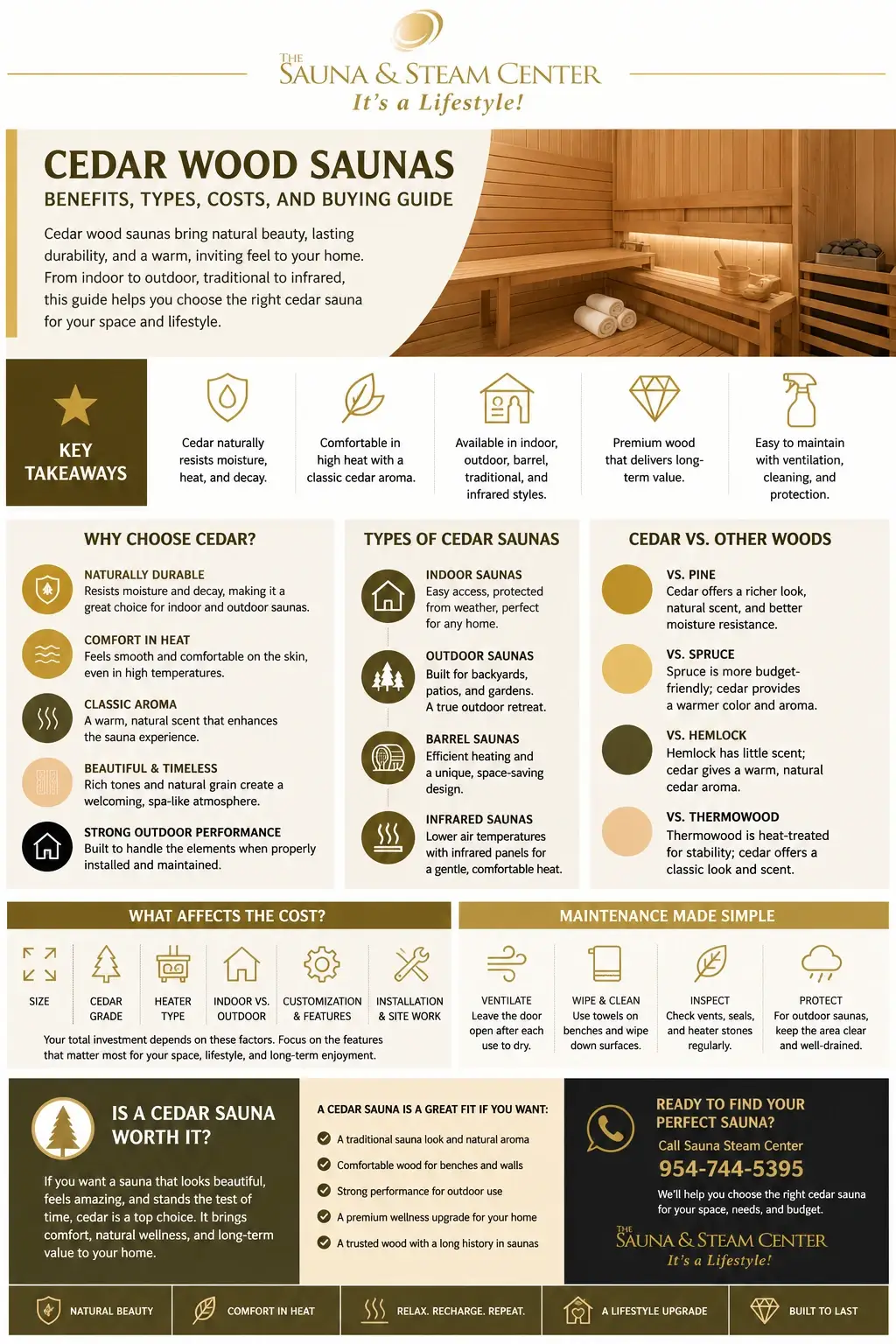
A cedar sauna is a sauna built or finished with cedar wood, most commonly Western Red Cedar. Homeowners choose cedar because it combines a warm natural appearance, distinctive aroma, dimensional stability, relatively low density, and strong natural durability. Cedar can be used in traditional, infrared, indoor, outdoor, barrel, prefab, and custom sauna designs.
People searching for cedarwood sauna, cedar wood sauna, or cedar wood for sauna are usually asking the same core question: is cedar actually a good sauna material, and is it worth paying more for than Thermowood, pine, spruce, hemlock, or aspen?
This guide answers that question directly, including cedar sauna benefits, why cedar is used in saunas, Western Red Cedar, Thermowood vs. cedar, pine vs. cedar, cedar steam sauna terminology, home wellness products using red cedar, maintenance, cost, and how to choose the right wood for your project.
Cedar Sauna: Quick Answer
Cedar Sauna: Quick Answers to the Most Common Searches
| Search | Direct Answer |
|---|---|
| Cedar sauna | A sauna built or finished with cedar, commonly Western Red Cedar, for its appearance, aroma, dimensional stability, low density, and natural durability. |
| Cedarwood sauna / cedar wood sauna | These phrases mean essentially the same thing as cedar sauna. The important details are the cedar species, grade, where the wood is used, and whether the sauna is indoor or outdoor. |
| Cedar sauna wood | Western Red Cedar is one of the best-known premium options. Compare species, clear vs. knotty grade, bench quality, moisture condition, and installation quality before buying. |
| Why is cedar used in saunas? | Because it combines dimensional stability, natural durability, relatively low density, insulation value, attractive color, and the classic cedar aroma. |
| Cedar sauna benefits | The main benefits are material and ownership benefits: stability, durability, comfortable surfaces, attractive grain and color, aroma, and indoor/outdoor versatility. |
| Thermowood vs. cedar sauna | Cedar gives the classic cedar look and scent. Thermowood is thermally modified for improved stability and durability and generally has a darker contemporary appearance. |
| Pine vs. cedar sauna | Pine is often less expensive. Cedar is usually the more premium choice for natural durability, dimensional stability, appearance, and aroma. |
| Cedar steam sauna | This phrase usually means a traditional cedar sauna where water may be added to hot stones. A true steam room is different and normally uses nonporous, steam-rated construction. |
| Home wellness products using red cedar | Common examples include custom home saunas, outdoor saunas, barrel saunas, infrared cabins, sauna wall paneling, benches, backrests, and integrated home wellness rooms. |
Key Takeaways About Cedar Saunas
- Best known cedar: Western Red Cedar is one of the most popular premium cedar choices for sauna construction.
- Why cedar works: It offers dimensional stability, natural durability, low density, insulation value, and an attractive appearance.
- Best for: Traditional saunas, outdoor saunas, custom home saunas, barrel saunas, walls, ceilings, benches, and backrests when appropriately designed.
- Main advantage: Cedar combines sauna performance with a distinctive premium appearance and aroma.
- Main disadvantage: It usually costs more than pine or spruce and has a stronger scent than woods such as aspen or hemlock.
- Cedar vs. Thermowood: Cedar provides the classic cedar appearance and aroma, while Thermowood uses thermal modification to improve wood stability and durability.
- Cedar vs. pine: Pine can cost less, while cedar generally provides greater natural durability and a more premium finish.
- Outdoor use: Cedar is a strong outdoor sauna material, but proper roofing, drainage, foundation, ventilation, and installation remain essential.
What Is a Cedar Sauna?
A cedar sauna, also commonly searched as a cedarwood sauna or cedar wood sauna, is a sauna that uses cedar wood for some or most of its visible wooden surfaces. Depending on the design, cedar may be used for wall and ceiling paneling, benches, backrests, trim, doors, exterior cladding, or virtually the entire sauna structure.
The phrase cedar sauna describes the construction material, not the heating method.
A cedar sauna can therefore be:
- A traditional electric sauna
- A wood-burning sauna
- An infrared sauna
- An indoor sauna
- An outdoor sauna
- A barrel sauna
- A prefab sauna
- A custom-built sauna
This distinction is important because homeowners sometimes assume a cedar sauna is a particular type of sauna heater. Cedar is simply the wood used to construct or finish the sauna.
Why Is Cedar Used in Saunas?
Cedar is used in saunas because it combines several characteristics that are valuable in an environment that repeatedly becomes hot and humid and then cools and dries.
1. Dimensional Stability
Wood naturally responds to changes in moisture. Western Red Cedar has a relatively low shrinkage factor and is known for resistance to warping, twisting, and checking.
That does not mean cedar cannot move. All natural wood can absorb and release moisture. Proper acclimation, installation, ventilation, and drying remain important.
2. Low Density
Western Red Cedar is a relatively low-density softwood. Lower-density woods generally provide good thermal insulation characteristics, which is useful in applications involving temperature control.
3. Natural Durability
Western Red Cedar contains natural extractives associated with its resistance to decay. This is one reason cedar has long been used in applications where moisture exposure is an important consideration.
4. Comfortable Sauna Environment
Sauna surfaces must be comfortable around people wearing minimal clothing. Wood species, surface finish, construction details, and bench design therefore matter significantly.
5. Appearance
Cedar’s natural variation from lighter amber tones to deeper reddish-brown colors creates the warm appearance many homeowners associate with luxury saunas.
6. Aroma
Western Red Cedar has a distinctive aroma. Many sauna owners consider that scent part of the sauna experience, although people who are sensitive to fragrances may prefer a lower-aroma wood.
Cedar Sauna Benefits
People searching for cedar sauna benefits are usually comparing the material itself, not looking for a different set of medical benefits. Cedar does not create a special health effect simply because the sauna is made from cedar. Its advantages are primarily durability, stability, comfort, appearance, aroma, and design versatility.
Natural Resistance to Moisture-Related Wear
Cedar’s natural characteristics make it useful where changing moisture levels are expected. Correct construction is still essential because even high-quality cedar can develop problems if water becomes trapped or ventilation is inadequate.
Good Dimensional Stability
Western Red Cedar’s relatively low shrinkage and resistance to warping and checking are particularly valuable when wood repeatedly experiences environmental changes.
Insulation Properties
The cellular structure and low density of Western Red Cedar give it useful thermal insulation characteristics.
Premium Appearance
Cedar provides natural grain and color variation that can work with rustic, Scandinavian-inspired, transitional, or contemporary sauna designs.
Distinctive Sauna Aroma
Heating cedar can make its characteristic scent more noticeable, creating the traditional cedar sauna atmosphere many buyers want.
Indoor and Outdoor Versatility
Cedar can be incorporated into both indoor and outdoor sauna projects when the complete assembly is designed appropriately for its location.
Multiple Sauna Styles
The material can be used in traditional, infrared, barrel, prefab, and fully custom sauna designs.
Are There Disadvantages to Cedar Saunas?
Cedar has many advantages, but a useful buying guide should also explain where another wood might make more sense.
- Higher cost: Quality Western Red Cedar can cost considerably more than budget woods such as pine or spruce.
- Strong aroma: Cedar’s scent is desirable to many people but can be a disadvantage for someone sensitive to aromatic woods.
- Natural color variation: Cedar boards do not necessarily have identical colors. Buyers wanting a highly uniform appearance should discuss grade and board selection.
- Softness: Western Red Cedar is relatively soft, so benches and other surfaces can be scratched or dented.
- Outdoor cedar still requires good construction: Cedar cannot compensate for poor drainage, roof leaks, inadequate ventilation, or an improper foundation.
The best sauna wood therefore depends on what you value most rather than simply choosing the most expensive material.
Western Red Cedar for Saunas
Western Red Cedar is one of the best-known cedar materials used in sauna construction. It is valued for its relatively low density, dimensional stability, natural durability, distinctive aroma, and attractive grain and color.
It is particularly appealing when the homeowner wants the wood itself to become an important part of the sauna’s design.
Why Western Red Cedar Works Well
- Relatively low shrinkage
- Good dimensional stability
- Resistance to warping and twisting
- Natural decay resistance
- Low density
- Good insulation characteristics
- Distinctive cedar aroma
- Rich natural color
- Suitable for many indoor and outdoor applications
However, “Western Red Cedar” alone does not tell you everything about the material you are purchasing. Grade, moisture condition, board selection, knots, grain, thickness, milling quality, and installation also affect the finished sauna.
Clear Cedar vs. Knotty Cedar for a Sauna
One of the most important decisions when choosing cedar wood for a sauna is whether you want clear cedar or knotty cedar.
| Feature | Clear Cedar | Knotty Cedar |
|---|---|---|
| Appearance | Clean and refined | Rustic and natural |
| Knots | Few or minimal visible knots | More visible knots |
| Typical style | Luxury and contemporary | Cabin and traditional |
| Cost | Usually higher | Usually lower |
| Best for | Premium custom saunas | Rustic designs and budget-conscious cedar projects |
Clear cedar is often selected when the sauna is intended to look like a high-end architectural feature. Knotty cedar can provide much of cedar’s natural character while producing a more rustic appearance.
For benches and areas that directly contact the body, board quality and knot placement deserve additional consideration because the surface should remain comfortable during sauna use.
Where Is Cedar Wood Used in a Sauna?
Cedar does not necessarily need to be used everywhere. In a custom sauna, different woods can sometimes be selected for different components.
| Sauna Component | Can Cedar Be Used? | What Matters |
|---|---|---|
| Walls | Yes | Proper paneling and installation |
| Ceiling | Yes | Heat, ventilation and proper construction |
| Benches | Yes | Smooth surface and comfortable board selection |
| Backrests | Yes | Comfort and smooth finishing |
| Trim | Yes | Appearance and detailing |
| Exterior cladding | Yes | Weather exposure and exterior detailing |
This means a homeowner can also consider a mixed-material sauna rather than assuming every visible and structural component must use the same species.
Thermowood vs. Cedar Sauna: Which Is Better?
Thermowood vs. cedar sauna is one of the most important material comparisons for modern sauna buyers. Neither is universally better. The choice depends on whether you prioritize classic cedar character or thermally modified wood performance and appearance.
The first thing to understand is that Thermowood is not simply another tree species competing with cedar. Thermowood refers to wood whose properties have been changed through controlled thermal modification.
Thermal modification reduces the wood’s ability to absorb moisture and can improve dimensional stability and biological durability. It also produces a darker appearance.
| Feature | Western Red Cedar | Thermowood |
|---|---|---|
| What is it? | Natural wood species | Thermally modified wood |
| Appearance | Warm reddish and amber variation | Usually darker, heat-modified appearance |
| Aroma | Distinctive cedar scent | Different, generally less like traditional cedar |
| Dimensional stability | Naturally good | Improved through thermal modification |
| Outdoor applications | Strong option with proper construction | Strong option depending on product class and application |
| Design style | Classic, natural, luxury | Modern, contemporary, European-inspired |
| Best reason to choose | Classic cedar character and natural durability | Modified stability and modern appearance |
Choose Cedar If:
- You specifically want the traditional cedar aroma.
- You prefer reddish or amber natural wood tones.
- You want the classic North American cedar sauna appearance.
- You value cedar’s natural characteristics.
Choose Thermowood If:
- You prefer a darker contemporary sauna.
- Dimensional stability is a major priority.
- You like the appearance of thermally modified wood.
- You want to explore modern sauna materials beyond traditional cedar.
Bottom line: Neither material is universally better. Cedar is especially attractive for buyers who want the classic cedar sauna experience, while Thermowood is compelling for buyers prioritizing thermally modified stability and a darker modern aesthetic.
Pine vs. Cedar Sauna: Which Should You Choose?
Pine vs. cedar sauna usually comes down to budget, appearance, knots, resin, durability, and the experience you want from the finished room.
| Feature | Cedar | Pine |
|---|---|---|
| Typical price | Higher | Lower |
| Aroma | Distinctive cedar scent | Traditional pine scent |
| Knots | Depends heavily on cedar grade | Often more noticeable in economical grades |
| Natural durability | Excellent characteristic of Western Red Cedar | Varies by pine species and treatment |
| Appearance | Amber to reddish brown | Usually lighter |
| Best for | Premium sauna projects | Cost-conscious projects |
Choose cedar when appearance, natural durability, cedar aroma, and premium character matter more than achieving the lowest material cost.
Consider pine when budget is the primary concern and the specific pine product has been selected appropriately for sauna use.
Cedar vs. Hemlock, Aspen, Spruce, Pine and Thermowood
| Wood | Appearance | Aroma | Key Reason to Consider It |
|---|---|---|---|
| Western Red Cedar | Warm amber to reddish brown | Distinctive | Premium traditional sauna character |
| Hemlock | Light and relatively uniform | Milder | Neutral-looking indoor sauna |
| Aspen | Very light | Mild | Clean Scandinavian-style appearance |
| Spruce | Light with natural variation | Wood aroma | Traditional Nordic appearance and value |
| Pine | Light, often knotty | Pine aroma | Lower-cost option |
| Thermowood | Darker heat-modified tone | Different from cedar | Improved stability and contemporary design |
There is no single sauna wood that is best for every installation. The right choice depends on location, design, budget, scent sensitivity, maintenance expectations, and the specific product being installed.
Types of Cedar Saunas
Traditional Cedar Sauna
A traditional cedar sauna uses a conventional sauna heater to warm the room and sauna stones. Depending on the heater and installation, water may be applied to the stones to temporarily increase perceived humidity.
Cedar Infrared Sauna
A cedar infrared sauna combines cedar construction with infrared heating panels. The cedar describes the surrounding wood while “infrared” describes the heating system.
Cedar Barrel Sauna
A cedar barrel sauna uses the recognizable curved barrel form, commonly for outdoor installations. Buyers should compare actual interior dimensions, bench width, headroom, heater sizing, roof protection, and assembly details rather than choosing solely by listed seating capacity.
Custom Cedar Sauna
A custom cedar sauna can be designed around the exact room dimensions, seating configuration, heater, glass, lighting, controls, ventilation, and architectural style of the home.
Prefab Cedar Sauna
Prefab cedar saunas arrive as manufactured components or panels designed for assembly. They can reduce some construction complexity but still require appropriate site preparation, electrical work, clearances, and ventilation.
What Is a Cedar Steam Sauna?
The phrase cedar steam sauna is commonly used online, but it can describe two very different things.
A traditional sauna and a steam room are not the same environment.
- Traditional cedar sauna: Primarily a hot, comparatively dry environment, although water may be applied to heated sauna stones when the heater permits it.
- Steam room: Uses a steam generator to create a highly humid environment and is normally constructed with moisture-resistant, nonporous assemblies rather than conventional exposed cedar sauna paneling throughout.
If you want the smell and appearance of cedar with traditional sauna heat, ask for a cedar traditional sauna. If you want a true steam room, the enclosure must be designed specifically for steam and moisture management.
Indoor vs. Outdoor Cedar Sauna
Indoor Cedar Sauna
An indoor cedar sauna provides convenient year-round access and avoids direct exposure to rain and exterior weather.
Planning should account for:
- Available dimensions
- Ceiling height
- Heater capacity
- Electrical requirements
- Ventilation
- Door placement
- Flooring
- Required clearances
- Bench configuration
Outdoor Cedar Sauna
An outdoor cedar sauna can create a dedicated backyard wellness area, but the project should be evaluated as a complete exterior structure rather than simply a wooden sauna placed outside.
Check:
- Foundation or pad
- Drainage
- Roof and water management
- Weather exposure
- Electrical service
- Delivery access
- Ventilation
- Exterior detailing
- Local permitting requirements
Cedar’s natural durability is helpful outdoors, but good construction and water management are still essential.
How Much Does a Cedar Sauna Cost?
The cost of a cedar sauna varies widely because a small prefab unit and a fully custom architectural sauna are fundamentally different projects.
Instead of relying on one universal price, consider the components that determine the final installed cost:
- Sauna dimensions
- Western Red Cedar grade
- Clear versus knotty cedar
- Prefab versus custom construction
- Indoor versus outdoor installation
- Traditional versus infrared heating
- Heater size and controls
- Electrical requirements
- Glass doors and glass walls
- Bench configuration
- Lighting
- Ventilation
- Delivery
- Site preparation
- Installation labor
- Permitting when applicable
For professionally installed sauna projects, the final investment can range from several thousand dollars for simpler configurations to well into five figures for larger, premium, outdoor, or custom cedar saunas.
The most useful comparison is therefore the complete installed project price, not simply the advertised price of the sauna kit.
How to Choose Cedar Wood for a Sauna
If you are buying or building a cedar sauna, ask these questions before selecting the material.
1. What Type of Cedar Is It?
“Cedar” is not specific enough. Ask for the exact species and product specifications.
2. Is It Clear or Knotty?
The grade can dramatically affect appearance and price.
3. Where Will the Cedar Be Used?
Wall paneling, benches, backrests, trim, and exterior cladding have different requirements.
4. Has the Wood Been Properly Acclimated?
Wood should be allowed to adjust to the environment according to supplier and installation recommendations before installation.
5. Is the Sauna Indoor or Outdoor?
Outdoor installations require additional attention to weather protection, drainage, roofing, base construction, and exterior detailing.
6. What Heating System Will Be Used?
The requirements for a traditional sauna can differ from those of an infrared sauna.
7. Are You Sensitive to Cedar Aroma?
If strong natural wood scents bother you, compare cedar with lower-aroma alternatives before purchasing.
Home Wellness Products Using Red Cedar
People searching for home wellness products using red cedar are often looking for more than a standalone sauna cabin. Western Red Cedar can be used as the main material or architectural finish in a broader residential wellness environment, especially where natural wood, warmth, and a spa-like visual style are priorities.
Examples can include:
- Custom home saunas
- Outdoor sauna structures
- Barrel saunas
- Infrared sauna cabins
- Sauna wall and ceiling paneling
- Sauna benches and backrests
- Poolside wellness areas
- Home gym sauna rooms
- Backyard wellness retreats
The important distinction is that cedar is a construction and finish material. The design of the complete wellness environment still needs to account for heat, moisture, electrical requirements, ventilation, safety, and the manufacturer’s specifications.
| Red Cedar Wellness Application | Why Homeowners Consider It | What to Verify |
|---|---|---|
| Custom indoor sauna | Premium natural appearance and year-round convenience | Heater sizing, ventilation, electrical work, bench layout |
| Outdoor sauna | Natural durability and backyard wellness design | Roofing, drainage, foundation, weather exposure |
| Barrel sauna | Compact outdoor form and cedar character | Bench width, headroom, roof protection, heater capacity |
| Infrared cedar cabin | Lower-temperature radiant heat with cedar finish | Electrical requirements, emitter placement, indoor approval |
| Wellness room paneling | Natural architectural finish around a home wellness zone | Heat, humidity, code, and manufacturer-approved use |
How to Maintain a Cedar Sauna
Cedar sauna maintenance is primarily about keeping the interior clean and allowing it to dry properly after use.
After Every Sauna Session
- Allow the sauna to ventilate.
- Let damp surfaces dry.
- Wipe excessive moisture when necessary.
- Use towels on benches to reduce sweat absorption.
Regularly
- Clean benches and high-touch surfaces gently.
- Sweep or vacuum the floor.
- Check ventilation openings.
- Inspect visible wood for unusual staining or moisture problems.
- Inspect the heater according to manufacturer instructions.
For Outdoor Cedar Saunas
- Check the roof and flashing.
- Make sure water drains away from the structure.
- Inspect the foundation or base.
- Keep vegetation and debris away from exterior walls.
- Inspect exterior wood and finishes according to manufacturer recommendations.
Avoid automatically applying household wood coatings or harsh chemicals to sauna interiors. Any product used around sauna heat should be specifically appropriate for the intended sauna application.
Is a Cedar Sauna Worth It?
A cedar sauna can be worth the additional cost when you value natural wood character, Western Red Cedar’s distinctive aroma, dimensional stability, natural durability, and a premium traditional sauna appearance.
Cedar makes the most sense when:
- You specifically like cedar’s aroma.
- You want a premium natural wood appearance.
- You are considering an outdoor sauna.
- You prefer warm amber and reddish wood tones.
- You want a classic cedar sauna experience.
Another material may make more sense when:
- You are highly sensitive to scents.
- Your primary objective is minimizing cost.
- You prefer a very light Scandinavian interior.
- You specifically want the dark appearance of thermally modified wood.
For most homeowners, the decision should be based on the complete sauna rather than the wood species alone. Heater performance, insulation, ventilation, bench design, electrical work, installation quality, and proper sizing can be just as important as the visible wood.
Planning a Cedar Sauna?
Need Help Choosing the Right Sauna Wood?
The best sauna wood depends on where the sauna will be installed, the type of heat you want, your design preferences, seating requirements, budget, and whether the sauna will be indoors or outdoors.
Sauna & Steam Center can help you compare Western Red Cedar, Thermowood, and other sauna materials based on the actual requirements of your project.
Call Sauna & Steam Center at 954-744-5395 and tell us:
- Indoor or outdoor installation
- Available dimensions
- Number of users
- Traditional or infrared preference
- Preferred wood appearance
- Approximate project budget
We can help narrow the options before you invest in the wrong sauna, wood, heater, or configuration.
Frequently Asked Questions About Cedar Saunas
Is cedar good for saunas?
Yes. Cedar, especially Western Red Cedar, is popular for saunas because of its dimensional stability, natural durability, relatively low density, appearance, and distinctive aroma.
Why is cedar used in saunas?
Cedar is used because sauna construction benefits from wood that can handle changing heat and moisture conditions while remaining comfortable and visually attractive. Western Red Cedar also has a relatively low shrinkage factor and good resistance to warping and checking.
Why are saunas made of cedar?
Not all saunas are made of cedar, but cedar is a popular premium option because it combines natural durability, dimensional stability, insulation characteristics, attractive color, and the classic cedar aroma.
Why are saunas made of wood?
Wood works well in traditional sauna construction because it has useful insulation characteristics and creates comfortable interior surfaces. Different sauna woods are selected based on density, stability, durability, appearance, aroma, availability, and cost.
What is the best cedar wood for a sauna?
Western Red Cedar is one of the most recognized choices. The best product still depends on grade, appearance, application, installation location, budget, and whether you prefer clear or knotty cedar.
Is Western Red Cedar good for sauna benches?
Western Red Cedar can be used for sauna benches and backrests. Smooth board selection, construction quality, knot placement, surface preparation, and appropriate sauna design are important for surfaces that contact the body.
Does cedar get too hot in a sauna?
Cedar’s relatively low density is one reason it is commonly considered suitable for sauna interiors. However, any sauna surface can become hot, so proper sauna design, heater clearances, material selection, and installation remain important.
Does cedar resist moisture?
Western Red Cedar has natural durability and good dimensional stability, but it is not waterproof. Cedar saunas still require proper ventilation, drying, drainage, and construction.
Does a cedar sauna smell?
Yes. Western Red Cedar has a distinctive natural aroma that can become noticeable in a warm sauna. Many people enjoy it, while scent-sensitive users may prefer a less aromatic sauna wood.
What is better, Thermowood or cedar for a sauna?
Neither is universally better. Cedar provides the classic cedar aroma, natural color variation, and natural durability. Thermowood is thermally modified to improve characteristics such as dimensional stability and durability and generally has a darker appearance.
What is better, pine or cedar for a sauna?
Cedar is typically the more premium option and offers strong natural durability and a distinctive aroma. Pine is often less expensive. The better choice depends on budget, pine species, grade, knots, resin, appearance, and intended sauna application.
Is cedar better than hemlock for a sauna?
Cedar is often preferred when aroma, natural color, and traditional sauna character are priorities. Hemlock can be attractive when you want a lighter and less aromatic interior.
Can cedar be used for an outdoor sauna?
Yes. Western Red Cedar is frequently used in outdoor applications because of its natural durability and dimensional stability. Outdoor sauna performance still depends on proper roofing, drainage, foundation, ventilation, and installation.
Can you build an infrared sauna from cedar?
Yes. Cedar can be used for infrared sauna construction. “Cedar” identifies the wood while “infrared” identifies the heating technology.
Is a cedar steam sauna the same as a steam room?
No. A traditional cedar sauna and a true steam room operate differently. Traditional saunas primarily use high-temperature sauna heat, while steam rooms use a steam generator to create a highly humid environment and require construction designed specifically for steam.
How long does a cedar sauna last?
A properly designed, installed, ventilated, and maintained cedar sauna can provide many years of use. Actual lifespan depends on material quality, construction, heater installation, moisture management, usage, weather exposure, and maintenance.
How do you clean cedar sauna wood?
Allow the sauna to dry after use, clean benches gently as needed, and avoid harsh household chemicals or unapproved coatings. Follow the sauna and wood manufacturer’s maintenance instructions.
Should cedar sauna wood be sealed?
Do not automatically apply conventional wood sealers to sauna interiors. Products exposed to sauna temperatures need to be suitable for that application. Follow the sauna manufacturer or wood supplier’s instructions before applying any finish.
How much does a cedar sauna cost?
Cedar sauna prices vary significantly. Smaller prefab systems may cost several thousand dollars, while professionally installed, outdoor, premium, and custom cedar sauna projects can reach well into five figures. Compare the complete installed price including heater, electrical work, delivery, site preparation, accessories, and installation.
Is clear cedar better than knotty cedar?
Clear cedar provides a cleaner premium appearance with fewer visible knots and generally costs more. Knotty cedar provides a more rustic appearance and can reduce material cost. The better choice is primarily determined by design preference, application, grade, and budget.
What should I compare before buying a cedar sauna?
Compare the cedar species and grade, sauna dimensions, heater, insulation, ventilation, electrical requirements, bench layout, glass, warranty, delivery, installation requirements, and total installed cost rather than comparing only the advertised purchase price.
Is cedarwood sauna the same as cedar sauna?
Yes. “Cedarwood sauna,” “cedar wood sauna,” and “cedar sauna” generally describe the same category. The more important distinction is the exact cedar species, grade, construction quality, and heating system.
What are the main cedar sauna benefits?
The main benefits of cedar are material-related: good dimensional stability, natural durability, relatively low density, attractive color and grain, a distinctive aroma, and versatility for indoor and outdoor sauna designs.
What is better for a sauna, Thermowood or cedar?
Cedar is a strong choice for classic appearance, aroma, and natural durability. Thermowood is thermally modified to improve stability and durability and normally has a darker contemporary appearance. The better choice depends on your design, location, budget, and maintenance priorities.
Can red cedar be used in home wellness products besides saunas?
Yes. Red cedar can be used in custom sauna rooms, barrel saunas, outdoor wellness structures, infrared cabins, wall and ceiling paneling, benches, backrests, and selected wellness-room architectural details when the application is suitable for the heat and moisture conditions.
Final Verdict: Should You Choose a Cedar Sauna?
Choose a cedar sauna if you want a premium natural wood sauna with warm color, distinctive aroma, good dimensional stability, natural durability, and the classic appearance associated with Western Red Cedar.
Do not choose cedar simply because someone says it is the “best” sauna wood. Compare it with Thermowood, hemlock, aspen, spruce, and pine according to your actual project.
For a traditional premium sauna experience, Western Red Cedar remains one of the strongest materials to consider. For a darker contemporary design with properties enhanced through thermal modification, Thermowood deserves serious consideration. For a lower-cost project, pine or spruce may be appropriate, while hemlock or aspen can make sense for homeowners who prefer a lighter or less aromatic interior.
The best sauna is ultimately the combination of the right wood, heater, insulation, ventilation, layout, electrical design, and installation for your home.
For help comparing cedar sauna options, call Sauna & Steam Center at 954-744-5395.
Sources & Further Reading