Sauna Hat Guide: What It Does, Benefits, Materials, Fit and Safety
Quick Answer
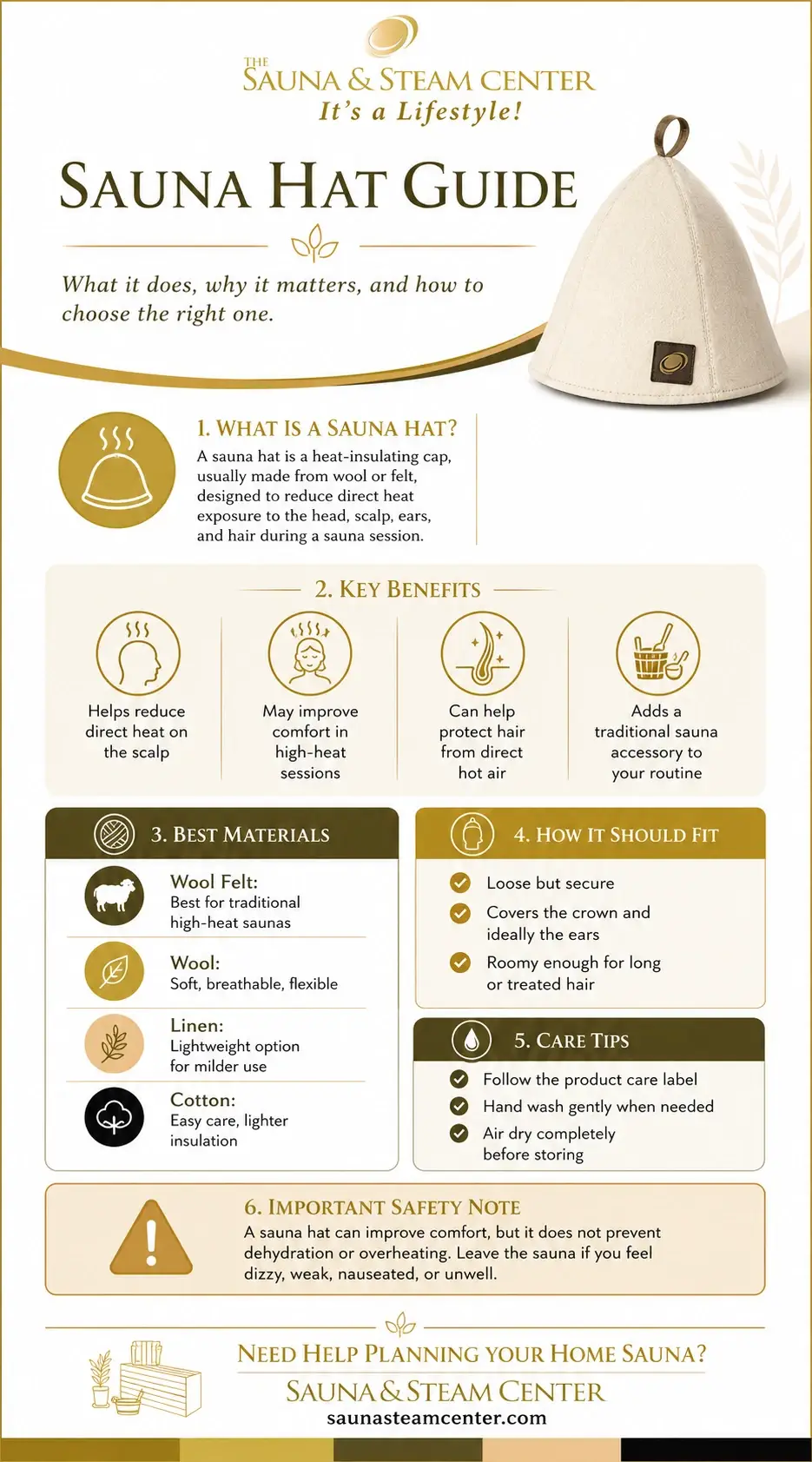
sauna hat is the common name for a heat-insulating cap worn in a sauna, usually made from wool or wool felt. It creates a barrier between the head and the hottest surrounding air, which may make the scalp, ears and hair feel more comfortable during a traditional sauna session.
A sauna hat is optional, not required safety equipment. It may reduce direct heat exposure to hair and make local heat feel less intense, but it has not been proven to prevent dehydration, dizziness, heat illness or whole-body overheating. Choose a loose, full-coverage design, follow its care label and leave the sauna immediately if you feel dizzy, weak, nauseated, confused, unusually headachy or otherwise unwell.
The useful question is not whether every sauna user needs a hat. The useful question is whether insulating the head improves your comfort without encouraging you to ignore heat stress. For many people, especially those with a bare scalp, sensitive ears, long hair or chemically treated hair, a well-fitted wool or felt cap is a practical accessory. It should complement sensible sauna habits, not replace them.
Important safety note: A sauna hat does not control core body temperature and is not personal protective equipment. Headache, nausea, dizziness, weakness, heavy sweating, confusion, loss of coordination or fainting can be signs of dangerous heat exposure. Stop the session, move to a cooler place and seek appropriate medical help when symptoms are severe or do not improve. [1]
Key Takeaways
- A sauna hat is an insulating accessory intended to make the head, ears and hair feel more comfortable in hot sauna air.
- Wool felt is the strongest all-around choice for high-temperature traditional saunas because it is dense, shape-stable and able to manage moisture vapor.
- Direct clinical evidence about sauna hats is limited. Claims that a hat protects the brain, prevents heat illness or creates additional medical benefits are not established.
- Hair protection is plausible because a hat reduces direct exposure to heated air, but sauna-specific studies have not proved that it prevents dryness, fading or breakage.
- The best fit covers the crown and ears without squeezing, slipping over the eyes or crushing the hair.
- Follow the manufacturer’s care label. For many wool hats, gentle hand washing, minimal agitation and room-temperature air drying help reduce shrinkage.
- A hat never replaces sensible session length, hydration, attention to symptoms or facility rules.
What Is a Sauna Hat?
A sauna hat is a soft cap designed specifically for a heated sauna environment. Traditional versions are commonly made from sheep’s wool or dense wool felt and shaped to cover the top of the head, forehead and ears. Some are cone-shaped, while others resemble a bucket hat, loose beanie or simple cap.
The hat works as a local thermal barrier. Insulation does not automatically make something hot or cold. It slows heat transfer. In winter, insulation slows heat leaving the body. In a sauna, where the surrounding air can be much hotter than the surface of the head, the same principle can slow heat moving toward the covered area.
The hat and the trapped air beneath it still warm gradually. The goal is a slower, less intense sensation, not complete thermal protection.
What Does a Sauna Hat Do?
A sauna hat mainly changes the small environment immediately around the head. Its fibers and structure trap pockets of air, which transfer heat more slowly than direct exposure to circulating hot air. Wool can also absorb moisture vapor within its fibers and release it over time, although performance depends on the hat’s density, construction, thickness and moisture level. [5]
Many users notice less stinging around the ears, less intense heat on a bare scalp and less direct exposure for the hair. These are comfort observations, not proof that the hat prevents heat illness.
Bottom line: A sauna hat can change local comfort. It should not be described as controlling brain temperature, preventing fainting or protecting the entire body from heat stress.
What Does the Evidence Support?
Sauna bathing has been studied much more extensively than sauna hats. Reviews describe short-term cardiovascular and thermoregulatory responses to passive heat, while also noting that much of the long-term health research is observational and cannot prove that sauna use caused the reported outcomes. [2] [3]
Direct peer-reviewed research on ordinary sauna hats is sparse. Heat-transfer principles, textile properties and user experience support a comfort claim. They do not support promises about preventing heat illness, improving circulation, increasing detoxification or making longer sessions healthier.
| Claim | What is reasonable to say | Evidence strength | Important limitation |
|---|---|---|---|
| It makes the head feel less exposed to hot air | Plausible and consistent with insulation physics and common user experience | Moderate mechanistic support, limited direct research | Comfort varies by fit, material, sauna temperature and individual tolerance |
| It protects hair | It can reduce direct hot-air exposure and may help hair feel less dry | Indirect evidence | No strong sauna-specific trial proves prevention of fading, breakage or dryness |
| It prevents dizziness or overheating | This should not be promised | Unsupported as a safety guarantee | Dizziness and headache can signal excessive heat exposure and require leaving |
| It protects the brain | This should not be claimed | Unsupported and misleading | A textile cap is not medical protective equipment |
| It lets you stay longer and gain more benefits | Some users may feel comfortable longer, but extending time is not the goal | Anecdotal | Local comfort can make whole-body heat strain easier to overlook |
| Wool felt is the best material | It is the most practical general choice for high-heat use | Material-property support and industry experience | No clinical head-to-head trial establishes one universal winner |
What Are the Potential Benefits of Wearing a Sauna Hat?
More Comfortable Heat Around the Head and Ears
The clearest potential benefit is comfort. The head is often positioned higher than much of the torso, and the upper part of a traditional sauna is generally hotter than the lower benches. A properly fitted hat can make that hot-air exposure feel less sharp, especially around bare skin and the ears.
Less Direct Exposure for Hair
A full-coverage cap creates a physical barrier between hair and circulating hot air. This may be useful for long, bleached, color-treated, tightly curled, very dry or extension-treated hair. The recommendation should remain practical rather than medical: the hat may reduce exposure, but it cannot guarantee that hair will not dry out, fade or break.
A More Consistent Personal Routine
Some home-sauna owners prefer having a dedicated set of accessories that includes a washable bench towel, water bottle and personal hat. Consistency can make the routine easier to follow, but the accessory itself does not create a health outcome.
Possible Comfort During Steam Bursts
When water is added to traditional sauna stones, the sudden increase in perceived heat can feel intense around the face, ears and scalp. A thick hat may soften that sensation around the covered area. It will not protect the uncovered face or airway, and it does not justify remaining inside when the heat feels excessive.
Readers exploring the broader effects of heat exposure can review our evidence-focused guide to using a sauna correctly. That guide covers preparation, session pacing and cooling without treating an accessory as a substitute for safe behavior.
Do Sauna Hats Protect Your Hair and Scalp?
A sauna hat can reduce direct hot-air exposure to the hair and scalp, but the amount of meaningful protection has not been established in sauna-specific clinical studies. Laboratory research on hair drying has found more surface damage at higher dryer temperatures, but a hair dryer delivers forced air close to the hair and is not identical to sitting in a sauna. The study supports caution around repeated high heat. It does not prove that a sauna hat prevents damage. [4]
Practical Guidance by Hair Type
- Color-treated, bleached, long or curly hair: Choose a roomy crown and a smooth interior. Tuck the hair inside without tight elastics or metal clips.
- Hair extensions: Follow the extension provider’s heat restrictions. A hat does not override adhesive, bond or synthetic-fiber instructions.
- Bald or closely shaved scalp: Full crown and ear coverage may provide the most noticeable comfort.
- Sensitive scalp: Stop using the hat if it causes burning, itching, rash or pressure. Seek clinical guidance for persistent symptoms.
Dry hair is usually easier to tuck inside a hat without trapping excess water. Avoid heavy oils, sprays or fragranced treatments unless the product maker permits them because residue can complicate washing and may produce unwanted odors in the heat.
Do You Really Need a Sauna Hat?
No. A sauna hat is optional. It is worth trying when the head or ears become uncomfortable before the rest of the body, hair feels overly exposed or you simply prefer head coverage.
| Likely useful for | Possibly unnecessary for | Use extra caution when |
|---|---|---|
| People whose ears or scalp feel intensely hot | Users already comfortable at their normal temperature and duration | The hat makes warning symptoms easier to ignore |
| Long, dry, bleached or treated hair | Short sessions in a lower-temperature cabin | The fit is tight, heavy or restrictive |
| Bald or closely shaved users | People who dislike head coverings | There is a wool allergy, contact reaction or severe sensitivity |
| Traditional high-heat sauna users | Users who prefer a lower bench and milder conditions | A medical condition or medication affects heat tolerance |
Before buying accessories, first make sure the sauna temperature and routine are appropriate. Our sauna temperature guide explains why the thermometer reading, humidity, bench height and personal tolerance all affect how hot a session feels.
What Is the Best Material for a Sauna Hat?
Dense wool felt is the strongest general recommendation for a traditional sauna. It combines insulation, shape retention and moisture-vapor management. A lighter woven material may feel more comfortable in a lower-temperature infrared cabin, but it usually provides less insulation.
| Material | Best for | Advantages | Tradeoffs | Choose this when |
|---|---|---|---|---|
| Wool felt | Traditional high-temperature saunas | Dense insulation, durable structure, good crown and ear coverage | Can shrink with heat, agitation or improper washing; may feel itchy to sensitive users | You want the strongest all-around option |
| Knitted or woven wool | Moderate heat and users who prefer flexibility | Breathable, flexible and able to manage moisture vapor | May stretch, lose shape or insulate less than dense felt | You dislike rigid felt but still want wool |
| Linen | Lower-temperature cabins and lightweight coverage | Light, quick-drying and less bulky | Usually provides less insulation from hot air | You prioritize lightness over maximum thermal buffering |
| Cotton | Occasional use and easy washing | Familiar feel, widely washable and often inexpensive | Absorbs liquid water, can become heavy and generally insulates less than felt | You need a simple washable option for mild conditions |
| Synthetic fabric | Only when specifically designed and labeled for sauna use | May be washable and shape-stable | Performance varies widely; ordinary synthetic hats may trap odor or be unsuitable for high heat | The manufacturer gives clear temperature and care guidance |
Is Felt Different From Wool?
Felt describes a fabric structure, not necessarily a different fiber. Traditional wool felt is produced by compressing and interlocking wool fibers into a dense material. Some products labeled “felt” use blended or synthetic fibers, so check the fiber-content label instead of assuming every felt hat is pure wool.
Is Thicker Always Better?
No. Greater thickness can increase insulation, but an oversized, heavy or poorly ventilated hat may become uncomfortable. Construction quality, coverage and fit matter as much as raw thickness.
How to Choose the Best Sauna Hat
Choose by sauna type, material, fit, hair volume, care requirements and personal sensitivity. Avoid choosing on appearance alone.
- Match the material to the environment. Dense wool felt is usually best for a hot traditional sauna. Lightweight linen or cotton may be enough for lower-temperature use.
- Check actual fiber content. “Felt” does not always mean wool. Look for a clear percentage on the label.
- Confirm coverage. The hat should cover the crown and preferably the ears without obstructing vision.
- Allow space for hair. Long or thick hair requires more internal volume than a standard head measurement suggests.
- Read the care instructions before buying. A hand-wash-only product may not suit a commercial facility that needs frequent standardized laundering.
- Avoid decorative hardware. Metal ornaments, pins and clips can become hot and uncomfortable.
- Consider skin sensitivity. A lined or softer wool option may work better for people who find coarse felt itchy.
Best for most traditional-sauna users: A dry, unlined or softly lined wool-felt hat with enough room to cover the ears and accommodate the hair without pressure.
How Should a Sauna Hat Fit?
A sauna hat should fit loosely enough to preserve a small insulating air layer while remaining stable when you sit, move or pour water on the stones. It should not compress the temples, pull on the hair or leave a deep pressure mark.
Simple Sizing Method
- Use a flexible tape measure around the widest part of the head, usually just above the eyebrows and ears.
- Compare that measurement with the maker’s size chart rather than relying only on “small,” “medium” or “large.”
- Add room when you plan to tuck long, curly, braided or extension-treated hair inside.
- Choose the larger size when you are between sizes unless the manufacturer specifically advises otherwise.
Signs the Hat Is Too Small
- It presses on the temples or forehead.
- It rides upward and exposes the crown.
- It cannot cover the ears.
- It tangles or sharply bends the hair.
- It becomes uncomfortable within a few minutes.
Signs the Hat Is Too Large
- It falls over the eyes.
- It shifts constantly when you move.
- It becomes heavy and unstable after absorbing moisture.
- It obstructs hearing or awareness in a shared facility.
How to Wear a Sauna Hat Correctly
- Start with a clean, dry hat. Unless the manufacturer specifically instructs you to wet it, dry use is the simplest baseline.
- Place it on before entering or before the room reaches full heat. This allows a more consistent air layer beneath the hat.
- Cover the crown and ears. Adjust the front so your vision remains clear.
- Tuck hair loosely. Avoid tight hair ties, metal clips or pins.
- Use your normal session limits. Do not add time simply because the head feels more comfortable.
- Remove the hat and exit if anything feels wrong. A hat should never be used to push through headache, nausea, dizziness or weakness.
- Air it out after use. Do not leave a damp hat sealed in a gym bag or vehicle.
Should You Wet a Sauna Hat?
Not automatically. A damp hat may initially feel cool, but water changes the material’s thermal behavior and adds weight. As the water warms, the hat may feel heavy or transfer heat differently. Repeated wetting can also affect shape, dye and shrinkage.
Start with the hat dry unless its manufacturer recommends wet use. If you test a damp hat, use clean cool water, wring out excess liquid and stop if it feels hotter, heavier or uncomfortable. Never treat a wet hat as a cooling device that makes a longer session safe.
How to Wash and Care for a Sauna Hat
The product label should take priority because wool type, dye, stitching, lining and construction vary. When no instructions are available, gentle care is the lowest-risk approach for a wool-felt hat.
General Wool-Felt Care
- Rinse or hand wash in cool or lukewarm water with a small amount of wool-safe detergent.
- Avoid scrubbing, twisting and aggressive agitation, which can encourage felting and shrinkage.
- Press out water gently without wringing.
- Reshape the crown and brim while damp.
- Air dry at room temperature away from a dryer, radiator, heater or direct intense sun.
- Store only when completely dry.
How Often Should It Be Washed?
Wash frequency depends on sweat, hair products, facility hygiene and frequency of use. A personal hat used occasionally may only need airing after each session and periodic washing. A hat used heavily or exposed to oils and products should be cleaned more often. Do not share personal hats unless a facility has an appropriate laundering process.
Common Care Mistakes
- Machine washing a hand-wash-only wool hat
- Using hot water
- Wringing or twisting felt
- Putting wool in a tumble dryer
- Leaving the hat wet in a closed bag
- Using bleach or strong fragrance without label approval
Can You Use a Towel or Regular Hat Instead?
Towel
A clean, dry towel wrapped loosely around the head can provide temporary coverage. It is less secure than a fitted hat, may slip over the eyes and can become heavy when wet. Use a facility-approved towel and keep your vision unobstructed.
Regular Cotton Beanie
A plain cotton cap can provide some coverage in milder conditions, but it generally lacks the structure and insulation of wool felt. It may absorb sweat and become heavy.
Winter Wool Hat
A simple wool beanie may work, but check for synthetic linings, elastic, metal logos, plastic decorations or adhesives that were not intended for a sauna environment. A dedicated sauna hat is usually easier to inspect and clean for this purpose.
Baseball Cap
A baseball cap is not a strong substitute. It provides incomplete crown and ear coverage, may contain rigid plastic or metal components and can obstruct heat awareness around the head.
Shower Cap
A disposable plastic shower cap is designed to keep hair dry, not to insulate the head in high heat. It can trap moisture and may not be rated for sauna temperatures. It should not be treated as an equivalent.
Best temporary alternative: A clean, dry, securely wrapped towel with no metal components. A properly fitted wool-felt hat remains more stable and purpose-specific.
Sauna Hat Culture and Etiquette
Sauna traditions vary by country, region and facility. Finnish sauna culture emphasizes calm bathing, respect for other users and listening to the body. Official Finnish tourism guidance describes traditional sauna as a quiet, adaptable ritual rather than a competition over temperature or duration. [6] The Finnish Sauna Society also describes respectful bathing traditions as central to sauna culture. [7]
Sauna hats are visible in several Northern and Eastern European sauna traditions, particularly in very hot sauna and banya environments, but wearing one is not a universal requirement. A hat may look traditional in one facility and unusual in another.
Public-Facility Etiquette
- Check posted rules before bringing personal accessories inside.
- Use a clean hat and keep it off shared benches when not in use.
- Do not shake water from the hat near other guests.
- Do not add fragrance, oil or disinfectant to the hat unless the facility permits it.
- Respect quiet areas and avoid commenting on another guest’s choice to wear or not wear one.
- Do not share a personal hat.
Hotels, gyms and wellness operators considering accessories for guests should also plan for cleaning, storage, replacement and liability rather than treating hats as décor. Our team provides planning support for saunas for hotels and gyms, including practical ownership and maintenance considerations.
Risks, Common Mistakes and Overstated Claims
Myth: A Sauna Hat Prevents Overheating
A hat may make the head feel more comfortable while the rest of the body continues gaining heat and losing fluid. It cannot be relied on to prevent heat exhaustion or heat stroke. Heat illness symptoms require action, not another accessory. [1]
Myth: It Protects the Brain
There is no sound basis for presenting an ordinary felt cap as brain-protection equipment. That language overstates what local insulation can do and may create false confidence.
Myth: Staying Longer Automatically Creates More Benefits
Comfort and benefit are not the same as duration. Sauna research uses different populations, temperatures, frequencies and protocols, and observational associations do not establish that extending an individual session produces a better outcome. [2] [3]
Myth: Sweating More Means More Detoxification
Sweating is primarily a thermoregulatory process. A hat does not turn sweat into a validated detox treatment. Claims about eliminating toxins should identify the substance, dose, clinical outcome and evidence rather than using “detox” as a general promise.
Mistake: Choosing a Tight Hat
A tight cap can create pressure, trap hair awkwardly and make the accessory distracting. Loose stability is preferable to compression.
Mistake: Using Metal Decorations
Metal pins, clips, badges and decorative hardware can become uncomfortable in a heated environment. Choose simple construction.
Mistake: Keeping a Damp Hat in a Bag
A damp, enclosed textile can develop odor and deteriorate faster. Air dry it completely after every use.
Mistake: Using the Hat to Ignore Symptoms
The most serious mistake is treating improved head comfort as permission to remain in the sauna despite nausea, weakness, dizziness, headache or confusion.
Who Should Seek Professional Guidance Before Sauna Use?
Speak with a qualified healthcare professional when you have a medical condition, are pregnant, recently had surgery, have a history of fainting or heat illness, or take medication that may affect blood pressure, fluid balance, sweating or heat tolerance. A sauna hat does not change those considerations.
Seek urgent medical help for confusion, loss of coordination, fainting, seizure, severe persistent symptoms or suspected heat stroke. Cooling should begin promptly while emergency help is obtained. [1]
This article is educational and not individualized medical guidance. No clinician reviewed it.
What Our Experience Since 2004 Has Taught Us
The following observations come from sauna showroom, installation, service and customer conversations. They are practical industry observations, not clinical findings.
Most Buyers Initially Choose by Appearance
Playful shapes and decorative designs attract attention, but material composition, internal room and care instructions determine whether the hat is used consistently. A plain hat that fits well often provides more value than an elaborate design that feels tight or is difficult to clean.
Ear Coverage Is Commonly Overlooked
Customers often focus on covering the crown while leaving the ears exposed. For users who notice sharp heat around the ears, a slightly deeper profile can make a meaningful comfort difference.
Long Hair Changes Sizing
A head-circumference measurement alone can be misleading when the user plans to place long, curly, braided or extension-treated hair inside the cap. Extra crown volume matters.
Washing Instructions Affect Real Ownership
A hat that requires careful hand washing may be acceptable for a homeowner but less practical for a gym, hotel or wellness facility. Commercial buyers need a documented cleaning process and enough inventory to rotate clean items.
A Hat Cannot Fix an Uncomfortable Sauna Design
When a sauna feels excessively harsh, the cause may involve bench height, heater sizing, ventilation, sensor placement, stone condition, humidity or user technique. Accessories should not be used to hide an installation or operation problem.
South Florida Storage Requires Attention
In humid climates, a used hat should be dried in a conditioned, ventilated space rather than left in a hot vehicle, outdoor cabinet or sealed bag. This is especially relevant for owners of an outdoor sauna in Florida.
Homeowners planning a new sauna can review our full home sauna pricing guide and get an instant price estimate before comparing optional accessories.
Sauna Hat Buyer Checklist
Use this checklist to compare products without relying on unsupported health promises.
- Fiber content: Is the percentage of wool, cotton, linen or synthetic fiber clearly listed?
- Sauna suitability: Does the maker identify it as a sauna product?
- Temperature guidance: Are any use limitations stated?
- Fit: Is there a real circumference chart?
- Coverage: Will it cover the crown and ears?
- Hair volume: Is the crown roomy enough for the intended hairstyle?
- Hardware: Is it free from exposed metal and unnecessary rigid parts?
- Care: Are washing and drying instructions clear?
- Return policy: Can an unworn item be exchanged when sizing is wrong?
- Claims: Does the seller focus on comfort and materials rather than promising medical protection?
| Your priority | Start with | Avoid |
|---|---|---|
| Maximum insulation in a traditional sauna | Dense wool felt with full ear coverage | Thin decorative caps with unknown fiber content |
| Long or treated hair | A roomy, smooth-interior design | Tight crowns, rough seams and metal clips |
| Sensitive skin | Soft wool, a suitable lining or washable linen | Coarse fiber that causes itching |
| Easy care | A clearly labeled washable product | Unlabeled felt with no care instructions |
| Commercial guest use | Documented cleaning process and replaceable inventory | Shared personal-use hats with unclear laundering |
Accessories can improve convenience, but the sauna itself determines the quality of the experience. South Florida homeowners who need help with layout, heater selection, ventilation or ownership planning can explore professional sauna installation. Those comparing relaxation features may also find our guide to color light therapy in saunas useful.
Planning a Home Sauna?
Get Practical Guidance Before Choosing the Extras
A hat is an optional finishing accessory. Heater sizing, room design, ventilation, materials and service access should come first. Sauna & Steam Center has designed, installed and serviced residential and commercial sauna systems in South Florida since 2004.
Frequently Asked Questions About Sauna Hats
What is the purpose of a sauna hat?
The purpose of a sauna hat is to insulate the head from direct exposure to very hot sauna air. It may make the scalp, ears and hair feel more comfortable, but it does not prevent whole-body overheating or replace safe sauna habits.
Does a sauna hat keep your head cool?
A sauna hat does not actively cool the head. Its insulating material slows heat transfer, so the covered area may warm more gradually and feel less intensely exposed. The hat itself will eventually warm.
Do sauna hats prevent overheating?
No. A hat may improve local comfort, but it cannot be relied on to prevent dehydration, heat exhaustion or heat stroke. Leave the sauna when you feel dizzy, weak, nauseated, confused, unusually headachy or unwell.
Does a sauna hat protect hair?
It creates a barrier that reduces direct hot-air exposure and may help hair feel less dry. However, sauna-specific clinical research has not proved that a hat prevents fading, breakage or heat damage.
What material is best for a sauna hat?
Dense wool felt is the best all-around choice for most traditional high-temperature saunas because it provides useful insulation and holds its shape. Linen or cotton may suit people who prefer lighter coverage in milder conditions.
Should a sauna hat cover your ears?
It does not have to, but ear coverage is useful for people who find their ears become uncomfortable quickly. The hat should cover them without pressing tightly or obstructing awareness in a shared facility.
Should you wet a sauna hat before using it?
Start with it dry unless the manufacturer instructs otherwise. A damp hat may initially feel cool, but it becomes heavier and its heat-transfer behavior changes as the water warms. Wetting it does not make a longer session safe.
Can you use a regular wool beanie in a sauna?
A plain wool beanie may provide some insulation, but inspect it for synthetic linings, metal logos, plastic decorations and adhesives. A purpose-made sauna hat normally provides better coverage and clearer care instructions.
How do you wash a wool sauna hat?
Follow the product label. Many wool-felt hats should be gently hand washed in cool or lukewarm water with wool-safe detergent, reshaped while damp and air dried away from direct heat. Avoid twisting and tumble drying.
Are sauna hats only for traditional saunas?
No, but they are usually most noticeable in hotter traditional saunas. Some infrared-sauna users wear lightweight hats for hair coverage or comfort, although the lower air temperature may make heavy felt unnecessary.
Is wearing a sauna hat part of Finnish sauna etiquette?
Sauna hats appear in Northern and Eastern European sauna traditions, but they are not a universal Finnish requirement. Etiquette depends on the facility. Respect posted rules, personal comfort and other guests.
Can children wear sauna hats?
A hat does not make sauna exposure safe for a child. Children have different heat tolerance and require close adult supervision, conservative conditions and guidance from an appropriate healthcare professional when there are health concerns.
Bottom Line
A sauna hat is a practical comfort accessory, not a medical device. A roomy wool-felt design can reduce direct exposure to hot air around the scalp, ears and hair, making it a sensible choice for many traditional-sauna users. Linen or cotton may be enough for people who want lighter coverage.
Choose by verified fiber content, fit, hair volume and care instructions. Wear the hat dry unless its maker says otherwise, clean it gently and never use improved head comfort as a reason to ignore symptoms or extend a session.
Your next step is simple: decide whether the head, ears or hair are the part of your sauna experience that needs more comfort. When the answer is yes, start with a properly sized wool-felt hat. When the entire room feels harsh or uncomfortable, evaluate the sauna temperature, ventilation and operation instead of expecting an accessory to solve the problem.
References
- Centers for Disease Control and Prevention, NIOSH: Heat-related illnesses and warning symptoms
- Laukkanen JA, Laukkanen T, Kunutsor SK. Cardiovascular and Other Health Benefits of Sauna Bathing: A Review of the Evidence. Mayo Clinic Proceedings. 2018.
- Hussain J, Cohen M. Clinical Effects of Regular Dry Sauna Bathing: A Systematic Review. Evidence-Based Complementary and Alternative Medicine. 2018.
- Lee Y et al. Hair Shaft Damage from Heat and Drying Time of Hair Dryer. Annals of Dermatology. 2011.
- The Woolmark Company: Wool Is Naturally Breathable
- Visit Finland: Guide to Finnish Sauna Culture and Beginner Etiquette
- Finnish Sauna Society: Traditional and Respectful Sauna Bathing Practices
- Finnish Sauna Society: Guidelines for Bathing in the Sauna